
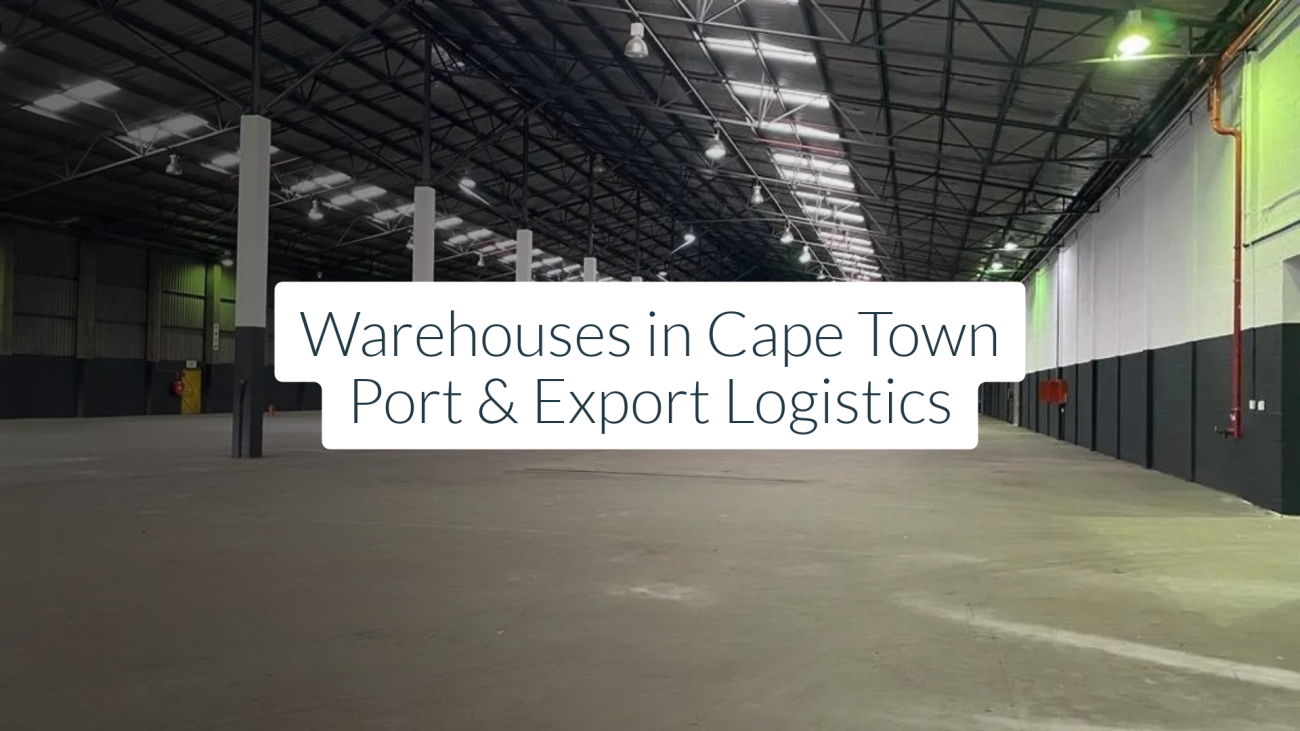
Warehouses in Cape Town: Logistics and Export Locations Near the Port
Warehouses in Cape Town play an important role in moving goods between the Western Cape, local distribution networks and international shipping routes. For importers, exporters, logistics operators and property investors, choosing the right warehouse involves considerably more than finding industrial space close to the harbour.
Paarden Eiland offers convenient access to the port, while Epping and Montague Gardens provide alternatives for businesses requiring larger distribution facilities, different property configurations or access to a broader customer base.
The right location depends on how frequently goods move through the port, the type of cargo handled and the total cost of operating from the property.
Export warehousing refers to storing, consolidating, packing and preparing goods before they move into the export transport chain. A conventional export warehouse is not automatically a customs-licensed or bonded facility. Those operations have separate regulatory requirements.
Key takeaways
-
Paarden Eiland is a logical starting point for businesses prioritising frequent movements to and from the Port of Cape Town.
-
Epping Industrial suits operators requiring established industrial infrastructure, storage space and access to multiple distribution routes.
-
Montague Gardens is worth considering for larger logistics operations, regional distribution and businesses that need modern warehouse specifications.
-
Warehouse rental is only one part of the cost. Truck travel, loading capacity, storage efficiency, electricity and handling costs can change the economics of a property.
-
Port performance matters. Exporters should allow for operational interruptions and changing container collection or delivery requirements when evaluating locations.
Where should exporters warehouse goods near the Port of Cape Town?
For businesses moving containers through the Port of Cape Town regularly, Paarden Eiland is a practical location to investigate first. Epping Industrial and Montague Gardens are alternatives when warehouse size, loading capacity, yard configuration or regional distribution requirements matter more than minimising the distance to the harbour.
The Port of Cape Town handles containerised cargo alongside bulk and general cargo. Its commercial importance extends beyond the city, connecting agricultural producers, manufacturers, importers and distributors with international markets.
According to the Western Cape Government, fresh fruit, including table grapes, citrus and apples, together with wine, are among the port’s important export products. Imports include automotive components, textiles, clothing, footwear and food products.
These cargo types do not all require the same warehouse.
An exporter consolidating dry goods for container loading has different operational requirements from a fresh-produce business maintaining a temperature-controlled supply chain. Likewise, an importer distributing products throughout Cape Town may benefit from an inland warehouse rather than one immediately beside the port.
For property owners and investors, understanding these differences is important because tenant demand depends on a building’s operational suitability, not simply its industrial zoning or proximity to a major transport route.
Warehouses in Cape Town: Comparing the main industrial locations
Cape Town’s industrial nodes serve different parts of the logistics market. The closest property is not necessarily the most operationally efficient, particularly when a business serves both local customers and overseas markets.
| Industrial location | Main advantages | Potential limitations | Best suited to |
|---|---|---|---|
| Paarden Eiland | Harbour proximity, Marine Drive and access towards the N1 | Older building configurations and restricted yards at some properties | Port-linked logistics, container handling and urban distribution |
| Epping Industrial | Established industrial precinct, N2 connections and varied warehouse sizes | Property specifications vary considerably between buildings | Storage, manufacturing, freight consolidation and distribution |
| Montague Gardens | Modern distribution facilities in selected precincts, N7 and Koeberg Road access | Longer port journeys, depending on route and traffic | Regional distribution, larger logistics operations and storage |
| Maitland | Position between central Cape Town and inland industrial areas | Some properties offer limited truck circulation or loading space | Smaller logistics operations, light industrial activity and local distribution |
| Airport Industria | Proximity to Cape Town International Airport and access to the N2 | Less convenient for operators focused primarily on frequent harbour movements | Air freight, express distribution and multimodal logistics |
Location assessments are indicative. Actual port access and operating suitability must be tested against the specific property, vehicle type and transport route.
Paarden Eiland: Prioritising port access
Paarden Eiland is one of Cape Town’s most relevant industrial locations for businesses with frequent harbour-related movements.
Positioned near the port and connected to Marine Drive, the area provides access to the central city and the broader road network. This makes it worth investigating for businesses involved in freight forwarding, transport coordination, warehousing and distribution.
However, choosing Paarden Eiland based on location alone can create problems.
A warehouse may be close to the port but lack sufficient space for articulated vehicles, container loading or temporary storage. Older premises may also have internal columns, limited eaves height or loading arrangements that do not suit modern distribution requirements.
Consider the operational specifications of Galetti’s 1 200 m² logistics warehouse at 5 Perfecta Road.
The advertised facility includes:
-
Four roller shutter doors.
-
Three loading docks.
-
A 160 Amp three-phase electrical supply.
-
A standalone warehouse configuration.
These characteristics are relevant because multiple loading points can support different vehicle movements, while the building’s power supply may accommodate particular operational equipment, subject to technical confirmation.
For businesses investigating the area, Galetti maintains industrial property listings in Paarden Eiland.
Epping Industrial: An established distribution alternative
Epping Industrial offers an alternative for businesses needing warehouse accommodation with access to a broader metropolitan distribution network.
The industrial precinct is positioned to connect with the N2 corridor and surrounding industrial and commercial areas. That makes Epping particularly relevant to businesses combining port freight with manufacturing, inventory storage or regular deliveries across the Western Cape.
Epping is worth considering where businesses require:
-
Larger storage or production areas.
-
Warehouse space with loading and dispatch facilities.
-
An established industrial location.
-
Access to multiple transport routes rather than exclusively harbour-facing movements.
Building condition remains a major consideration.
Two warehouses with similar floor areas may support different storage capacities because of differences in roof height, column spacing, floor loading and circulation space.
A property with a lower rental per square metre may ultimately cost more if inefficient racking layouts or restricted vehicle access increase handling time.
Businesses can compare industrial warehouses available to lease in Epping before arranging technical inspections.
Montague Gardens: Larger logistics and distribution requirements
Montague Gardens is an established industrial location for warehousing, manufacturing and distribution businesses.
The precinct connects with the N7, Koeberg Road and surrounding northern-suburb industrial areas. Its location makes it relevant to businesses distributing products across Cape Town while maintaining access to port logistics routes.
For operators requiring larger facilities, Montague Gardens offers an opportunity to investigate warehouse developments designed around more demanding storage and dispatch requirements.
For example, Galetti advertises a 6 075 m² distribution facility at 22 Topaz Boulevard.
The property is marketed as an A-grade warehouse and office facility suited to logistics and distribution operations. Its suitability for a particular exporter would still depend on the required floor loading, usable storage volume, vehicle access and supporting infrastructure.
The trade-off is the journey to the port.
A business regularly moving containers may place greater value on Paarden Eiland’s location. An operation serving customers throughout the metropolitan area may find Montague Gardens more appropriate for its delivery network.
Explore industrial property to rent in Montague Gardens to assess different warehouse sizes and configurations.
Which warehouse specifications matter for export logistics?
An export warehouse must support the physical movement, storage and dispatch of cargo without creating unnecessary handling delays. The most important specifications are generally loading access, vehicle circulation, floor capacity, usable storage height, security and reliable operational infrastructure.
These specifications should be assessed against the cargo being stored and the equipment used to handle it.
1. Loading docks and roller shutter doors
Loading arrangements directly affect how quickly goods move between the warehouse and transport vehicles.
Operators should establish whether the property provides dock-level loading, on-grade loading or a combination of both.
Dock levellers can help bridge height differences between loading platforms and vehicles. On-grade doors may be more suitable for certain container or delivery operations.
Where several vehicles must be loaded simultaneously, the number and placement of loading points become particularly important.
2. Yard space and truck circulation
Adequate yard space is essential for warehouses handling large vehicles.
A warehouse may have a generous floor area but insufficient external space for trucks to reverse, turn or wait without obstructing other operations.
Inspect the property while considering the actual vehicle combinations used by the business.
Pay attention to gate widths, turning areas, yard surfacing, loading positions and whether goods vehicles can enter and leave without excessive reversing.
3. Eaves height and storage efficiency
Warehouse eaves height influences the amount of vertical storage space available.
A higher roof can increase pallet storage capacity where an appropriate racking system is installed. However, usable height must account for structural obstructions, fire protection systems, equipment clearances and operating requirements.
For investors, usable storage volume is an important indicator of how attractive a facility may be to modern logistics occupiers.
4. Floor loading and warehouse condition
Floor slabs must be suitable for the loads placed on them.
Heavy goods, concentrated racking loads and material-handling equipment can create requirements that a conventional industrial floor may not satisfy.
Before committing to a property, request available structural specifications and confirm design loads with a suitably qualified engineer.
Visible floor condition alone is not evidence of adequate load-bearing capacity.
5. Electricity, security and operational resilience
Power interruptions can affect access systems, refrigeration, IT equipment, loading operations and warehouse productivity.
Exporters should assess the available electrical capacity, backup arrangements and the cost of operating essential equipment.
Security requirements should reflect the cargo’s value and risk profile. Controlled access, perimeter protection and appropriate monitoring may be important, but the level of protection required differs between occupiers.
For temperature-sensitive goods, the evaluation must extend to refrigeration capacity, backup power, monitoring systems and continuity procedures.
A warehouse advertised as A-grade or modern is not automatically suitable for cold-chain, customs-controlled or specialist cargo operations. Those capabilities require separate verification.
What does export warehousing cost in Cape Town?
Export warehouse costs depend on location, building size, specifications and lease conditions. Rental per square metre provides a useful starting point, but it does not capture the full cost of operating a logistics facility.
The following advertised Galetti properties illustrate how asking rentals can differ between locations.
Advertised rental examples reviewed October 2026. These are individual property listings, not independently established area rental averages.
| Location | Warehouse size | Advertised rental | Monthly asking rental |
|---|---|---|---|
| Paarden Eiland, 5 Perfecta Road | 1 200 m² | R108/m² | R130 000 |
| Epping Industrial, 29 Packer Avenue | 3 452 m² | R70/m² | R241 640 |
| Montague Gardens, 22 Topaz Boulevard | 6 075 m² | R104/m² | R628 762 |
Sources: Galetti property advertisements reviewed 15 October 2026. Figures are rounded where advertised, exclude VAT and may exclude additional charges. Availability, terms and prices must be reconfirmed before publication.
These examples should not be interpreted as proof that one industrial area is universally cheaper than another. The properties differ in size, configuration and specifications.
Calculating total warehouse occupancy costs
When comparing logistics properties, consider:
-
Base rental and annual escalations.
-
Operating costs, municipal charges and recoveries.
-
Electricity, water and backup power requirements.
-
Security and property maintenance.
-
Warehouse fit-out, racking and material-handling equipment.
-
Vehicle operating costs, loading time and additional freight movements.
For an exporter, a relatively modest difference in base rental could be outweighed by transport costs or operational inefficiencies.
The correct comparison is therefore total occupancy and logistics cost, not rental per square metre alone.
Looking for a warehouse near the Port of Cape Town? Galetti can assist with an initial property comparison based on your required size, cargo type, loading facilities and transport routes. Request confirmation of available properties, asking rentals and any applicable service fees before proceeding.
How do Port of Cape Town delays affect warehouse selection?
Port delays can affect inventory holding periods, container movements, transport schedules and the amount of temporary storage a business requires. Exporters should evaluate warehouse flexibility alongside location, particularly where shipments are time-sensitive.
The Port of Cape Town has faced operational challenges involving container handling, congestion and weather-related interruptions.
On 23 June 2026, the Western Cape Government reported that its Digital Logistics Planning Platform showed a 33% improvement in vessel port call times during 2026 year-to-date compared with the same period in 2025.
However, the province also identified wind-related stoppages, container stack management and landside congestion as areas requiring further intervention.
These developments have practical implications for warehouse selection.
An exporter may benefit from sufficient space to hold goods when shipping schedules change. Similarly, a logistics operator may require flexible loading arrangements to accommodate revised container collection times.
The provincial government’s port improvement programme specifically identifies inland terminals, off-port facilities and better coordination across the logistics chain as opportunities to improve efficiency.
For property occupiers, the lesson is straightforward: a warehouse needs to support operations when the port is functioning normally and when cargo movements are disrupted.
What should you know about customs and export warehousing?
Not every warehouse used for exporting goods is a customs-licensed warehouse. Ordinary warehouse operations and customs-controlled storage involve different requirements, and businesses should establish which category applies before signing a lease.
The South African Revenue Service (SARS) distinguishes between several types of licensed customs storage facilities.
These include storage warehouses for specified imported goods and special storage warehouses that can accommodate particular export-related activities, subject to the relevant licences and conditions.
SARS also requires qualifying exporters to register with Customs.
Before committing to premises, confirm whether your intended operation requires:
-
A particular customs warehouse or depot licence.
-
Specific security, record-keeping or cargo-control arrangements.
-
Regulatory approval for the goods being stored or handled.
Property use rights must also be considered.
The City of Cape Town requires property uses to comply with applicable zoning and land-use permissions. Industrial zoning does not automatically authorise every type of storage, processing or hazardous activity.
A property practitioner can assist with establishing property suitability, but customs, tax and legal obligations should be verified with the relevant qualified professionals.
What should investors consider when buying export warehousing?
For investors, a warehouse’s long-term value depends partly on its ability to accommodate the operational requirements of potential tenants. Port proximity may support tenant interest, but location alone cannot establish rental sustainability or investment returns.
An investor assessing warehouses in Cape Town should consider the following.
Tenant demand and property adaptability
A warehouse with practical loading arrangements, usable storage height and suitable yard access may appeal to more types of occupiers than a highly specialised building.
However, specialised facilities can also be attractive when there is demonstrable demand from suitable tenants.
The important distinction is between a property designed for a specific use and one capable of accommodating several potential uses.
Capital expenditure and maintenance
Buyers should assess the condition of warehouse floors, roofs, loading docks, electrical infrastructure and external hardstanding areas.
Potential expenditure on these components can materially affect the total acquisition cost.
A lower purchase price does not necessarily represent better value when substantial capital improvements are needed to secure a suitable tenant.
Lease quality and income sustainability
For income-producing properties, investors should review lease duration, escalations, operating-cost recoveries, tenant obligations and the financial position of the occupier.
Market rental evidence, vacancy assumptions and the property’s maintenance requirements should form part of a broader investment assessment.
Investors can also review industrial property for sale in Montague Gardens when assessing potential acquisition opportunities.
How should you choose a warehouse near the Port of Cape Town?
Start with the movement of goods rather than the building’s advertised floor area. Understanding cargo volumes, delivery frequency and vehicle requirements helps identify which industrial locations and warehouse specifications are appropriate.
A practical selection process involves five steps.
-
Map your freight movements. Identify where goods originate, how frequently they pass through the port and where they are delivered.
-
Define your property requirements. Establish the floor area, storage height, loading configuration, vehicle access and infrastructure needed.
-
Shortlist suitable industrial nodes. Compare Paarden Eiland, Epping, Montague Gardens and other locations using your actual transport routes.
-
Assess the full cost. Compare rental, operating expenditure, fit-out requirements and logistics expenses.
-
Complete property due diligence. Verify permitted use, technical capacity, lease or purchase terms and any necessary regulatory approvals.
Property inspections should involve the people responsible for operating the facility, not only the individuals negotiating the property transaction.
For some businesses, an established industrial warehouse will meet operational requirements without substantial modifications. Others may benefit from a purpose-designed distribution facility.
Businesses with limited port movements or a primarily local delivery network may not benefit from paying for harbour proximity. Similarly, buyers should avoid assuming that every warehouse near the port is suitable for container logistics.
The best property is one that supports the intended operation at a sustainable total cost.
Frequently asked questions about Cape Town export warehouses
How close should a warehouse be to the Port of Cape Town?
There is no universal ideal distance. A business moving containers frequently may benefit from a property in Paarden Eiland, while an operator distributing goods throughout Cape Town may find Epping or Montague Gardens more suitable. Compare actual vehicle travel times, road access, loading facilities and total operating costs rather than relying only on distance.
Can a conventional industrial warehouse be used for export goods?
Yes, a conventional industrial warehouse may be suitable for storing and preparing export goods, provided the intended activities comply with applicable requirements. However, customs-controlled activities may require specific licensing or approvals. Confirm your cargo handling and storage requirements with SARS and the appropriate customs or regulatory professionals before occupying the premises.
What is the difference between an export warehouse and a bonded warehouse?
An export warehouse generally refers to premises used for storing or preparing goods for international shipment. A bonded or customs-licensed warehouse operates under specific customs arrangements. The applicable licence determines which goods and procedures are permitted. The terms are not interchangeable, and businesses should verify the precise customs status of a facility.
Is leasing or buying a warehouse better for a logistics business?
Leasing may offer greater flexibility where business volumes, storage requirements or distribution networks could change. Buying may suit an established operation seeking long-term control of its premises. The decision depends on capital availability, property suitability, expected occupancy duration, finance costs and future expansion requirements. Both options require proper financial and legal assessment.
Do warehouses near the port need container loading facilities?
Not necessarily. The required loading arrangements depend on whether containers are handled at the warehouse or goods are moved using conventional trucks and other vehicles. Operators should establish how containers will be loaded, unloaded and transported before choosing a property. Suitable external circulation and safe vehicle access may be as important as the loading equipment itself.
Find the right logistics warehouse in Cape Town
Choosing between Paarden Eiland, Epping, Montague Gardens and Cape Town’s other industrial areas requires a clear understanding of the intended operation.
Galetti Corporate Real Estate assists businesses and investors with industrial property leasing, sales and property advisory services.
Whether you are expanding an export operation, relocating a distribution facility or assessing an industrial acquisition, the starting point is a property requirement that accurately reflects your logistics needs.
Contact Galetti to discuss your warehouse requirements. Provide your preferred location, approximate floor area, cargo type and required loading facilities. The broking team can review potential matches, confirm current availability and explain the relevant commercial terms and any applicable fees before you commit to a property.