
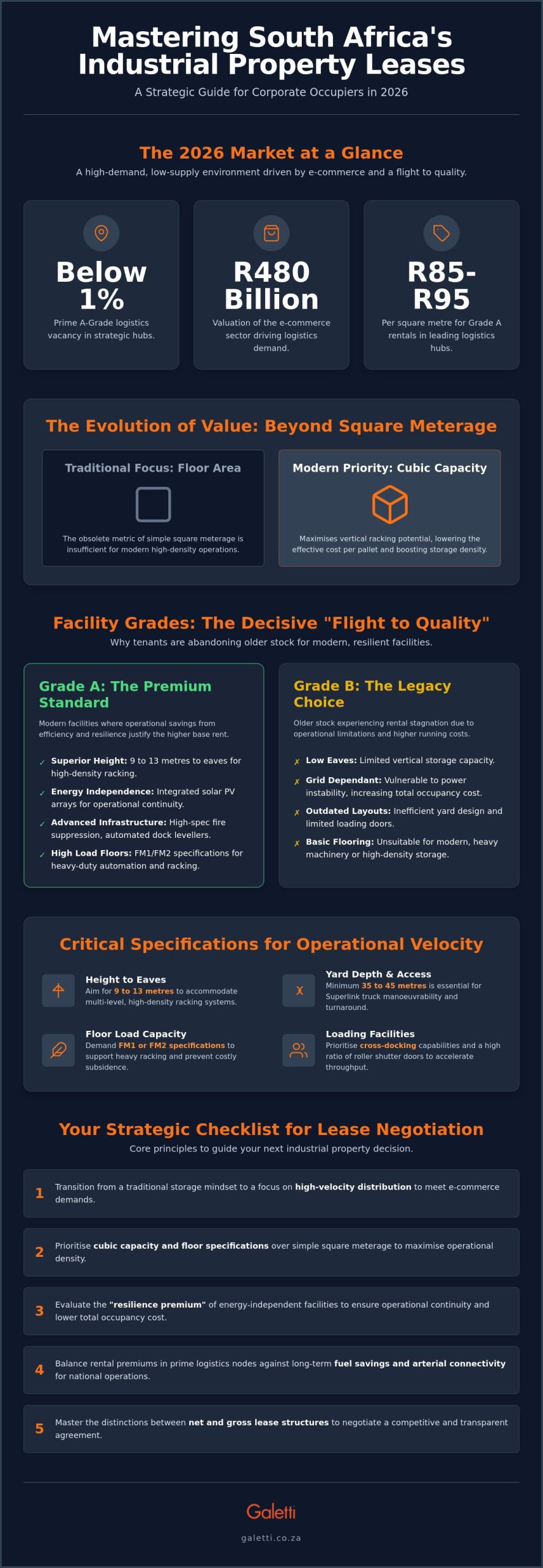
With prime A-grade logistics vacancy rates now sitting below 1% in South Africa’s most strategic hubs, the traditional approach to site selection is obsolete. You understand that rising operational costs and infrastructure instability make it increasingly difficult to benchmark fair market rates. This strategic overview ensures you master the critical variables driving costs to optimise your logistics footprint and negotiate your next industrial property lease agreement South Africa with confidence.
We provide a clear framework for evaluating lease proposals while identifying the high-spec features, such as energy independence and advanced loading infrastructure, that justify premium rates. You’ll learn to align property choices with supply chain goals in a market driven by a R480 billion e-commerce sector. This guide moves beyond simple square meterage to focus on operational velocity, municipal reliability, and strategic advantage. Expertise. Efficiency. Clarity.
Key Takeaways
- Transition from traditional storage to high-velocity distribution centres to meet the demands of South Africa’s evolving e-commerce landscape.
- Prioritise cubic capacity and floor load-bearing specifications over simple square meterage to maximise high-density racking efficiency.
- Balance rental premiums in prime logistics nodes against long-term fuel savings and arterial connectivity for national operations.
- Factor in the “resilience premium” of energy-independent warehouses to ensure operational continuity and lower the total cost of occupancy.
- Negotiate a competitive industrial property lease agreement South Africa by mastering the critical distinctions between net and gross lease structures.
The Evolution of South African Industrial Lease Dynamics in 2026
Industrial property has officially decoupled from traditional commercial cycles. By mid-2026, the sector continues to outperform retail and office categories, driven by a chronic shortage of prime logistics space. National industrial vacancy rates have tightened to below 4%. In the most sought-after industrial precincts, A-grade vacancy is effectively below 1%. This scarcity fundamentally alters how an industrial property lease agreement South Africa is negotiated. Landlords now hold significant leverage, particularly for facilities that support high-velocity distribution rather than static storage.
Macroeconomic pressures remain a primary concern for corporate occupiers. Inflation continues to dictate rental escalations, with many 2026 agreements reflecting rates that align with rising construction costs and municipal utility hikes. Understanding the foundational South African property law is essential here; it governs the rights and obligations within these increasingly complex contracts. The focus has shifted from finding the cheapest rate per square metre to securing operational resilience. Efficiency beats price.
Market Segmentation: Grade A vs. Grade B Facilities
A clear “flight to quality” defines the 2026 market. Corporate tenants are abandoning older, low-eave warehouses in favour of modern facilities that offer energy independence and superior height. Grade A rentals in leading logistics hubs now command R85 to R95 per square metre, whilst B-grade stock often sees rental stagnation. Institutional landlords are the primary drivers of this trend. They set market benchmarks by offering high-spec builds that include solar PV arrays and advanced fire suppression systems. Many tenants find that the operational savings in a Grade A facility easily justify the higher base rent. You can explore these high-spec opportunities through our corporate real estate leasing services.
The Impact of E-commerce on Logistics Demand
The South African e-commerce sector is now valued at approximately R480 billion. This explosive growth has triggered a desperate search for last-mile delivery hubs and micro-fulfilment centres. These “dark stores” require proximity to major residential centres, often inflating rates for well-positioned urban industrial parks. The correlation is simple: as consumer demand for same-day delivery increases, the rental premium for strategically located last-mile hubs rises proportionally. Supply chain managers are no longer just looking for space; they’re looking for time. Every minute saved in transit justifies a higher premium on the lease agreement. Strategic alignment is the only way to protect margins.
Structural Specifications: Beyond Square Meterage in Lease Agreements
Total floor area is no longer the primary metric for valuing industrial space. In the 2026 market, cubic capacity has overtaken square meterage as the critical factor for logistics efficiency. Modern warehouses with height to eaves ranging from 9 to 13 metres allow for sophisticated multi-level racking systems. This vertical expansion enables you to store more stock on the same footprint, effectively lowering your cost per pallet. When negotiating an industrial property lease agreement South Africa, ensuring the height specifications align with your racking requirements is vital for long-term viability.
Floor load-bearing capacity is the silent partner to warehouse height. High-density racking exerts immense pressure, requiring advanced flooring specifications such as FM1 or FM2. Without these, the risk of floor subsidence or cracking increases, leading to costly operational downtime. Beyond the floor, modern occupiers prioritise natural lighting and high-performance thermal insulation. These features reduce the reliance on artificial lighting and climate control, directly cutting utility bills. Specialised features like integrated cold storage zones or hazardous chemical stores carry a rental premium but provide the essential infrastructure that generic warehouses lack.
Loading Facilities and Yard Depth
Efficiency at the perimeter is just as important as internal volume. Cross-docking capabilities, which allow for the simultaneous receiving and dispatching of goods, are a high-value feature in any industrial property lease agreement South Africa. You must also account for yard depth. A minimum depth of 35 to 45 metres is standard for Superlink access and manoeuvrability. Facilities equipped with automated dock levellers and a high ratio of roller shutter doors justify higher base rents by accelerating throughput and reducing vehicle turnaround times.
Warehouse Automation and Tech-Readiness
The 2026 landscape is defined by a shift towards robotics and Automated Storage and Retrieval Systems (ASRS). These technologies require specific structural tolerances and high-speed fibre connectivity to operate at peak performance. Smart warehouses that integrate IoT sensors for energy management and stock tracking offer significant operational savings. This transition is a core component of current industrial market dynamics, where tech-ready assets command the highest demand. If you’re struggling to value these specialised technical features, consult our advisory team for a detailed market benchmarking analysis.
Logistics Connectivity: Strategic Positioning for National Operations
Location remains the ultimate arbiter of value in the industrial sector. In 2026, the “Prime Location” premium is no longer a luxury; it’s a calculated logistics necessity. Strategic positioning along the N3 corridor, which handles the bulk of container traffic between Durban and Johannesburg, commands the highest rental rates. According to the South African Property Owners Association (SAPOA), these prime nodes see lower vacancy rates even as broader economic conditions fluctuate. When signing an industrial property lease agreement South Africa, you must weigh the base rent against the total cost of transport. A warehouse located 20 kilometres further from a port or arterial off-ramp may offer a lower rental rate, but the increased fuel consumption and vehicle wear often negate those savings.
Municipal infrastructure quality is another critical variable. Well-maintained roads, efficient drainage, and reliable power grids in nodes like Midrand or Epping directly impact property accessibility. If heavy vehicles face delays due to poorly maintained municipal roads, your logistics velocity drops. This operational friction is a hidden cost that isn’t always visible on a balance sheet but should inform every site selection decision. Proximity to national ports and inland container terminals, such as City Deep, ensures that your operations remain integrated with global trade flows.
Urban vs. Peripheral Industrial Zones
Discrepancies between established industrial nodes and emerging peripheral areas are widening. Established nodes offer immediate access to transport networks but come with rental ceilings that reflect their maturity. In contrast, peripheral zones often provide lower rates and larger land parcels. However, the trade-off is significant. Increased transport lead times can disrupt “just-in-time” supply chains. Zoning regulations also play a role; emerging areas may have less restrictive zoning, but the lack of existing infrastructure can lead to unforeseen development levies that eventually trickle down into the rental bill.
Intermodal Connectivity and Efficiency
Intermodal connectivity is becoming a priority for bulk commodity handlers. Rail-linked facilities allow for the efficient movement of heavy goods, bypassing road congestion. Proximity to labour pools is equally vital. A warehouse that is inaccessible via public transport will face higher operational overheads due to staff transport requirements. Superior logistics connectivity directly offsets base rental costs by reducing the total time and capital spent moving goods through the supply chain. You can leverage our corporate real estate leasing expertise to identify sites that offer this specific strategic advantage.
Operational Resilience: Energy Independence and ESG Compliance
Resilience is the new currency for industrial property. Base rentals are no longer the only figure that matters. The true cost of occupancy is now tied directly to energy independence. In the 2026 market, a “Load Shedding Proof” facility is a non-negotiable requirement for blue-chip tenants. Integrated backup systems and solar PV installations allow your operations to continue whilst the national grid falters. These features often carry a rental premium. However, they drastically reduce the total cost of occupancy by hedging against Eskom tariff hikes and eliminating the financial burden of lost production time.
Water security has joined energy as a critical industrial requirement. On-site harvesting and storage systems ensure that sanitation and cooling processes remain uninterrupted during municipal outages. When drafting an industrial property lease agreement South Africa, clearly defining the maintenance responsibilities for these off-grid systems is essential. Landlords who invest in this infrastructure see higher tenant retention and more stable rental growth. You can utilise Galetti Corporate Services for a comprehensive portfolio risk assessment to identify gaps in your current assets.
Security Infrastructure and Risk Mitigation
Physical security remains a top-tier priority for logistics operators. 24-hour manned security, electrified perimeter fencing, and AI-driven CCTV monitoring are standard expectations. These features do more than just protect stock. They directly impact insurance premiums. A warehouse located within a secure, well-managed industrial park typically commands a higher rental than a standalone unit due to the shared cost of high-end security. This environment provides the stability needed for long-term operational planning.
ESG and Sustainable Building Certifications
Corporate occupiers are increasingly bound by global carbon-reduction targets. This has created a surge in demand for Green Building Council South Africa (GBCSA) rated space. Carbon-neutral facilities are no longer just an ethical choice; they’re a corporate mandate. Tenants are willing to pay a premium for buildings that offer clear ESG reporting data. Securing a GBCSA-rated facility within your industrial property lease agreement South Africa ensures your business remains compliant with international sustainability standards. You can explore these strategic opportunities through our corporate real estate leasing division.
Does your current facility meet 2026 resilience standards? Contact our advisors to benchmark your property against current ESG and energy independence requirements.
Navigating Lease Structures and Total Cost of Occupancy
Distinguishing between net and gross lease structures is the first step in accurate logistics budgeting. In the South African industrial sector, net leases are the prevailing standard for A-grade assets. Under this structure, you pay a base rental whilst remaining responsible for operating costs, rates, and taxes. Gross leases, which bundle these costs into a single monthly figure, are increasingly rare for large-scale distribution centres. Municipal rates and taxes represent a significant and often volatile portion of the final bill. These costs fluctuate based on municipal valuations and can impact your bottom line if not properly accounted for. Mastery of your industrial property lease agreement South Africa requires a granular view of these pass-through costs to avoid unforeseen financial exposure.
Negotiating Tenant Installation (TI) allowances and rent-free periods is a critical lever for occupiers. These incentives help offset the capital expenditure required to customise a facility for specialised racking or automation. Landlords are often more amenable to generous TI allowances for longer lease commitments. If you require expert Corporate Real Estate Leasing support, our team can benchmark these incentives against current market norms to ensure you secure a competitive deal.
Escalation Rates and Lease Duration
Typical industrial escalation benchmarks for 2026 range between 7% and 8%. These annual increases are designed to hedge against inflation and rising operational costs. There is a direct relationship between lease term length and your ability to negotiate base rental discounts. A five-year commitment provides the security landlords need to offer more favourable terms. You must also be aware of Triple Net leases. This structure shifts all maintenance risks, including structural repairs, to the occupier. It’s a common requirement for institutional-grade assets but demands rigorous property due diligence before signing.
Hidden Costs and Operational Overheads
Operational overheads extend far beyond the base rent. You must factor in park levies, security contributions, and common area maintenance (CAM) charges. In the current energy climate, the cost of backup power is a major variable. Whilst solar installations reduce the total electricity bill, the cost of diesel for generators during extended outages can be substantial. Many 2026 developments are shifting towards battery storage to mitigate these costs. For a comprehensive analysis of these variables, our Galetti Corporate Services team provides the strategic advisory needed to align your property choice with your long-term supply chain goals.
Securing Your Strategic Advantage in the 2026 Industrial Landscape
The South African industrial market requires a fundamental shift from passive occupancy to active strategic alignment. Success no longer rests on square meterage alone. It depends on energy independence, logistics velocity, and structural specifications that support modern automation. Navigating these variables is the only way to ensure your next industrial property lease agreement South Africa delivers genuine long-term value. Every decision must move your business closer to operational resilience and growth.
Securing the right asset requires deep market intelligence. We offer access to exclusive off-market industrial listings and data-driven market benchmarking specifically for current conditions. Our national reach and local expertise ensure your logistics footprint remains resilient against rising costs and infrastructure volatility. Don’t leave your supply chain to chance. Optimise your industrial footprint with Galetti’s expert leasing services to turn complex market variables into a definitive competitive edge. Secure your operational future today.
Frequently Asked Questions
What is the average warehouse rental rate in South Africa for 2026?
Average rates vary significantly by grade and industrial node. Prime A-grade facilities in Johannesburg hubs like Gosforth Park range from R85 to R95 per square metre on a net basis. New developments often exceed R100 per square metre due to escalating construction costs. B-grade stock remains more affordable, typically between R65 and R85 per square metre. These figures exclude municipal rates, taxes, and utility costs.
How does load shedding affect industrial property rental prices?
Energy independence is now a primary value driver in the local market. Facilities with integrated solar PV and battery backup systems command a “resilience premium.” Tenants are increasingly willing to pay higher base rents for load shedding proof warehouses to eliminate the financial burden of operational downtime. Properties without backup power face higher vacancy risks as corporate occupiers prioritise continuity over low rental costs.
What is the difference between a net lease and a gross lease in South Africa?
A net lease separates the base rent from operational costs like municipal rates, taxes, and insurance. This is the prevailing standard for an industrial property lease agreement South Africa, particularly for A-grade assets. In a gross lease, all costs are bundled into a single monthly payment. Gross leases provide budget certainty but are less common for large logistics centres where utility and rate fluctuations are significant.
Why are Grade A warehouses more expensive than Grade B or C?
Grade A facilities offer superior structural specifications that directly enhance logistics velocity. These include eaves heights of 9 to 13 metres for high-density racking and specialised FM1 or FM2 flooring. They also incorporate modern security, energy independence, and ESG compliance features. Grade B and C stock usually lacks the cubic capacity and tech-readiness required for sophisticated e-commerce fulfilment, leading to lower rental ceilings.
How much should I budget for annual rental escalations in 2026?
Budget for annual escalation rates between 7% and 8% in 2026. These benchmarks align with current inflationary pressures and rising municipal utility hikes. While some long-term leases for blue-chip tenants might see slightly lower increments, the majority of industrial agreements reflect this range. It’s vital to factor these compounded increases into your multi-year financial planning to ensure the facility remains affordable throughout the lease term.
Does proximity to a port significantly increase warehouse rent?
Proximity to major ports like Durban or Cape Town significantly inflates rental rates. High demand and limited land availability in these logistics corridors drive vacancy rates below 1% for prime stock. While the base rent is higher, the strategic advantage of reduced transport lead times and lower fuel costs often justifies the premium. Port-centric locations are essential for businesses focused on international trade and rapid container turnaround.
What are the most important security features for a South African warehouse?
24-hour manned security and AI-driven CCTV monitoring are the highest priorities for modern occupiers. Perimeter electrification and secure gatehouse access are standard requirements for top-tier industrial parks. These features don’t just mitigate risk; they also lower insurance premiums. Fire suppression systems, such as ESFR sprinklers, are equally critical for protecting high-value stock and ensuring the property remains insurable under corporate mandates.
Can I negotiate a lower rent by signing a longer lease term?
Landlords typically offer more competitive base rates in exchange for longer lease commitments. A five-year industrial property lease agreement South Africa provides the security needed for landlords to grant rental discounts or larger Tenant Installation (TI) allowances. Longer terms reduce the landlord’s vacancy risk and re-tenanting costs. This leverage allows you to negotiate more favourable terms whilst securing operational stability for your supply chain.