The “Cape Premium” is no longer a forecast. It’s a fixed operational reality for every corporate entity entering the 2026 fiscal year. With decentralised vacancy rates sitting as low as 2.7%, securing a strategic foothold requires more than just a cursory glance at the average commercial rent Cape Town currently offers. You likely recognise that the local market has decoupled from national trends, making traditional South African property benchmarks increasingly irrelevant for your regional budgeting and expansion plans.
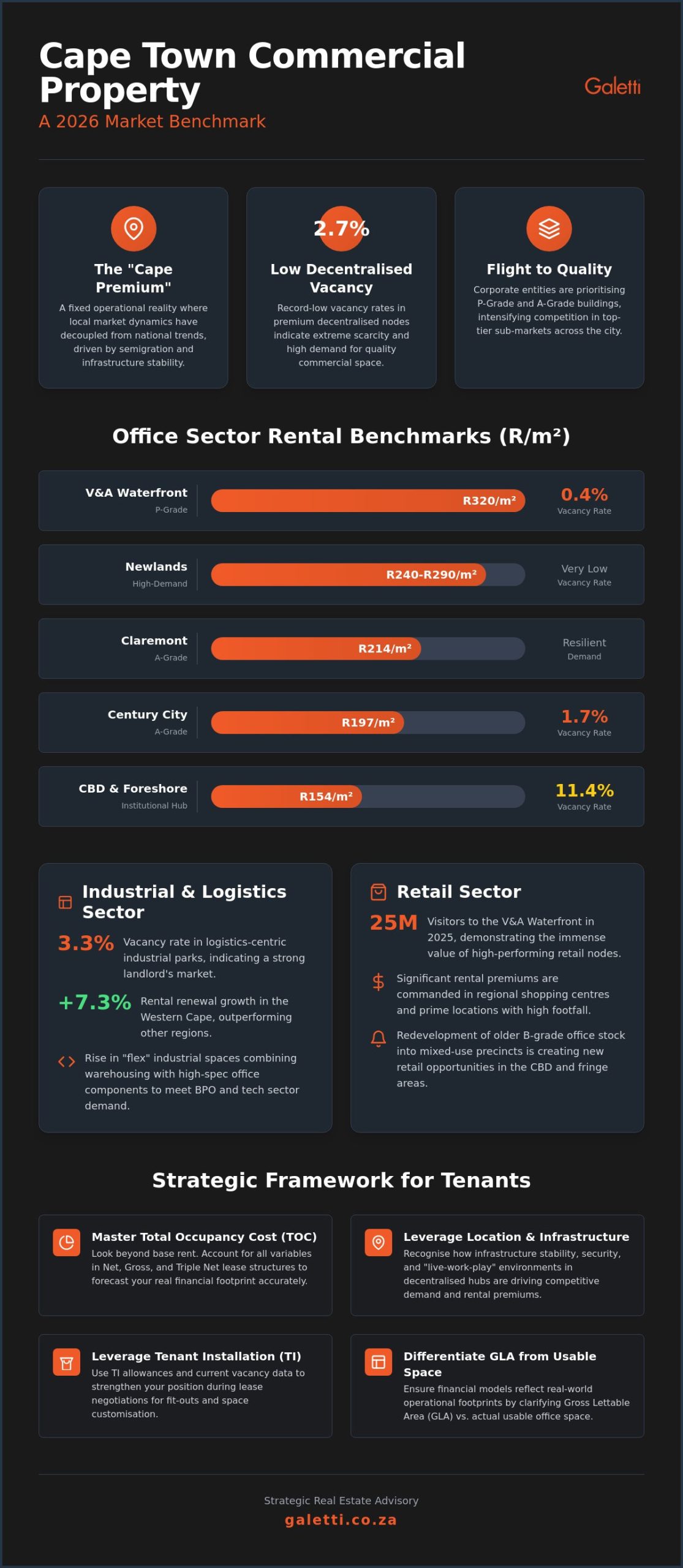
This analysis provides the granular clarity required to navigate this high-demand environment. We deliver a precise breakdown of R/m² benchmarks across premium sub-markets, from the R320/m² highs of the V&A Waterfront to the R154/m² institutional opportunities within the CBD. You’ll gain a strategic framework for lease negotiations and a clear understanding of total occupancy costs in a post-2025 landscape. We’ll examine how the 7.00% repo rate and the city’s unique energy security are currently dictating price floors. From Century City’s 1.7% vacancy to the surging BPO demand, this is your definitive guide to Cape Town’s commercial trajectory.
Key Takeaways
- Establish clear benchmarks for average commercial rent Cape Town to align your 2026 property strategy with actual market performance in prime nodes.
- Differentiate between Gross Lettable Area (GLA) and usable space to ensure your financial models reflect real-world operational footprints.
- Master the Total Occupancy Cost (TOC) framework to account for the variables inherent in Net, Gross, and Triple Net lease structures.
- Leverage Tenant Installation (TI) allowances and current vacancy data to strengthen your position during critical lease negotiations.
- Recognise how infrastructure stability and the “Cape Premium” are driving competitive demand in decentralised commercial hubs.
Benchmarking Average Commercial Rent in Cape Town for 2026
The Cape Town commercial landscape in 2026 is defined by a distinct “flight to quality” and extreme scarcity in premium nodes. Semigration continues to be a primary catalyst; as skilled professionals and corporate entities relocate to the Western Cape, demand for high-tier office and logistics space has outpaced supply. Understanding the Economic Drivers in the Western Cape is essential for corporate planners. The province’s relative energy security and infrastructure stability have created a market that operates independently of broader national trends. Consequently, the average commercial rent Cape Town commands is now a reflection of this systemic resilience rather than just simple inflation.
When evaluating a corporate real estate leasing opportunity, you must distinguish between Gross Lettable Area (GLA) and usable space. In the current market, common area factors in P-grade buildings can significantly impact your effective R/m² rate. With vacancy rates in decentralised nodes sitting at a record low of 2.7%, landlords have reduced their flexibility on space efficiency ratios. Pricing ceilings are no longer theoretical; they’re driven by a 0.4% vacancy rate in the V&A Waterfront and a tight 1.7% in Century City. If you’re looking for value, the CBD offers more breathing room with an 11.4% vacancy rate, though even this is tightening as institutional confidence returns.
Office Sector Benchmarks: P-Grade to B-Grade
Premium P-grade headquarters in the V&A Waterfront now average R320/m², setting the upper limit for the city. A-grade stock in decentralised hubs remains highly resilient. Claremont has seen median asking rents reach R214/m², whilst Century City holds steady at R197/m². Newlands remains a high-demand pocket with rentals ranging between R240 and R290/m². Conversely, B-grade stock is undergoing a structural evolution. Many older office blocks are being redeveloped into mixed-use precincts or residential conversions, particularly in the CBD and fringe areas like Woodstock, to address the shortage of modern, efficient space.
Industrial and Retail Rental Standards
The industrial sector remains a landlord’s market. Logistics-centric industrial parks are experiencing a low 3.3% vacancy rate, with rental renewal growth in the Western Cape hitting +7.3%. Retail rental variance is equally sharp. Regional shopping centres and high-performing nodes like the V&A Waterfront, which saw 25 million visitors in 2025, command significant premiums. This sustained interest in the region is often bolstered by curated holiday packages from The Real South Africa Travel and Tourism, showcasing the world-class lifestyle that makes the Cape so attractive to international businesses. We’re also seeing a rise in “flex” industrial spaces. These hybrid units combine warehousing with high-spec office components, catering to the burgeoning BPO and tech sectors that require versatile, high-security environments outside of traditional office parks.
Regional Variance: Sub-market Drivers Across the City
Location dictates liquidity. In the Western Cape, sub-market geography serves as the primary determinant for rental premiums. Whilst the average commercial rent Cape Town offers varies significantly by node, the underlying driver is infrastructure efficiency. Corporate tenants increasingly prioritise “live-work-play” environments that reduce commute times and enhance employee retention. This preference has sparked a notable shift from the traditional City Bowl toward northern decentralised hubs. Access to the MyCiTi bus network and reliable private security remains non-negotiable for high-value occupiers seeking long-term stability.
The CBD and Foreshore: The Traditional Financial Hub
The CBD is currently experiencing a period of institutional revival. Recent high-value transactions, such as the R580 million sale of Portside Towers, signal renewed confidence in the central core. Median asking rents in the CBD currently sit at R154/m², offering a competitive alternative to premium decentralised nodes. Urban regeneration projects continue to modernise older stock, creating opportunities for businesses seeking retail property for lease South Africa within a high-density environment. Whilst vacancies remain at 11.4%, the influx of BPO operators is rapidly absorbing large-floorplate stock, particularly on the Foreshore.
Century City and the Northern Suburbs
Century City remains the benchmark for A-grade office performance. With a vacancy rate of just 1.7%, it represents one of the tightest commercial pockets in the country. Rents here average R197/m², justified by superior connectivity and precinct-wide security. The broader State of the Commercial Property Sector highlights that tenants are willing to pay a premium for managed environments. Bellville and Tygervalley offer similar connectivity advantages, acting as vital commercial corridors that bridge the gap between the city centre and the growing residential hubs of the North.
The Southern Suburbs and Atlantic Seaboard
Scarcity defines the Southern Suburbs. Claremont has emerged as a premium destination with median rents reaching R214/m², whilst Newlands commands between R240 and R290/m². These figures represent the upper end of the average commercial rent Cape Town businesses must budget for when seeking prestige addresses. The Atlantic Seaboard remains the most expensive and land-constrained region, making commercial opportunities rare. Creative and tech industries are particularly drawn to these areas for their lifestyle appeal and proximity to executive residential nodes. If you’re looking to secure space in these high-demand zones, it’s advisable to consult with a strategic advisor to identify off-market opportunities.
Calculating Total Occupancy Cost (TOC) Beyond Base Rent
Focusing solely on the sticker price is a common oversight in corporate expansion. Whilst the average commercial rent Cape Town landlords quote provides a baseline, it rarely reflects the true impact on your balance sheet. Strategic decision-makers must transition from “Rent” to “Total Occupancy Cost” (TOC). This metric encompasses every financial commitment required to operate the space. In the South African market, lease structures vary between Net, Gross, and Triple Net agreements. A Triple Net lease, where the tenant assumes responsibility for all operating expenses, can result in an effective rate significantly higher than the initial base rent. Our corporate services team specialises in auditing these complex structures to ensure transparency before commitment.
Hidden costs often inflate the effective rental rate beyond initial projections. According to the Cape Town 2026 Commercial Market Insights, operational efficiency is now as critical as geographic location. Tenants frequently find that property management fees, security levies, and maintenance contributions add a substantial layer to monthly outflows. If you’re comparing a CBD office to a decentralised park, the difference in CID levies and common area maintenance can shift the financial feasibility of the deal entirely. With CPI inflation at 4.5% as of May 2026, understanding how these variables escalate over a five-year term is vital for long-term fiscal health.
Municipal Rates, Levies, and Utilities
Municipal rate increases in 2026 have directly impacted TOC across all sectors. Energy security remains a non-negotiable requirement for modern business. Whilst Cape Town has avoided national load shedding for over a year as of May 2026, the cost of maintaining backup power infrastructure, whether through diesel generators or solar integration, must be factored into the rental mix. Central Improvement District (CID) levies also play a vital role. These levies fund the additional security and cleaning services that maintain the high standards of nodes like Century City and the CBD, providing the “Cape Premium” environment corporate occupiers expect.
Parking Ratios and Bay Costs
Parking remains a significant cost driver in the current market. We’re seeing a shift toward “unbundled” parking, where bay costs are negotiated separately from the office space. Basement bays command a higher premium than open bays, with monthly costs varying based on the node’s density. Feasibility often hinges on parking ratios; a standard requirement of 4 bays per 100m² can be difficult to satisfy in older CBD buildings. Strategic occupiers must evaluate whether a building’s ratio aligns with their hybrid work models or if they’re paying for surplus capacity that remains underutilised.
Negotiating Commercial Leases in the 2026 Market
Data is your primary lever in any negotiation. Relying on anecdotal evidence or outdated benchmarks puts your corporate strategy at risk. By leveraging the average commercial rent Cape Town currently supports across its various nodes, you can effectively challenge aggressive renewal quotes from landlords. In high-demand areas like the Southern Suburbs or Century City, landlords often lead with optimistic figures based on low vacancy rates. You need verified market intelligence to anchor the conversation in reality. Securing a competitive rate is just the first step; the structure of the lease determines its long-term viability.
Escalation clauses are currently a focal point for corporate occupiers. The historical standard of 7% to 8% annual increases is no longer the only option. With CPI inflation recorded at 4.5% in May 2026, savvy negotiators are pushing for CPI-linked escalations or lower fixed rates that reflect the current economic climate. The Tenant Installation (TI) allowance is another vital tool. With the Prime rate at 10.50%, using a landlord’s capital for fit-outs is a strategic way to preserve your own cash flow. If you are planning your interior, you can discover elevenpast for contemporary furniture and decor to elevate your professional environment. Additionally, including break clauses provides the operational agility required to scale or pivot your footprint without the burden of prohibitive penalties.
The Role of Tenant Representation
Direct negotiation with landlords often results in missed opportunities for yield optimisation. Professional representation ensures you aren’t just accepting the first “market rate” presented. A broker provides the necessary buffer to secure corporate real estate leasing terms that protect the tenant’s interests over the landlord’s. We often identify off-market opportunities where the yield potential is higher and the competition is significantly lower. This insider access is vital in a market where prime space is as scarce as it is in Cape Town today.
Lease Duration and Incentives
Lease length remains your most significant bargaining chip. A five-year or ten-year commitment typically unlocks more substantial TI allowances and generous rent-free periods. You should also consider the “Right of First Refusal” for any adjacent space. For a growing business, this clause prevents the logistical headache of fragmented offices. Rent-free periods should be negotiated upfront to offset the costs of relocation and initial setup. Balancing these incentives against your long-term growth projections is essential for maintaining a lean operational model. To ensure your next lease reflects these strategic advantages, contact our advisory team today.
Strategic Real Estate Advisory with Galetti
Galetti provides more than raw data. We offer a strategic partnership built on 18 years of industry leadership and a national footprint. This reach ensures our local market intelligence is backed by a comprehensive understanding of broader economic shifts. Whilst the average commercial rent Cape Town commands is a vital metric, it’s only one component of a successful property strategy. We use proprietary technology to identify portfolio efficiencies that others overlook. When market conditions favour ownership, we guide clients through the transition from leasing to corporate real estate sales to build long-term equity. For those seeking immediate acquisitions, our on auction platform provides transparent access to high-value assets and strategic opportunities.
Data-Driven Portfolio Optimisation
Effective property management requires constant evaluation of current holdings. We conduct a thorough commercial property portfolio audit to align your physical footprint with your broader corporate goals. This process ensures you aren’t overpaying relative to the average commercial rent Cape Town currently supports in your specific node. Integrating corporate real estate advisory ZA into your business planning allows for proactive adjustments rather than reactive moves. We focus on asset value optimisation, ensuring that every square metre serves a functional and financial purpose. Our approach transforms real estate from a static cost into a dynamic corporate advantage.
Next Steps: Securing Your Next Premises
Securing your next premises requires a methodical approach and a clear understanding of market ceilings. You can list your property or your specific space requirements with our team to tap into our extensive network of landlords and institutional investors. A professional valuation is non-negotiable before signing any new lease or sale agreement. It provides the necessary baseline for fair market negotiations and protects your bottom line. Contact Galetti for a bespoke market report tailored to your industry and specific geographic requirements. We provide the clarity and expertise required for decisive, results-oriented action in the 2026 market.
Strategic Positioning in the 2026 Cape Market
Navigating the 2026 commercial landscape requires a shift from passive observation to active portfolio management. You’ve seen that the average commercial rent Cape Town provides is merely a baseline; the real value lies in understanding Total Occupancy Cost and specific sub-market nuances. Whether you’re targeting the high-demand corridors of Century City or the reviving CBD, your strategy must account for escalating municipal rates and the unique infrastructure requirements of your sector. Success in this market depends on your ability to leverage data against scarcity.
Galetti brings over 18 years of commercial real estate expertise to your side. Our integrated approach combines proprietary technology with granular market data to ensure your property decisions drive measurable growth. With specialised divisions across the Office, Industrial, and Retail sectors, we provide the authoritative insight required to secure superior lease terms and identify off-market opportunities. Don’t leave your corporate footprint to chance in this competitive environment.
Optimise your portfolio with Galetti’s Corporate Leasing Services and position your business for sustained success in the Western Cape. We’re ready to help you secure a strategic advantage.
Frequently Asked Questions
What is the average R/m² for A-grade office space in the Cape Town CBD in 2026?
Median asking rents for A-grade office space in the Cape Town CBD currently sit at R154/m². Whilst this represents a more accessible entry point than premium decentralised nodes, the 11.4% vacancy rate is steadily contracting as institutional confidence and BPO demand return to the city centre.
How do utility escalations typically work in a South African commercial lease?
Utility escalations are generally treated as a direct pass-through cost based on municipal tariff increases and actual consumption. These are separate from the base rental escalation, which in the 2026 market often aligns with the 4.5% CPI recorded in May or fixed annual increments ranging between 6% and 8%.
What is a Tenant Installation (TI) allowance and how is it calculated?
A Tenant Installation (TI) allowance is a capital contribution provided by the landlord to fund the fit-out and customisation of a workspace. It is typically calculated based on the length of the lease commitment, often equating to one month of the base rental for every year of the lease term secured.
Are commercial rental rates in Century City higher than in the CBD?
Yes, Century City commands a significant premium with median office rents at R197/m² compared to R154/m² in the CBD. This price gap is driven by an exceptionally low 1.7% vacancy rate and the high demand for secure, precinct-managed environments with reliable infrastructure.
How much should I budget for commercial parking bays in Cape Town?
Parking costs depend heavily on the node and whether the bays are open-air or secure basement sites. Occupiers must budget for these as a separate monthly line item, as the average commercial rent Cape Town landlords quote usually excludes parking to accommodate the trend toward unbundled leasing structures.
What is the difference between a Gross Lease and a Triple Net Lease?
A Gross Lease provides an all-inclusive monthly rate that covers base rent and operating costs, offering the tenant budget certainty. A Triple Net Lease requires the tenant to pay a lower base rent but assumes responsibility for all pro-rata operating expenses, including municipal rates, insurance, and maintenance.
Does Galetti provide tenant representation services for small businesses?
Galetti offers Property Leasing Services and Corporate Advisory to businesses across the full corporate spectrum. We leverage 18 years of market data to ensure that every occupier, regardless of scale, secures competitive terms and high-performance space that aligns with their growth objectives.
How has the “semigration” trend affected industrial warehouse rates?
Semigration has accelerated the demand for industrial and logistics stock, resulting in a record-low vacancy rate of 3.3%. This sustained pressure has driven the average commercial rent Cape Town industrial parks command upward, with rental renewal growth in the Western Cape reaching +7.3% in 2026.