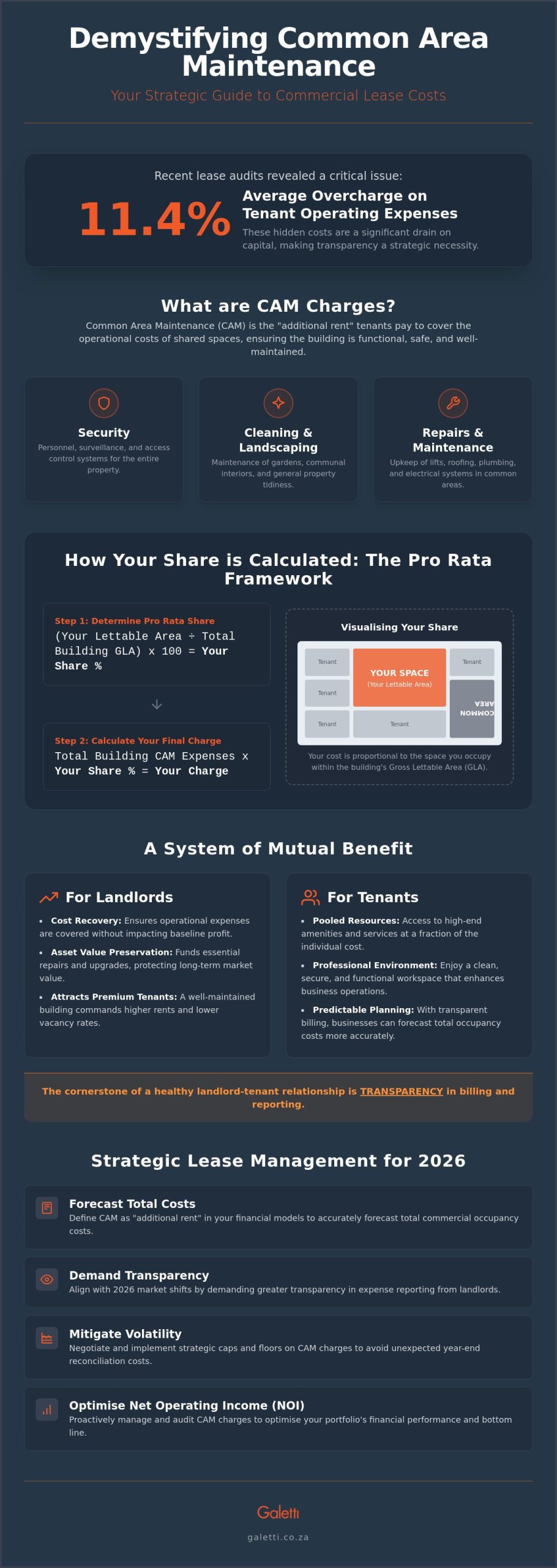
Recent lease audits in major commercial hubs found that tenants are overcharged by an average of 11.4% on their operating expenses. For a high-growth property portfolio, these hidden costs represent a significant drain on capital. Having common area maintenance charges explained is no longer a luxury; it’s a strategic requirement for 2026. You deserve total clarity on where your money goes. Unexpected year-end reconciliation costs shouldn’t be the norm for your business. We know that opaque billing practices make comparing lease offers a complex, frustrating task.
This guide provides the expertise you need to negotiate transparent terms, optimise your commercial lease, and secure predictable operating expenses. You’ll learn to master the latest RICS standards and ensure a fair pro rata distribution of costs across your premises. We’ll break down the 2026 shift toward fixed management fees and show you how to protect your bottom line from unnecessary expenditure. From understanding the new apportionment matrices to verifying discrete bank accounts, we’ll give you the tools to audit your costs with confidence. This is how you align landlord interests with your own growth targets.
Key Takeaways
- Define CAM as “additional rent” to forecast total commercial occupancy costs with accuracy.
- Master pro rata calculations using Gross Lettable Area (GLA) to ensure fair cost distribution.
- Align with 2026 South African market shifts as landlords adopt greater transparency in expense reporting.
- Implement strategic caps and floors to mitigate the volatility of year-end reconciliation payments.
- Optimise portfolio Net Operating Income (NOI) by having common area maintenance charges explained and managed with precision.
Understanding Common Area Maintenance (CAM) in Commercial Real Estate
Common Area Maintenance (CAM) represents the operational expenses incurred by a landlord to manage and maintain shared spaces within a property. In the context of Commercial Real Estate, these costs are passed through to tenants on a pro rata basis. Think of CAM as the financial engine that keeps a building functional, safe, and aesthetically pleasing. For many occupiers, having common area maintenance charges explained is the first step toward understanding their total cost of occupancy. These charges are typically classified as “additional rent” because they sit on top of the base rental rate. They’re not static. They fluctuate based on the actual costs of running the building.
Strategic property management relies on these funds to protect the asset’s long-term value. Efficient CAM management directly impacts a property’s Net Operating Income (NOI). A well-maintained building commands higher market valuations and attracts premium tenants. Core components usually include security, landscaping, communal cleaning, and structural maintenance. To see an example of high-standard infrastructure upkeep, visit GA PERRY for expert plumbing and electrical solutions. When managed correctly, these charges ensure that the building operates at peak efficiency without the landlord absorbing all the risk of rising municipal or service costs.
What Constitutes a Common Area?
Shared spaces are areas that don’t belong to a specific tenant but are vital for the building’s operation. This includes lobbies, lifts, parking lots, and communal bathrooms. The definition of a common area often changes based on the asset class. In a retail centre, the food court and public walkways are primary common areas. In an industrial park, the focus shifts to loading bays, shared yards, and heavy-duty access roads. Understanding these nuances is critical for accurate budgeting.
The distinction between “usable area” and “rentable area” is central to this calculation. Usable area is the actual space your business occupies. Rentable area includes your share of the building’s common spaces. This “add-on factor” determines your final bill. If you’re looking to expand or relocate, our corporate real estate leasing experts can help you navigate these measurements to ensure you aren’t paying for more than your fair share.
The Purpose of CAM for Landlords and Tenants
For landlords, CAM is a cost-recovery mechanism. It ensures the preservation of the asset’s market value by funding essential repairs and upgrades. Without it, a building’s condition would deteriorate, leading to lower occupancy rates. Tenants also benefit from this arrangement. By pooling resources, occupants enjoy a professional environment and high-end amenities that would be prohibitively expensive to maintain individually. Shared cost efficiencies mean better security and cleaner facilities for everyone.
Transparency is the most important factor in this relationship. When landlords provide clear, itemised billing, it builds trust and encourages long-term tenant retention. In the 2026 market, sophisticated tenants demand detailed insights into how their money is spent. They want to know that every Rand contributed to the CAM pool is being used to enhance their operational environment. Predictability in these expenses allows businesses to plan their growth without the fear of sudden, unmanaged cost spikes.
How CAM Charges are Calculated: The Pro Rata Framework
Understanding the mathematics of your lease is the only way to audit your occupancy costs effectively. Having common area maintenance charges explained requires a deep dive into the pro rata framework, which serves as the industry standard for cost distribution. The logic is simple. You pay for the portion of the building you occupy. How CAM Charges are Calculated typically follows a fundamental formula: the Total CAM Expenses multiplied by the Tenant’s Pro Rata Share. This ensures that every occupant contributes a fair amount toward the shared operational burden of the asset.
The denominator for these calculations is the Gross Lettable Area (GLA). This figure represents the total floor space designed for occupation by tenants. Landlords use this baseline to determine your specific percentage of the building. It’s vital to distinguish between fixed and variable expenses during this process. Fixed costs, such as security contracts or scheduled lift maintenance, remain constant regardless of occupancy. Variable costs, like water usage or communal electricity, fluctuate based on how many people are using the building. If you are unsure whether your current billings align with market standards, speak with our strategic advisory team for a portfolio review.
Determining Your Pro Rata Share
Pro rata share is the ratio of a tenant’s leased space to the total rentable area. To calculate this, divide your unit’s square footage by the building’s total GLA. This percentage is then applied to the total pool of operating expenses. Accuracy here is paramount. Small errors in measurement lead to significant overcharges over a five-year lease term. You must also account for secondary spaces. Mezzanine levels, private balconies, or dedicated storage areas can increase your GLA calculation. Whilst these spaces offer utility, they also expand your share of the maintenance bill. Always verify the measurement standards used in your lease to avoid paying for “phantom” space.
Controllable vs Uncontrollable Expenses
Strategic tenants categorise costs into two buckets: controllable and uncontrollable. Controllable costs are those the landlord can influence through efficient management. This includes janitorial services, landscaping, and administrative fees. You can often negotiate “caps” on these items to prevent annual spikes. Uncontrollable costs are external. Property taxes, insurance premiums, and municipal utility hikes fall into this category. Landlords have little power over these rates, so they are rarely capped. Distinguishing between these two is critical for lease negotiations. It allows you to focus your efforts on the expenses that the landlord can actually manage, ensuring your operating costs remain predictable throughout 2026 and beyond.
CAM in the South African Market: Lease Structure Impacts
South Africa’s commercial property landscape has historically relied on varied lease structures. In 2026, we’re seeing a decisive shift amongst local landlords toward greater cost transparency. This evolution is driven by tenant demand for detailed expenditure reporting. It’s no longer enough to provide a lump-sum bill. Occupiers want to see the breakdown of every service provided. Having common area maintenance charges explained in the context of local market norms is vital for any business looking to scale. Galetti Corporate Services acts as a strategic partner in this environment, helping clients navigate complex local regulations and benchmarking costs against industry standards.
Managing Common Area Maintenance (CAM) charges requires an understanding of how South African leases are typically drafted. Most agreements are designed to protect the landlord’s yield whilst ensuring the building remains operational. However, the specific type of lease you sign will determine your exposure to cost fluctuations. Whether you’re in a high-rise office in Sandton or a distribution centre in Cape Town, the lease structure is the ultimate authority on your financial obligations.
Triple Net (NNN) Leases vs Gross Leases
The Triple Net (NNN) lease is the most common structure for industrial and large-scale retail assets. In this model, the tenant pays a base rent plus their pro rata share of all CAM, property taxes, and insurance. It offers the landlord the most protection. Conversely, a Gross Lease includes these costs in the base rent. The landlord pays for most expenses, but these leases often include an “escalation” clause to cover annual inflation. Many South African offices utilise a “Modified Gross” lease. This is a middle ground where the tenant and landlord share certain operational risks, providing a balance of predictability and cost-recovery.
Sector-Specific CAM Nuances
Each property sector has its own maintenance priorities. In retail, CAM charges are usually higher. This is due to the inclusion of marketing funds and the intensive maintenance required for high-traffic walkways and food courts. Industrial properties typically enjoy lower CAM obligations. The focus here is on perimeter security, yard maintenance, and heavy-duty road surfaces. Office environments sit in between. Their CAM focus is on internal systems like HVAC, lift maintenance, and concierge services. Knowing these distinctions allows you to audit your billings more effectively. You don’t want to pay retail-level security rates for a quiet industrial warehouse.
Managing CAM Fluctuations: Reconciliations, Caps, and Floors
At the close of each financial year, the reconciliation process compares your monthly estimated payments against the landlord’s actual expenditure. This is where many businesses encounter the dreaded “top-up” payment. If the actual costs of running the building exceeded the initial budget, you are liable for the difference. It’s a high-stakes moment for your cash flow. Having common area maintenance charges explained within your lease agreement is only the first step. You must also leverage your audit rights. These clauses allow you to inspect the landlord’s books to ensure that the expenses billed are legitimate and correctly apportioned. Without these protections, you risk subsidising a landlord’s operational inefficiencies.
Negotiating CAM Caps and Floors
Strategic negotiation involves the implementation of CAM caps. A cap limits the annual increase of controllable expenses. You should push for a non-cumulative cap. This prevents the landlord from “carrying over” unused increases from previous years to hit you with a massive surge in year three. Conversely, landlords often insist on floors. These set a minimum recovery level to protect their bottom line against significant cost-saving measures. Balancing these two mechanisms is essential for long-term budget predictability. This is particularly vital since TPN reports indicate that over half of commercial tenants find annual escalations above 4% to be unsustainable.
The Importance of a Lease Audit
When you have common area maintenance charges explained by a specialist, you can identify capital improvements incorrectly billed as maintenance. Replacing an entire HVAC system is a capital expenditure that increases the asset’s value. It should not be passed through as a routine repair. Our corporate services team specialises in verifying these expenses to ensure you aren’t paying for the landlord’s long-term property upgrades. We verify that shared expenses only apply to shared areas. This prevents the misallocation of costs from dedicated tenant spaces into the communal pool. Verify your billings with our expert team today.
Optimising Portfolio Performance through Strategic CAM Management
Strategic CAM management is a critical lever for value creation. It shouldn’t be viewed merely as a line item on a ledger. For property owners, driving efficiency in these shared costs directly improves the Net Operating Income (NOI). A higher NOI translates into a more robust valuation. This is vital when preparing an asset for the market. Having common area maintenance charges explained through the lens of asset performance reveals that well-maintained lobbies and high-functioning lifts are more than just comforts; indeed, specialised renovations by Svenska trappsteg show how upgrading shared staircases can further enhance an asset’s appeal. They are tools for high-quality tenant procurement. Blue-chip occupiers prioritise buildings where maintenance is proactive and costs are transparent. They’re willing to pay a premium for environments that reflect their corporate standards.
Data is your most valuable asset in 2026. Reviewing your CAM expenditure allows you to identify energy efficiency opportunities that reduce long-term costs. The second edition of the RICS Service Charges in Commercial Property standard encourages sustainable practices and ESG considerations. Transitioning to LED lighting or installing solar arrays often requires an initial outlay, but the reduction in communal utility bills benefits everyone. These upgrades lower the variable component of CAM, making the building more competitive. Professional brokerage ensures that your costs aren’t just low, but accurately benchmarked against the national market. This prevents “expense creep” from eroding your margins.
Advisory for Landlords and Investors
Investors must structure their CAM to ensure full cost recovery without alienating tenants. It’s a delicate balance. If your charges are too high, your vacancy rates will climb. If they’re too low, you’re subsidising your tenants’ operations. This balance significantly impacts property exit yields. When a building goes to market, savvy buyers scrutinise the CAM history. High efficiency in this area suggests a well-run asset. For those considering a sale, explore Commercial Property Auctioneers South Africa for asset disposal strategies. It’s the best way to realise the built-up value of a well-managed property.
Occupier Services: Ensuring Fair Value
For tenants, the goal is fair value for every Rand spent. Benchmarking your charges against similar properties in your specific node is the only way to know if you’re being overcharged. We use real-time market data to help our clients verify their occupancy costs. Transparency in these billings becomes a powerful lever during lease renewals. If a landlord cannot justify a cost spike, you have the data to negotiate a better deal. It’s about ensuring your business isn’t footing the bill for a landlord’s lack of oversight. Ready to optimise your lease? Contact Galetti for expert advisory and let us audit your portfolio’s performance.
Secure Your Commercial Portfolio Advantage
Mastering the nuances of lease structures is non-negotiable for modern property stakeholders. Accuracy is vital. We’ve seen how precise pro rata calculations and the strategic use of caps protect your bottom line from unexpected surges. Having common area maintenance charges explained is just the start. Real success comes from active management and consistent market benchmarking. With over 18 years of commercial real estate expertise, Galetti provides an integrated approach across leasing, sales, and auctions. Our national coverage across South Africa ensures you have local insights wherever your portfolio expands.
Transparency and efficiency are the benchmarks of a high-performing asset. By aligning your CAM strategy with 2026 standards, you ensure long-term tenant retention and maximum exit yields. We’re ready to help you navigate these complexities with clarity and precision. Optimise your property portfolio with Galetti’s expert advisory services today. Your strategic growth starts with expert oversight.
Frequently Asked Questions
Are Common Area Maintenance (CAM) charges negotiable?
Yes, CAM charges are highly negotiable during the initial lease drafting phase. Savvy tenants often negotiate caps on controllable expenses or the exclusion of specific administrative fees to ensure cost predictability. Setting these boundaries early prevents future surges in your occupancy costs. It’s essential to define which costs are fixed and which are variable before signing any agreement.
What is the difference between CAM and Operating Expenses (OpEx)?
CAM is a specific subset of broader Operating Expenses (OpEx). Whilst OpEx encompasses every cost related to running a property, including property taxes and insurance, CAM focuses exclusively on the physical upkeep of shared spaces. This includes cleaning, security, and landscaping for communal areas. Distinguishing between these allows for more precise budget forecasting and expense auditing.
Can capital improvements be included in CAM charges?
Capital improvements are typically excluded from CAM as they represent long-term asset upgrades rather than routine maintenance. Replacing a roof or installing a new lift system adds permanent value to the landlord’s asset and should not be billed as a repair. The 2026 RICS standard emphasises that landlords must only recover actual service costs without generating additional profit from these charges.
How often should CAM reconciliations occur?
Reconciliations must occur annually to ensure transparency. Under the latest professional standards for 2026, landlords should provide year-end accounts within four months of the service charge year-end. This process ensures that the common area maintenance charges explained in your initial budget align with the actual funds spent. Timely reconciliation prevents the accumulation of massive “top-up” debts at the end of a lease term.
Is VAT applicable to CAM charges in South Africa?
Yes, VAT is applicable to CAM charges in South Africa if the landlord is a registered VAT vendor. These charges are viewed as part of the consideration for the supply of commercial premises. Tenants who are also VAT vendors can usually claim this back as input VAT, provided the landlord issues a valid tax invoice. Always verify the VAT status of your landlord during the due diligence phase.
What happens if a building has high vacancy? Who pays the CAM for empty units?
Landlords are generally responsible for the CAM share attributed to vacant units. However, some leases include “gross-up” clauses. These allow landlords to calculate variable expenses as if the building were 95% or 100% occupied. This ensures that the costs for services actually used, such as communal water or security, are fully covered. You must review your lease to see if a gross-up provision exists.
Can a tenant refuse to pay CAM if shared services are poorly maintained?
Withholding CAM payments is legally risky and often results in a breach of lease. Most South African commercial leases require payment regardless of service disputes. The professional approach is to pay “under protest” whilst triggering your formal audit rights. This allows you to legally challenge the landlord’s performance and seek a credit or reduction without risking eviction or legal penalties.
How do I know if my pro rata share calculation is correct?
Verify your unit’s square footage against the building’s total Gross Lettable Area (GLA). You should use the BOMA 2026 Mixed-Use Standard for measurement accuracy to ensure the denominator in your calculation is current. If the math remains opaque, having your common area maintenance charges explained by a professional surveyor or advisory team will ensure your pro rata share is mathematically precise and fair.