
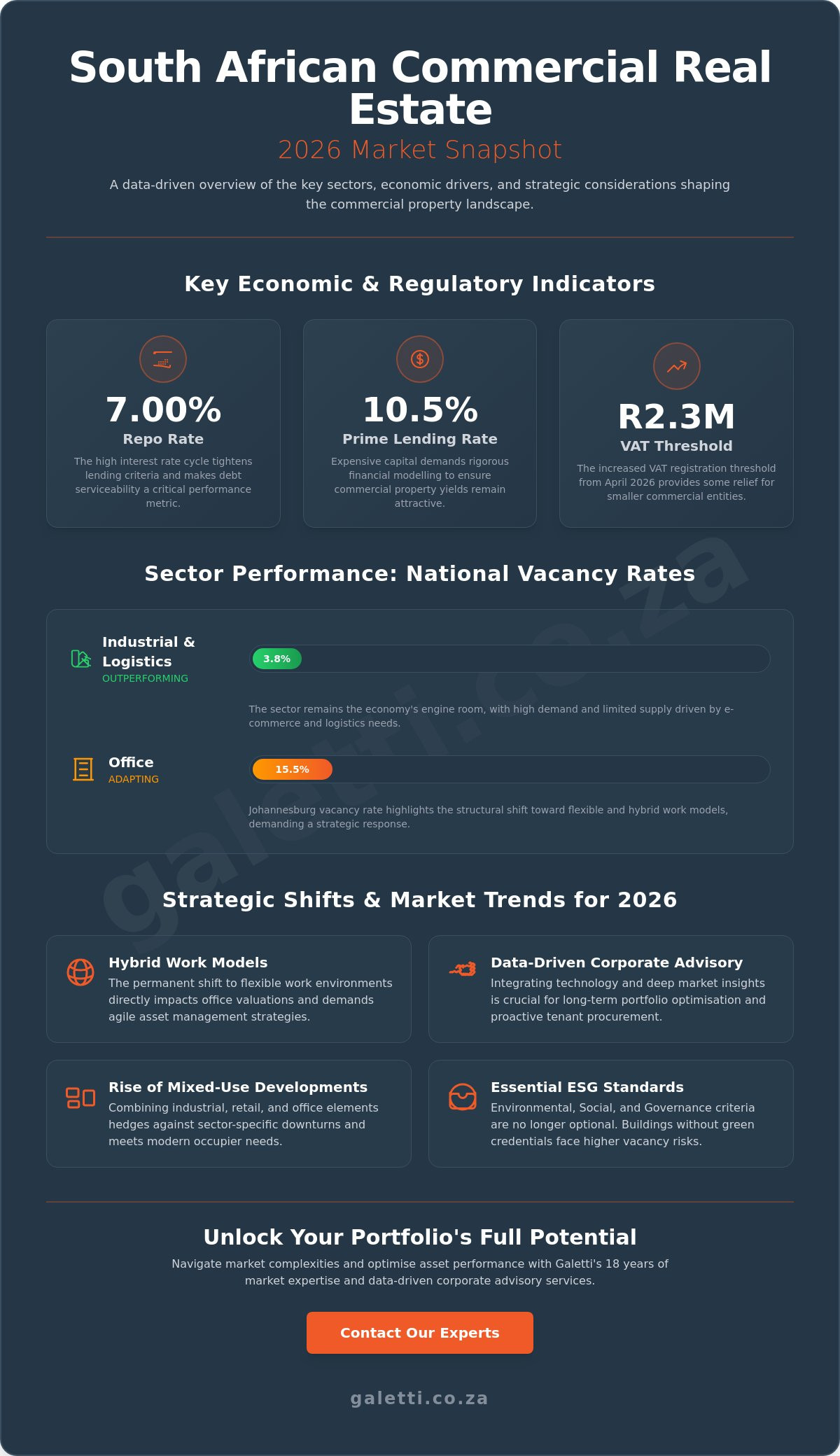
With the Johannesburg office vacancy rate climbing to 15.5% in early 2026, many investors are questioning the long-term viability of traditional assets. You’ve likely noticed that market volatility and the recent repo rate hike to 7.00% have made portfolio management increasingly complex for even the most seasoned stakeholders. Navigating commercial real estate South Africa now requires more than just local knowledge; it demands a data-driven strategy to counter rising operational costs and shifting tenant behaviours. Securing value in this climate requires precision and a move beyond standard listings.
This article provides the expert insights needed to master these complexities. You’ll learn how to maximise asset value during disposal and secure strategic tenants to reduce vacancies across your portfolio. We examine the latest market data, from the new R2.3 million VAT threshold adjustment to the industrial sector’s robust 3.8% vacancy rate, to help you build a resilient strategy for growth. We provide a clear roadmap covering property leasing, auction services, and corporate advisory to ensure your assets perform at their peak in a fast-moving market.
Key Takeaways
- Adapt your investment strategy to the 2026 shift toward flexible and hybrid office models to maintain long-term asset relevance.
- Explore why the industrial and logistics sectors continue to lead the commercial real estate South Africa market in both performance and stability.
- Compare the speed and transparency of property auctions against private treaty sales to determine the most efficient disposal method for your assets.
- Implement a structured framework for national property audits to identify underperforming assets and reduce vacancies through proactive tenant procurement.
- Leverage data-driven corporate advisory services to integrate technology and market insights into your long-term portfolio optimisation strategy.
Navigating the South African Commercial Real Estate Market in 2026
South Africa’s commercial landscape is undergoing a structural transformation. The traditional office model is no longer the default. Occupiers now prioritise flexibility, causing a permanent shift toward hybrid work environments. This evolution directly impacts valuations and requires a more sophisticated approach to commercial real estate South Africa. Success in 2026 depends on understanding these micro-shifts before they become macro-trends. Investors can’t rely on historical performance alone; they must adapt to a market that rewards agility and data-driven decision-making.
Economic Drivers and Market Resilience
National infrastructure projects remain a primary catalyst for property demand. Strategic upgrades to transport corridors and energy logistics are creating new nodes of value across the provinces. However, the interest rate cycle continues to dictate the pace of acquisition. With the repo rate at 7.00% and the prime lending rate at 10.5% as of May 2026, capital remains expensive. This environment necessitates rigorous financial modelling for any commercial property investment to ensure yields remain attractive.
Retail sector performance is tracking closely with national GDP growth. Whilst consumer spending is under pressure, high-quality retail centres in resilient catchments are outperforming the broader market. Investors must look beyond the surface to identify assets with sustainable footfall and defensive tenant mixes. Key economic factors influencing the market include:
- Interest Rate Stability: High rates have tightened lending criteria, making debt serviceability a critical metric.
- Infrastructure Investment: Renewed focus on rail and port efficiency is driving industrial demand in logistics hubs.
- Tax Adjustments: The VAT registration threshold increase to R2.3 million in April 2026 has provided some relief for smaller commercial entities.
The Shift Towards Integrated Property Solutions
Mixed-use developments are the new standard. These assets combine industrial, retail, and office elements to hedge against sector-specific downturns. This integration provides a buffer against the volatility seen in traditional single-use buildings. Corporate occupiers are seeking agile real estate strategies that allow them to scale space up or down as their workforce requirements change.
ESG (Environmental, Social, and Governance) standards have moved from optional to essential. In 2026, tenants demand buildings that meet strict environmental benchmarks. Properties lacking solar integration or water-saving systems face higher vacancy risks and lower valuations. Navigating these shifts requires expert guidance. Local regulatory frameworks add layers of complexity to every transaction. Partnering with Galetti Corporate Services ensures your strategy is backed by 18 years of market expertise and data-driven insights that protect your portfolio’s long-term value.
Key Asset Classes: Industrial, Office, and Retail Sectors
Understanding the primary pillars of commercial real estate South Africa is vital for long-term portfolio stability. While market dynamics differ significantly by province, three core sectors define the national landscape. Industrial remains the undisputed outperformer, whilst the office and retail sectors are undergoing a period of structural adaptation. Investors must align their acquisitions with the 2026 commercial real estate trends that prioritise functional efficiency and technological integration over mere physical scale.
Industrial and Logistics: The Engine Room
The industrial sector is the economy’s engine room. National industrial vacancy rates held steady at 3.8% in late 2025, reflecting a market with limited supply and high demand. High-spec distribution centres are no longer a luxury; they are a requirement for modern supply chains. Cold storage demand is particularly high in coastal hubs like Durban, where industrial space remains scarce compared to the 11.7% vacancy rate in the city’s office sector. E-commerce growth has fundamentally changed warehouse lease rates, pushing them higher in strategic logistics hubs near national transport corridors. Landlords are now focused on power security and yard depth to attract blue-chip tenants who require 24-hour operational capacity.
The Evolution of the Corporate Office
The national office vacancy rate sat at 12.6% in Q1 2026, but regional disparities are stark. Cape Town leads the recovery with a 6.0% vacancy rate, whilst Johannesburg faces a more challenging 15.5%. A clear flight to quality is occurring across the country. Grade-A office rentals rose by 3.5% year-on-year in Q4 2025, proving that premium assets still command strong yields. Landlords are aggressively retrofitting B-grade properties to offer the flexible, amenity-rich spaces that hybrid workforces demand. Securing favourable lease terms in this environment requires professional property leasing services that understand the nuances of tenant retention and incentive structures.
Retail Resilience and Consumer Behaviour
Convenience-led shopping centres are outperforming large regional malls. Consumers prefer local, accessible retail nodes for their daily needs, which has made these smaller centres a defensive asset class. Success in this sector depends on a precise tenant mix that drives footfall through essential services, gyms, and medical suites. This strategy ensures consistent performance despite broader economic headwinds. Accurate pricing in the commercial real estate South Africa retail market now requires data-driven valuations to benchmark performance against national averages. To find out how these shifts impact your specific holdings, you can contact a consultant today for a detailed market analysis.
Strategic Disposal: Auctions vs Private Treaty Sales
Choosing the right exit strategy is as critical as the initial acquisition. In the current commercial real estate South Africa market, sellers must weigh the immediate liquidity of an auction against the strategic control of a private treaty sale. Each method serves a distinct purpose within a broader portfolio optimisation plan. The decision depends on asset type, market demand, and the seller’s timeline for capital redeployment.
Auctions provide total transparency and a definitive timeline. They eliminate the protracted negotiation cycles often found in traditional sales. By setting a fixed date, auctions create a sense of urgency that forces buyers to act. This competitive environment often results in a price that exceeds the reserve, particularly for high-demand industrial assets or multi-tenanted retail nodes. In 2026, auctions have become a preferred tool for sellers looking to exit assets quickly whilst ensuring market-related pricing through open competition.
Private treaty sales offer a different set of advantages, primarily around confidentiality and control. For complex, high-value corporate assets, this method allows for deep-level negotiations and structured deal terms that the auction floor cannot accommodate. It provides the discretion required for sensitive divestments where public knowledge of the sale might disrupt tenant relations or corporate stability. Private treaty is often the best route for bespoke assets that require a specific type of buyer rather than a broad market audience.
The Mechanics of Commercial Auctions
Before a gavel falls, rigorous due diligence is non-negotiable. Sellers must provide comprehensive information packs covering zoning, title deeds, and detailed tenant schedules. Success on the day depends entirely on aggressive, targeted marketing. Reaching a vetted pool of qualified investors is the only way to ensure a competitive result. You can view our Galetti Property Auction Services for current schedules and upcoming opportunities across the country.
Private Treaty for Strategic Divestment
Off-market transactions offer a level of discretion that many institutional investors require. This is especially relevant for large-scale industrial portfolios or CBD office blocks undergoing repurposing. The process involves identifying a shortlist of vetted buyers and managing a high-touch negotiation phase to align with the seller’s long-term corporate objectives. For bespoke disposal strategies, our Corporate Real Estate Sales team provides the necessary expertise to close complex, high-value deals efficiently.
Optimising Portfolio Performance and Occupier Strategy
Maximising returns requires a move from passive ownership to active management. A national property portfolio audit serves as the first step in this transition. It identifies underperforming assets and exposes operational inefficiencies that erode yield. In the commercial real estate South Africa sector, maintaining asset liquidity depends on having a clear, data-backed view of every square metre. Proactive tenant procurement is the only sustainable way to counter the high vacancy rates currently seen in traditional office nodes.
Accurate valuations are a tool for strategic growth, not just a requirement for disposal. They allow landlords to benchmark performance against national averages and adjust rentals to meet market demand. Strategic advisory helps reduce operational property costs by streamlining utilities and facilities management. This lean approach ensures that portfolios remain resilient even when economic drivers, such as the 10.5% prime lending rate, put pressure on cash flow. Efficiency is the new benchmark for success.
Portfolio Management and Risk Mitigation
Asset diversification is the most effective hedge against sector-specific downturns. Whilst the industrial sector remains robust, over-exposure to Johannesburg’s office market presents a significant risk. Professional management bridges the gap between landlord objectives and tenant needs. High-quality management improves retention rates and fosters long-term stability. For specialised advice on restructuring your holdings, Galetti Corporate Services provides the necessary strategic framework to protect your capital.
Leasing Strategies for Long-term Stability
Lease audits are essential for identifying cost-saving opportunities. They catch billing errors and ensure that escalation clauses remain competitive. Negotiation tactics for renewals must move beyond basic rental rates to include fit-out allowances and flexible term options. This agility attracts the modern corporate occupier who prioritises functional, well-located space. Our Corporate Real Estate Leasing team focuses on securing high-calibre tenants to ensure your assets remain income-producing. To begin your portfolio optimisation process, contact Galetti today for a professional consultation.
Unlocking Value with Galetti’s National Property Advisory
Navigating the complexities of commercial real estate South Africa requires more than a standard brokerage approach. It demands a partnership with a firm that understands the nuances of 18 years of market cycles. Galetti provides this stability. We offer a comprehensive suite of services, including property auction services and corporate advisory, designed to maximise asset value in any climate. Our focus remains on clarity and results. We don’t just list properties; we engineer successful outcomes for landlords and institutional investors alike. Precision is our baseline.
The 2026 landscape rewards those who move with speed and accuracy. Our team serves the office, industrial, and retail sectors nationally, providing a bridge between local market intelligence and global investment standards. We provide the definitive answers required to navigate local regulatory frameworks and shifting tenant behaviours. Whether you’re managing a high-performing logistics hub or a CBD office block undergoing repurposing, our advisory ensures your strategy aligns with current economic realities. We prioritise your strategic advantage above all else.
The Galetti Advantage: Data-Driven Results
Technology is at the core of our operations. We integrate real-time market data with sophisticated analytics to provide our clients with a competitive edge. This approach ensures that every decision, from a strategic disposal to a complex lease renewal, is backed by evidence. Our national reach covers every major commercial hub in South Africa, whilst our international network provides access to global capital and occupier trends. For investors managing portfolios with North American components, Massingill Attorneys & Counselors at Law provides the specialised business law and estate planning counsel required to navigate those markets. We maintain a commitment to efficiency; we remove the friction from transactions. Our clients benefit from:
- Precision-targeted marketing for property sales services.
- Transparent bidding environments through our auction platform.
- Bespoke tenant procurement strategies for all primary asset classes.
- Comprehensive property management and advisory via our corporate services division.
Take Action: Optimise Your Assets Today
The current market shift presents both risks and opportunities. Landlords must act now to secure their portfolios against volatility. Whether you’re looking to divest a single industrial asset or require a full-scale national property audit, our team is ready to facilitate the process. We invite corporate occupiers and institutional landlords to schedule a portfolio strategy session to identify cost-saving opportunities and implement a data-driven growth strategy. If you’re ready to divest, you can list your property with us for expert disposal. Secure your position in the commercial real estate South Africa market by partnering with a leader that prioritises your strategic advantage.
Future-Proof Your Commercial Strategy
Success in the 2026 market depends on your ability to adapt to rapid sector shifts. Whether you’re navigating the flight to quality in the office sector or capitalising on the sustained demand for high-spec industrial space, a proactive approach is essential. Identifying the right disposal method ensures you realise maximum value for your assets. Mastering commercial real estate South Africa requires shifting from passive ownership to a strategy rooted in data and market intelligence. Efficiency and foresight are now the primary drivers of yield.
Optimising your portfolio is a continuous process of refinement. Galetti provides the strategic partnership needed to execute these complex moves with precision. With 18 years of industry-leading expertise and comprehensive national coverage across all sectors, we offer the integrated technology and data-driven market analysis required to stay ahead. Take the next step to secure your investments and drive sustainable growth. Partner with Galetti for expert commercial real estate advisory and ensure your assets are positioned for long-term success. Your portfolio’s future starts with a single strategic decision.
Frequently Asked Questions
What is the current trend in South African commercial real estate for 2026?
The primary trend in 2026 is a “flight to quality” as occupiers prioritise premium, sustainable assets. Grade-A office rentals rose by 3.5% year-on-year in late 2025, reflecting demand for buildings with green features and modern amenities. This shift is accompanied by the continued dominance of the industrial sector, which remains the top-performing commercial asset class nationally.
How do property auctions differ from traditional sales in South Africa?
Auctions differ by providing a fixed timeline and a transparent, competitive bidding environment that creates immediate liquidity. Traditional sales rely on private treaty negotiations, which can take months to conclude. Auctions force price discovery in an open forum, often resulting in a higher final price for high-demand assets like industrial warehouses or well-located retail nodes.
Why should a business use a commercial property broker instead of an online portal?
Brokers provide strategic advisory and off-market data that online portals cannot offer. Portals are simple listing aggregators, but a broker navigates the complexities of commercial real estate South Africa regulations and leads professional negotiations. Brokers identify specific opportunities that align with corporate strategy and ensure that lease terms protect the tenant’s long-term interests.
What are the benefits of industrial real estate investment in the current market?
Industrial real estate offers the lowest vacancy rates in the country, holding steady at 3.8% in late 2025. Demand for high-spec distribution centres and cold storage remains high due to the growth of e-commerce and logistics requirements. This sector provides stable, defensive yields and benefits from national infrastructure projects that improve transport corridor efficiency.
How can corporate occupiers reduce their property overheads?
Occupiers can reduce overheads through lease audits and portfolio audits to identify underutilised space and billing errors. Restructuring leases to include flexible terms or fit-out allowances helps align property costs with actual workforce needs. Strategic advisory ensures that facilities management and utility costs are streamlined, directly improving the bottom line for large-scale operations.
What sectors are showing the highest yields in South African commercial property?
Logistics and convenience-led retail centres are currently showing the highest yields. Industrial assets benefit from a supply-demand imbalance, whilst local retail nodes offer defensive performance against economic volatility. Investors focus on these sectors because they provide consistent rental growth and lower vacancy risks compared to traditional CBD office blocks.
How does Galetti assist with national property portfolio management?
Galetti assists through a data-driven framework provided by our corporate services division. We conduct comprehensive portfolio audits, manage landlord-tenant relations, and implement proactive leasing strategies to reduce vacancies. Our team uses 18 years of market expertise to ensure that every asset in a national portfolio is performing at its peak operational capacity.