
What if your property disposal was a catalyst for growth rather than a reaction to market volatility? In the current landscape, a commercial auction is a sophisticated tool for price discovery and rapid capital reallocation. Selecting the right commercial property auctioneers South Africa is essential for a high-level disposal strategy that prioritises efficiency. You have likely experienced the frustration of slow timelines and the fear of underselling assets through a perceived “distressed” lens.
This guide provides a framework to select an auction partner that maximises asset value and accelerates liquidity. You’ll learn how to leverage competitive bidding to achieve premium pricing while maintaining a polished corporate image. We’ll also outline the critical role of the Due Diligence Pack and the importance of navigating the 2026 regulatory landscape to ensure your transaction remains transparent. By the end of this article, you will understand how to transform the “voetstoots” clause into a strategic advantage that simplifies your exit strategy and secures market-related returns.
Key Takeaways
- Redefine the role of commercial property auctioneers South Africa as strategic facilitators for price discovery in a volatile market.
- Evaluate potential partners based on investor database depth and the seamless integration of virtual and live bidding technologies.
- Contrast the non-contingent nature of auctions with the finance-related delays typical of traditional private treaty sales.
- Master the preparation of a comprehensive Due Diligence Pack to eliminate buyer uncertainty and accelerate the closing process.
- Leverage 18 years of industry expertise to choose a disposal method that prioritises both speed and capital preservation.
The Strategic Role of Commercial Property Auctioneers in South Africa
Modern commercial property auctioneers South Africa act as strategic advisors rather than mere transactional facilitators. In a volatile economic climate, institutional investors and corporate boards view auctions as a primary tool for capital recycling. This shift marks a departure from the historical perception of auctions as a last resort for distressed sellers. Today, sophisticated funds use the platform to rebalance portfolios, moving capital from underperforming assets into high-growth sectors. By aggregating demand through a single, high-intensity event, premier auctioneers ensure that local assets receive national exposure, preventing the localisation of pricing that often occurs in private sales.
South Africa’s property market remains highly fragmented across major metros. A logistics hub in Durban requires a different investor profile than a retail centre in Cape Town. Strategic disposal partners provide the national reach necessary to tap into these diverse buyer pools. This ensures that assets are not merely sold, but are exposed to the widest possible array of liquid capital, regardless of the property’s physical location.
Beyond the Gavel: Auctions as a Liquidity Solution
Time is a significant cost factor in real estate. Protracted negotiation periods in private sales often lead to deal fatigue and missed opportunities. Auctions compress the disposal timeline into a fixed window, typically six to eight weeks. This speed allows sellers to realise the time-value of money, converting brick-and-mortar assets into liquid capital almost immediately. Accelerated marketing is a high-impact promotional strategy designed to generate maximum market saturation within a condensed timeframe.
By removing the subject-to-finance clauses that plague traditional transactions, auctions provide a level of certainty that is rare in the current market. Sellers don’t have to wait months for a buyer’s bond approval to fail at the last minute. The fall of the hammer signifies a binding commitment, which is essential for companies that need to meet specific financial year-end targets or reinvest capital into new developments.
Market Transparency and Competitive Bidding
The competitive environment of a live or digital auction creates a palpable sense of urgency. Qualified buyers are forced to act decisively, often pushing prices beyond initial valuations. This transparency is vital for corporate governance. Board members have a fiduciary duty to prove they achieved the best possible market price. Because the auction process is public and documented, it eliminates concerns regarding under-the-table deals or preferential treatment. It provides a clean, auditable trail that satisfies both internal auditors and external stakeholders.
Working with experienced commercial property auctioneers South Africa ensures that the bidding process remains professional and legally sound. The open-market nature of the event prevents the quiet discounting that sometimes occurs when an asset sits on the market for too long. Instead of a property becoming stale, the auction format keeps the asset’s profile high and its value protected through public competition.
Criteria for Selecting Premier Commercial Property Auctioneers
Selecting a partner for asset disposal requires more than a review of past records. It demands a rigorous analysis of their network reach and technical proficiency. Premier commercial property auctioneers South Africa must demonstrate a deep database of active national and international investors. Without this network, even the best asset will fail to achieve its true market potential. High-quality marketing collateral and detailed investment prospectuses are the baseline for any serious disposal campaign. These documents must include precise data on net operating income, lease expiry profiles, and historical maintenance costs to build immediate trust with bidders.
The Importance of Sector-Specific Expertise
Marketing an industrial warehouse requires a vastly different approach than selling a retail centre. Industrial buyers prioritise logistics connectivity, floor loading capacities, and power availability. Retail investors focus on footfall, anchor tenant stability, and catchment area demographics. A strategic auctioneer must articulate the highest and best use of a property to prospective bidders. This involves commissioning technical valuations to set realistic reserve prices that reflect current market sentiment. Compliance is equally critical. All practitioners must operate within the framework of the Property Practitioners Act to ensure the transaction is legally robust and transparent.
Technological Integration and Global Reach
The modern auction room is no longer confined to a physical hotel ballroom. Online bidding platforms have significantly expanded the buyer pool. International institutional investors now participate in South African auctions from their London or Dubai offices. This global reach is only possible through seamless virtual participation and real-time data analytics. During a campaign, sellers should expect daily updates on lead generation and bidder registration numbers. This data-driven approach allows for tactical adjustments before the day of the sale. It ensures that no potential lead is left unpursued, regardless of their geographic location.
Institutional sellers often seek integrated auction and advisory services to ensure their disposal strategy matches current market demand. Look for an auctioneer that offers a hybrid model. This combines the energy of a live floor presence with the expansive reach of a digital platform. The goal is to create maximum competition whilst maintaining absolute transparency throughout the bidding process. Efficiency in these areas directly correlates to the final price achieved at the fall of the hammer.
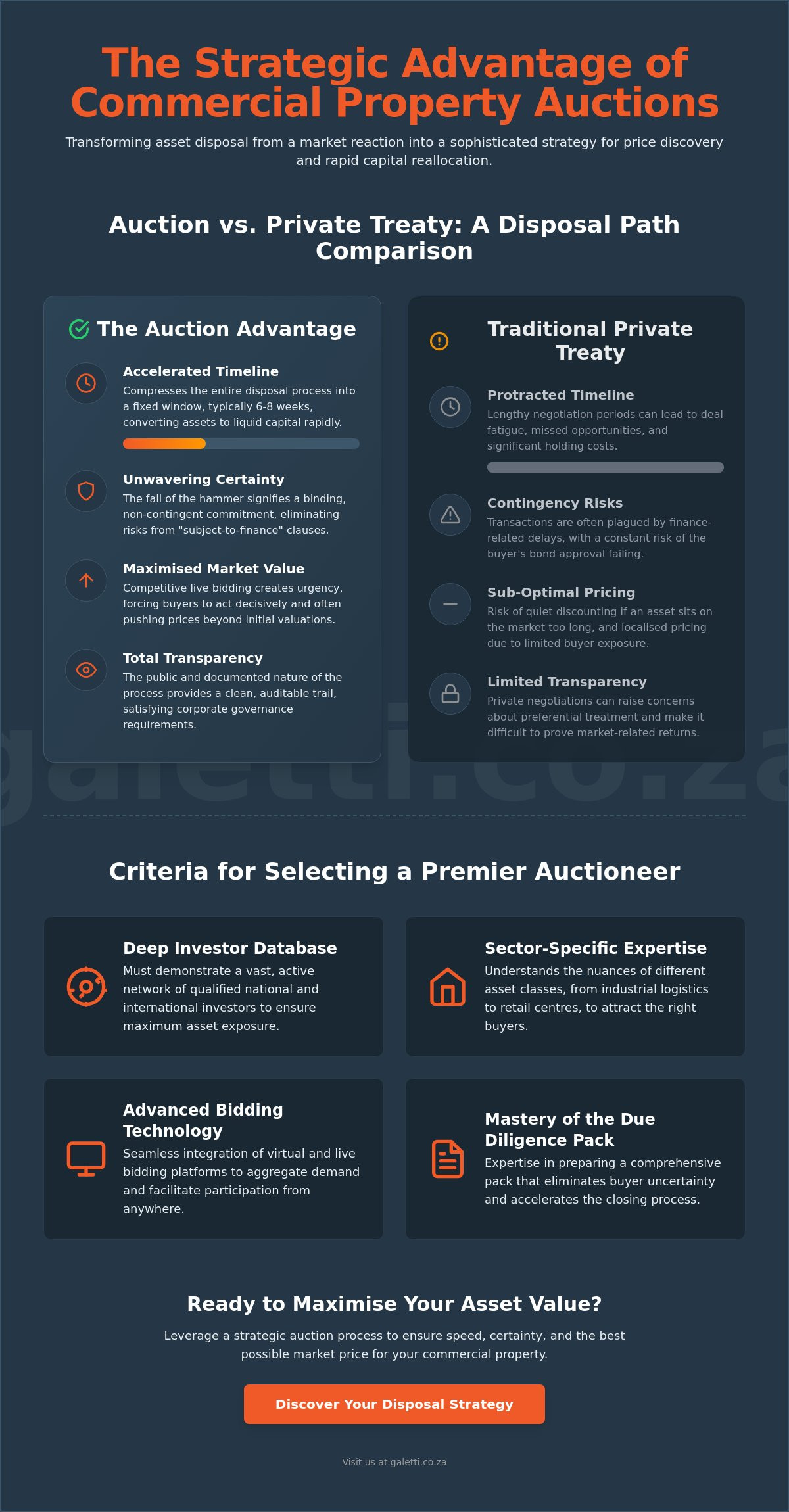
Auction vs Private Treaty: Determining the Best Disposal Path
Choosing between an auction and a private treaty is a strategic decision that impacts both liquidity and final yield. Traditional private treaty sales allow sellers to maintain absolute control over the asking price. However, they frequently suffer from protracted timelines and “subject-to-finance” contingencies. In the South African market, where interest rates remain a critical variable, these contingencies often lead to deal collapse at the eleventh hour. Conversely, auctions provide a non-contingent environment. Engaging professional commercial property auctioneers South Africa ensures that once the hammer falls, the sale is legally binding and cash-backed, removing the uncertainty of bank valuations and buyer creditworthiness. For a detailed breakdown of how these two methods compare in 2026, our analysis of auction vs sale commercial property disposal paths provides data-driven guidance on selecting the optimal route for your asset.
For highly sensitive or complex corporate disposals, the “Tender” process offers a structured alternative. This method requires bidders to submit sealed offers by a specific deadline. It provides the competitive pressure of an auction whilst allowing the seller to review terms and conditions in private. This is often the preferred route for government-linked entities or large REITs managing multi-million Rand portfolios where public scrutiny is high. Members of the South African Institute of Auctioneers (SAIA) are trained to manage these varied disposal methods to ensure absolute compliance and market-related outcomes.
When to Choose the Auction Platform
Auctions excel when an asset has high demand but a difficult-to-quantify market value. If a property in a high-performing sector like logistics has several interested parties, the auction floor is the only place to find the true price ceiling. It’s the superior choice for sellers requiring a fixed disposal date for financial year-end reporting or immediate capital re-investment. Properties that have languished on the private market for over six months often benefit from an auction “reset.” This creates a fresh sense of urgency and forces the market to re-evaluate the asset under a time-limited window. For logistics and manufacturing assets specifically, understanding how industrial property auctions ZA have evolved into a sophisticated institutional price discovery mechanism can help you determine whether this high-velocity platform is the right fit for your asset.
The Private Treaty Alternative
Private treaty remains a viable path for unique assets with a very narrow, highly specific buyer pool. If a property requires a specific type of owner-occupier or a specialised industrial tenant, a targeted sales campaign is often more effective than a public call for bids. This method also suits situations where extreme discretion is required to protect tenant relationships or corporate reputations before a deal is finalised. A strategic advisor will typically assess the asset class and current vacancy rates before recommending a hybrid approach. This might involve an initial private marketing phase followed by a public auction if the reserve isn’t met through traditional channels. For portfolio owners evaluating all disposal options, understanding how commercial property brokers South Africa complement the auction process can help determine the most effective route to market.
Preparing Your Commercial Asset for a Successful Auction
Success at auction is determined long before the first bid is placed. For commercial property auctioneers South Africa, the preparation phase is a rigorous process of risk mitigation. A “no-sale” outcome is often the result of unresolved questions rather than a lack of market interest. Professional preparation removes friction. It allows bidders to focus solely on value rather than potential liabilities. This starts with a comprehensive Due Diligence Pack that serves as the single source of truth for all prospective buyers.
Physical presentation remains a critical driver of bidder perception. Even in the industrial sector, “kerb appeal” influences the perceived quality of the asset. Addressing minor maintenance issues, ensuring the site is clean, and providing clear access for inspections can significantly impact the final bid. Finally, setting a strategic Reserve Price is essential. This figure must be informed by data-driven market analysis rather than sentiment. A realistic reserve encourages early bidding momentum. This is vital for achieving a premium price at the fall of the hammer.
The Due Diligence Framework
Bidders require absolute transparency to commit capital. A robust Due Diligence Pack must include accurate rent rolls, signed lease agreements, and detailed expense schedules. It’s also imperative to provide legal documentation such as Title Deeds, zoning certificates, and Surveyor General (SG) diagrams. Any ambiguity regarding property boundaries or usage rights will lead to lower bids or withdrawal from the process. Sellers must ensure all municipal accounts are settled and up to date. Outstanding rates and taxes can cause significant transfer delays, which erodes the liquidity benefits of the auction process.
Visual marketing has evolved beyond basic snapshots. High-resolution professional photography and drone footage are now standard requirements. Drone imagery is particularly effective for industrial and retail assets. It illustrates logistics connectivity and catchment area density. This visual data allows international investors to evaluate the site without immediate physical travel. If you are ready to bring your asset to market, you can enlist our property auction services to begin the formal preparation process.
Compliance and Legal Readiness
The South African regulatory environment is stringent. Navigating FICA (Financial Intelligence Centre Act) requirements is a non-negotiable step for both sellers and bidders. Auctioneers must verify the identity and source of funds for all participants to ensure the transaction is legally sound. Under the Consumer Protection Act, the “Rules of Auction” must be clearly displayed and understood by all parties. The fall of the hammer creates a binding, non-contingent contract. There’s no cooling-off period in commercial auctions, making legal readiness paramount before the event begins. Once the sale is concluded, the conveyancer manages the post-auction transfer process to ensure a seamless change of ownership.
Galetti: Integrating Corporate Advisory with Auction Excellence
Galetti operates at the intersection of corporate advisory and transactional excellence. We aren’t just commercial property auctioneers South Africa. We’re strategic partners in capital reallocation. With 18 years of experience navigating the local market, we understand that asset disposal is a high-stakes strategic choice. Our approach prioritises clarity and efficiency for high-level decision-makers. We ensure every asset reaches its maximum potential through a blend of technical expertise and market-leading platforms. This isn’t about the event. It’s about the outcome.
Our team acts as a high-level consultant ready to provide definitive answers to complex problems. We avoid emotional fluff. We focus on movement, growth, and strategic advantage. By positioning your property within a broader corporate strategy, we move beyond the hammer to provide a comprehensive liquidity solution. This results-oriented demeanor is what builds trust with the country’s leading property funds and private investors.
A Data-Driven Approach to Asset Disposal
We use internal market benchmarks to determine the optimal timing for an auction. This isn’t based on guesswork. We analyse current vacancy trends and rental growth figures to position your asset correctly. Identifying the “ideal buyer profile” happens long before the marketing campaign launches. We leverage our deep database to target specific institutional funds or private investors who are actively seeking yield. There’s a powerful synergy between our leasing expertise and sales value maximisation. A property with a stable, high-quality tenant profile always commands a premium on the auction floor. We help you refine these variables to ensure the market sees the highest possible value. For firms seeking to align their physical footprint with broader business objectives, our corporate real estate advisory ZA services provide the data-driven framework to optimise your portfolio before and after disposal.
National Coverage with Local Market Intelligence
Our national footprint provides a distinct advantage for corporate clients. We manage large-scale portfolio disposals across South Africa. Whether it’s Johannesburg’s dominant industrial hubs or the recovering office markets in Cape Town, we have the granular data to drive results. Granular market knowledge ensures that we don’t just broadcast a sale; we curate it. We understand the nuances of each metro and how they affect buyer behaviour. Transparency remains our core value. We provide a legally sound environment that satisfies corporate fiduciary duties while driving intense competitive bidding. This focus ensures rapid liquidity and market-related pricing for every client.
Success in the commercial sector requires a partner that understands growth and strategic advantage. We provide definitive answers to complex disposal problems. Our team is ready to facilitate your next move with precision and authority. Enquire about Galetti’s commercial auction services to secure market-leading liquidity and value for your commercial assets.
Secure Your Strategic Market Advantage
Asset disposal is a calculated move; it shouldn’t be a gamble. You’ve seen how the modern auction format provides a transparent, non-contingent path to rapid capital recycling. By prioritising technical preparation and a robust Due Diligence Pack, you eliminate the friction that often stalls private treaty sales. Selecting the right commercial property auctioneers South Africa ensures your asset is positioned for maximum competition amongst a national pool of qualified buyers. This transition from a static portfolio to a liquid one requires a partner that understands the nuances of the local economic landscape.
Galetti brings over 18 years of corporate real estate expertise to every transaction. We combine integrated advisory services with a national disposal platform to reach a database of vetted institutional investors. This ensures your disposal strategy is backed by data and executed with precision. It’s time to unlock the true value of your commercial assets through a partner that prioritises your bottom line and delivers definitive results. Your next strategic exit deserves the clarity and authority of an industry leader.
Partner with South Africa’s leading commercial property auctioneers today to accelerate your liquidity and secure market-leading returns. We’re ready to facilitate your growth with professionalism and expertise.
Frequently Asked Questions
How long does the commercial property auction process take in South Africa?
The entire process typically spans six to eight weeks from the commencement of the marketing campaign to the day of the sale. This condensed timeline allows sellers to achieve rapid liquidity compared to the months often required for private treaty negotiations. Once the hammer falls, the transfer process follows standard South African conveyancing timelines, which depend on municipal clearance speeds and deed office efficiency.
What are the typical costs and commission structures for selling a property at auction?
In ordinary public auctions, the purchaser is generally responsible for paying the auctioneer’s commission, which is typically 10% of the purchase price plus VAT. Sellers are usually responsible for a tailored marketing budget to ensure maximum asset exposure across national platforms. This structure aligns the interests of commercial property auctioneers South Africa with the seller by incentivising the highest possible sale price through competitive bidding.
Can a seller reject the highest bid if it does not meet the reserve price?
A seller is not obligated to accept any bid that falls below the pre-agreed reserve price. If the highest bid is lower than the reserve, the property is “sold subject to confirmation.” This gives the seller a specific window, often 48 to 72 hours, to either accept the bid, reject it, or enter into further negotiations with the highest bidder to reach a market-related price.
What is the difference between a “Live” auction and a “Timed Online” auction?
A live auction occurs in real-time, often at a physical venue or via a live-streamed digital platform with an auctioneer directing the bids. A timed online auction takes place over a set period, such as 24 or 48 hours, where bidders place increments digitally until the clock expires. The latter is increasingly popular for its ability to attract international institutional investors who require flexible participation across different time zones.
Is a property auction legally binding in South Africa?
Property auctions are legally binding from the moment the auctioneer’s hammer falls. Under the Consumer Protection Act, this action signifies a non-contingent contract between the buyer and the seller. There’s no cooling-off period for commercial transactions. The successful bidder is legally required to sign the conditions of sale and pay the required deposit immediately, ensuring a secure and transparent transaction.
What documents do I need to provide to list my property with a commercial auctioneer?
Sellers must provide a comprehensive set of legal and financial documents to initiate the process. This includes the Title Deed, zoning certificates, Surveyor General (SG) diagrams, and up-to-date municipal accounts. For tenanted assets, you’ll also need current rent rolls, signed lease agreements, and detailed expense schedules. These documents form the basis of the Due Diligence Pack, which is essential for building bidder confidence.
How do auctioneers ensure that all bidders are qualified and have the necessary funds?
Auctioneers implement a rigorous registration process that includes FICA verification and the payment of a refundable registration deposit. This deposit acts as a barrier to entry for non-serious participants. While the auctioneer doesn’t provide financing, the non-contingent nature of the sale means bidders must have their capital or pre-approved facilities ready before they can participate in the bidding process.
Why should a corporate entity choose an auction over a private sale for an industrial asset?
The industrial sector currently experiences low vacancy rates of 3.8%, which creates an ideal environment for competitive bidding. An auction forces multiple buyers to compete openly, often driving the price beyond what a private treaty might achieve. For corporate entities, the transparency of the process also fulfills fiduciary duties by providing a clear, auditable trail of how the asset’s true market value was determined. To understand how this dynamic specifically applies to logistics and manufacturing properties, our guide on industrial property auctions ZA outlines the full strategic framework for maximising returns in this high-demand sector.