
What if the volatility currently unsettling your portfolio is actually the clearest signal to pivot towards high-yield commercial assets? In a market defined by shifting yields and complex regulatory hurdles, the most lucrative commercial property investment opportunities are rarely found on the surface. Identifying value in 2026 requires a departure from traditional “wait-and-see” tactics in favour of a more aggressive, data-driven approach.
We recognise that sourcing off-market assets or navigating the intricacies of distressed property acquisitions can be daunting. You’ve likely felt the pressure of compressed margins and the weight of rigorous due diligence requirements. This guide provides the strategic framework you need to secure high-performing assets in the current South African landscape. You’ll learn to identify high-growth sectors like industrial and data centres, understand the speed of property auctions, and see how strategic advisory maximises asset performance.
Key Takeaways
- Identify high-growth commercial property investment opportunities within the 2026 economic landscape to ensure long-term yield stability.
- Prioritise the industrial and logistics sectors as primary performance drivers, complemented by the resilience of neighbourhood retail centres.
- Master strategic evaluation metrics, including net yield calculations and cap rates, to accurately assess risk and return profiles.
- Evaluate the speed of property auctions against the negotiation depth of private treaty sales to streamline your acquisition strategy.
- Utilise data-driven advisory and professional management services to unlock hidden value and optimise the performance of underperforming assets.
Analysing Commercial Property Investment Opportunities in 2026
Commercial real estate in 2026 is no longer just a passive asset class; it’s a sophisticated vehicle for capital preservation and aggressive yield generation. Understanding what is commercial property in the current economic context is vital. It encompasses any land or building intended to generate a profit, either from capital gain or rental income. While residential markets often grapple with legislative caps and high tenant turnover, the commercial sector offers superior yield stability through long-term, triple-net leases where tenants cover most operating expenses.
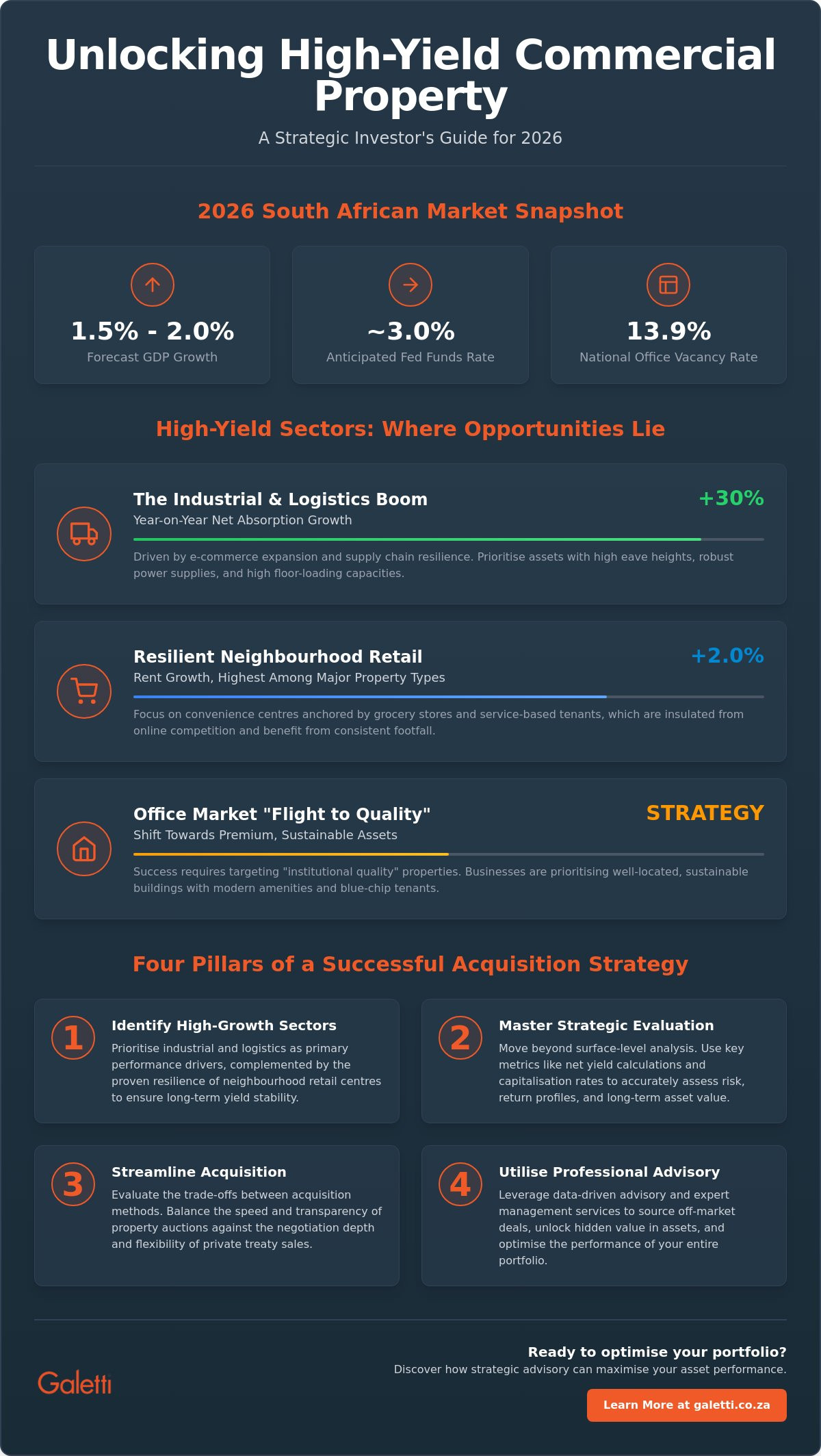
South African investors are increasingly pivoting from residential portfolios to commercial property investment opportunities. This shift is driven by the search for predictable cash flow in a stabilising interest rate environment. With the Federal Reserve anticipated to have lowered the Fed Funds Rate to approximately 3% by late 2026, the spread between borrowing costs and property yields has become highly attractive. Investors are monitoring key market indicators closely. GDP growth is currently forecast in the 1.5% to 2.0% range, providing a steady, if modest, backdrop for business expansion and tenant demand.
The Shift from Passive to Strategic Investment
The “buy and hold” era has evolved into an “active management” mandate. Success now requires a strategic approach to asset performance. Diversification is non-negotiable. Spreading capital across the industrial, retail, and office sectors mitigates the risk of sector-specific downturns. Technology plays a pivotal role here. Advanced data analytics and AI-driven platforms now allow investors to identify viable commercial property investment opportunities before they reach the open market. Utilising strategic real estate consulting ensures that every square metre of a portfolio is optimised for its highest and best use.
Identifying National Growth Drivers
Infrastructure development remains the primary catalyst for commercial value appreciation. Locations near new transport corridors or upgraded logistics hubs see immediate spikes in demand. Tenant behaviour has also stabilised in the post-hybrid work era. We’re seeing a “flight to quality” where businesses prioritise well-located, sustainable buildings with modern amenities. For those entering the market, “institutional quality” assets represent the safest entry point. These properties feature blue-chip tenants and modern specifications, ensuring they remain resilient even during periods of market correction. Monitoring vacancy trends, such as the 13.9% national office vacancy rate recorded in early 2026, helps in selecting nodes with the highest absorption potential.
High-Yield Sectors: Where the Opportunities Lie
Identifying the right sector is as critical as the location itself. In 2026, the market has bifurcated. While some traditional assets struggle with oversupply, others are seeing unprecedented demand. Investors must look beyond general market sentiment to find specific commercial property investment opportunities that offer both capital protection and yield growth. The current landscape rewards those who target sectors with high absorption rates and structural tailwinds, such as logistics and specialised tech-driven real estate.
The Industrial and Logistics Boom
Industrial property remains the undisputed leader in 2026 performance. Data from April 2026 shows that net absorption in the industrial sector rose 30% year-on-year, reaching 122.7 million square feet. This surge is underpinned by the permanent expansion of e-commerce and a national shift towards resilient supply chains. High-performance industrial assets are no longer simple warehouses. They require specific technical specifications to remain competitive. Investors should prioritise properties with significant eave heights, high floor-loading capacities, and robust three-phase power supplies to accommodate automation. For those looking to capitalise on these trends, exploring industrial real estate investment strategies is essential for securing prime logistics hubs before they reach the open market.
Reimagining the Office and Retail Landscape
The retail sector has shown surprising resilience, particularly in neighbourhood convenience centres. While massive regional malls face pressure, smaller centres anchored by grocery stores saw 2.0% rent growth in April 2026. This is currently the highest growth rate among major property types. These assets benefit from consistent footfall and service-based tenants that are insulated from online competition. Conversely, the office market is undergoing a “flight to quality.” With a national vacancy rate of 13.9% in early 2026, only high-spec, flexible environments are seeing positive absorption. Many investors are now finding value in repurposing underutilised B-grade office blocks into mixed-use residential or medical suites. Understanding these Commercial Real Estate Trends and Risks is vital for navigating the nuances of urban redevelopment. If you are looking to secure high-performance space, reviewing current retail property for lease options can reveal strategic urban hubs with high growth potential.
Specialised assets are also emerging as lucrative niches. Data centres and cold storage facilities are in high demand due to the growth of AI and cloud computing. These properties often command higher premiums and offer longer lease terms compared to standard commercial units. If you want to refine your portfolio, you might consider how these emerging niches fit into your broader strategy. You can connect with our consultants to discuss specific sector allocations that align with your risk profile.
Strategic Evaluation: How to Spot a Profitable Deal
Identifying high-yield commercial property investment opportunities requires a clinical approach to data. Success isn’t found in a glossy brochure; it’s discovered in the fine print of a lease agreement and the precision of a spreadsheet. In the 2026 market, where margins are tighter and buyers are more selective, your ability to dissect a deal’s fundamentals determines your long-term success. You must move beyond surface-level aesthetics to evaluate the underlying mechanics of the asset’s cash flow.
Understanding property yields is your first line of defence. While gross yield provides a quick snapshot, net yield is the only metric that matters. It accounts for rates, taxes, insurance, and maintenance costs. You should also master the Capitalisation Rate (Cap Rate). This ratio between Net Operating Income and the property’s value serves as a barometer for risk. A low cap rate typically indicates a stable, low-risk asset in a prime location, whereas a higher cap rate reflects greater risk or potential for value-add. Diversifying into commonly overlooked investment opportunities can often yield higher cap rates for those with the expertise to manage specialised assets.
The strength of your investment relies heavily on tenant covenants. A building is only as valuable as the company paying the rent. You must analyse the Weighted Average Lease Expiry (WALE) to determine the security of your future income. A short WALE suggests imminent vacancy risk, while a long WALE provides the stability needed for debt financing. Physical inspections remain non-negotiable. They reveal hidden liabilities such as structural defects or non-compliant fire systems that could erode your returns immediately after acquisition.
The Critical Role of Due Diligence
Due diligence is the process of verifying all financial and legal claims before acquisition. This phase requires a rigorous audit of zoning rights to ensure the property’s current use is lawful. You must also scrutinise historical operating costs and utility efficiencies. In 2026, rising municipal costs mean that “green” buildings with solar integration or water recycling systems offer a significant competitive advantage. Failing to verify these details can lead to unforeseen capital expenditure that ruins your projected internal rate of return.
Valuation Methods for Accurate Pricing
Accurate pricing relies on two primary methods: income capitalisation and the comparable sales approach. Income capitalisation is the gold standard for commercial assets as it values the property based on its ability to generate future wealth. However, comparing recent sales of similar assets in the same node provides a vital reality check. Professional commercial property sales services provide the data-driven insights needed to prevent over-capitalisation. In a competitive market, an objective valuation ensures you pay a price that allows for both immediate yield and future capital appreciation.
Acquisition Strategies: Auctions vs Private Treaty
The method you choose to acquire an asset is as critical as the asset itself. In the 2026 market, where competition for high-performing stock is intense, your acquisition strategy dictates both your entry price and the speed of your transaction. Identifying the most lucrative commercial property investment opportunities requires a dual-track approach. You must be equally adept at navigating the high-speed environment of the auction floor and the nuanced, long-form negotiations of private treaty sales.
Speed and transparency have become the primary currencies of successful acquisitions. Traditional methods often suffer from opaque negotiation cycles and “subject to” clauses that can delay transfers for months. Conversely, modern acquisition channels prioritise certainty. Whether you’re targeting a distressed industrial unit or a blue-chip retail centre, understanding the mechanics of these different channels ensures you don’t lose out to more agile competitors. Sourcing off-market opportunities through established professional networks remains a vital tactic for securing assets before they reach the general public.
Why Auctions are the Preferred Entry Point
Auctions have emerged as the strategic entry point for investors seeking immediate results and absolute transparency. Unlike private sales, the auction process allows you to see real-time market value through competitive bidding. There’s no guesswork; you know exactly what your peers are willing to pay. Efficiency is the other major driver. Auctions operate on fixed timelines for closing and transfer, which is essential for investors looking to deploy capital within specific financial periods. You can view our current Property Auction Services to identify upcoming high-yield assets across the country.
The Process of Securing an Asset
Securing a premium commercial asset in 2026 requires a methodical, three-step execution plan. It’s not enough to find a property; you must be positioned to close the deal before the market shifts.
- Step 1: Financial pre-approval. Ensure your capital allocation is ready and your credit lines are secured. In a market where interest rates have stabilised at around 3% by late 2026, having liquid capital allows you to strike when yields are most favourable.
- Step 2: Strategic sourcing. Partner with expert Commercial Property Brokers who have access to off-market stock and institutional disposals. These professionals provide the data-driven insights needed to evaluate a deal’s true potential.
- Step 3: Execution and transfer. Move quickly from the initial offer to the legal transfer. Speed is a competitive advantage that often outweighs a slightly higher bid.
Refining your acquisition strategy is the first step towards a more resilient portfolio. If you’re ready to secure your next asset, contact Galetti today to discuss our current mandates and off-market opportunities.
Optimising Your Portfolio with Professional Advisory
Acquisition is merely the beginning. Real wealth in the 2026 market is built through the relentless optimisation of existing assets. Professional advisory services are essential for transforming underperforming properties into high-yield anchors. Many investors overlook the fact that commercial property investment opportunities often exist within their own portfolios, hidden by inefficient management or outdated leasing structures. Strategic consulting identifies these gaps and implements recovery plans to restore asset performance.
Data-driven insights now dictate every move. We use granular market data to forecast supply shifts and tenant migration patterns. This proactive approach allows you to future-proof your investment against sudden market corrections. By aligning your property with modern standards, such as energy efficiency and flexible floor plates, you ensure it remains attractive to blue-chip tenants. Maximising occupancy is achieved through aggressive Corporate Leasing Services, which focus on securing long-term covenants rather than short-term fixes.
Leveraging Corporate Real Estate Services
Active portfolio management requires a multi-faceted approach. Tenant representation and lease audit services provide landlords with a clear view of their contractual positions and potential revenue leakage. A strategic portfolio audit is the most effective tool for identifying “sell” versus “hold” candidates. By evaluating each asset against current market benchmarks, you can divest from stagnant properties and redeploy capital into more lucrative commercial property investment opportunities. Utilising corporate real estate advisory ensures your decisions are backed by institutional-grade research and local expertise.
The Galetti Advantage in 2026
Our approach combines 18 years of industry expertise with the latest market technology. We provide investors with a distinct advantage by offering access to a national network of opportunities across the industrial, retail, and office sectors. Galetti facilitates the entire investment lifecycle from sourcing to disposal. Our team acts as a strategic partner, delivering definitive answers to complex property problems. We prioritise efficiency and results, ensuring your portfolio is positioned for growth in any economic climate.
Securing Your Competitive Advantage in 2026
Commercial real estate success in 2026 is reserved for those who prioritise data over sentiment. By targeting high-growth sectors like industrial logistics and neighbourhood retail, you align your capital with the market’s most resilient drivers. We’ve seen that transparent acquisition channels, particularly property auctions, offer the speed and certainty required to outpace competitors in a stabilising interest rate environment. Strategic portfolio optimisation ensures your assets continue to perform regardless of external volatility.
Galetti brings 18+ years of industry-leading expertise to every mandate. With national coverage across all commercial sectors and integrated auction and advisory solutions, we provide the clarity needed to navigate complex market dynamics. Identifying the most lucrative commercial property investment opportunities is a clinical process that demands a seasoned strategic partner. We’re ready to provide the definitive answers your portfolio requires.
Your next high-yield acquisition is within reach. Explore current commercial property investment opportunities with Galetti and position your business for sustained growth.
Frequently Asked Questions
What are the best commercial property investment opportunities in 2026?
The most resilient commercial property investment opportunities in 2026 are found in the industrial and logistics sectors. Data centres and cold storage facilities are also emerging as high-yield niches due to rapid technological growth. Neighbourhood retail centres anchored by essential services remain a stable choice. These sectors benefit from structural demand shifts that are less affected by general market volatility.
How do commercial property yields compare to residential real estate?
Commercial property yields are generally higher and more predictable than residential returns. Commercial assets often utilise triple-net leases; this ensures tenants are responsible for rates, taxes, and maintenance. This structure provides a superior net income profile. Residential investments frequently suffer from higher tenant turnover and rising operational costs that erode the landlord’s profit margins.
What is a good cap rate for an industrial property in South Africa?
A competitive cap rate for prime industrial property in South Africa typically ranges between 8% and 11%. This figure varies based on the location and the strength of the tenant covenant. Assets in established nodes like Midrand or the Western Cape often command lower cap rates due to their perceived stability and higher demand from institutional investors. Higher rates usually reflect secondary locations or increased vacancy risks.
Can I buy commercial property through an auction as a first-time investor?
First-time investors can certainly acquire assets through auctions; it’s often the preferred method for those seeking transparency. The process removes the ambiguity of private negotiations. You must have your financing secured and your due diligence completed before the auction date. Bidding is legally binding, so understanding the property’s technical specifications is vital before the hammer falls.
What are the main risks associated with commercial real estate investment?
The primary risks include vacancy periods and tenant default. A short Weighted Average Lease Expiry (WALE) increases the risk of income loss. Investors must also account for capital expenditure requirements and potential changes in municipal regulations. Thorough due diligence and proactive asset management are the most effective ways to mitigate these financial liabilities. Economic shifts impacting GDP growth also affect tenant demand.
How much deposit is typically required for a commercial property loan?
Commercial lenders usually require a deposit of 30% to 40% of the total purchase price. This is significantly higher than residential requirements because commercial loans are assessed on the property’s income-generating potential and the borrower’s creditworthiness. Having a robust business case and clear yield projections is essential for securing favourable lending terms. Lenders prioritise the asset’s ability to service its own debt.
Is it better to invest in office or industrial property right now?
Industrial property is currently the superior choice for most investors. Demand for warehouse space remains high, with national absorption rates showing significant growth in early 2026. While the office sector faces higher vacancy rates, it still offers value in high-spec, modern buildings or “flight to quality” assets. Most strategic portfolios are currently overweight in industrial stock to capture higher yields and lower vacancy risks.
What role does a commercial property broker play in finding opportunities?
A broker acts as a strategic partner who provides access to off-market commercial property investment opportunities. They use deep industry networks to source stock that isn’t available to the general public. Beyond sourcing, they assist with lease audits, market valuations, and the complex negotiations required for institutional-grade acquisitions. Their expertise ensures you don’t over-capitalise on an asset and helps identify hidden value in underperforming properties.