
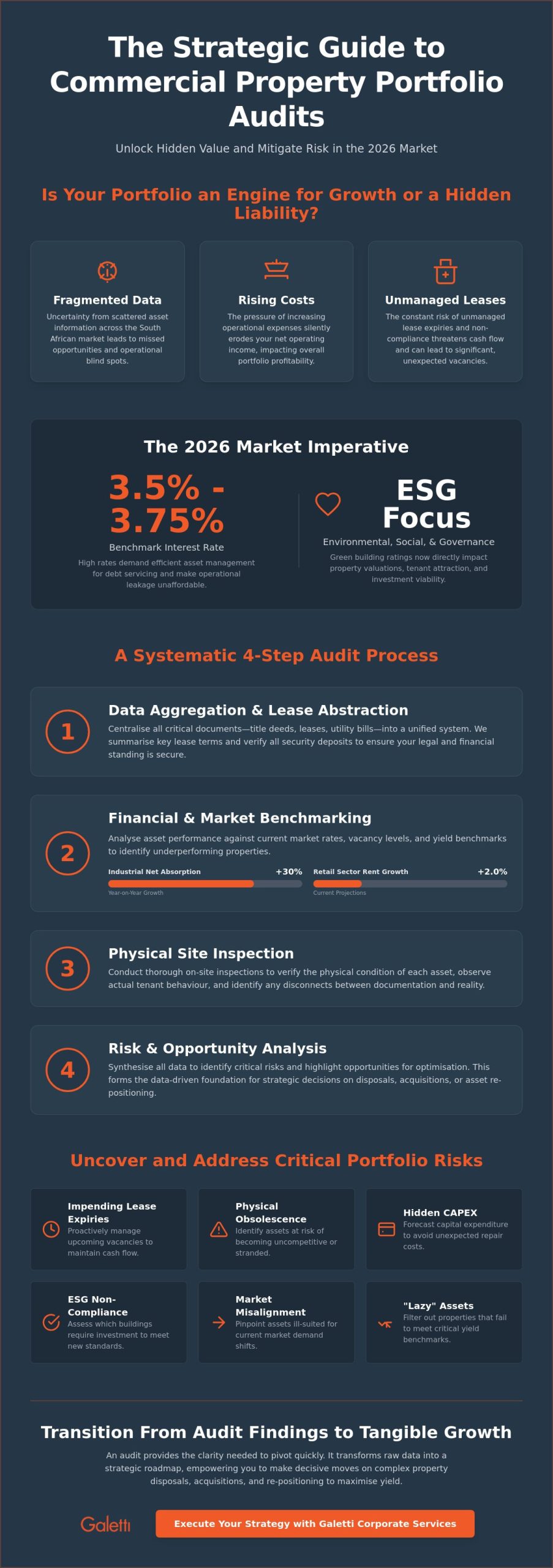
Is your commercial property portfolio a strategic engine for growth, or is it a collection of hidden liabilities silently eroding your net operating income? Managing assets across the South African market often leads to fragmented data and uncertainty regarding lease compliance. You likely feel the pressure of rising operational costs and the constant risk of unmanaged lease expiries. Conducting a rigorous commercial property portfolio audit is no longer a passive compliance task. It’s a vital tool for performance in a 2026 market defined by a 3.5% to 3.75% benchmark interest rate and shifting ESG mandates.
We understand that maintaining visibility over multiple assets is complex and demanding. This guide provides a clear roadmap to master the systematic process of auditing your commercial assets to mitigate risk and unlock hidden value. You’ll learn how to identify underperforming properties and improve portfolio yield. We’ll preview the essential steps for a modern asset review, ensuring your strategy remains resilient and ready to capture growth in the current economic landscape.
Key Takeaways
- Understand how a comprehensive audit aligns your real estate assets with your overarching corporate strategy to ensure long-term market competitiveness.
- Follow a systematic roadmap for a commercial property portfolio audit by centralising documentation and conducting physical site inspections to verify tenant behaviour.
- Learn to calculate the Internal Rate of Return (IRR) for each asset and optimise net operating income through more efficient expense recoveries.
- Identify critical risks such as impending lease expiries and physical obsolescence that could necessitate significant capital expenditure if left unmanaged.
- Discover how to transition from audit findings to tangible asset growth by leveraging expert advisory for complex property disposals and acquisitions.
What is a Commercial Property Portfolio Audit?
A commercial property portfolio audit is a forensic examination of every asset within a real estate holding. It’s far more than basic bookkeeping. This process evaluates the financial, legal, and physical health of each commercial property to ensure it remains a productive vehicle for capital. In 2026, an audit serves as a proactive filter. It identifies “lazy” assets that fail to meet yield benchmarks or possess hidden structural risks. By consolidating fragmented data into a single, actionable report, you create a data-driven foundation for critical disposal or acquisition decisions.
Strategic alignment is the ultimate goal. You aren’t just checking if the rent is paid. You’re asking if the property still fits your long-term vision. If a building’s market positioning has shifted due to local infrastructure changes or economic pivots, the audit highlights this disconnect immediately. It transforms raw data into a strategic roadmap that protects your net operating income from erosion.
The Core Objectives of a Strategic Audit
The primary goal is risk mitigation and value extraction. We look beyond the surface to identify lease risks that threaten cash flow. This includes upcoming expiries or unfavourable break clauses that could leave you with significant vacancies. A robust audit also assesses the physical condition of the asset. You must understand the required capital expenditure (CAPEX) to maintain market relevance and avoid unexpected repair costs.
Benchmarking financial performance against national standards is equally vital. If an asset isn’t performing at the top of its class, it’s a candidate for re-positioning or sale through Galetti Corporate Services. This comparative analysis ensures your portfolio isn’t just growing, but outperforming the market average. It provides the clarity needed to pivot quickly in a fast-moving economy.
Why 2026 Demands a More Rigorous Approach
The 2026 market presents unique pressures. With the federal funds rate holding between 3.5% and 3.75%, efficient asset management is vital for debt servicing. You can’t afford operational leakage. There is also an unprecedented focus on ESG (Environmental, Social, and Governance) compliance. Green building ratings now directly impact property valuations and tenant attraction. An audit reveals which buildings meet these standards and which require urgent investment.
Additionally, the shift in office demand requires creative re-purposing strategies. A commercial property portfolio audit identifies buildings that can adapt to these new trends and those at risk of becoming stranded assets. High interest rates mean every square metre must work harder. A rigorous audit ensures your capital isn’t tied up in underperforming bricks and mortar. It gives you the evidence needed to restructure your holdings for maximum yield.
A Step-by-Step Guide to Conducting Your Audit
Executing a commercial property portfolio audit requires a methodical approach to ensure no value is left on the table. In the South African context, this involves navigating specific municipal regulations and unique market nuances. You must start by centralising every piece of documentation. This includes title deeds, current leases, and historical utility bills. Without a unified view, you cannot identify the operational inefficiencies that silently erode your bottom line.
Step 1: Data Aggregation and Lease Abstraction
Fragmented data is the enemy of performance. You must organise all asset information into a centralised management system to maintain visibility. Summarise key lease terms, including annual escalations and recovery structures. It’s essential to verify that all security deposits and bank guarantees are current and accessible. This phase ensures that your legal standing is secure and your income projections are based on verified, historical data rather than assumptions.
Step 2: Financial and Market Benchmarking
Once your data is organised, compare your current rentals against prevailing market rates. In 2026, the retail sector shows a 2.0% rent growth, whilst the industrial sector has seen net absorption rise 30% year-on-year. Analyse your vacancy rates against these national averages to determine if your assets are lagging. Yield analysis is the ratio of annual net income to asset value. This single metric helps you rank your assets by their actual contribution to your wealth and identifies which properties require immediate intervention.
Don’t rely solely on paper records. Conduct physical site inspections to verify the actual condition of the asset and observe tenant behaviour. Are they utilising the space as intended? Are there signs of deferred maintenance that could lead to physical obsolescence? Identifying these issues early allows you to plan for necessary CAPEX before it becomes a crisis. If you require a professional assessment of your current holdings, you can consult with our advisory team to streamline your review process.
Finally, review legal compliance by focusing on zoning rights and municipal valuations. Ensure your property is utilised to its highest and best use under current law. You should then synthesise all findings into a prioritised action plan. This roadmap should clearly state which properties to hold, which to refurbish, and which to dispose of through strategic sales services to ensure your portfolio remains lean and high-yielding.
Analysing Asset Performance and Yield Benchmarks
Determining the actual performance of your holdings requires moving beyond simple rent rolls. A rigorous commercial property portfolio audit must evaluate the Internal Rate of Return (IRR) for each asset over its specific holding period. This metric accounts for the time value of money and provides a clearer picture of capital growth versus income returns than a basic yield calculation. You need to know if each property is still meeting the hurdle rate established at the point of acquisition or if it has become a drag on your overall returns.
Efficiency in operating expense recoveries is another critical focal point. If you aren’t recovering the maximum allowable costs from your tenants, your net operating income is suffering a slow, avoidable leak. You must also identify properties where the “highest and best use” has shifted. A 2026 market defined by a 13.9% office vacancy rate might mean a previously successful office block is now a prime candidate for residential conversion or a data centre. Reviewing tenant covenants is equally vital. You must assess the risk of default amongst anchor tenants by scrutinising their financial stability and creditworthiness in the current economic climate.
Calculating the True Cost of Occupancy
Hidden costs often hide in plain sight. Municipal rate increases and necessary security upgrades frequently erode your margins if they aren’t properly managed or passed through. You must also factor in the capital and operational impact of load-shedding mitigation. Whilst solar arrays and high-capacity generators are essential for tenant retention, the capital outlay must be balanced against long-term energy savings and property valuation increases. It’s also a prudent time to evaluate whether your commercial property management fees ZA are aligned with current market standards to ensure you aren’t overpaying for administrative services.
Benchmarking Against National Standards
Context is everything in asset management. Use recent industrial and office data to determine if your properties are over or under-rented relative to the 2026 market. With retail rent growth sitting at 2.0%, properties lagging behind this benchmark require immediate investigation. You should also assess your portfolio’s weighted average unexpired lease term (WAULT). A long WAULT provides stability, but in a rising rent environment, a shorter term might offer an opportunity to capture higher market rates. Assets that fall outside of these performance norms may benefit from targeted commercial vacancy reduction strategies to restore their competitive edge and secure long-term yield.
Identifying Risks and Optimisation Opportunities
Identifying risks is the pivot point of a commercial property portfolio audit. This phase transforms a historical review into a forward-looking strategy by highlighting vulnerabilities before they impact your balance sheet. Lease expiry risk is the most immediate threat. You must isolate properties where a high concentration of leases expire within the next 12 to 24 months. These clusters create significant cash flow volatility and require proactive tenant retention strategies to maintain your weighted average unexpired lease term.
Physical obsolescence is another critical factor. Assets requiring heavy capital expenditure to remain competitive in the 2026 market often yield diminishing returns. You must also evaluate concentration risk. Over-exposure to a single sector, such as retail or a specific industrial niche, leaves your portfolio vulnerable to localised economic downturns. Regulatory risk is also rising. Non-compliance with updated building codes or evolving ESG requirements can lead to “stranded assets” that are difficult to lease or sell. Mapping these risks allows you to decide which properties to defend and which to exit.
Unlocking Hidden Liquidity
An audit often reveals capital tied up in unproductive areas. You should look for surplus land or unutilised development rights that can be sold or developed to increase the asset’s value. Evaluating sale and leaseback opportunities for corporate occupiers is another effective way to free up capital for core business operations. If you identify non-core assets that no longer align with your strategy, consider the auction route. Engaging commercial property auctioneers South Africa provides an efficient, transparent mechanism for rapid asset disposal and capital recycling.
Mitigating Portfolio Vulnerabilities
Stability requires more than just filling vacancies. It demands a structured approach to risk management. We recommend implementing a commercial property risk assessment for each major holding. This checklist helps you quantify threats and prioritise interventions. Diversifying your tenant mix is essential, but you must maintain high-quality covenants to protect your income stream. Renegotiating leases early, even those with 18 months remaining, can secure long-term stability in a volatile market. If you’re ready to stress-test your holdings and identify growth opportunities, contact our corporate advisory team for a professional consultation.
Executing Your Strategy with Galetti Corporate Services
A successful commercial property portfolio audit is only as valuable as the execution that follows. Data without action is merely overhead. At Galetti, we bridge the gap between identifying underperforming assets and realising tangible value growth. Leveraging over 18 years of industry leadership, we provide the strategic framework required to navigate complex South African market dynamics. Our Galetti Corporate Services division delivers data-driven insights that transform your audit findings into a high-performance roadmap. We ensure your holdings aren’t just stagnant bricks and mortar but active contributors to your corporate wealth.
From Audit to Action: Disposal and Acquisition
Moving from theory to practice requires precision and market reach. When your commercial property portfolio audit identifies non-core assets or properties at risk of obsolescence, you need professional commercial property brokers South Africa to execute disposals. This process isn’t solely about selling; it’s about recycling capital into high-yield targets that fit your revised investment strategy. We identify acquisition opportunities that align with your risk profile and yield requirements. Our team manages these transitions seamlessly, ensuring minimal disruption to your ongoing operations whilst repositioning your holdings for maximum liquidity.
Ongoing Strategic Portfolio Management
Agility is not a one-time event. It’s a continuous discipline. Establishing a regular audit cycle ensures your portfolio remains healthy and responsive to economic shifts. By integrating corporate real estate advisory ZA into your annual planning, you maintain a persistent competitive edge. This proactive approach prevents the accumulation of underperforming assets and keeps your yield benchmarks aligned with national standards. We act as your strategic partner, providing the clarity needed to make bold decisions in a volatile environment. Ready to optimise? Contact Galetti to schedule a professional portfolio audit and secure your asset value for the years ahead.
Securing Your Portfolio’s Future Performance
A rigorous commercial property portfolio audit ensures your assets remain resilient against 2026 market volatility. You’ve seen the value of systematic reviews. By benchmarking yields and identifying physical obsolescence, you transform passive holdings into a strategic growth engine. Identifying hidden risks early prevents capital erosion. It prepares your business for a shifting landscape. Moving from data aggregation to tangible execution is the final, most critical step in maintaining your competitive edge.
Galetti brings over 18 years of South African market expertise to your asset review. Our integrated technology and advisory approach provides clarity across the office, industrial, and retail sectors. We don’t just identify problems. We deliver the transactional and management solutions required to fix them. Stop guessing. Start growing your net operating income through proven professional oversight. Partner with Galetti for a Strategic Portfolio Audit and take command of your real estate strategy today. Your portfolio’s potential is waiting to be realised.
Frequently Asked Questions
How often should a commercial property portfolio audit be conducted?
You should ideally conduct an audit annually to ensure your strategy remains aligned with market movements. In a volatile economic climate, such as the 2026 interest rate cycle, a biennial review is often too infrequent to catch operational leakage. Consistent monitoring allows you to pivot quickly when tenant behaviour or sector demand shifts.
What is the difference between a lease audit and a portfolio audit?
A lease audit is a forensic check of a single tenant’s compliance and recovery accuracy. In contrast, a commercial property portfolio audit is a high-level strategic review of all real estate assets. It evaluates physical health, market positioning, and the long-term viability of every property within your holdings.
Can a portfolio audit help in reducing municipal rates and taxes?
It provides the evidence required to challenge over-valuations by identifying discrepancies between market value and municipal rolls. By comparing your property’s actual performance against the local authority’s assessment, you can pinpoint instances where you’re overpaying. This data is essential for lodging successful appeals to reduce annual tax liabilities.
What documents are required for a comprehensive property audit?
You must provide title deeds, current lease agreements, and at least 24 months of utility and maintenance records. Zoning certificates and the latest municipal accounts are also vital. These documents allow for a complete reconciliation of legal rights against actual operational costs and physical asset status.
How does a portfolio audit impact the valuation of my assets?
A successful audit often leads to a higher valuation by improving net operating income through optimised recoveries. It highlights opportunities to reduce vacancies and lower operational costs. Additionally, a documented audit history provides transparency, which can lower the risk premium applied by investors during a disposal process.
Should I conduct the audit internally or hire a professional advisory firm?
Professional advisory firms offer objective benchmarking that internal teams often lack. Whilst internal staff understand day-to-day operations, they don’t always have access to national market data or the specialised tools required for deep lease abstraction. A professional firm ensures your portfolio is measured accurately against the entire market.
This requirement for specialist oversight extends to all corporate assets; for example, when managing a fleet of company vehicles, obtaining precise valuations from experts like Kfzgutachten-Ari ensures that your balance sheet reflects true market values and potential insurance recoveries.
What are the most common risks uncovered during a commercial audit?
The most frequent risks include high concentrations of lease expiries and significant deferred maintenance. Audits also often reveal that properties aren’t meeting modern ESG standards, which impacts tenant attraction. Identifying these vulnerabilities early prevents your properties from becoming stranded assets in a competitive market.
How long does a typical portfolio audit take to complete?
A typical audit takes between four and twelve weeks to complete. The duration depends on the volume of assets and the quality of your existing records. Portfolios with centralised digital data move faster, whilst those requiring extensive physical inspections and document recovery take longer to synthesise into an action plan.