Asset liquidation is no longer a defensive retreat. In the current market, a sophisticated commercial property disposal strategy South Africa serves as a proactive tool for capital reallocation and portfolio optimisation. You’ve likely experienced the friction of protracted sales timelines or the frustration of inaccurate valuations whilst navigating a 10.5% prime lending rate. Stagnant capital in underperforming B-grade office blocks represents a significant missed opportunity in a landscape where industrial and retail yields are strengthening. Managing FICA and POPIA compliance adds layers of complexity that can stall even the most robust corporate growth agendas.
This framework provides the data-driven methodology required to master these hurdles. You’ll learn how to secure accelerated liquidity and maximum capital realisation through a transparent, auditable transaction process. We examine the 2026 shift toward auction-led excellence, the implications of the PIE Amendment Bill, and the strategic exit from non-core assets to ensure your portfolio remains lean, liquid, and high-performing. This is your blueprint for navigating the 2026 commercial landscape with precision, speed, and authority.
Key Takeaways
- Reframe asset liquidation as a proactive capital reallocation tool within a modern commercial property disposal strategy South Africa.
- Apply the “Keep, Repurpose, or Dispose” framework to audit your portfolio for maximum capital realisation.
- Evaluate the speed and transparency of property auctions to select the most efficient route for rapid liquidity.
- Minimise transaction friction by preparing a robust due diligence pack that addresses 2026 regulatory requirements.
- Integrate expert advisory and execution services to leverage a national network for precise asset-to-capital matching.
The 2026 Landscape: Why Your Disposal Strategy Needs a Modern Overhaul
Asset disposal is no longer a reactive measure. It’s a strategic pivot. A robust commercial property disposal strategy South Africa ensures that capital remains fluid and productive. In the current climate, holding a non-core asset is often more expensive than the cost of a rapid exit. Traditional “wait-and-see” approaches have become liabilities. They lead to value erosion as maintenance costs climb and market yields shift. Strategic disposal allows you to recycle capital into high-growth opportunities before the market corrects.
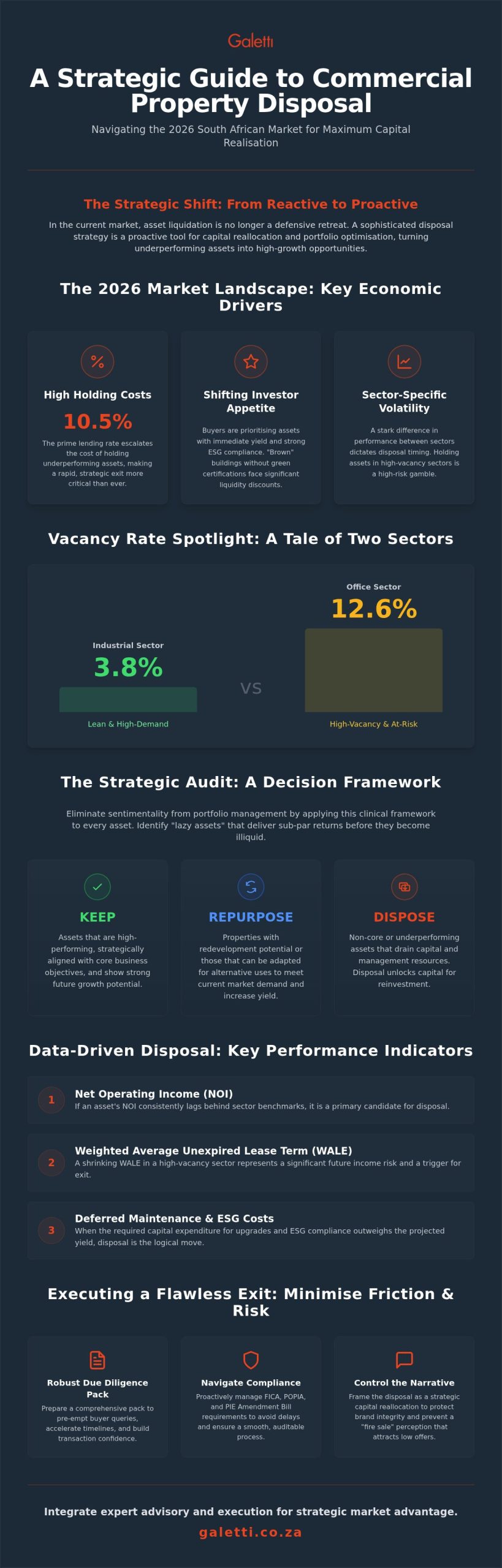
The 2026 market presents a unique set of variables. With the prime lending rate holding at 10.5%, the cost of holding underperforming assets has escalated. Passive ownership is a risk. Professional market intelligence now dictates the timing of an exit. It’s about identifying the precise moment when buyer appetite matches your asset’s peak valuation. Relying on outdated benchmarks is a mistake. You need real-time data to navigate this volatility.
Economic Drivers Influencing Asset Liquidity
Institutional appetite has shifted significantly. Buyers now prioritise commercial property assets that offer immediate yield and ESG compliance. “Brown” buildings, those lacking green certifications, face significant liquidity discounts. This is a structural change, not a trend. Whilst the national industrial vacancy rate sits at a lean 3.8%, the office sector remains at 12.6%. This sector-specific volatility dictates your disposal timing. If your asset isn’t performing, it’s a candidate for disposal or repurposing. Waiting for a market recovery that may not arrive for your specific asset class is a gamble you don’t need to take.
From Distress to Strategy: Changing the Market Perception
A successful exit requires a shift in narrative. Disposal must be communicated as a strategic reallocation of capital into higher-growth sectors. This protects corporate brand integrity. It prevents the “fire sale” label that attracts predatory low-ball offers. Professional corporate real estate sales execution relies on a polished marketing narrative. High-value assets require sophisticated positioning to attract institutional-grade capital. You aren’t just selling a building; you’re offering a strategic opportunity to the next investor. A well-executed disposal signals strength and foresight to your shareholders and the broader market.
The Strategic Audit: Evaluating Assets for Maximum Capital Realisation
Maximum capital realisation begins with a clinical internal audit. Every asset in your portfolio must justify its position. A modern commercial property disposal strategy South Africa relies on the “Keep, Repurpose, or Dispose” framework to eliminate sentimentality from the decision-making process. You must identify “lazy assets”; these are properties that consume disproportionate management time or capital whilst delivering sub-par returns. To gain an objective view, many institutional landlords leverage corporate services for expert portfolio valuations that reflect the current 2026 market realities.
The audit process should be a recurring exercise. It prevents the accumulation of underperforming stock that dilutes your overall internal rate of return (IRR). When applying the “Dispose” label, speed is your ally. Holding onto a “lazy asset” in a 10.5% interest rate environment is a direct drain on your bottom line. These assets often suffer from structural vacancies or are situated in nodes experiencing urban decay. Recognising these issues early allows you to exit before the asset becomes truly illiquid.
Key Performance Indicators (KPIs) for Disposal
KPIs must be data-driven. Net Operating Income (NOI) is the primary lens. If an asset’s NOI consistently lags behind sector benchmarks, it’s a candidate for exit. You must also evaluate the weighted average unexpired lease term (WALE). A shrinking WALE in a high-vacancy sector, such as B-grade office space currently at 12.6%, represents significant risk. Finally, assess deferred maintenance. If the capital expenditure required for ESG compliance outweighs the projected yield, disposal is the logical strategic move. It’s often more prudent to engage a strategic partner to quantify these risks before they impact your valuation.
Market Sentiment and External Valuation Factors
Valuation isn’t static. A “highest and best use” (HBU) analysis might reveal that an underperforming retail centre is better suited for conversion into last-mile logistics or residential units. This shift in perspective can significantly enhance the asset’s marketability. Surrounding infrastructure projects also play a critical role; a new transport hub or improved road network can instantly re-rate an asset’s value. In the 2026 South African context, Cap Rate Compression refers to the narrowing of yields as investor confidence returns and competition for high-quality industrial and retail assets intensifies. Understanding these external drivers ensures your commercial property disposal strategy South Africa is timed to capture maximum market appetite.
Auction vs. Private Treaty: Selecting the Optimal Disposal Method
Selecting the right transaction channel is a decisive pillar of any commercial property disposal strategy South Africa. It isn’t a binary choice; it’s a strategic decision based on asset type and liquidity requirements. In the 2026 market, where the prime lending rate remains at 10.5%, the cost of time is high. You must weigh the rapid finality of a public sale against the nuanced, often slower, path of a private treaty negotiation. Both have distinct roles in a modern portfolio exit.
The Auction Advantage: Speed and Certainty
For many institutional landlords, commercial property auctions have become the primary tool for achieving rapid liquidity. The process creates an intense, competitive bidding environment that forces buyers to show their hands. In May 2026, Galetti concluded R328 million in transactions via auction-led sales, highlighting a significant market shift towards this method. This volume proves that buyers are ready to deploy capital when the process is transparent and the timeline is fixed.
Auctions offer unique structural benefits:
- Price Discovery: Public bidding ensures the market determines the true value in real-time, often driving prices beyond initial expectations.
- Voetstoots Sales: Assets are sold “as is,” eliminating the risk of protracted post-sale negotiations or repair claims.
- Reserve Protection: You maintain control by setting a confidential reserve price, ensuring the asset is never sold below your minimum threshold.
Registration requirements, such as the R100,000 fee for online participation, ensure that only vetted capital enters the room. This filters out speculative enquiries and streamlines the path to a confirmed sale. Buyers at these events typically factor in a 5% commission plus VAT on top of the purchase price, which helps protect the seller’s net realisation.
Private Treaty: Discretion and Tailored Negotiations
Whilst auctions excel in speed, corporate real estate sales via private treaty remain essential for sensitive or complex disposals. This method provides the discretion required when dealing with anchor tenants or high-profile corporate headquarters. It allows for a targeted marketing approach, where the asset is presented directly to a curated list of institutional investors whose investment mandates align with the property’s profile. You can manage the narrative more tightly here, which is vital for maintaining corporate brand integrity.
Private treaty is the preferred route for complex sale-and-leaseback arrangements. These deals require intricate negotiations regarding lease terms and rental escalations that are difficult to replicate in a fast-paced auction environment. Broker networks play a vital role in this space. They source off-market opportunities and manage the delicate balance between price realisation and long-term operational stability. For complex national portfolios, a hybrid approach often yields the best results. You can use auctions to clear “lazy assets” quickly whilst utilising private treaty for flagship properties that require a bespoke touch.
Mitigating Risk: Compliance and the Strategic Due Diligence Pack
Due diligence is frequently viewed as a buyer’s mechanism for price reduction. A sophisticated commercial property disposal strategy South Africa flips this dynamic. By preparing a “Clean” Due Diligence Pack before the asset hits the market, you seize control of the narrative. This transparency builds buyer confidence and significantly reduces the time from offer to transfer. In a market where the prime lending rate sits at 10.5%, every week saved on the transfer process preserves capital value. A well-organised data room acts as a catalyst for rapid liquidity.
The Seller’s Due Diligence Checklist
Buyers in 2026 demand granular detail. Your pack must include updated rent rolls, executed lease agreements, and comprehensive tenant profiles. Municipal accounts must be current; any historical debt or billing dispute can derail a sale at the eleventh hour. Pre-empting objections is vital. Commissioning an independent building condition report allows you to disclose defects upfront. This neutralises the buyer’s ability to demand discounts later in the process. Ensure zoning documents and occupancy certificates are not only present but verified for accuracy. Environmental and structural compliance certificates are now mandatory for institutional-grade buyers. These documents prove the asset is fit for purpose and meets modern ESG standards.
Legal and Regulatory Safeguards
Regulatory compliance is non-negotiable. The Property Practitioners Act (PPA) mandates strict disclosure of all known defects. Failure to comply can lead to severe litigation risks and financial penalties. Simultaneously, FICA and POPIA requirements have added layers of administrative complexity. You must ensure that tenant data shared during the audit process adheres to POPIA standards to avoid heavy penalties. If the property includes on-site staff or service contracts, Section 197 considerations of the Labour Relations Act apply. This ensures the smooth transfer of employees as a going concern. Managing the transition of these obligations is a critical component of a clean exit. Transparent disclosure isn’t just a legal requirement; it’s a strategic safeguard against future claims. It ensures the transaction remains auditable and legally sound.
Executing the Exit: Partnering for Strategic Market Advantage
Execution is the final test of your commercial property disposal strategy South Africa. Success depends on the seamless integration of advisory, valuation, and execution services. Fragmented approaches often lead to information leakage and inconsistent market narratives. By housing these functions under one professional umbrella, you ensure that your asset’s value is protected from the first marketing collateral to the final signature. This unified method provides the clarity and speed required to navigate the 10.5% prime lending environment of 2026.
A national network is your greatest asset during the exit phase. It allows for the precise matching of specific assets with the right capital, whether institutional or private. Leveraging corporate services for strategic portfolio management ensures that your asset is physically and financially prepared for scrutiny. This preparation involves tightening lease terms and resolving maintenance backlogs to present a “turnkey” investment. When the preparation is complete, the transition from marketing launch to closing becomes a structured, predictable process.
Data-Driven Marketing Strategies
Modern asset marketing requires more than a listing. It demands a data-driven approach that utilises proprietary databases to reach qualified corporate buyers directly. In 2026, digital twins and virtual tours have become essential tools. They provide the immersion required for international and out-of-province capital to commit without immediate physical inspections. Your marketing message must be tailored. Core investors seek long-term stability and ESG compliance. Opportunistic investors look for value-add potential and “highest and best use” conversions. Precision in targeting ensures you don’t waste time on unqualified leads.
The Galetti Difference: Professionalism and Results
Galetti provides a distinct competitive edge through 18 years of transactional data. This depth of information allows for accurate price anchoring, ensuring your asset is neither undervalued nor over-priced for the current market. We understand the synergy between leasing and disposal. A well-timed lease renewal can significantly enhance your disposal valuation. Our team acts as a strategic partner, providing definitive answers to the complex problems of portfolio optimisation. Efficiency and clarity are our priorities. Ready to optimise your portfolio? List your property with Galetti today and leverage our national network for maximum capital realisation.
Optimising Your Portfolio for 2026 and Beyond
Mastering asset liquidation in the current market requires more than a simple listing. It demands a clinical internal audit to identify underperforming stock and the strategic selection of disposal channels. Whether you require the rapid finality of a public auction or the targeted discretion of a private treaty, a modern commercial property disposal strategy South Africa transforms compliance into a competitive advantage. By preparing “clean” due diligence packs and leveraging data-driven marketing, you accelerate transfer timelines and protect your capital realisation.
Galetti brings over 18 years of commercial real estate expertise to every transaction. Our specialised divisions for the industrial, office, and retail sectors ensure that your asset is positioned with sector-specific intelligence. With comprehensive national coverage across South Africa, we provide the reach and reliability needed to match your property with the most relevant capital. It’s time to turn underperforming assets into liquid growth opportunities.
We are ready to provide the definitive answers your portfolio requires. Secure your strategic market advantage today.
Frequently Asked Questions
What is the most effective commercial property disposal strategy in South Africa for 2026?
The most effective strategy in 2026 involves a data-driven, auction-led approach that prioritises rapid liquidity and price discovery. With the prime lending rate at 10.5%, holding underperforming assets is increasingly costly. A successful commercial property disposal strategy South Africa must leverage real-time market intelligence to time the exit perfectly. This ensures capital is reallocated into higher-growth sectors like industrial or retail before asset value erodes further.
How long does a typical commercial property disposal take via auction vs private treaty?
Auctions provide the fastest route to a confirmed sale, often reaching legal finality within four to six weeks of the marketing launch. Transfer then follows the standard legal timeline. Private treaty sales are more variable; they often take six to twelve months due to protracted negotiations and suspensive conditions. Auctions eliminate these delays by selling the property “as is” with immediate legal certainty upon the fall of the hammer.
What are the tax implications of commercial property disposal in South Africa?
Disposal triggers Capital Gains Tax (CGT) and either VAT or transfer duty. For companies, 80% of the capital gain is included in taxable income, resulting in an effective tax rate of 21.6%. If the seller is a VAT vendor selling in the course of business, VAT at 15% applies. Otherwise, transfer duty is levied on a sliding scale, with rates reaching 13% for properties valued above R13,310,001 as of April 2026.
Can I sell a commercial property with existing tenants and a high vacancy rate?
You can absolutely sell properties with high vacancies; these are often marketed as “opportunistic” or “value-add” investments. Buyers look for the “highest and best use” potential, such as converting B-grade offices into residential units or last-mile logistics hubs. Existing tenants provide some immediate cash flow whilst the buyer executes their redevelopment plan. Professional positioning is key to attracting the right redevelopment capital in a volatile market.
What documents are required for a commercial property due diligence pack?
A robust pack requires updated rent rolls, executed lease agreements, and three years of financial statements for the property. You also need zoning certificates, occupancy certificates, and current municipal accounts. Compliance certificates for electrical, fire, and gas installations are non-negotiable. Including an independent building condition report can pre-empt buyer objections and prevent aggressive price negotiations during the due diligence period, ensuring a smoother transaction.
How does the Property Practitioners Act affect the disposal of corporate real estate?
The Property Practitioners Act (PPA) mandates the use of a formal “mandatory disclosure form” detailing all known defects. This document must be signed by the seller and provided to the buyer before an offer is made. For corporate disposals, this increases the importance of a transparent commercial property disposal strategy South Africa. It ensures that all latent and patent defects are documented, protecting the seller from future litigation and ensuring compliance.
What is a sale and leaseback strategy, and when should I use it?
A sale and leaseback involves selling your owner-occupied property to an investor and simultaneously signing a long-term lease to remain in the building. This is an effective tool for unlocking capital tied up in real estate to fund core business operations or expansion. It’s best used when you want to improve your balance sheet whilst maintaining long-term operational control of your headquarters or industrial facility without moving.
How do I choose between a commercial property broker and an auctioneer?
Choosing depends on your specific liquidity goals and the asset’s complexity. Auctioneers excel at rapid price discovery and certain sales for high-demand assets. Brokers are often better for sensitive negotiations or complex sale-and-leaseback deals requiring discretion. Galetti eliminates this conflict by providing an integrated service that combines both auction and private treaty expertise under one professional advisory umbrella, ensuring the best method is chosen for your specific asset.