A distribution centre is a strategic asset, not just a shell. Selecting the ideal distribution center for lease South Africa requires a shift in focus from simple square meterage to technical throughput and operational agility. With logistics vacancy rates along the N3 corridor falling under 3% in 2025, the margin for error in site selection has vanished. You recognise that poor facility design creates bottlenecks that drain profitability. Hidden costs and security vulnerabilities in industrial parks remain constant threats to your bottom line, especially as prime lending rates sit at 10.5%.
To further bolster site security and operational oversight in expansive facilities, many logistics managers partner with Golf Cart Rental to provide their teams with the mobility needed to monitor large perimeters and yard areas effectively.
This article provides the clarity you need to master these complexities. We’ve developed a comprehensive checklist designed for the high-stakes South African logistics market to ensure your next move is a strategic win. We will break down essential technical requirements, sophisticated lease structures, and the critical infrastructure needed to secure a future-proofed space that drives supply chain efficiency and long-term growth.
Key Takeaways
- Define the technical requirements for modern high-throughput facilities to eliminate operational bottlenecks and enhance supply chain speed.
- Assess critical facility specifications, including eave heights and floor flatness, to support advanced high-bay racking systems.
- Verify yard depth and security protocols to ensure safe and efficient superlink truck manoeuvrability within industrial parks.
- Navigate the complexities of Triple Net Leases and rental escalations to secure favourable financial terms and avoid hidden costs.
- Utilise a data-driven approach to source a strategic distribution center for lease South Africa that supports long-term scalability and growth.
The Strategic Role of Modern Distribution Centres
The industrial sector is undergoing a fundamental transformation. Traditional warehouses, once reserved for static storage, are being replaced by high-throughput facilities. These buildings serve as the engine room of the modern supply chain. When you evaluate a distribution center for lease South Africa, the primary metric is no longer square metreage. Instead, you must prioritise cubic capacity and operational velocity. It’s about movement, not just storage.
Defining what is a distribution center today requires looking beyond the four walls. It’s a strategic hub designed for the rapid movement of goods. E-commerce has driven this shift, creating intense demand for facilities that can handle high volumes of small-parcel traffic. With logistics vacancy rates along the N3 corridor sitting below 3% in 2025, finding the right space requires precision. Your property selection must align with national supply chain objectives to ensure seamless integration into the broader logistics network.
E-commerce and Last-Mile Delivery Demands
The rise of online retail has made last-mile delivery a critical priority. Facilities must now be equipped for high-frequency parcel sorting and dispatch. Strategic proximity to major transport arterials is essential to minimise transit times and fuel costs. We focus on sites that offer flexible loading bay configurations. These bays must accommodate a diverse fleet, ranging from heavy freight carriers to light delivery vehicles. Without this flexibility, your operation will face inevitable bottlenecks during peak periods.
Operational Flow and Efficiency Benchmarks
True efficiency is found in the layout. Intelligent racking systems are necessary to minimise internal travel distances and reduce labour costs. Every unnecessary movement is a drain on profitability. Modern FMCG distribution often requires cross-docking capabilities. This allows goods to move directly from receiving to shipping with virtually no storage time. To maintain this pace, your distribution center for lease South Africa must meet several operational criteria:
- 24-hour cycles: The facility must support continuous operations without infrastructure failure.
- Advanced lighting: High-specification LED systems are mandatory for staff safety and productivity during night shifts.
- Strategic oversight: Office placement should allow for real-time visibility of the warehouse floor.
Selecting the right industrial space is a high-stakes decision. You aren’t just renting a building; you are investing in a logistical tool. The goal is to create a fluid environment where goods move in, through, and out with maximum speed and minimum friction. This strategic alignment ensures that your physical assets support your commercial growth.
Technical Infrastructure and Facility Specifications Checklist
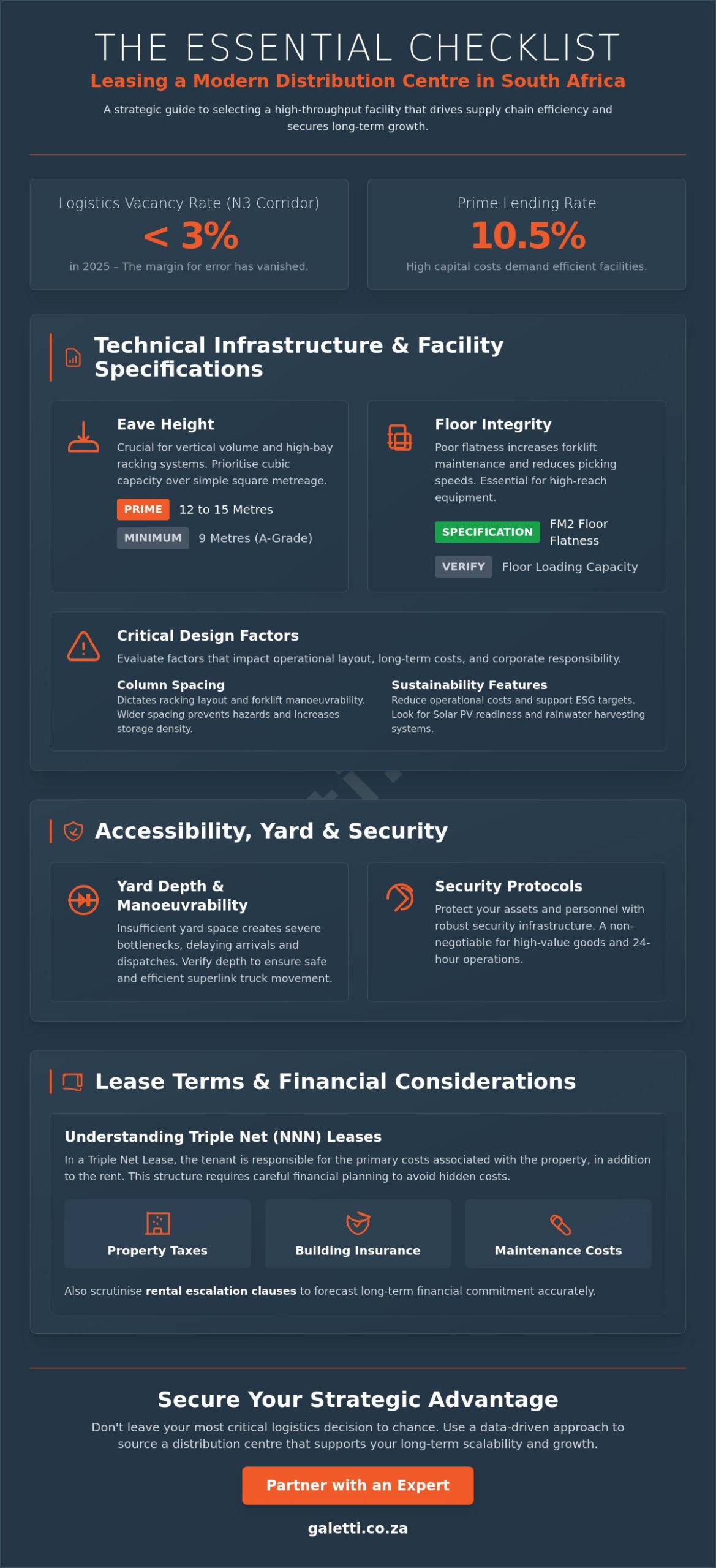
Selecting a distribution center for lease South Africa requires a technical audit that extends far beyond a visual inspection. Modern logistics operations rely on vertical volume. Minimum eave heights for high-bay racking should start at 9 metres for A-grade stock. Prime Gauteng developments now frequently offer 12 to 15 metres to allow for maximum pallet density. However, height is useless without floor integrity. You must verify floor loading capacity and flatness tolerances. Most high-reach forklifts require FM2 floor specifications. Poor floor flatness leads to increased forklift maintenance and reduced picking speeds.
Column spacing is another critical factor. It dictates your racking layout and forklift manoeuvrability. If columns are placed too close together, you lose storage density and create operational hazards. Understanding Africa’s supply chain challenges and opportunities highlights why infrastructure resilience is a non-negotiable requirement. With the prime lending rate at 10.5%, capital for internal fit-outs is expensive. You need a facility that supports high-density automation from day one.
Sustainability features have transitioned from “nice-to-have” to essential. Solar PV readiness and rainwater harvesting systems reduce long-term operational costs. They also support corporate ESG targets. If you need technical guidance on specific site requirements for your distribution center for lease South Africa, consult our industrial experts today for a detailed site analysis.
Internal Structural Requirements
Evaluate roof insulation and natural lighting carefully. High-quality insulation reduces the energy load required for temperature control. Translucent roof sheets provide natural light, which lowers electricity bills and improves staff morale. We recommend an office-to-warehouse ratio of 5% to 10%. This ensures enough administrative space without sacrificing valuable floor area. If you handle specialised goods, check for flooring treatments required for chemical or food-grade storage.
Power and Utility Resilience
Automated sorting systems are power-intensive. You must verify that the KVA supply meets your peak demand. Backup generator capacity or UPS integration is vital for continuous uptime during local power constraints. Fire safety is equally important. Assess the water pressure and storage tanks dedicated to Early Suppression Fast Response (ESFR) systems. Finally, look for future-proofed sites that include infrastructure for electric delivery vehicle charging. This prepares your fleet for the inevitable shift toward green transport.
Accessibility, Yard Space, and Security Evaluation
Yard space is often the most frequent point of failure in site selection. A distribution center for lease South Africa must accommodate 22-metre superlink trucks with precision. These vehicles require a minimum yard depth of 35 to 45 metres for safe turning and docking. Anything less leads to shunting delays and an increased risk of vehicle damage. It’s vital to ensure the yard surface is constructed from heavy-duty reinforced concrete. Asphalt often fails under the weight of static trailer legs and high-frequency heavy traffic, leading to costly maintenance issues that can disrupt your flow.
Congestion at the gate is a silent profit killer. Separate entry and exit points are essential for maintaining 24-hour operational velocity. This layout prevents bottlenecks during peak dispatch windows when multiple vehicles arrive simultaneously. According to the CSIR State of Logistics Survey, transport and logistics costs remain a significant portion of South Africa’s GDP. Every minute a truck idles at a congested gate, your operational costs rise. Efficient traffic flow is a cornerstone of a high-performance site. Our leasing experts provide the technical oversight needed to secure these high-spec assets.
External Logistics and Yard Management
The ratio of roller shutter doors to floor area dictates your loading capacity. For high-volume FMCG operations, a higher door density is required to maintain throughput. You must also evaluate the condition and specification of dock levellers. Ask for the maintenance history of these units before signing. Faulty levellers compromise safety and slow down loading cycles. Ensure there is ample on-site parking for both staff and your haulage fleet to avoid the risks associated with off-site parking.
Risk Mitigation and Security Standards
Security is a primary concern for any industrial operator. A robust distribution center for lease South Africa requires multi-layered protection. This includes high-specification perimeter fencing, biometric access control, and 24-hour professional monitoring. Fire safety is equally critical for insurance purposes. The facility must comply with ASIB standards. Ensure the sprinkler systems are insurance-approved and supported by dedicated on-site water storage and pumps. High-quality LED lighting throughout the yard is necessary for secure and efficient night-time operations.
Lease Terms and Financial Considerations
Financial structures in the industrial sector are inherently complex. When you secure a distribution center for lease South Africa, you will likely encounter a Triple Net Lease structure. This standard commercial arrangement means the base rental is only the starting point. As the tenant, you are responsible for the net rental plus municipal rates, taxes, building insurance, and all maintenance costs. It’s essential to audit these line items during the due diligence phase. Municipal rates can fluctuate significantly between different industrial precincts, directly impacting your total occupancy cost.
Capital is expensive in the current market. With the repo rate at 7.00% and the prime lending rate at 10.5%, every square metre must justify its cost. You must evaluate annual rental escalations against current market benchmarks to ensure long-term viability. Standard escalations in South Africa typically range between 7% and 9%. If your lease exceeds these figures without clear justification, you are overpaying. To negotiate effectively, contact our advisory team today for a professional lease audit.
Financial Benchmarking and Transparency
Transparency is vital when comparing gross and net rental figures. A low net rental can be deceptive if the operating costs and park levies are disproportionately high. We recommend using current industrial warehouse lease rates as a negotiation baseline. For example, modern A-grade facilities in prime hubs like Gosforth Park currently command R85 to R95 per m², while high-spec new developments can exceed R100 per m². Factor in the Tenant Installation (TI) allowance offered by the landlord. This capital contribution is critical for customising the facility with specialised racking or the power upgrades discussed in previous sections.
Contractual Flexibility and Clauses
Your lease must support business growth. We prioritise negotiating renewal options and a “first right of refusal” on adjacent space. This prevents your operation from becoming landlocked as demand scales. Pay close attention to restoration clauses. These require you to return the building to its original state at the end of the tenure. If you’ve installed heavy-duty racking or specialised flooring, the “make-good” costs can be substantial. Finally, clearly define maintenance responsibilities for specialised plant and equipment, such as dock levellers and sprinkler pumps, to avoid disputes over operational uptime. For businesses also evaluating ownership as a long-term strategy, understanding the current landscape of logistics property for sale in South Africa can provide a valuable benchmark when weighing lease commitments against acquisition opportunities.
Partnering with Galetti for Industrial Leasing
Galetti has spent 18 years refining its position as a leader in the South African industrial sector. We don’t rely on generic listings or surface-level data. Our approach is rooted in a high degree of professionalism and a results-oriented methodology. Finding a distribution center for lease South Africa requires a partner who understands that industrial property is a logistical tool, not just a building. We provide the expertise needed to navigate a market where A-grade stock is increasingly scarce and technical requirements are becoming more sophisticated.
Our integrated service model sets us apart from traditional brokerages. We offer a comprehensive suite of solutions, including property leasing, valuations, and property auction services. This multi-disciplinary approach allows us to provide a holistic view of the market. We don’t just facilitate transactions; we act as strategic consultants. By leveraging our deep industry connections and data-driven insights, we ensure that your real estate strategy aligns with your broader corporate objectives. Every recommendation we make is designed to enhance operational efficiency and long-term value.
Expert Market Insights and Selection
Our national network gives you access to off-market opportunities that never reach public portals. This is a vital advantage when vacancy rates in key corridors are at historic lows. We perform tailored property searches that prioritise your specific technical needs, from power availability to floor flatness tolerances. By utilising Galetti Corporate Services, you gain access to high-level strategic advisory that goes beyond simple site selection. We help you future-proof your industrial footprint by identifying assets that can scale with your business.
The Galetti Advantage in Negotiations
The negotiation phase is where our expertise delivers the most significant impact. We use our corporate real estate leasing experience to secure terms that protect your bottom line. We understand the nuances of Triple Net Leases and the long-term impact of rental escalations. Our team assists with rigorous due diligence and technical site evaluations to ensure the distribution center for lease South Africa you select meets every operational benchmark. Whether you need to list your property or begin a complex search for a new hub, our team provides the definitive answers you need to move forward with confidence.
Optimising Your Industrial Future
Selecting the right industrial space is a high-stakes commercial decision that dictates your supply chain’s long-term viability. You’ve seen that modern logistics success relies on more than just square metreage. It requires a precise alignment of technical infrastructure, resilient security, and transparent financial structures. By auditing eave heights and floor tolerances while navigating the complexities of Triple Net Leases, you position your business for sustained growth.
Securing a strategic distribution center for lease South Africa ensures your operations remain agile in a competitive market. Galetti brings 18+ years of industry experience and a comprehensive national portfolio to your search. Our specialised corporate real estate advisory team provides the data-driven clarity needed to master these technical and contractual challenges. View our current industrial listings or contact our leasing experts to secure your next strategic asset. Your next move defines your operational capacity; make it with the backing of a seasoned industry leader.
Frequently Asked Questions
What is the difference between a warehouse and a distribution centre in South Africa?
A warehouse primarily serves as a long-term storage facility for goods. In contrast, a distribution centre is a high-velocity hub designed for the rapid movement, sorting, and dispatch of products. Modern distribution centres often feature advanced automation and cross-docking capabilities to minimise dwell time. While a warehouse focuses on inventory management, a distribution centre prioritises throughput and supply chain speed.
How much yard space is required for superlink trucks?
Superlink trucks require a minimum yard depth of 35 to 45 metres to ensure safe manoeuvrability and efficient docking. This space allows for the 22-metre vehicle length plus the necessary turning circle. Insufficient yard depth creates operational bottlenecks and increases the risk of property damage. When evaluating a distribution center for lease South Africa, verify that the yard surface is reinforced concrete to withstand heavy axle loads.
What are the typical lease periods for distribution centres in South Africa?
Typical lease periods for large-scale distribution centres range from five to ten years. Landlords often prefer longer tenures to amortise the costs of specialised tenant installations and infrastructure upgrades. Shorter leases of three years are sometimes available for smaller industrial units; however, high-spec facilities usually require a longer commitment. These extended terms provide businesses with the stability needed for complex logistical planning.
What does a triple net lease mean for industrial property?
A triple net lease is a common industrial structure where the tenant pays a base net rental plus all operating expenses. These additional costs include municipal rates and taxes, building insurance, and ongoing maintenance of the facility. This arrangement ensures that the landlord receives a net income while the tenant maintains control over operational overheads. It’s vital to audit these costs during negotiations to understand the total occupancy expense.
What is the standard eave height for a modern distribution centre?
Standard eave heights for modern A-grade facilities typically start at 9 metres. Prime logistics hubs in South Africa now frequently reach heights of 12 to 15 metres to accommodate high-bay racking systems. Greater height increases the cubic capacity of the building, allowing for more pallet positions within the same footprint. This vertical volume is a critical factor for businesses looking to maximise their storage density and operational efficiency.
Are security costs usually included in the monthly industrial rental?
Security costs are generally not included in the base net rental. In a secure industrial park, these costs are typically recovered through a monthly park levy. For standalone sites, the tenant is usually responsible for appointing and funding their own security personnel and monitoring services. Always clarify the security boundary and cost responsibility before signing to avoid unexpected monthly expenses during the lease term.
How does solar power integration affect industrial lease terms?
Solar power integration reduces long-term utility costs and supports corporate sustainability targets. Many modern industrial leases now include specific clauses regarding the installation and maintenance of PV arrays. In some cases, the landlord provides a solar-ready roof, while the tenant invests in the panels. These arrangements can lead to lower monthly electricity bills and provide a degree of protection against local grid instability.
Can I customise a leased distribution centre to my specific needs?
You can customise a distribution center for lease South Africa through a Tenant Installation (TI) allowance or direct investment. Customisations often include specialised racking, cold storage units, or upgraded power supplies for automation. Landlords typically permit these alterations provided they don’t compromise the building’s structural integrity. It’s essential to agree on restoration requirements at the start of the lease to manage end-of-term costs effectively. Businesses that anticipate long-term growth may also wish to explore acquiring logistics property for sale in South Africa as an alternative to leasing, particularly where deep customisation and capital investment are planned.