
Is your logistics footprint a strategic asset or a mounting liability? In a market where prime interest rates sit at 10.5%, your ability to accurately benchmark industrial warehouse lease rates determines your bottom line. You likely recognise that comparing Grade A logistics hubs in Gosforth Park to older stock in Pretoria West is no longer a simple calculation. The lack of transparency between gross and net figures makes justifying real estate spend difficult. Municipal costs now comprise up to 61% of total operating expenses, further complicating the board’s decision-making process.
We’ve developed this comprehensive reference guide to provide the clarity you require. You’ll gain a precise understanding of national rental benchmarks and the strategic framework necessary for high-level lease negotiations. We’ll examine current market data from Cape Town’s R135/m² prime spaces to Durban’s evolving industrial nodes. This analysis also covers the critical implications of the 2026 PIE Amendment Bill and the rising demand for sustainable, energy-efficient infrastructure. Use these insights to transform your property portfolio into a driver of operational growth.
Key Takeaways
- Understand how logistics efficiency and technical specifications now dictate market value over basic floor area.
- Master Total Occupancy Cost (TOC) calculations to accurately benchmark industrial warehouse lease rates across complex lease structures.
- Identify strategic opportunities to unlock corporate liquidity through sale and leaseback arrangements and portfolio audits.
- Secure a competitive advantage by accessing exclusive off-market opportunities through established industry relationships and expert advisory.
Understanding Industrial Warehouse Lease Rates in South Africa
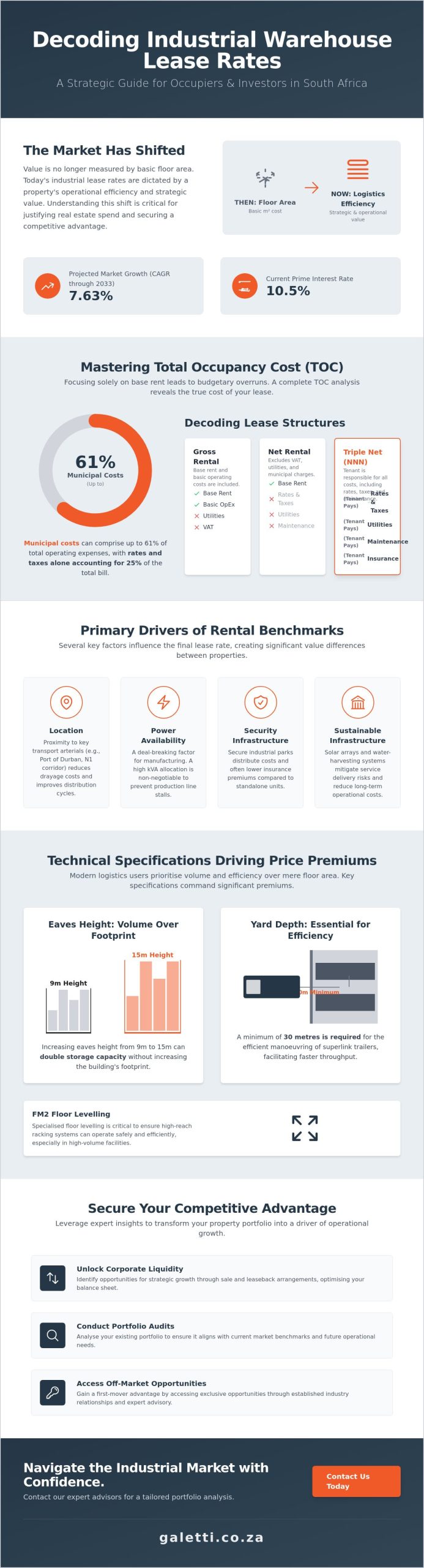
Industrial lease rates represent the fixed financial obligation for occupying Commercial property designed for logistics, manufacturing, or distribution. In the current 2026 market, these rates have shifted. They no longer represent simple “per square metre” storage costs. Instead, they reflect the operational efficiency and strategic value of a site. Benchmarking is vital for transparency. It allows institutional landlords to remain competitive and corporate tenants to justify real estate spend to the board. South Africa’s industrial sector is undergoing a rapid transformation, with the market expected to grow at a CAGR of 7.63% through 2033.
Effective industrial warehouse lease rates are determined by more than just floor area. They incorporate power security, yard depth, and proximity to major transport arterials. For high-level decision makers, understanding these benchmarks is the first step in strategic portfolio management. You can explore current opportunities through our Property Leasing Services to see these benchmarks in action.
The Evolution of Industrial Space Requirements
E-commerce and third-party logistics (3PL) expansion drive the demand for high-spec distribution centres. These facilities require significant eaves height and specialised floor loading capacities. Last-mile logistics nodes in Gauteng and Cape Town now command a premium. These locations enable rapid delivery cycles, which is a critical advantage in a competitive retail environment. Modern benchmarks also account for sustainable building certifications. Solar arrays and water-harvesting systems are standard requirements. They mitigate the risk of municipal service delivery failures and reduce long-term operational costs.
Key Terminology for Industrial Occupiers
Precision in terminology prevents costly errors during negotiation. A “Gross Rental” typically includes the base rent and basic operating costs. Conversely, a “Net Rental” excludes VAT, utilities, and municipal charges. Most institutional-grade assets in South Africa now utilise “Triple Net” structures. This arrangement shifts the responsibility for rates, taxes, and maintenance to the occupier. It’s essential to calculate the Total Occupancy Cost (TOC) rather than focusing solely on the base rate. Municipal costs can constitute up to 61% of total operating expenses. Rates and taxes alone often account for 25% of the bill. Failing to account for these variables leads to significant budgetary overruns.
Primary Drivers Influencing Industrial Rental Benchmarks
Market benchmarks are not static. They fluctuate based on a hierarchy of operational requirements that vary between logistics providers and manufacturers. While a standard unit in an older industrial area might attract a lower base rate, modern facilities in prime nodes command significant premiums. These industrial warehouse lease rates are justified by the tangible efficiencies they offer. Location remains the most visible driver. Proximity to the Port of Durban or the N1 corridor in Midrand reduces drayage costs and improves distribution cycles. Insights from the South African real estate sector indicate that properties within well-managed industrial parks see higher demand due to superior infrastructure and security.
Power availability has become a deal-breaking factor. For manufacturing entities, a high kVA allocation is non-negotiable. Without sufficient electrical capacity, production lines stall. Security infrastructure also influences the final figure. Standalone units often require independent guarding and fencing, whereas secure-park environments distribute these costs across multiple tenants. This collective security model provides a safer environment whilst often lowering individual insurance premiums.
Technical Specifications and Price Premiums
Modern logistics users prioritise volume over mere floor area. An increase in eaves height from 9m to 15m can effectively double storage capacity without increasing the building’s footprint. This verticality requires specialised FM2 floor levelling to ensure high-reach racking systems operate safely. Yard depth is also critical. A minimum of 30 metres is required for the efficient manoeuvring of superlink trailers. Facilities with a high ratio of loading docks to floor area facilitate faster throughput, directly impacting the rental value of the asset. If you require a detailed analysis of specific site specs, consult our advisory team for a bespoke assessment.
The “Green” Premium and Energy Security
Energy resilience is no longer a luxury. Solar PV installations and industrial-scale battery storage are now standard in Grade A developments. These features protect against grid instability and contribute to ESG targets. Backup water tanks and boreholes provide additional security for high-demand users. In 2026, the transition to energy-efficient industrial lighting delivers a rapid return on investment by reducing base electrical consumption by up to 60% whilst simultaneously improving warehouse safety and visibility. These “green” assets often secure better financing terms and attract higher-tier corporate tenants willing to pay a premium for operational continuity.
Decoding Lease Structures: Gross vs Net Rentals
Headline figures often obscure the true cost of occupancy. While many property portals list a single monthly price, professional industrial warehouse lease rates are almost exclusively quoted as “net” rentals in the institutional sector. This shift ensures transparency. It allows both parties to separate the base property value from volatile operational expenses. According to JLL’s Industrial Market Dynamics Report, this trend is accelerating as landlords seek to hedge against rising municipal service costs. For a corporate tenant, mastering the Total Occupancy Cost (TOC) is the only way to protect margins.
Calculating TOC requires adding the net base rental to the pro-rata share of operating costs, rates, taxes, and insurance. In the South African market, annual escalation rates typically range between 7% and 8%. These increases are compounded. They significantly impact long-term cash flow projections. If you are occupying a site that requires modernisation, “Tenant Installation” (TI) allowances become a pivotal negotiation point. Landlords often provide a capital contribution for refurbishments, such as upgraded lighting or office fit-outs, in exchange for longer lease commitments. You can explore these options through our Corporate Real Estate Leasing services.
The Components of a Triple Net Lease
Triple Net (NNN) structures are now the benchmark for Grade A assets. In this model, the tenant is responsible for three primary categories beyond the base rent: insurance, external maintenance, and municipal recoveries. Landlords categorise “common area” maintenance (CAM) charges to cover shared infrastructure like gatehouses, estate landscaping, and internal roads. It’s vital to negotiate caps on these operating cost increases. Without a cap, a sudden spike in municipal valuations or security requirements can lead to unbudgeted expenses that disrupt your operational viability.
Benchmarking Lease Terms and Renewals
Lease duration varies by asset class. Grade A logistics hubs often require five to ten-year commitments to justify the high-spec construction costs. Light industrial units remain more flexible, with three-year terms being common. Strategic occupiers secure their future through “right of first refusal” clauses and expansion options. These terms allow you to claim adjacent space as your business grows. When approaching a lease renewal, don’t simply accept the escalated rate. Conduct a market review to ensure your industrial warehouse lease rates remain aligned with current benchmarks. This proactive stance ensures you aren’t paying a premium for loyalty in a fluctuating market.
Strategic Considerations for Occupiers and Investors
Asset management requires a shift from passive oversight to active strategic alignment. A comprehensive portfolio audit is the primary tool for identifying hidden inefficiencies. By reviewing existing agreements, you can determine if your current industrial warehouse lease rates align with the 2026 benchmarks or if you’re overpaying for legacy space. This process often reveals opportunities to consolidate operations or renegotiate terms in line with current market standards. You must decide between the security of an industrial park and the autonomy of a standalone facility. Parks offer shared security costs and reliable infrastructure, whereas standalone units provide greater control over site modifications but carry higher operational risks.
For corporations seeking to unlock capital, sale and leaseback strategies offer a viable path to liquidity. You sell the fixed asset to an investor and simultaneously sign a long-term lease agreement. This provides an immediate cash injection for operational expansion whilst ensuring you retain occupation. You must weigh this capital gain against the loss of long-term asset appreciation and the commitment to a fixed rental escalation. Risk assessment must also include environmental compliance and zoning restrictions. Ensure your facility is correctly zoned for its specific use, particularly if your operations require 24/7 manufacturing or hazardous material storage. For investors evaluating ownership rather than occupancy, our guide to the strategic acquisition of logistics property for sale in South Africa outlines how to identify and secure high-performance assets in the current 10.50% prime lending environment.
Optimising Logistics Networks through Real Estate
Logistics network optimisation involves a calculated trade-off. Paying higher industrial warehouse lease rates in a prime distribution hub is often offset by significant reductions in transport and fuel costs. For occupiers evaluating their next facility, our comprehensive guide to securing a distribution centre for lease in South Africa provides a detailed checklist covering technical throughput, lease structures, and critical infrastructure requirements. In space-constrained nodes, multi-storey industrial facilities are emerging as a solution. These high-density assets use vertical space to maintain proximity to urban centres, allowing for faster last-mile delivery. We use data-driven insights to predict future rental growth areas, ensuring your footprint remains competitive as market dynamics shift.
The Role of Professional Advisory in Leasing
Tenant representation is now standard practice for sophisticated occupiers in South Africa. Professional advisors mitigate the risks associated with outdated industrial stock that may lack modern fire suppression or sufficient floor loading. By partnering with Galetti Corporate Services, you gain access to a strategic partner capable of navigating complex lease structures. We provide the technical expertise needed to justify your real estate spend to the board. This proactive approach ensures you avoid the pitfalls of restrictive lease clauses and unbudgeted maintenance costs.
Secure a strategic consultation with our industrial specialists to optimise your property portfolio and align your footprint with current market benchmarks.
Navigating the Industrial Market with Galetti
Experience defines the difference between a standard lease and a strategic asset. Galetti brings 18 years of specialised expertise to the South African industrial sector. We don’t just facilitate transactions. We provide a sophisticated framework for corporate decision-making. Our deep-rooted landlord relationships offer you a distinct advantage. You gain access to off-market leasing opportunities that never reach public listings. This insider perspective is vital in a competitive landscape where prime space is limited. We use a data-driven methodology to secure industrial warehouse lease rates that protect your margins and support operational growth.
Our approach is integrated and results-oriented. We move beyond simple brokerage to offer a full suite of professional services. This includes accurate valuations, private treaty sales, and expert advisory. We understand the nuances of logistics-driven property requirements. Whether you’re a manufacturer requiring high kVA or a 3PL provider needing 15m eaves, we find the match. Our team ensures that every lease term is scrutinised for transparency. You’ll know exactly what your total occupancy cost looks like before you sign.
Our Integrated Leasing and Sales Solutions
We provide a seamless connection between high-quality tenants and premium industrial space. Our Property Leasing Services are designed for efficiency. We match your specific technical needs with the best available stock in the country’s primary logistics nodes. If your strategy requires asset disposal, our Property Auction Services offer a transparent, market-driven platform. This ensures you achieve the best possible price within a fixed timeframe. We also provide customised portfolio management for institutional investors who require a proactive approach to vacancy mitigation and rental growth.
Partnering for Strategic Advantage
Transparency is our core value. We believe in providing clear, actionable data that allows you to justify real estate spend to your board. When you choose to list your property with Galetti, you tap into a vast national network of corporate occupiers. This exposure is critical for securing high-tier tenants and maintaining long-term occupancy. Our industrial specialists are ready to provide bespoke market benchmark reports tailored to your specific location and asset class. We don’t just find space. We secure your future in the South African industrial landscape.
Contact our team today to align your property strategy with the 2026 market benchmarks and secure a competitive edge in your sector.
Strategic Alignment for 2026 and Beyond
Market conditions in 2026 demand a more rigorous approach to property procurement. You’ve seen how technical specifications and energy security now dictate industrial warehouse lease rates across South Africa’s primary nodes. Success requires mastering the nuances of Triple Net structures and Total Occupancy Costs. By prioritising operational efficiency over simple storage costs, you transform your logistics footprint into a competitive advantage. Portfolio optimisation isn’t just about reducing spend; it’s about ensuring your infrastructure supports long-term corporate growth.
Galetti provides the authoritative expertise required to navigate these complexities. With over 18 years of commercial real estate experience and national coverage across all major industrial hubs, we offer specialised corporate services tailored to your specific requirements. We help you identify off-market opportunities and negotiate terms that protect your bottom line. Don’t leave your real estate strategy to chance. Contact our industrial specialists for tailored leasing advice and align your operations with current market benchmarks. We’re ready to partner with you for a more efficient, results-driven future.
Frequently Asked Questions
What is the average industrial warehouse lease rate in South Africa for 2026?
Rates vary significantly by node and grade. In 2026, A-grade logistics space in Gauteng’s Gosforth Park benchmarks between R85 and R95/m² net, whilst prime Cape Town locations reach up to R135/m². Pretoria options like Silverton offer lower entry points between R55 and R75/m². These figures reflect net industrial warehouse lease rates, excluding municipal recoveries and VAT.
What is the difference between a gross lease and a net lease in industrial property?
A gross lease combines the base rent and all operating costs into a single monthly figure, whereas a net lease separates the base rent from operational recoveries. In the current market, net leases are the standard for institutional-grade assets. This structure provides transparency by allowing tenants to see the exact cost of municipal rates, taxes, and insurance rather than paying a flat, estimated premium.
How are annual rental escalations usually calculated for warehouses?
Annual escalations are fixed percentage increases compounded annually, typically ranging between 7% and 8% in South Africa. These rates are negotiated at the lease inception and apply to the base rental component. Whilst some agreements link increases to the Consumer Price Index (CPI), fixed escalations remain the preferred method for providing long-term budgetary certainty for both landlords and corporate occupiers.
Does the lease rate typically include security and park levies?
Most industrial warehouse lease rates are quoted as net figures and do not include security or park levies. These are usually recovered as part of the operating costs or common area maintenance (CAM) charges. In a secure industrial park, these levies cover shared gatehouse security, estate landscaping, and road maintenance. It’s essential to confirm the total occupancy cost before committing to a lease.
Are there hidden costs I should look for in an industrial lease agreement?
Hidden costs often manifest as municipal valuation spikes or unbudgeted maintenance recoveries for items like fire suppression systems. You should also scrutinise the metering of utilities to ensure you aren’t paying for shared consumption. Check for reinstatement clauses that require you to return the property to its original state at your own expense, as these capital outlays can be substantial at the end of a term.
How does eaves height affect the rental price of a warehouse?
Increased eaves height commands a rental premium because it allows for greater volumetric storage capacity on the same footprint. A facility with a 15m height allows for more racking levels than a standard 9m unit, effectively lowering the cost per pallet for the occupier. Landlords justify higher rates for these modern builds due to the increased construction costs and specialised floor levelling required for high-reach equipment.
Can I negotiate a Tenant Installation (TI) allowance for an industrial space?
Tenant Installation allowances are negotiable, particularly for long-term commitments of five years or more. Landlords often provide a capital contribution toward office fit-outs, specialised lighting, or mezzanine installations to secure a high-quality corporate tenant. The size of the TI allowance is usually linked to the lease length and the overall strength of the tenant’s covenant, serving as an incentive for modernisation.
What is a “Triple Net” lease in the South African context?
A Triple Net (NNN) lease is an agreement where the tenant pays the base rent plus all property-related expenses, including insurance, maintenance, and municipal rates. This structure is common for single-tenant standalone facilities and institutional logistics parks. It shifts the operational risk of rising service costs to the tenant, requiring a meticulous review of the building’s condition and municipal valuation before signing.