
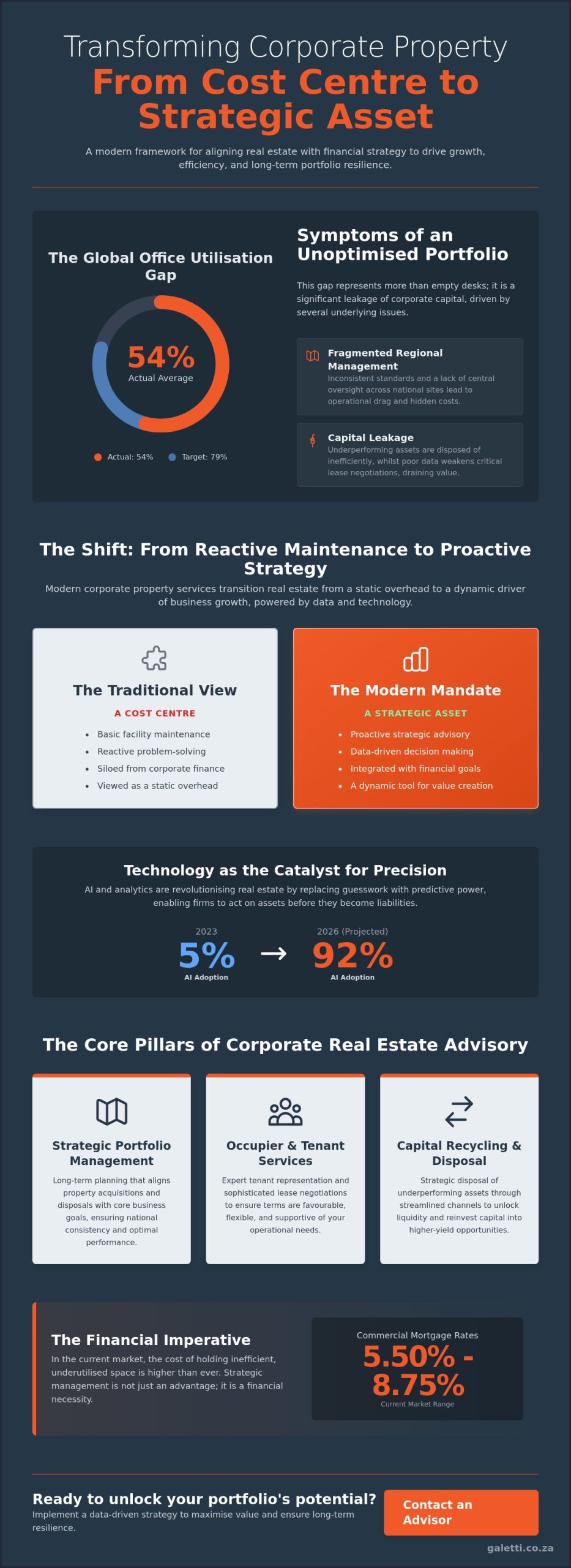
Global office utilisation currently averages just 54% against typical targets of 79%. This gap represents more than just empty desks; it signifies a massive leakage of corporate capital. Managing fragmented regional sites often leads to the inefficient disposal of underperforming assets and a distinct lack of data during critical lease negotiations. You likely recognise that your property portfolio should be a driver of growth, yet it often remains a stubborn cost centre on the balance sheet.
Professional corporate property services transform this dynamic by aligning physical assets with high-level financial strategy. By centralising control and leveraging data-driven insights, businesses move away from reactive management toward proactive portfolio optimisation. It’s about ensuring every square metre serves a strategic purpose whilst maximising market value during asset disposal. This guide explores how modern management frameworks and technology integration streamline your operations, improve occupancy rates, and secure long-term portfolio resilience in an evolving commercial market.
Key Takeaways
- Understand why the modern real estate mandate has shifted from basic facility maintenance to high-level strategic advisory.
- Learn how to resolve the complexities of managing fragmented regional sites by implementing uniform operational standards across a national footprint.
- Optimise portfolio performance through expert corporate property services that focus on high-quality tenant procurement and sophisticated lease negotiations.
- Explore how property auctions provide a streamlined route to market for underperforming assets, creating competitive environments that maximise disposal value.
- Identify the essential benchmarks for selecting an advisory partner with the national reach and local intelligence required to manage complex portfolios.
What Are Corporate Property Services in the Modern Business Landscape?
The traditional view of property management is outdated. For decades, businesses treated real estate as a necessary but static overhead. This reactive approach focused on basic facility maintenance and fixing problems after they occurred. Today, the mandate has shifted. Modern corporate property services represent a move toward proactive strategic advisory. It’s the difference between merely occupying a space and leveraging that space to drive business growth. Strategy precedes action. Data drives results.
In the South African context, the need for centralised control is acute. National portfolios often suffer from fragmentation. Managing regional offices through multiple uncoordinated service providers leads to inconsistent standards and capital leakage. Centralised corporate property services provide a single point of oversight. This ensures that every site, from Cape Town to Pretoria, adheres to the same financial and operational benchmarks. It eliminates the “silo” effect that plagues large-scale organisations.
Technology is the catalyst for this transformation. AI adoption in corporate real estate has surged from under 5% in 2023 to 92% in 2026, according to JLL research. This isn’t just about automation. It’s about predictive power. Decision-makers now utilise digital twins and real-time analytics to identify underperforming assets before they become liabilities. With global office utilisation averaging just 54%, the ability to use data to resize or relocate is a competitive necessity. Precision replaces guesswork.
The Core Pillars of Corporate Real Estate Advisory
A robust advisory framework rests on three specific functions. First, strategic portfolio management involves long-term planning that aligns property acquisitions with business expansion goals. Second, occupier services focus on tenant representation, ensuring that lease terms are favourable and flexible. Third, capital recycling strategies allow firms to exit underperforming assets and reinvest that liquidity into higher-yield opportunities. The scope of Corporate real estate extends far beyond the physical building; it involves the intricate balance of lease obligations, capital expenditure, and market timing.
Transitioning from Cost Centre to Strategic Asset
Professional management reduces operational drag. When real estate strategy is siloed from corporate finance, the result is often wasted space and inflated operating costs. By integrating these functions, businesses can align their property decisions with broader financial targets, such as improving EBITDA or strengthening the balance sheet. Efficiency is the priority. Corporate property services are an integrated approach to managing, optimising, and disposing of commercial assets. This transition turns a static cost into a dynamic tool for value creation.
Strategic Portfolio Management: Achieving National Consistency
Managing a national footprint in South Africa presents unique logistical hurdles. Fragmented management across regional sites often leads to operational drag. This occurs when local offices operate under disparate standards, making it impossible to compare performance accurately. Effective corporate property services bridge the gap between regional site requirements and overarching corporate goals. Without a unified reporting structure, significant financial leakage often goes unnoticed in the form of redundant space or unoptimised utility spend.
Centralisation is the primary solution to these inefficiencies. By implementing uniform operational standards, a business ensures that its real estate strategy is executed with precision in every province. This approach requires regular portfolio audits. These aren’t just tick-box exercises; they are deep-dive assessments that identify underperforming assets. In a market where global office utilisation sits at just 54%, identifying redundant space is critical for maintaining liquidity. Identifying these gaps allows for a shift from reactive maintenance to strategic capital recycling.
The 2026 market environment demands a cautious, deliberate approach to underwriting. With commercial mortgage rates currently ranging from 5.50% to 8.75%, the cost of holding inefficient space is higher than ever. Leveraging professional corporate services provides the data-driven insights necessary for these high-stakes decisions. It moves the conversation from anecdotal evidence to hard metrics that justify lease renewals or asset disposals.
Centralised Control and Regional Expertise
Success requires balancing national policy with local market dynamics. A centralised strategy provides the framework, whilst regional expertise handles the nuances of local zoning or specific utility challenges. This streamlined approach improves communication between landlords, tenants, and service providers. It also ensures a consistent employee experience. Whether staff are in a Durban hub or a Johannesburg headquarters, the quality of the commute-worthy environment remains identical, supporting talent retention across the entire organisation.
Data-Driven Portfolio Optimisation
Advanced corporate property services utilise market benchmarks to evaluate lease rates and utility costs against current standards. This data reveals immediate consolidation opportunities. If two regional offices are underutilised, merging them reduces unnecessary overheads without impacting operational capacity. A robust risk assessment framework for multi-site operations further protects the business from unforeseen regional market shifts or regulatory changes that could impact asset value.
If your current management structure feels fragmented, it’s time to review your national portfolio strategy with an expert partner.
Optimising Occupancy: Strategic Leasing and Sales
Transaction momentum is returning to the commercial market. This recovery is underpinned by a cautious, deliberate approach to underwriting. Speculative growth has been replaced by a focus on strong fundamentals. For organisations, occupancy is no longer merely about filling floor space. It’s about securing institutional-grade tenants who contribute to long-term asset resilience. Comprehensive corporate property services facilitate this by aligning physical space with financial performance.
Modern corporate property services must navigate the complexities of 2026 lease negotiations. As of June 2026, conventional commercial mortgage rates range from 5.50% to 8.75%. These figures significantly impact the financial stakes for both landlords and occupiers. Tenant procurement strategies must now reflect the hybrid work model. Workplaces must be “commute-worthy” to attract high-quality occupiers. Energy performance is now a top sustainability driver for 62% of organisations, making efficient buildings a priority for modern tenants.
Professional brokerage is a vital component of successful corporate real estate sales. It ensures that assets are positioned correctly to attract the right buyers. Expert representation protects the interests of the occupier, ensuring that every lease agreement or sale aligns with the broader corporate strategy. It isn’t just a transaction. It’s a strategic move.
Landlord and Tenant Representation
Securing favourable terms requires a balance. You must maintain landlord relationships whilst advocating for your financial interests. Expert representation manages this tension effectively. It covers lease renewals, expansions, and risk mitigation within complex corporate real estate leasing agreements. Firms can secure necessary flexibility through market-leading expertise. This is vital as average office lease sizes have increased by 14% over the last two years.
Maximising Returns on Asset Disposals
Choosing the right time to exit an investment is a strategic decision. It involves an analysis of market cycles and internal capital needs. Preparing an asset for sale requires professional valuations and clean lease data to attract institutional-grade buyers. The “One, Big, Beautiful Bill Act” of 2025 reinstated 100% bonus depreciation for qualifying business property. This creates a powerful incentive for buyers. A well-prepared asset can capitalise on this tax-driven demand to maximise value during the disposal process.
Unlocking Liquidity: The Power of Property Auctions and Valuations
Liquidity is paramount in corporate strategy. When an organisation identifies an underperforming asset, the primary goal is a swift exit at maximum market value. Traditional sales processes can often become protracted, tying up capital and increasing holding costs. Auctions have emerged as a preferred mechanism for corporate asset disposal because they force the market to act. They create an immediate sense of urgency that private treaties often lack. This accelerated timeline is essential for firms looking to recycle capital into higher-yield opportunities.
Integrated corporate property services use the auction platform to transform static assets into liquid capital. This method is particularly effective for industrial and retail properties where buyer demand is high but pricing remains subjective. A competitive bidding environment removes this ambiguity. It ensures the final price reflects the true market ceiling. By bringing multiple institutional and private investors together in a single forum, the process guarantees that the asset’s value is tested and proven in real-time.
Setting a reserve price requires more than a simple estimate. It demands technical precision. Accurate valuations ensure that reserve prices are realistic enough to trigger bidding whilst high enough to protect the seller’s interests. In an environment where commercial mortgage rates range from 5.50% to 8.75%, buyers are more discerning. A data-backed valuation provides the confidence needed to move forward with a disposal strategy.
The Strategic Advantage of Property Auctions
The auction process offers unparalleled transparency. For corporate boards and shareholders, this clear audit trail is vital for governance and compliance. By utilising on-auction platforms, sellers reach a national pool of qualified investors instantly. This broad exposure significantly reduces time-on-market. It bypasses the lengthy back-and-forth negotiations typical of traditional brokerage, moving directly from marketing to a firm, non-suspensive sale.
Precision Valuations for Corporate Decision-Making
Accuracy is non-negotiable. Professional valuations ensure that balance sheets reflect the true current value of holdings, which is essential for financial reporting. Beyond the numbers, a deep-dive valuation identifies hidden value in underutilised industrial or office space. It might reveal redevelopment potential or a more lucrative “highest and best use” that the owner hadn’t previously considered. A professional valuation is the baseline for any successful corporate property strategy.
If you need to accelerate the disposal of underperforming assets, contact our auction and valuation team for a strategic assessment.
Selecting a National Partner for Corporate Property Services
Selecting a partner for corporate property services is a high-stakes decision. It’s not about finding a broker; it’s about finding an extension of your executive team. A firm must possess a national footprint to ensure consistency across provinces, yet maintain the local intelligence required to navigate specific municipal challenges. Fragmented providers often fail here. They lack the integrated oversight needed to manage complex, multi-site portfolios, leading to communication gaps and missed opportunities for capital recycling.
The value of an integrated partner lies in their ability to offer multiple exit and entry strategies. When one firm handles leasing, sales, and auctions, they can objectively recommend the best path for an asset without the bias of a single-service agency. This synergy reduces administrative friction. It ensures that your property strategy remains agile in a market where commercial mortgage rates remain high. A proven track record across industrial, retail, and office sectors is the minimum benchmark for any national advisory firm seeking to manage corporate interests.
Efficiency is the priority. An advisory partner should act as a central hub for all property-related data, providing a single source of truth for your balance sheet. This centralisation allows for better risk assessment and more accurate forecasting. It moves the relationship from a series of isolated transactions to a continuous strategic partnership that prioritises long-term value over short-term gains. You need a partner that understands that real estate is a financial tool, not just a physical location.
Key Questions for Prospective Advisory Partners
Evaluation requires specific inquiries. Does the firm have deep experience in your particular sector? Generalists often miss the nuances of industrial cold-storage requirements or retail footfall patterns. You must also ask how they leverage technology to provide portfolio insights. With AI adoption reaching 92% in 2026, a partner without a digital-first approach is a liability. Finally, investigate their framework for risk management and compliance. Your partner must mirror your own corporate governance standards to protect your brand and your assets.
The Galetti Advantage: Integrated Corporate Solutions
Galetti leverages 18 years of expertise in the South African commercial market. We provide a comprehensive suite of corporate property services that combine traditional brokerage with innovative auction solutions. This dual-track approach ensures that every client receives the most effective route to market, whether securing a long-term tenant or liquidating a portfolio of assets. We understand the complexities of national operations and the need for data-driven decision-making. List your property with a partner that understands corporate strategy and delivers measurable results.
Future-Proof Your Commercial Real Estate Strategy
Transforming a property portfolio from a static overhead into a high-performing strategic asset requires a move toward centralised, data-driven oversight. You’ve seen how national consistency reduces operational drag and how sophisticated disposal methods like auctions unlock immediate liquidity. Success in the current market hinges on the ability to navigate complex lease negotiations and identify underutilised space before it impacts your bottom line. Integrated corporate property services provide the framework necessary to achieve these objectives whilst maintaining the flexibility required for long-term growth.
Galetti offers over 18 years of South African industry expertise with specialised divisions dedicated to the Industrial, Retail, and Office sectors. Our approach combines traditional brokerage with integrated auction and sales capabilities to deliver definitive results for high-level decision-makers. It’s time to align your real estate holdings with your broader corporate financial goals to ensure every square metre contributes to your success. Partner with Galetti for Expert Corporate Property Services and secure a competitive advantage in the commercial landscape. Your portfolio is ready for its next strategic evolution.
Frequently Asked Questions
What do corporate property services typically include?
These services encompass strategic advisory, tenant representation, and comprehensive asset disposal strategies. They move beyond the physical building to address lease management, portfolio audits, and capital recycling. The objective is to ensure that every property decision supports the broader financial and operational goals of the organisation. It integrates physical asset management with high-level financial strategy.
How can strategic property management reduce corporate overheads?
Strategic management identifies underutilised space and consolidates regional offices to eliminate redundant costs. With global office utilisation averaging just 54%, resizing portfolios to match actual occupancy significantly cuts utility spend and rent obligations. It turns a static cost centre into a lean, strategic asset by removing operational drag and capital leakage.
Why should a company use a professional tenant representation service?
Professional representation ensures that lease terms align with long-term business goals whilst mitigating financial risks. Experts navigate complex market dynamics to secure favourable escalations and tenant installation allowances. This protects the occupier’s interests during renewals or expansions, especially when conventional commercial mortgage rates are high. It provides the data needed for firm negotiations.
What is the benefit of selling corporate property via auction?
Auctions create a competitive, non-suspensive environment that accelerates the liquidation of industrial or retail assets. This method removes pricing ambiguity and forces the market to act within a specific timeframe. The efficiency of an auction is vital for organisations looking to exit underperforming holdings quickly and reinvest capital into higher-yield opportunities.
How often should a corporate property portfolio be audited?
A comprehensive audit should occur annually to ensure alignment with shifting market conditions and corporate objectives. Regular reviews identify lease expiry risks and immediate opportunities for consolidation. In a fast-moving economy, waiting longer can result in significant capital leakage through unoptimised space or missed market cycles. Constant monitoring ensures portfolio resilience.
Can corporate property services help with multi-location consistency?
Yes, corporate property services centralise control to implement uniform operational and financial standards across a national footprint. This eliminates the silo effect where regional offices operate under disparate benchmarks. It ensures every site, regardless of location, adheres to the same quality protocols and financial reporting standards, providing a single source of truth.
How do professional valuations impact a company balance sheet?
Accurate valuations ensure that property assets are recorded at their true market value, providing essential transparency for shareholders and auditors. This precision is vital for financial reporting and maintaining healthy debt-to-equity ratios. It allows for realistic underwriting and informed decision-making during asset disposal, ensuring that the balance sheet reflects current market realities.
What is the difference between facility management and corporate property services?
Facility management focuses on the day-to-day physical upkeep of a building, such as cleaning and repairs. In contrast, corporate property services operate at a strategic level, focusing on lease management, portfolio optimisation, and financial performance. One maintains the physical environment whilst the other manages the property as a financial asset to drive business growth.