
Your property portfolio is not a support function. It’s a strategic asset, and in 2026, the companies that treat it as one will hold a measurable competitive edge over those that don’t. For many South African corporates, however, the reality looks very different: legacy office space sitting underutilised, balance sheets weighed down by owned assets that no longer serve the business, and a workforce that has permanently reshaped how, where, and when it works.
You already know something isn’t aligned. The question is how to fix it. A robust corporate real estate strategy in South Africa requires more than a lease review or a cost-cutting exercise; it demands a deliberate framework that connects every square metre of your portfolio directly to your business objectives.
This article delivers exactly that. Drawing on over 18 years of market intelligence and an integrated approach across leasing, sales, and auctions, Galetti outlines a practical strategic framework for 2026. You’ll learn how to rationalise legacy holdings, unlock capital through targeted disposals, and build a leaner, more flexible property portfolio backed by data, not assumptions.
Key Takeaways
- Transition from passive occupancy to active strategic asset management to secure a measurable competitive advantage in the 2026 market.
- Implement the three-pillar Alignment Model to ensure your property portfolio synchronises with your financial, functional, and strategic business goals.
- Refine your corporate real estate strategy South Africa by utilising sale and leaseback structures to unlock immediate capital liquidity from owned assets.
- Identify the most efficient disposal methods by comparing the speed and transparency of competitive auctions against traditional private treaty sales.
- Mitigate operational risks and capital depreciation through data-backed decision-making and integrated advisory services.
The Evolution of Corporate Real Estate Strategy in South Africa
Property is no longer just a line item on the balance sheet. In 2026, a successful corporate real estate strategy ensures that every square metre of space serves a specific commercial purpose. Historically, South African businesses treated property as a passive container for operations. This “space procurement” mindset is dead. It’s been replaced by strategic asset management; a discipline that demands property portfolios remain as lean and agile as the businesses they house.
The South African economic climate forces this evolution. With rising operational costs and volatile market conditions, organisations can’t afford the drag of underutilised space. Developing a corporate real estate strategy South Africa requires a national perspective. Whether you operate a multi-node footprint across Sandton, Umhlanga, and Century City, or manage a centralised industrial hub, your portfolio must be responsive. Static portfolios lead to capital stagnation. Movement and alignment lead to growth.
The Move Towards Agile Portfolios
Rigid, decade-long leases are becoming relics. Modern organisations are pivoting toward “core-and-flex” models. They maintain a stable long-term core for essential operations whilst using flexible, short-term agreements to scale up or down based on project needs. Digitisation has accelerated this shift. In the industrial sector, automated warehousing requires specialised footprints, whilst retail footprints are shrinking in favour of last-mile delivery centres.
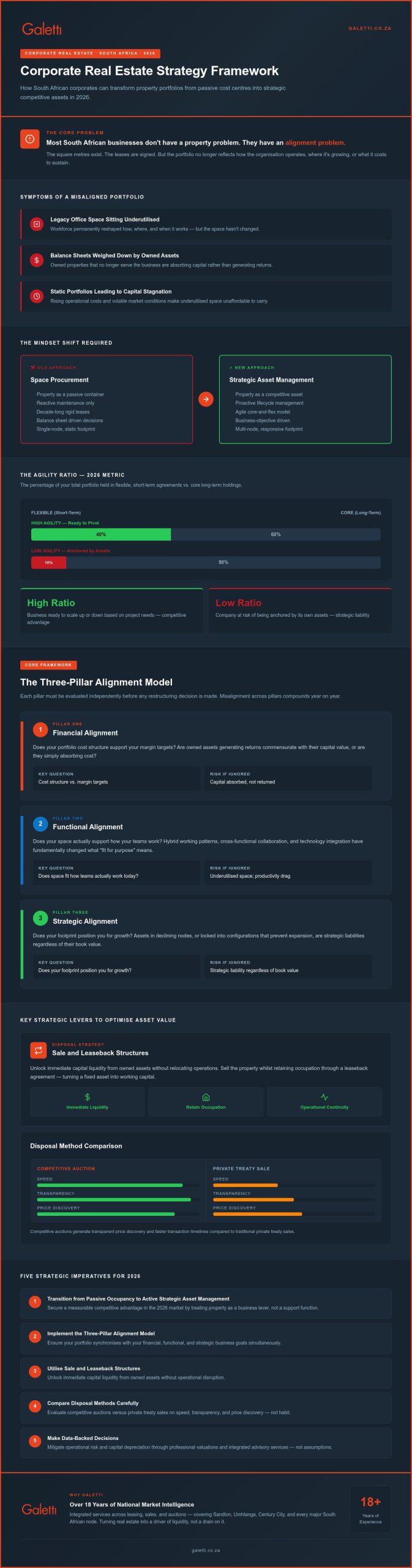
To measure success, Galetti tracks the Agility Ratio. In 2026, the Agility Ratio is defined as the percentage of a total portfolio held in flexible, short-term agreements compared to core, long-term holdings. A high ratio indicates a business ready to pivot; a low ratio suggests a company at risk of being anchored by its own assets.
Strategic Real Estate Consulting in a Volatile Market
Navigating these shifts requires expert oversight. Engaging a corporate real estate advisory ZA is the only way to bridge the gap between market data and boardroom decisions. Professional valuations are the first line of defence. They prevent over-capitalisation in stagnant sectors and identify hidden value in emerging nodes.
Transitioning from reactive maintenance to proactive asset lifecycle management is the final step. Galetti leverages over 18 years of national experience to help occupiers move beyond “fixing what’s broken.” We focus on integrated corporate services that optimise every phase of property ownership. By aligning maintenance schedules, lease renewals, and disposal timelines with business cycles, we turn real estate into a driver of liquidity rather than a drain on it.
Aligning Property Portfolios with Core Business Objectives
Most South African businesses don’t have a property problem. They have an alignment problem. The square metres exist. The leases are signed. But the portfolio no longer reflects how the organisation operates, where it’s growing, or what it costs to sustain. Closing that gap is the central challenge of any credible corporate real estate strategy South Africa in 2026.
The Alignment Model addresses this directly. It connects your operational reality to your real estate capacity through three distinct pillars, each of which must be evaluated independently before any restructuring decision is made.
- Financial Alignment: Does your portfolio cost structure support your margin targets? Are owned assets generating returns commensurate with their capital value, or are they simply absorbing cost?
- Functional Alignment: Does your space actually support how your teams work? Hybrid working patterns, cross-functional collaboration, and technology integration have fundamentally changed what “fit for purpose” means.
- Strategic Alignment: Does your footprint position you for growth? Assets in declining nodes, or locked into configurations that prevent expansion, are strategic liabilities regardless of their book value.
This is not a facilities management conversation. It belongs in the boardroom. Property represents one of the largest fixed-cost commitments on any corporate balance sheet, and misalignment across these three pillars compounds year on year. The South African property asset management framework published by National Treasury reinforces this principle, emphasising structured asset governance as a prerequisite for sustainable value extraction. The same logic applies directly to private sector portfolios.
Office Space Planning and Optimisation
Hybrid working has matured. The question is no longer whether it’s permanent, but how your space responds to it. The critical distinction here is between occupancy rate and utilisation rate. Occupancy measures how many desks are assigned; utilisation measures how many are actually in use at any given time. The gap between these two figures is where wasted expenditure lives. A practical office space optimisation strategy starts with sensor data or structured observation to establish real utilisation patterns, then redesigns space around those patterns rather than legacy assumptions. The “Centre of Excellence” model replaces rows of fixed desks with purpose-built collaboration zones, focus areas, and client-facing spaces, reducing total footprint whilst increasing the quality of in-person interaction.
Portfolio Audits and Strategic Planning
A structured commercial property portfolio audit does one thing above all else: it forces clarity. Every asset gets categorised into one of three buckets.
- Core: Assets essential to operations, appropriately sized, and financially justified.
- Surplus: Assets generating no strategic return, candidates for disposal or subletting.
- Strategic: Assets held for future expansion or market positioning, requiring active management rather than passive retention.
Misaligned leases are often the most damaging discovery. A lease that made commercial sense five years ago may now lock the business into space that’s too large, incorrectly configured, or in the wrong location entirely. Identifying these early creates options; ignoring them removes them.
If your portfolio hasn’t been audited against current operational reality, the data gaps alone represent a risk. Speak to Galetti’s advisory team to establish where your portfolio stands before your next lease event forces the decision.
Optimising Asset Value through Strategic Disposal and Leasing
Identifying surplus assets is only half the work. The other half is extracting maximum value from them through the right disposal mechanism, at the right time, with the right advisory support. This is where many South African corporates leave money on the table. A credible corporate real estate strategy South Africa must specify not just which assets to exit, but precisely how to exit them.
The sale and leaseback model deserves particular attention here, because no competitor in the South African market explains it with sufficient rigour. The structure is straightforward: a corporate entity sells an owned property asset to an investor, then immediately leases that same property back under a negotiated long-term agreement. The result is immediate capital liquidity, often substantial, without any disruption to operations. The business retains full use of the space whilst converting a fixed asset into deployable working capital. For organisations carrying owned property on their balance sheets that generates no return beyond housing their own operations, this mechanism is one of the most powerful liquidity tools available in 2026.
Auctions vs. Traditional Sales for Corporate Assets
When disposal is the objective, the method of sale determines both the timeline and the outcome. Commercial property auctioneers in South Africa offer a fundamentally different value proposition to private treaty sales. The auction floor creates competitive tension. Multiple qualified buyers bid simultaneously, and price discovery happens in real time rather than through protracted negotiation. The result is a transparent, defensible transaction that corporate boards and shareholders can scrutinise without ambiguity.
| Criteria | Competitive Auction | Private Treaty Sale |
|---|---|---|
| Speed to Completion | Typically faster; defined auction date creates urgency | Variable; dependent on buyer negotiation timelines |
| Price Certainty | Market-determined on the day; no post-offer renegotiation | Subject to due diligence, finance conditions, and price chipping |
| Transparency | High; open competitive bidding process | Lower; terms negotiated privately between parties |
| Buyer Pool | Broad; attracts opportunistic and strategic buyers simultaneously | Narrower; limited to parties approached or self-identified |
| Corporate Governance | Easier to defend to boards and shareholders | Requires more documentation to demonstrate arm’s-length pricing |
Neither method is universally superior. Trophy assets with a limited buyer universe may achieve stronger outcomes through a targeted private sale. Surplus industrial stock or secondary retail nodes, where speed and certainty outweigh maximum price optimisation, are natural candidates for the auction platform.
Strategic Tenant Procurement and Leasing
On the leasing side, the 2026 national market presents diverging conditions by sector. Industrial demand remains robust, driven by logistics operators, e-commerce fulfilment networks, and cold chain requirements. Retail leasing is more selective; dominant regional centres continue to attract quality tenants, whilst secondary retail space faces sustained pressure on rental rates and occupancy terms.
Securing the right tenant for retail property for lease in South Africa requires active market benchmarking, not passive advertising. Lease terms negotiated without current market data routinely leave value uncaptured, whether through below-market base rentals, uncapped escalation clauses, or tenant improvement allowances that erode net yield. Professional tenant representation and leasing advisory services close that gap by anchoring every negotiation to verified comparable transactions.
The objective is not simply to fill space. It’s to structure leases that protect corporate interests across the full term, align escalation schedules with inflation assumptions, and position the asset for its next strategic decision, whether that’s retention, refinancing, or disposal.
Managing Risk and Performance in the South African Market
Risk doesn’t announce itself. It accumulates quietly in underperforming assets, ageing building stock, and lease structures that no longer reflect market reality. Any credible corporate real estate strategy South Africa must build risk management into its architecture from the outset, not treat it as a remedial exercise after value has already eroded.
Three risk categories demand active attention in the current South African climate. Vacancy risk is the most visible: space that sits unoccupied generates cost without return, and prolonged vacancy in secondary nodes can accelerate asset depreciation beyond recoverable levels. Regulatory risk is less predictable but equally damaging; changes to zoning classifications, environmental compliance requirements, and building standards can materially affect both asset value and operational continuity. Capital depreciation risk is structural. Assets held in declining nodes or maintained below market standard lose value relative to the broader portfolio, compressing net yield and weakening balance sheet positions.
The industrial real estate investment ZA sector illustrates this clearly. Industrial assets that meet modern logistics specifications, including adequate eave heights, robust power supply, and sealed yard configurations, command measurably stronger occupier demand and rental premiums over outdated stock. The gap between specification-compliant and non-compliant assets is widening, not narrowing.
Technology is closing the information gap that historically made proactive risk management difficult. Real-time portfolio monitoring platforms now allow corporate occupiers to track occupancy rates, maintenance liability, lease expiry profiles, and energy consumption across a multi-node national footprint from a single dashboard. The operational insight this delivers is significant: portfolio managers can identify emerging vacancy risk months before lease events, rather than responding to them after the fact.
Professional valuations remain non-negotiable. Balance sheets carrying property at historical cost rather than current market value create a distorted picture of financial position. Independent, professionally conducted valuations provide the accurate baseline that boards require to make defensible capital allocation decisions.
Risk Assessment Frameworks
A national risk matrix for multi-property portfolios assigns each asset a risk score across four dimensions: location fundamentals, structural condition, lease security, and environmental compliance. The “Green Premium” versus “Brown Discount” dynamic is now a live consideration in South Africa. Green-rated buildings attract stronger tenant covenants and lower vacancy rates, whilst non-compliant stock faces both regulatory exposure and tenant attrition as occupier sustainability commitments tighten.
Yield Analysis and Market Benchmarking
Yield analysis in 2026 requires sector-specific benchmarking, not portfolio-wide averages. Industrial yields are behaving differently to office yields, and both diverge from retail. Benchmarking each asset against verified comparable transactions in its specific node and asset class reveals where the portfolio is outperforming, where it’s underperforming, and where timing a disposal or acquisition creates the greatest strategic advantage. Data drives that timing. Assumptions don’t.
Partnering for Strategic Real Estate Execution
Strategy without execution is just a document. The gap between a well-constructed corporate real estate strategy and measurable results is almost always an execution gap, not an intelligence gap. Bridging that distance requires a partner with the market depth, integrated capability, and national reach to convert boardroom decisions into portfolio outcomes.
That’s precisely where Galetti operates. With over 18 years of experience across the South African commercial property market, Galetti doesn’t position itself as a transactional service provider. The role is that of a strategic execution partner, one that holds the full picture from initial portfolio audit through to final disposal or lease negotiation, and manages every stage in between.
The Galetti Integrated Approach
Most advisory firms offer a slice of the value chain. Galetti delivers the full sequence. Valuation, leasing, corporate real estate sales, and auction services operate as a single integrated model rather than siloed disciplines. This matters because property decisions rarely exist in isolation. A disposal decision affects lease strategy. A lease restructure affects balance sheet positioning. When the same advisory team holds visibility across all of these dimensions simultaneously, the advice is materially better.
Proprietary market data underpins every recommendation. Galetti’s technology infrastructure tracks transaction activity, yield movements, and occupier demand across key national nodes in real time. For corporate occupiers managing multi-property portfolios, this translates into a decisive information advantage over competitors still relying on periodic market reports.
Consider the practical application: a corporate client carrying surplus industrial stock in a secondary node used Galetti’s integrated platform to assess disposal timing, identify the optimal sale mechanism, and execute through the auction channel. The competitive bidding process delivered a transparent, board-defensible outcome at market-determined pricing, without the protracted negotiation timelines of a private treaty process.
Next Steps: Listing and Strategy Development
Beginning a portfolio review doesn’t require a complete picture upfront. It requires a structured starting point. Galetti’s advisory process opens with a diagnostic assessment of your current holdings, mapped against your operational requirements, lease expiry profile, and financial objectives. From that baseline, disposal candidates are identified, leasing gaps are addressed, and a prioritised action plan is built.
If disposal or leasing is the immediate priority, listing your property through Galetti’s platform connects your asset to a qualified buyer and tenant pool across both auction and private sale channels. The process is structured, transparent, and designed to protect corporate governance requirements at every stage.
A credible corporate real estate strategy South Africa doesn’t end with a framework. It ends with results. If your portfolio isn’t delivering against its commercial potential, the next step is a confidential consultation with Galetti’s corporate services team to establish exactly where value is being left on the table, and how to recover it.
Your Portfolio Won’t Wait. Neither Should You.
The framework is clear. Align your portfolio across financial, functional, and strategic dimensions. Exit surplus assets through the right disposal mechanism. Build in risk management before value erodes, not after. A credible corporate real estate strategy South Africa doesn’t emerge from periodic reviews; it’s built through disciplined, data-backed execution across every stage of the property lifecycle.
Galetti brings over 18 years of strategic market leadership to that process. With an integrated platform spanning advisory, leasing, sales, and auctions, and expert coverage across all commercial sectors, the capability to convert your portfolio from a cost centre into a competitive asset is already in place.
The companies that act on this framework in 2026 will hold a measurable advantage over those that don’t. Your next lease event, disposal decision, or balance sheet review is closer than it appears.
The right move, made at the right time, changes everything.
Frequently Asked Questions
What is the primary goal of a corporate real estate strategy in South Africa?
The primary goal of a corporate real estate strategy South Africa is to ensure every property asset directly supports the organisation’s financial, functional, and strategic objectives. Property must generate measurable commercial value, not simply house operations. A well-executed strategy eliminates misalignment between your portfolio and your business model, converting real estate from a fixed cost into a competitive instrument.
How does a sale and leaseback strategy improve corporate liquidity?
A sale and leaseback converts an owned property into immediate working capital without disrupting operations. The business sells the asset to an investor, then leases it back under a negotiated long-term agreement, retaining full occupancy. For organisations carrying property that generates no return beyond housing their own teams, this structure unlocks capital that can be redeployed into core business activities rather than sitting tied up in bricks and mortar.
Can commercial auctions handle large-scale corporate property disposals?
Yes. Commercial auction platforms are well-suited to large-scale corporate disposals, particularly where speed, transparency, and board-defensible pricing are priorities. The competitive bidding process creates real-time price discovery across a broad buyer pool, including both opportunistic and strategic acquirers. For surplus industrial stock or secondary-node assets, auctions consistently deliver faster completion timelines than protracted private treaty negotiations.
How often should a South African company perform a property portfolio audit?
A structured portfolio audit should be conducted at minimum every two years, and immediately ahead of any significant lease event, corporate restructure, or balance sheet review. Markets shift, operational requirements evolve, and a lease that was commercially sound three years ago may now represent a liability. Waiting for a lease expiry to force the conversation removes options rather than creating them.
What is the difference between tenant representation and traditional brokerage?
Traditional brokerage typically serves the landlord’s interest, filling space at the best achievable rent. Tenant representation works exclusively for the occupier, anchoring every negotiation to verified comparable transactions and current market benchmarks. The practical difference is significant: without representation, corporates routinely accept below-market terms, uncapped escalation clauses, or tenant improvement allowances that erode net value across the full lease term.
How is remote work affecting office real estate strategy in 2026?
Hybrid working has matured from a temporary adjustment into a permanent structural shift. The critical implication for a corporate real estate strategy South Africa is that utilisation rates, not occupancy rates, now determine how much space a business actually needs. Organisations that haven’t measured real utilisation patterns are likely carrying surplus office footprint. The shift toward purpose-built collaboration zones and activity-based working environments reflects this new operational reality.
Why is professional valuation critical for corporate real estate alignment?
Balance sheets carrying property at historical cost rather than current market value produce a distorted picture of financial position. Professional valuations establish the accurate baseline that boards require to make defensible capital allocation decisions, whether that’s a disposal, refinancing, or strategic hold. Without independent verification, organisations risk over-capitalising in stagnant sectors or undervaluing assets that could generate significant liquidity if exited at the right moment.
What are the risks of a misaligned property portfolio?
Misalignment across financial, functional, and strategic dimensions compounds year on year. The immediate risks include sustained vacancy costs, lease obligations that exceed operational requirements, and capital depreciation in assets held in declining nodes. The longer-term risk is structural: a portfolio that anchors the business to yesterday’s footprint actively prevents the agility required to respond to market shifts, competitor moves, or growth opportunities as they emerge.