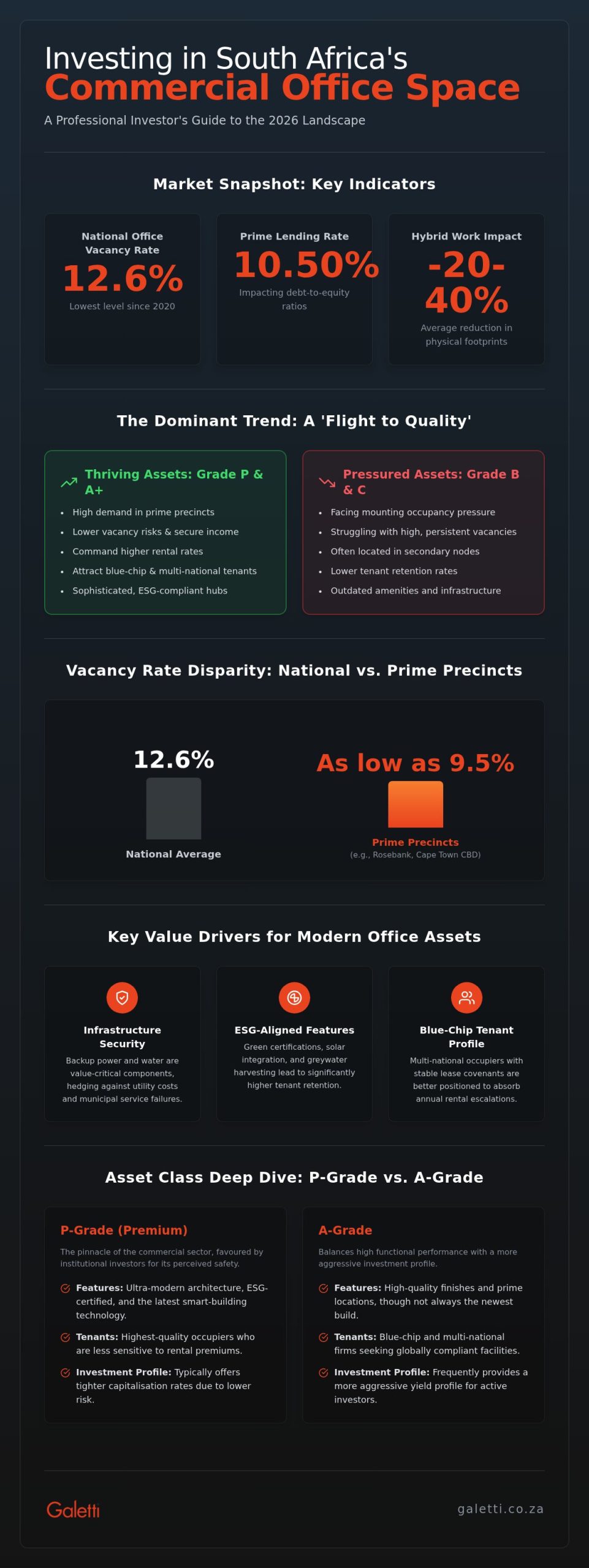
National office vacancy rates have fallen to 12.6 per cent, reaching their lowest level since 2020 and signalling a robust recovery for strategic investors. While B-grade buildings face mounting pressure, premium assets in mixed-use precincts continue to thrive. If you are serious about investing in commercial office space South Africa currently provides a highly polarised landscape where ‘Flight to Quality’ is the essential driver of value. You’ve likely observed how hybrid work has reduced total footprints whilst increasing the demand for sophisticated, ESG-compliant hubs that justify a return to the office.
We understand the challenge of balancing debt-to-equity ratios when the prime lending rate sits at 10.50 per cent. This guide provides the professional clarity required to identify high-yield opportunities that deliver secure, inflation-hedged rental income. We’ll examine the outperformance of the Western Cape market, the impact of the 2026 transfer duty rates, and the most efficient acquisition methods to safeguard your capital. You’ll gain the insights necessary to move quickly from market inquiry to decisive asset acquisition.
Key Takeaways
- Identify why Grade P and A+ assets dominate returns in a market defined by the ‘Flight to Quality’ trend.
- Master metrics like Cap Rates and IRR to identify high-yield opportunities when investing in commercial office space South Africa.
- Compare the efficiency of property auctions against private treaty sales to secure assets at true market value.
- Optimise portfolio yields through strategic tenant procurement and rigorous lease audits to prevent revenue leakage.
- Leverage data-driven advisory to secure inflation-hedged rental income amidst fluctuating interest rates.
The 2026 Landscape for Investing in Commercial Office Space South Africa
The 2026 market for investing in commercial office space South Africa is defined by a stark divergence in performance. National office vacancy rates have stabilised at approximately 12.6 per cent, but this figure masks the intense demand for high-tier assets. Investors are prioritising Grade P and A+ spaces, a trend known as the ‘Flight to Quality’. These premium buildings command higher rentals and lower vacancy risks because they provide the amenities necessary to entice staff back to the workplace. Understanding the broader definition of commercial property is essential for any strategic acquisition, as the lines between office, retail, and lifestyle spaces continue to blur.
Hybrid work models have forced a structural shift. While companies have reduced their physical footprints by an average of 20 to 40 per cent, they haven’t abandoned the office. Instead, they’ve consolidated into smaller, more efficient, and better-located hubs. This has left B-grade and C-grade buildings in secondary nodes struggling with high vacancies, whilst prime precincts like Rosebank and the Cape Town CBD maintain vacancy rates as low as 9.5 per cent. In this climate, identifying resilient assets requires a data-driven approach to Property Sales Services and market positioning.
Precinct Resilience and Infrastructure Security
Reliability is now the primary currency of value. Assets located within managed precincts often outperform standalone buildings due to superior security and private infrastructure management. In 2026, backup power and water security are no longer optional additions; they’re value-critical components. Buildings with ESG-aligned features, such as solar integration and greywater harvesting, benefit from significantly higher tenant retention. These green building certifications act as a hedge against rising utility costs and municipal service failures, directly impacting the asset’s long-term viability.
Macroeconomic Factors Shaping Office Yields
Financing remains a core consideration for investing in commercial office space South Africa. With the prime lending rate at 10.50 per cent and the repo rate at 7.00 per cent, gearing must be calculated with precision. Inflation serves as a double-edged sword. It drives annual rental escalations, which protects real income, yet it also increases operational costs. Strategic investors are looking for assets where the Internal Rate of Return (IRR) accounts for these fluctuations. A direct correlation exists between GDP growth and office demand, making it vital to select nodes that show economic resilience despite national volatility.
Evaluating Office Asset Classes and Selection Criteria
Success in investing in commercial office space South Africa requires a granular understanding of asset grading. Investors must distinguish between mere aesthetic appeal and long-term functional performance. The current market rewards those who can identify buildings that balance occupancy costs with tenant productivity. Key metrics such as Capitalisation Rates (Cap Rates) and Internal Rate of Return (IRR) remain the primary benchmarks for performance. Whilst P-grade assets often offer tighter cap rates due to their perceived safety, Grade A properties frequently provide a more aggressive yield profile for those willing to manage active leases.
Tenant profile analysis has become more sophisticated. Strategic investors now prioritise blue-chip and multi-national occupiers who require global-standard facilities. These tenants offer stable lease covenants and are better positioned to absorb annual rental escalations. Recent reports on the State of South Africa’s commercial property sector indicate that while the office market is recovering, the quality of the tenant remains the most significant predictor of asset resilience. We also see a growing demand for ‘Plug-and-Play’ spaces. These pre-fitted offices reduce initial capital expenditure for tenants and allow landlords to command higher per-square-metre rates.
The Premium Grade (P-Grade) Advantage
P-grade assets represent the pinnacle of the commercial sector. These buildings feature ultra-modern architecture, high-volume ceilings, and superior air-filtration systems. They’re often ESG-certified and offer the latest in smart-building technology. Institutional investors favour this class because it attracts the highest-quality tenants who are less sensitive to rental premiums. In nodes like Sandton or Rosebank, the premium for P-grade space remains robust, providing a reliable hedge against the volatility found in secondary markets. For those looking to secure high-tier tenants, our Property Leasing Services can help identify market-leading opportunities.
Adaptive Reuse: Unlocking Value in B-Grade Assets
Older Grade B stock presents a different strategic play. Many of these buildings are located in established business centres but no longer meet the technical requirements of modern corporate occupiers. Adaptive reuse refers to the process of repurposing an existing building for a function other than its original design, such as converting redundant office blocks into residential apartments or mixed-use precincts, whilst adhering to local zoning and heritage regulations. Modernising these assets requires a precise cost-benefit analysis. Investors must evaluate if the structural integrity allows for the integration of modern HVAC systems or if a complete residential conversion offers a better IRR. If you’re considering a strategic shift in your portfolio, you may wish to consult with our advisory team to assess your asset’s redevelopment potential.
Acquisition Strategies: Auctions versus Private Treaty Sales
The method of acquisition is as critical as the asset class itself when investing in commercial office space South Africa. In 2026, the speed of capital deployment and the transparency of the transaction have become primary concerns for institutional and private investors alike. Traditional purchase methods are being increasingly challenged by more streamlined channels that reduce the time spent in protracted legal cycles. Selecting the right strategy requires a clear understanding of your liquidity requirements and your appetite for competitive bidding.
Property auctions have emerged as a preferred mechanism for securing high-value assets at true market value. This channel provides a ‘clean’ sale, meaning once the hammer falls, the transaction is legally binding without the typical suspensive conditions found in private deals. For institutional buyers, this transparency is invaluable. It ensures that the price paid is a direct reflection of current market sentiment, supported by the latest SAPOA office market data regarding vacancy and rental benchmarks. However, this efficiency demands rigorous due diligence before the auction day. You must complete your structural inspections, title deed searches, and financial approvals in advance.
The Strategic Benefits of Commercial Auctions
Auctions eliminate the uncertainty of back-and-forth negotiations that can often stall for months. The competitive environment forces a definitive outcome within minutes, allowing you to move from inquiry to ownership with unparalleled speed. This process is particularly effective for high-demand P-grade assets where multiple parties are vying for the same yield. To see how this works in practice, you can view current office assets on auction to identify opportunities that fit your portfolio criteria.
Navigating the Private Treaty Acquisition Process
Private treaty sales remain the standard for off-market deal sourcing and complex, multi-tenanted acquisitions. This method allows for a more nuanced negotiation regarding the ‘Offer to Purchase’ (OTP) and specific suspensive conditions, such as rezoning or tenant renewals. Whilst the timeline is longer, it provides the opportunity for deep-level strategic positioning. Success in this arena depends heavily on professional brokerage to navigate the complexities of the current economic climate. You can explore corporate real estate sales to find assets that aren’t yet listed on public platforms. This approach is often best for investors seeking long-term redevelopment projects where the acquisition terms are as important as the price itself.
Regardless of the channel, investing in commercial office space South Africa requires a partner who understands the technicalities of both platforms. Whether you’re bidding on the auction floor or negotiating a private contract, the goal remains the same: securing a resilient asset that delivers a predictable return on investment.
Risk Mitigation and Portfolio Yield Optimisation
Strategic risk management is the foundation of investing in commercial office space South Africa. High-level investors recognise that long-term success depends on active asset management rather than passive ownership. Landlords must move beyond the basic objective of filling empty floor space and instead focus on curating a tenant mix that enhances the overall value of the precinct. Efficiency drives performance. By selecting occupiers with complementary business models, you create a resilient ecosystem that is less susceptible to regional economic shifts.
Lease audits identify hidden revenue leakages, such as under-recovered municipal charges or incorrect escalation applications. These audits ensure that the financial performance of the asset matches its contractual potential. Staggered lease expiry profiles are equally essential. They prevent a catastrophic revenue drop by ensuring that no more than 20 per cent of the building’s gross lettable area (GLA) expires in a single financial year. Using technology for data-driven asset management allows for real-time tracking of utility usage and predictive maintenance, which significantly reduces operational overheads.
Tenant Retention and Relationship Management
Proactive maintenance schedules reduce tenant churn. A well-maintained building justifies higher rentals and lowers the risk of expensive emergency repairs. Professional property management directly correlates with improved Net Operating Income (NOI). It ensures that every operational expense is scrutinised and every revenue stream is protected. To learn more about our specialised approach, view our guide on Strategic Property Portfolio Management Services: Optimising Asset Value in 2026.
Financial Modelling for Robust Returns
Accurate financial modelling must account for the true cost of Tenant Installations (TI) and rent-free periods. These incentives, whilst necessary for securing blue-chip occupiers, can erode initial yields if they aren’t managed with precision. Forecasting long-term Capital Expenditure (CAPEX) ensures that the building remains competitive against newer P-grade stock. Net initial yield is calculated by dividing the current annualised net rental income by the total property acquisition cost, including all associated transaction fees and taxes.
Partnering with Galetti for Strategic Office Investment
Galetti has spent 18 years refining the process of investing in commercial office space South Africa. We don’t just act as brokers; we function as high-level strategic partners for institutional and private investors. Our integrated platform combines Property Auction Services, Property Sales Services, and Property Leasing Services into a single, efficient ecosystem. This synergy ensures that every asset is positioned for maximum market impact. Whether you’re acquiring a P-grade hub or disposing of a B-grade block, our team provides the clarity needed to execute complex transactions with precision.
We believe data is the only reliable guide in a volatile market. Our proprietary insights allow us to identify shifts in tenant behaviour before they become mainstream trends. This foresight helps our clients avoid the pitfalls of high-vacancy nodes and instead focus on precincts with proven resilience. We unlock value by aligning your portfolio with the ‘Flight to Quality’ and ESG standards discussed earlier in this guide. Our track record is built on results, not speculation.
Expert Advisory and Market Insights
Informed decision-making requires more than just surface-level statistics. We utilise deep-market analytics to provide bespoke advisory and portfolio strategies that protect your capital. Professional valuations are a cornerstone of this process. They’re essential for securing finance and assessing risk accurately in the current economic climate. By understanding the technical nuances of your asset, you can better manage your debt-to-equity ratios. Discover Galetti Corporate Services to see how our data-driven approach can stabilise your long-term returns.
Next Steps: Securing Your Office Investment
The path to a successful acquisition often begins with off-market deals. Our brokers maintain extensive networks that grant access to opportunities before they reach the public domain. If you’re serious about investing in commercial office space South Africa, having a well-connected insider is your greatest advantage. We also assist landlords in preparing their assets for disposal. Whether through a private treaty or our specialised auction solutions, we ensure your property is market-ready to achieve its highest possible valuation.
Strategic disposal is just as important as acquisition. If your current office stock no longer aligns with your long-term goals, we can facilitate a streamlined exit that maximises liquidity. List your property with Galetti to leverage our 18 years of industry expertise and ensure your asset reaches the right institutional buyers at the right price.
Securing Your Position in the 2026 Office Market
The current landscape rewards precision over volume. Success in investing in commercial office space South Africa now depends on identifying high-tier assets within resilient precincts that offer infrastructure security and ESG compliance. You’ve seen how the ‘Flight to Quality’ has created a clear divide between high-performing P-grade hubs and struggling secondary stock. Navigating this polarisation requires more than just capital; it demands a strategic partner with a deep understanding of market technicalities and tenant requirements.
Galetti provides this clarity through 18 years of commercial real estate expertise and an integrated platform that connects auctions, sales, and leasing. We specialise in data-driven portfolio management and professional valuations that protect your capital in a volatile economy. Whether you require bespoke auction solutions for fast asset liquidation or strategic advisory to optimise your yields, we ensure your investment aligns with current benchmarks. Our team is ready to help you capitalise on the recovery of the South African office sector.
We look forward to facilitating your next strategic acquisition and helping you secure long-term, inflation-hedged returns.
Frequently Asked Questions
Is investing in South African office space still profitable in 2026?
Investing in commercial office space South Africa remains profitable for those who target high-tier assets in resilient, mixed-use precincts. National vacancy rates have reached their lowest level since 2020 at 12.6 per cent, signalling a robust recovery in specific sectors. Success depends on selecting properties that meet modern ESG standards and offer infrastructure security. While secondary assets face pressure, premium buildings in nodes like Rosebank and the Cape Town CBD provide stable, inflation-hedged income.
What is the average yield for Grade A office space in South Africa?
Average yields for Grade A office space currently range between 8.5 per cent and 10.5 per cent, depending on the specific node and tenant covenant. Cape Town often commands tighter yields due to high demand and a 9.5 per cent vacancy rate. Conversely, Gauteng A-grade rentals of roughly R158 per square metre offer attractive entry points for yield-seeking investors. These figures fluctuate based on the building’s age and its backup infrastructure capabilities.
How do I calculate the capitalisation rate for an office building?
You calculate the capitalisation rate by dividing the building’s annual Net Operating Income (NOI) by its current market value or purchase price. This metric excludes financing costs to provide a pure reflection of the asset’s performance. For a precise calculation, ensure you’ve accounted for all operational expenses, including municipal rates and maintenance. It’s a vital tool for comparing the relative value of different office assets within the same market.
What is the difference between P-grade and A-grade office space?
P-grade office space represents the top tier of the market, featuring ultra-modern architecture, state-of-the-art technology, and full ESG certification. These buildings are often less than five years old or have undergone extensive recent refurbishments to meet global standards. A-grade space is high-quality and well-located but may lack the cutting-edge technical specifications or architectural significance of P-grade assets. The distinction is critical for investors as P-grade space currently drives the highest tenant retention.
Should I buy or lease office space for my business in South Africa?
Buying office space is generally preferred for established businesses seeking long-term capital appreciation and operational control over their environment. Ownership allows you to hedge against rental escalations whilst building equity in the asset. Leasing remains the superior choice for companies requiring flexibility or those prioritising capital for core business operations. Your decision should align with your corporate strategy and your ability to manage long-term maintenance and utility costs.
What are the hidden costs of owning commercial office property?
Hidden costs often include significant Tenant Installation (TI) allowances, leasing commissions, and unforeseen municipal rate hikes. Landlords must also budget for long-term capital expenditure (CAPEX) to maintain the building’s competitive edge against newer developments. Utility recoveries can be complex; any shortfall in these recoveries directly erodes your net yield. It’s essential to conduct a thorough lease audit to identify any revenue leakages or unrecovered operational expenses.
How does the ‘Green Building’ status affect office property value?
Green Building certification significantly enhances property value by reducing long-term operational costs and attracting high-quality, ESG-conscious tenants. Certified buildings often command a rental premium and experience lower vacancy periods. As corporate sustainability mandates become stricter in 2026, non-compliant buildings risk becoming ‘stranded assets’. Investing in sustainable energy and water solutions isn’t just an environmental choice; it’s a critical strategy for protecting your asset’s future resale value.
What due diligence is required before buying office space at an auction?
Due diligence before an auction must be exhaustive because the fall of the hammer signifies a legally binding, unconditional contract. You must review the title deeds, zoning certificates, and current rent rolls in the weeks leading up to the sale. Structural inspections and environmental assessments should be completed beforehand. Since auction sales don’t allow for suspensive conditions, your financing must be pre-approved to ensure you can meet the payment deadlines.