
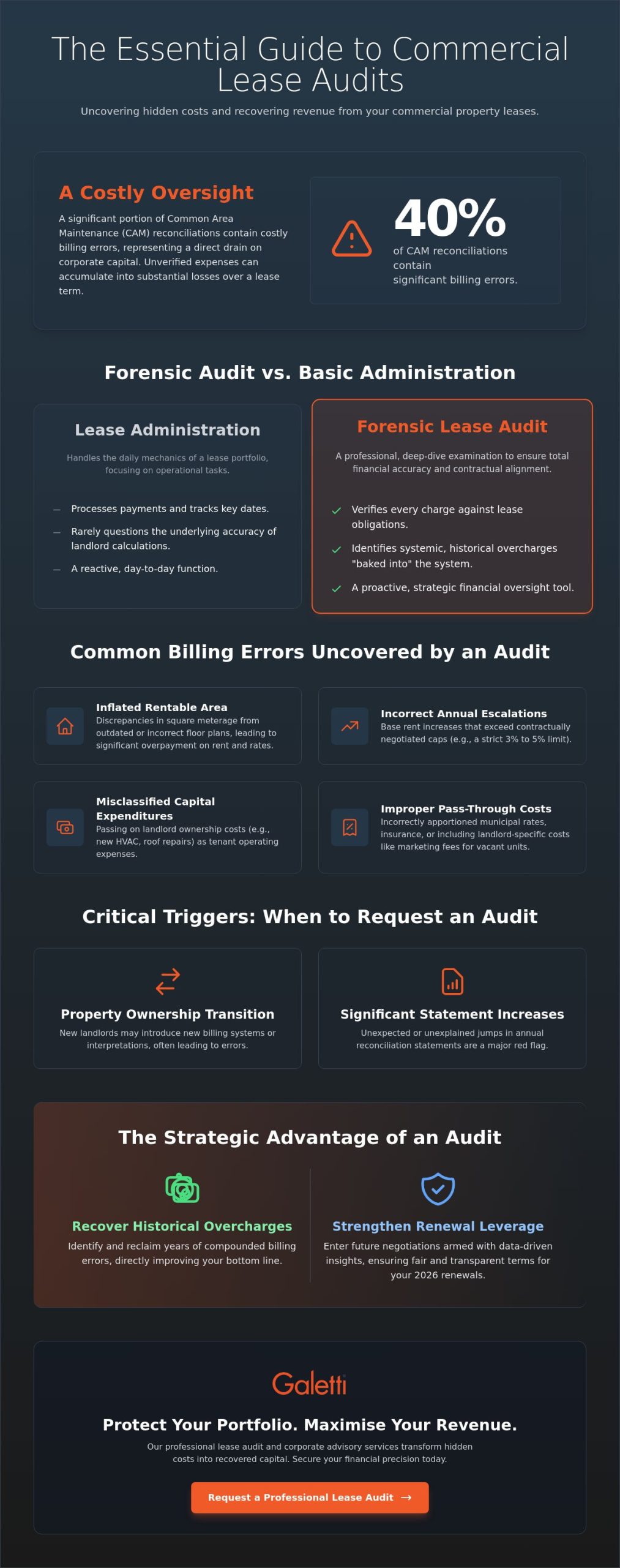
Forty per cent of commercial Common Area Maintenance (CAM) reconciliations contain significant billing errors. With these discrepancies costing tenants billions annually, unverified expenses represent a direct drain on your corporate capital. Utilising professional commercial lease audit services is the most effective way to transform these hidden costs into recovered revenue.
You’ve likely experienced the frustration of opaque landlord statements and unexpected increases in monthly operating costs. It’s difficult to manage a budget when complex lease clauses remain open to interpretation. We understand that transparency is paramount for high-level decision-makers who prioritise efficiency and fiscal precision.
This article explains how a professional audit identifies overcharges, ensures total contractual compliance, and protects your bottom line. We’ll preview the essential steps to recover historical losses and gain the necessary leverage for your 2026 renewals.
Key Takeaways
- Identify the fundamental differences between basic invoice tracking and forensic commercial lease audit services to protect your operating budget.
- Detect systemic billing errors, including inflated rentable area measurements and miscalculated annual escalations.
- Master the strategic process of document gathering and preliminary desktop reviews to pinpoint high-level financial red flags.
- Recognise critical audit triggers, such as property ownership transitions or significant increases in annual reconciliation statements.
- Recover historical overcharges and strengthen your leverage during upcoming lease renewals through professional corporate advisory.
What are Commercial Lease Audit Services?
A commercial lease audit is a professional, forensic examination of a landlord’s financial billings against the specific contractual obligations outlined in a lease agreement. It’s not a cursory check of monthly invoices. Instead, it’s a structured verification process designed to ensure that every Rand charged aligns with the legal realities of the contract. For corporate occupiers, this represents a critical pillar of financial oversight and risk management.
Many businesses mistake basic accounts payable functions for a thorough Lease Audit. While internal teams may spot obvious discrepancies, they often lack the specialised market data and legal nuance required to identify systemic overcharges. Professional commercial lease audit services provide the third-party expertise necessary to dissect complex reconciliation statements, which are frequently opaque by design. The primary goal is simple: total financial accuracy and contractual alignment throughout the entire lease term.
The Core Components of a Professional Audit
Professional audits target high-risk financial touchpoints where errors most frequently occur. Recent data suggests that 40 per cent of commercial Common Area Maintenance (CAM) reconciliations contain significant billing errors. Our process includes:
- Base Rent Verification: We check escalation calculations to ensure they don’t exceed negotiated limits. For 2026, we advise occupiers to maintain a strict 3 per cent to 5 per cent cap on annual rent increases.
- Pro-rata Analysis: We confirm that your share of common area expenses is calculated correctly based on your actual rentable area.
- Pass-through Scrutiny: We conduct a forensic review of municipal rates, insurance premiums, and utility recoveries to ensure the landlord isn’t profiting from these non-rent items.
Audit vs. Lease Administration
Lease administration handles the daily mechanics of your portfolio, such as processing payments and tracking expiry dates. Whilst essential, this function rarely questions the underlying accuracy of the landlord’s calculations. A forensic audit provides the necessary deep-dive to identify historical errors that have been “baked into” the system over time. Integrating these findings into your broader corporate services strategy ensures that your real estate portfolio remains a lean, strategic asset rather than an unmonitored liability. This proactive approach prevents billing inaccuracies from becoming permanent financial fixtures.
Common Errors Identified During Commercial Lease Audits
Identifying financial discrepancies requires a granular understanding of both accounting principles and property law. Landlords often operate on high-volume billing systems where errors, once introduced, tend to compound over several years. Professional commercial lease audit services are designed to intercept these systemic failures before they permanently erode your operational budget.
One of the most frequent issues involves the inaccurate measurement of premises. Landlords may use outdated floor plans or incorrect calculation methods that inflate the “rentable area” of your office or retail space. Even a minor discrepancy in square meterage results in significant overpayments when applied to base rent, municipal rates, and insurance premiums over a multi-year term. Ensuring your physical footprint matches the billed area is a fundamental step in any forensic review.
Another common pitfall is the misclassification of capital expenditures (CAPEX). Landlords sometimes attempt to include the costs of major building upgrades, such as a new HVAC system or structural roof repairs, within operating expense (OPEX) recoveries. These are ownership costs that should not be passed on to the occupier. Additionally, many tenants fail to verify if negotiated “caps” on specific spending categories, such as security or cleaning, have been correctly applied in the final reconciliation.
Operating Expense and Municipal Rate Discrepancies
Municipal rate increases are a significant cost driver, yet they’re often incorrectly apportioned amongst tenants. Errors occur when landlords fail to adjust for changes in building valuation or apply the wrong category of tariff. We also frequently find landlord-specific costs, such as marketing fees for vacant units or legal expenses related to other tenants, buried within the general expense pool. Operating expense reconciliation is the annual process of balancing estimated payments against actual costs. If you suspect your current statements contain these discrepancies, contact our advisory team for a preliminary assessment.
Hidden Utility and Service Charge Overflows
Utility recoveries are often rife with administrative mark-ups that may violate local regulations or the specific terms of your lease. Forensic auditors look for “phantom” services, where a business is billed for maintenance or landscaping that was budgeted but never actually delivered. We also scrutinise the “double-dipping” phenomenon, where expenses are charged directly to a specific tenant whilst also remaining in the common area pool. Most importantly, we ensure that you aren’t subsidising the utility or service costs of vacant units within the building, a common error in property management accounting.
The Strategic Process: How an Audit is Conducted
Executing a successful forensic review requires a disciplined, multi-stage approach. It is a strategic operation designed to uncover financial leakage through methodical verification. Professional commercial lease audit services follow a rigorous protocol to ensure no overcharge remains undetected. This process moves from high-level analysis to granular ledger inspection.
- Step 1: Preliminary Desktop Review. We begin by identifying high-level red flags in your recent reconciliation statements. This initial scan highlights obvious anomalies or unexpected spikes in specific cost categories.
- Step 2: Document Gathering. This is the most critical phase. We organise the original lease, all subsequent addendums, and several years of historical invoices. Many audits fail because of incomplete data; we ensure every contractual amendment is accounted for.
- Step 3: Detailed Field Audit. Our experts examine the landlord’s actual books and records. We verify that the expenses billed to you match the landlord’s internal general ledger and third-party invoices.
- Step 4: Findings Report. We present a quantified list of overcharges and compliance issues. This report serves as a definitive financial roadmap for recovery.
- Step 5: Negotiation and Recovery. The final stage involves reaching an amicable settlement. We present the evidence to the landlord to secure a refund or a future rent credit.
The Importance of the “Right to Audit” Clause
Every commercial agreement should contain a clear provision for tenant-led financial reviews. Landlords often attempt to limit these rights through “time-bar” clauses, which may restrict your ability to dispute charges to a narrow 60 or 90-day window. If your current lease lacks an explicit audit clause, common law or implied rights may still allow for a review; however, it’s always preferable to negotiate these protections upfront. We help you navigate these restrictions to ensure your right to transparency remains intact.
Data-Driven Insights for Future Negotiations
The value of an audit extends far beyond immediate cost recovery. The data gathered provides immense leverage during your next commercial lease negotiation services engagement. By identifying historical errors, you can demand stricter caps and more transparent accounting methods in your renewal. Modern technology now allows us to automate much of the data collection process, creating a “single source of truth” for your entire portfolio. This proactive stance ensures that your future lease terms are built on a foundation of verified accuracy rather than landlord estimates.
When Should Your Business Request a Lease Audit?
Timing is a critical component of financial recovery. Whilst many occupiers view an audit as a reactive measure, the most successful businesses integrate commercial lease audit services into their standard operational cycle. Identifying discrepancies early prevents small errors from ballooning into significant historical overcharges over a multi-year term.
The most immediate trigger is the receipt of an annual reconciliation statement showing unexpected spikes. If your costs have surged without a corresponding increase in service quality, a review is essential. You should also request an audit when a property changes ownership or management. New landlords often implement different accounting methods or software systems, which frequently leads to data migration errors and misapplied clauses during the transition.
Strategic milestones are equally important. Conduct an audit before exercising a renewal option or a lease break to ensure you aren’t carrying over unresolved debt or overpayments. Similarly, during corporate mergers or acquisitions, a forensic review should form part of your due diligence to prevent inheriting a financial liability from the seller’s portfolio. Establishing a “clean slate” at these junctures protects your future budget certainty.
Standard Triggers for High-Value Audits
An annual increase in operating expenses exceeding 10 per cent without clear justification is a major red flag. This often happens when landlords attempt to pass through the costs of major capital projects, such as building facade upgrades or structural repairs, which should be capitalised rather than expensed. Inconsistent billing patterns or a lack of transparency in reconciliation statements also suggest poor administrative control, making a deep-dive highly profitable. If you have noticed these red flags, enquire about our forensic review process today.
Maintaining the Landlord-Tenant Relationship
Occupiers often hesitate to audit for fear of damaging their relationship with the landlord. In reality, professional landlords often welcome these reviews. It ensures their own records are accurate and reduces the risk of future litigation. Framing the audit as a standard compliance procedure, rather than a hostile act, is key to maintaining a productive partnership. By using third-party experts, you create a neutral buffer. The auditor handles the technical disputes, whilst your team maintains a positive day-to-day working relationship with building management. This professional distance ensures that financial accuracy is achieved without compromising contractual goodwill.
Galetti: Professional Lease Audit and Corporate Advisory
Galetti delivers more than just a financial review; we provide a comprehensive framework for long-term portfolio resilience. Our approach to commercial lease audit services is deeply integrated into our broader corporate services division. This ensures that every forensic finding is leveraged to improve your overall asset performance and operational efficiency. We don’t simply identify errors; we resolve them through assertive, data-backed negotiation.
With 18 years of experience in the South African commercial sector, we possess an intimate understanding of local billing anomalies. We recognise the specific nuances of municipal rate adjustments, regional utility tariffs, and local property legislation that international firms often overlook. Our team remains committed to protecting occupier interests whilst upholding the highest professional standards. We translate complex forensic data into tangible savings that directly impact your bottom line and improve your internal financial reporting accuracy.
Beyond the Audit: Comprehensive Occupier Support
Audit results shouldn’t exist in a vacuum. We link these financial insights directly to corporate real estate leasing strategies to inform future site selections and portfolio expansions. If a specific landlord or property management firm shows a pattern of systemic billing errors, we use that data to advise against certain locations or to negotiate more robust protections during the drafting phase. Our national network of property experts provides specialised sector insights, helping landlords and tenants find a data-driven “middle ground” that ensures long-term stability for both parties.
Take the Next Step in Portfolio Optimisation
Initiating a preliminary review of your current lease portfolio is the first step toward reclaiming lost capital. We recommend establishing a recurring audit cycle to maintain financial hygiene and ensure ongoing compliance as market conditions shift in 2026. This proactive stance transforms your real estate from a static expense into a strategically managed asset that supports your broader corporate goals. Contact Galetti today to discuss your specific commercial lease audit services requirements and begin the process of professional portfolio optimisation.
Securing Financial Precision in Your 2026 Portfolio
Commercial real estate represents one of your organisation’s most significant overheads. Leaving these costs unverified is a risk your bottom line shouldn’t carry. Professional commercial lease audit services provide the forensic oversight needed to identify systemic overcharges and ensure total contractual compliance. By addressing discrepancies during critical business cycles, you recover historical losses and secure budget certainty for future periods. This proactive stance is essential for maintaining corporate transparency in a shifting market.
Galetti brings over 18 years of industry experience and an integrated national advisory team to every forensic engagement. Our results-oriented approach ensures that corporate occupiers receive definitive answers to complex billing problems. We move beyond simple identification to deliver tangible financial recovery and improved leverage during renewals. Our expertise acts as a shield for your capital, ensuring that your property portfolio remains lean and efficient.
Optimise your property portfolio with Galetti’s expert audit services today and transform your lease obligations into a strategic advantage. Your path to financial accuracy starts with a single, professional review.
Frequently Asked Questions
What is the typical cost of a commercial lease audit?
Fees for commercial lease audit services are usually structured to align with the occupier’s financial outcomes. Many providers operate on a contingency basis, where the fee is calculated as a percentage of the actual overcharges recovered from the landlord. Other structures include a fixed fee for an initial desktop review or a flat fee for specific forensic tasks. This results-oriented approach ensures that the service provides a clear return on investment.
How far back can a lease audit go to recover overcharges?
The recovery period is primarily dictated by the “right to audit” clause within your agreement. Whilst many landlords attempt to impose “time-bar” restrictions of 60 to 90 days following an annual reconciliation, these aren’t always legally absolute. In many jurisdictions, statutory prescription periods allow for the recovery of overcharged amounts for up to three years, provided the error was not reasonably discoverable earlier.
Will a lease audit damage my relationship with my landlord?
Professional landlords generally view audits as a standard component of corporate financial hygiene. Accurate records are in the interest of both parties, and institutional property managers often welcome the opportunity to correct systemic accounting errors. Utilising a third-party advisory firm provides a neutral buffer, allowing technical disputes to be resolved professionally whilst your team maintains a positive day-to-day working relationship with building management.
Do I need a lease audit if my landlord provides an audited financial statement?
A landlord’s general financial audit does not guarantee your specific lease compliance. Their audit is designed to ensure the landlord’s overall financial reporting is accurate for shareholders or lenders; it doesn’t verify if your unique “pro-rata” share or negotiated “caps” were applied correctly. A forensic lease audit is the only way to confirm that the specific charges on your statement align with your individual contract.
How long does the lease audit process usually take?
The timeline varies depending on the complexity of the portfolio and the landlord’s cooperation. A preliminary desktop review to identify red flags can be completed within a few business days. However, a full forensic audit involving the inspection of the landlord’s internal ledgers and third-party invoices typically takes between four and twelve weeks to reach a quantified findings report.
Can a lease audit be performed on retail and industrial properties too?
Forensic reviews are essential across all commercial sectors, including retail and industrial assets. Retail leases are particularly prone to errors in turnover rent calculations and promotional fund contributions. Industrial leases often involve complex utility recoveries and shared site maintenance costs that require specialised scrutiny. Any lease that involves the recovery of operating expenses is a candidate for a professional audit.
What happens if the audit finds that I have been undercharged?
Whilst the primary goal is identifying overcharges, an audit may occasionally uncover an undercharge. Most professional auditors perform a preliminary risk assessment before engaging in a full review to minimise this possibility. If an undercharge is found, identifying it during a controlled audit allows you to manage the liability proactively rather than facing an unexpected, back-dated demand from the landlord during a future reconciliation.
Is a lease audit necessary for a small office space?
The necessity of an audit depends on the complexity of the lease rather than the physical size of the office. Even in smaller spaces, compounding errors in annual escalations or misallocated municipal rates can result in significant financial leakage over a five-year term. If your lease contains complicated “pass-through” costs or shared service charges, a preliminary review is a prudent step to ensure your budget is being managed accurately.