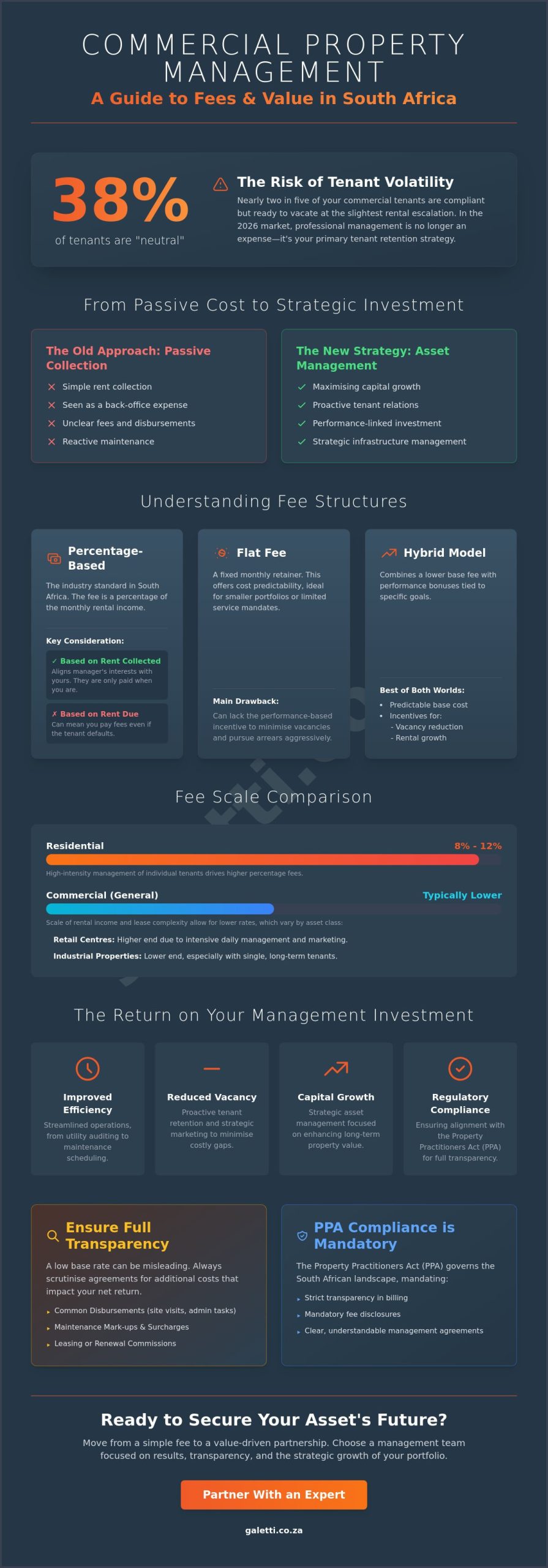
Nearly 38% of your commercial tenants are currently categorised as “neutral,” meaning they are technically compliant but ready to vacate at the slightest hint of a rental escalation. This volatility in the 2026 market proves that your choice of oversight is no longer a back-office expense; it’s a critical retention strategy. You likely feel the frustration of unclear fee structures that lead to unexpected disbursements, or perhaps you’re seeing high vacancy rates despite paying for professional management. It’s a common struggle to distinguish between a “cheap” quote and a value-driven partnership that actually protects your bottom line.
This guide provides a definitive framework for understanding commercial property management fees ZA in the current South African climate. You’ll discover the industry standard structures used by leading firms and learn how to evaluate these costs against tangible asset performance. We will outline the legal requirements for property practitioners and show you how to move from fixed escalations to a model of negotiated value. By the end of this article, you’ll have the clarity needed to compare management proposals and ensure your portfolio remains resilient against shifting economic growth projections. We focus on results, transparency, and strategic growth.
Key Takeaways
- Transition from passive rent collection to strategic asset management to secure long-term capital growth and tenant satisfaction.
- Navigate 2026 fee benchmarks by distinguishing between gross and net rental calculations across industrial, retail, and office sectors.
- Identify common disbursements and maintenance mark-ups to ensure full transparency and eliminate unexpected costs in your management agreement.
- Align your portfolio with the Property Practitioners Act (PPA) to ensure mandatory fee disclosures and regulatory compliance.
- Learn why commercial property management fees ZA represent a performance-linked investment that reduces vacancy gaps and improves operational efficiency.
Understanding Commercial Property Management Fee Structures in ZA
The South African regulatory landscape, governed by the Property Practitioners Act (PPA), mandates strict transparency in how professional services are billed. Within this framework, commercial property management fees ZA are no longer viewed as a simple administrative cost. The industry has shifted from passive rent collection to strategic asset management. This evolution means you aren’t just paying for a bookkeeper; you’re investing in a partner who manages technical infrastructure, tenant relations, and capital growth. Professional oversight ensures your asset remains competitive in a 2026 market where tenant retention is paramount.
Commercial fee structures differ significantly from residential standards. Residential agents often charge between 8% and 12% because of the high intensity of individual tenant management. In the commercial sector, the scale of rental income and the complexity of the leases allow for much lower percentage rates. These fees reflect the sophisticated nature of industrial, retail, and office environments, where technical maintenance and multi-year lease negotiations require a higher level of professional expertise. For comprehensive oversight, many landlords look to Corporate Services to handle these intricate requirements.
Percentage-Based Fees: The Industry Standard
Most South African agreements are based on a percentage of gross monthly income. It’s vital to clarify whether the fee applies to “Rent Collected” or “Rent Due”. Professional managers typically bill based on rent collected. This alignment of interests ensures the manager is incentivised to pursue arrears and maintain high occupancy levels. If the tenant fails to pay, the manager’s fee is impacted, creating a direct link between management performance and your cash flow.
Property management fee structures often fluctuate based on the asset class. Retail centres require intensive daily management and frequent marketing efforts, often commanding higher rates. Industrial properties with single, long-term blue-chip tenants are less labour-intensive and may sit at the lower end of the scale. The lease length also dictates the rate; a ten-year lease provides long-term stability that can reduce the risk-adjusted management fee during negotiations.
Flat Fee and Hybrid Models
Flat monthly retainers provide cost predictability for landlords with smaller portfolios or specific, limited mandates. This model works well when the workload is consistent and predictable. However, flat fees can lack the performance-based drive found in percentage models. To bridge this gap, many firms now offer hybrid structures. These combine a lower base fee with performance incentives tied to vacancy reduction or rental growth targets.
When evaluating these models, consider the balance between “all-inclusive” services and “disbursement-heavy” contracts. Some managers offer a low base rate but add significant surcharges for every site visit or administrative task. A transparent, results-oriented agreement is always the superior choice. It ensures that every Rand spent on management contributes directly to the long-term resilience and value of your property portfolio.
How Management Fees are Calculated: Benchmarks for 2026
Calculating commercial property management fees ZA involves more than a simple percentage. It’s a strategic calculation based on the asset’s operational intensity and the scale of the portfolio. Most leading firms utilise Gross Rent as the base for these calculations. This includes the base rent plus all recoveries, such as utilities and municipal rates. Managing these recoveries requires significant administrative effort and technical auditing. By using Gross Rent, the fee structure remains aligned with the total volume of work performed by the management team.
Regional consistency is a hallmark of professional management in South Africa. Whilst operational costs like security or cleaning may fluctuate between Gauteng, the Western Cape, and KwaZulu-Natal, the management fee percentages remain relatively stable. This provides institutional investors with a predictable framework for national portfolios. However, local nuances, such as electricity instability or infrastructure challenges, may require more intensive oversight in specific nodes. This operational reality is often reflected in the final negotiated management agreement.
Sector Benchmarks: Office, Retail, and Industrial
Each asset class demands a different level of expertise. Office properties currently show a 39% positive outlook in tenant satisfaction, according to 2026 industry data. Maintaining this confidence requires high-touch management and proactive infrastructure maintenance. Retail assets are notoriously complex due to turnover-based leases and the management of Common Area Maintenance (CAM). These factors often result in higher management fees compared to industrial assets. Industrial properties, often featuring single tenants and lower foot traffic, allow for more competitive percentage rates due to their lower management intensity.
Tiered Pricing for Large Portfolios
Institutional investors often benefit from economies of scale. As the total value or square meterage of a portfolio grows, the management fee percentage typically slides downwards. This tiered approach ensures that large-scale owners aren’t penalised for their success. The South African Property Owners Association (SAPOA) standards often inform these negotiations, ensuring fairness and transparency across the sector.
The “Base Plus” model is a key trend for 2026. It combines a fixed monthly fee to cover essential operational costs with performance-based incentives. These incentives are often tied to specific KPIs, such as reducing the vacancy gap or achieving rental growth targets. This model ensures that your management partner is directly invested in your asset’s performance. If you want to see how your current agreements align with these benchmarks, contact our strategic advisors for a portfolio review.
Beyond the Base Rate: Additional Costs and Disbursements
Achieving total transparency in commercial property management fees ZA requires looking past the monthly retainer. Base rates typically cover the day-to-day administrative burden, but strategic asset growth often involves variable disbursements. These costs shouldn’t be viewed as “hidden” charges. They are functional line items that facilitate tenant movement, structural improvements, and legal protection. Understanding Property Management Fee Structures in South Africa helps landlords anticipate these requirements during the budgeting phase. Clear communication regarding these extras prevents friction and ensures your manager has the resources to perform at a high level.
Project management fees for tenant installations (TI) and capital expenditure (CAPEX) represent a significant portion of these additional costs. When a new tenant moves in or a building undergoes a major upgrade, your management team oversees the contractors and ensures the work meets professional standards. This oversight often carries a fee based on the total project value. It’s a necessary investment; poor project management during a TI phase can lead to delays that cost far more in lost rental income than the management fee itself. Professional oversight guarantees that your capital is deployed efficiently and that the asset’s value is preserved.
Leasing and Renewal Commissions
Leasing brokerage is a distinct professional service that sits apart from monthly management. In the South African market, the South African Property Owners Association (SAPOA) provides the industry benchmark for these commissions. The standard 2026 structure involves a sliding scale: 5% on the first two years’ rental, 2.5% on the next three years, and 1.5% on the balance. Securing a lease extension also carries a renewal fee. This charge compensates the practitioner for the administrative work of renegotiating terms, updating legal documentation, and conducting market research to ensure the new rate is competitive. You can learn how Galetti manages corporate leasing to see how these benchmarks are applied to drive portfolio performance.
Administrative and Technical Disbursements
Operational excellence demands more than basic rent collection. Legal fees for custom lease drafting are standard, particularly for anchor tenants with complex requirements that fall outside a generic template. Technical audits are equally non-negotiable. Fire safety, electrical compliance, and HVAC inspections ensure your asset remains compliant with the Occupational Health and Safety Act and municipal by-laws. Some managers apply a maintenance mark-up, often around 10% of the total work cost, to manage these repairs and verify the quality of contractor outputs. Marketing and advertising costs for vacant spaces are also billed as disbursements, ensuring your property remains visible to the highest quality tenant profiles in a competitive market.
Evaluating ROI: Why Management Fees are a Strategic Investment
Viewing commercial property management fees ZA as a simple line-item expense is a strategic oversight. It is a performance-linked investment. The true cost of “cheap” management manifests in high vacancy rates and deferred maintenance that erodes capital value. Professional oversight ensures that your asset remains competitive, especially when nearly 38% of tenants are currently at risk of non-renewal. You can explore vacancy reduction strategies to understand how proactive management closes the gap between potential and actual yield.
Risk mitigation is a core component of this ROI. A professional commercial property risk assessment identifies vulnerabilities before they become liabilities. From PPA compliance to structural integrity audits, a seasoned manager protects you from litigation and unforeseen repairs. This proactive stance preserves the asset’s reputation and ensures long-term stability in a volatile market. Evaluating the ROI of commercial property management fees ZA requires a shift in perspective; it’s about the value created, not just the cost incurred.
Asset Value Protection and Growth
Professional management directly influences the Capitalisation (Cap) Rate. Investors pay a premium for properties with a history of efficient operations and high-quality tenant profiles. By optimising Net Operating Income (NOI), a manager increases the overall property valuation. Consider the logic of a 5% management fee. If that oversight results in a 15% increase in NOI through better recoveries and reduced operational waste, the ROI is undeniable. Management is the engine that drives capital appreciation. Investors pay a premium. It guarantees stability.
Operational Efficiency and Procurement Power
A managed portfolio benefits from collective bargaining. Managers leverage national vendor networks to secure preferential rates for security, cleaning, and technical maintenance. This procurement power often offsets a significant portion of the management fee. Utility management and energy efficiency also serve as vital cost-saving tools in 2026. You can learn more about optimising asset value through portfolio management to see how these efficiencies compound over time. Collective bargaining reduces overheads. It protects your margins.
If you want to maximise your asset’s performance, request a strategic portfolio consultation with our experts to identify untapped growth opportunities.
Selecting a Management Partner: Transparency and Compliance
Selecting a partner is a high-stakes decision that requires a clinical evaluation of a firm’s operational transparency and regulatory standing. Under the Property Practitioners Act (PPA), all commercial property management fees ZA must be disclosed with absolute clarity. This legislation protects landlords from hidden surcharges and ensures that every practitioner operates with a valid Fidelity Fund Certificate (FFC). When you review a proposal, don’t just look at the percentage. Audit the underlying structure to ensure your interests are protected. Transparency is the foundation of a resilient landlord-tenant partnership.
The Galetti advantage lies in our role as a strategic partner rather than a distant corporation. We provide a well-connected insider’s perspective, combining property management with our broader advisory and leasing expertise. This integrated approach ensures that your management strategy isn’t siloed from your long-term investment objectives. We provide definitive answers to complex problems, especially in a 2026 market where economic growth is projected at a modest 1.6%. Efficiency is our priority. Results are our metric.
Regulatory Requirements for South African Managers
Compliance is non-negotiable in the current legal landscape. You must verify that your chosen firm maintains audited trust accounts for all rent collection and service charge recoveries. These accounts ensure your capital is handled with institutional-grade security and is subject to annual independent audits. A professional management report in 2026 should go beyond basic bookkeeping. It must include detailed vacancy aging, utility recovery ratios, and municipal audit trails. If a manager cannot provide a transparent reporting suite, they aren’t equipped to handle a sophisticated commercial portfolio. Demand proof of FFC compliance before signing any mandate.
Tailoring the Agreement to Your Portfolio
A generic contract won’t suffice for complex industrial or retail assets. Your Service Level Agreement (SLA) must be customised to match your specific operational needs and tenant profiles. For institutional landlords, Galetti Corporate Services provides tailored oversight that aligns with high-level corporate strategy. We focus on movement and growth. We ensure that your management partner is accountable for specific performance KPIs, such as reducing the 38% neutral tenant risk identified in recent market studies. Use this final checklist to identify red flags in a management contract:
- Vague disbursement clauses that allow for uncapped administrative charges.
- Lack of clear PPA disclosure regarding shared commissions or mark-ups.
- Absence of performance-linked incentives for vacancy reduction.
- Opaque maintenance procurement processes that lack competitive bidding.
- Generic reporting templates that omit technical infrastructure status.
Securing the right partner means finding a facilitator who understands that management is a tool for asset appreciation. Don’t settle for a rent collector when you need a strategist.
Optimising Asset Performance for 2026
Effective oversight in the 2026 landscape requires a shift from expense management to value creation. Navigating commercial property management fees ZA is the first step toward securing a resilient portfolio. You now have the framework to evaluate proposals based on transparency, PPA compliance, and performance-linked incentives. A strategic partner doesn’t just collect rent. They actively protect your cap rate and reduce the vacancy gap through technical expertise and market intelligence. This proactive approach is vital when economic growth is projected at 1.6%. Pairing this with a rigorous commercial property portfolio audit gives you a complete picture of your asset performance and hidden liabilities across your holdings.
Galetti brings over 18 years of South African market expertise to your portfolio. Our integrated leasing, sales, and management approach ensures that every operational decision aligns with your broader investment goals. We utilise data-driven portfolio optimisation strategies to identify efficiencies and drive capital growth in a challenging climate. This ensures your assets remain competitive and attractive to high-quality tenants. Our team provides the clarity and results required by institutional landlords and private investors alike.
Maximise your asset's performance with Galetti Corporate Services. Take control of your property’s future today.
Frequently Asked Questions
What is the average commercial property management fee in South Africa for 2026?
Industry standards for commercial property management fees ZA typically involve a negotiable rate based on the complexity of the asset. Whilst a general market range of 4% to 12% of monthly rent is often cited, South African landlords should expect sector-specific benchmarks. Industrial properties with single tenants often command lower rates than high-intensity retail centres. These percentages are usually calculated on gross rental income, including recoveries.
Do management fees include the cost of building maintenance and repairs?
No, management fees cover the strategic and administrative oversight of the property rather than the direct cost of repairs. Landlords are responsible for the actual expenses related to building maintenance. It’s a common industry practice for property management firms to charge a mark-up, often around 10%, to oversee these maintenance projects and ensure that contractors meet professional standards. This ensures quality control and technical compliance.
How do commercial leasing commissions differ from monthly management fees?
Leasing commissions are once-off fees paid to a practitioner for successfully procuring a tenant or renewing a lease. These are often calculated using the SAPOA sliding scale based on the total lease value. Monthly management fees are ongoing charges for the day-to-day operations of the asset. They cover rent collection, technical oversight, and tenant relationship management throughout the year as part of commercial property management fees ZA.
Are property management fees in ZA subject to VAT?
Yes, all professional property management services in South Africa attract VAT at the standard rate of 15%. Landlords must account for this when evaluating management proposals, as most quotes are provided as a net percentage. If the landlord is a registered VAT vendor, this amount can usually be claimed back as input tax against the rental income collected. It’s a critical factor in your monthly cash flow projections.
What is a ‘disbursement fee’ in a commercial property context?
Disbursement fees are recoveries for specific expenses incurred by the manager whilst performing their duties. Common examples include marketing costs for vacant spaces, legal fees for bespoke lease drafting, and technical audit costs for fire or electrical compliance. These are functional line items that sit outside the base management percentage. They ensure the asset remains compliant and visible to the market without diluting the manager’s core operational budget.
Can commercial property management fees be negotiated based on portfolio size?
Negotiation is standard practice for landlords with substantial portfolios. Most professional firms offer a sliding scale where the management fee percentage decreases as the total value or square meterage of the portfolio grows. This tiered approach reflects the operational efficiencies gained when managing multiple assets for a single client. It ensures that institutional investors receive a competitive rate aligned with their scale and the reduced risk of their portfolio.
Does the Property Practitioners Act affect how fees are charged?
The Property Practitioners Act (PPA) significantly impacts fee transparency and disclosure requirements. It’s now a legal necessity for all commercial property management fees ZA to be clearly documented in a signed mandate. Practitioners must also possess a valid Fidelity Fund Certificate (FFC). The act protects landlords by ensuring that all trust accounts are audited and that any shared commissions or contractor mark-ups are fully disclosed before being charged.
Is it cheaper to manage a commercial property portfolio internally?
Internal management often carries hidden costs, such as specialised payroll, software licensing, and the loss of collective bargaining power. Professional management firms leverage national vendor networks to secure preferential rates for security and maintenance. This procurement power, combined with reduced vacancy risks through expert tenant procurement, often makes external management a more strategic investment. It protects your margins and frees you to focus on high-level portfolio growth. Before making this decision, conducting a thorough commercial property portfolio audit can reveal the true operational costs and performance gaps that inform whether internal or external management best serves your investment objectives.