The private treaty market is no longer the most efficient route to liquidity for high-value logistics assets. With national industrial vacancies at a lean 3.8% as of late 2025, industrial property auctions ZA have evolved from a distress-only channel into a sophisticated strategy for institutional price discovery. This shift reflects a market that demands speed, transparency, and absolute certainty.
You likely recognise that traditional sales timelines often stretch across months, leaving capital trapped whilst you navigate opaque negotiations and unqualified buyers. It’s a frustrating process that lacks the urgency your portfolio requires. This guide demonstrates how the auction mechanism provides a high-velocity, transparent platform for unlocking capital and securing prime manufacturing assets. We’ll examine how to achieve market-related pricing through competitive bidding, the benefits of non-suspensive sales, and how to access a pool of pre-qualified institutional investors ready to transact on a fixed timeline.
Key Takeaways
- Learn why industrial property auctions ZA have evolved into a primary strategy for institutional portfolio rebalancing and rapid capital liquidation.
- Discover how to leverage live and online auction formats to create maximum competitive tension amongst national and international buyers.
- Identify essential due diligence factors, from three-phase power availability to zoning compliance, to ensure a seamless acquisition process.
- Realise the benefits of a fixed 4-6 week marketing timeline that culminates in a non-suspensive sale at true market value.
- Understand how combining professional advisory experience with auction expertise provides a sophisticated alternative to traditional private treaty sales.
The Strategic Shift: Industrial Property Auctions in ZA Today
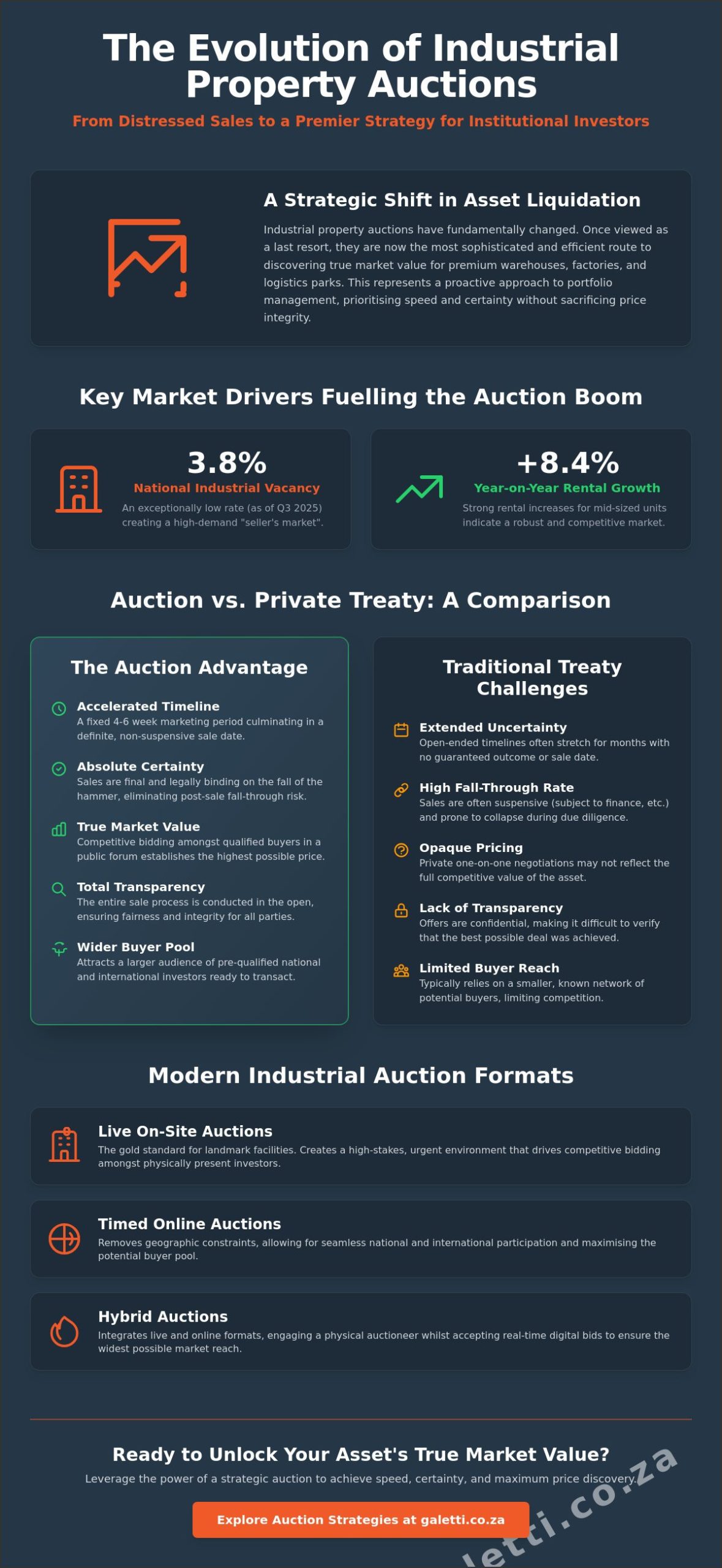
Industrial property auctions ZA have transitioned from a last-resort liquidation tactic to a sophisticated tool for institutional portfolio management. In the current 2026 landscape, these events provide a competitive, time-bound sale process specifically designed for high-value warehouses, factories, and logistics parks. The “distressed sale” stigma has vanished. It’s been replaced by a recognition that auctions offer the most transparent and efficient route to true market value for premium assets.
For Real Estate Investment Trusts (REITs) and large corporate entities, auctions facilitate rapid capital recycling. Most listed REITs delivered double-digit total returns in 2025, and maintaining that momentum requires aggressive asset disposal strategies. Auctions allow these organisations to offload non-core assets quickly, freeing up liquidity for new developments or strategic acquisitions in high-growth hubs. It’s a proactive approach to balance sheets that prioritises speed without sacrificing price integrity.
Market Drivers for Industrial Liquidity
National industrial vacancies sat at a remarkably low 3.8% as of Q3 2025, with rentals for mid-sized units growing by 8.4% year-on-year. This supply-demand imbalance creates a “seller’s market” where traditional negotiations often fail to capture the full upside of an asset’s value. National retailers are aggressively seeking modern logistics space to support regional distribution expansion. In this environment, auctions provide an immediate market-clearing price. They bypass the uncertainty of interest rate cycles, which are currently trending towards cautious cuts, by locking in buyers who are already capitalised and ready to move.
Auction vs Private Treaty: A 2026 Perspective
The primary advantage of an auction is certainty. Private treaty sales are open-ended and prone to falling through during long due diligence periods. By contrast, industrial property auctions ZA set a fixed date of sale, compelling bidders to complete their investigations beforehand. This structure relies on established auction formats and mechanics to drive price discovery through public competition. When multiple qualified buyers are in a single room, the psychological pressure often results in a final price that exceeds initial valuations.
Choosing the right disposal method is a critical corporate decision. Whilst private sales have their place, the transparency of the auction room is often superior for high-demand industrial assets. You can explore our broader approach to divestment through our guide on Auction vs Sale: Choosing the Best Commercial Disposal Path in 2026 to determine which path aligns with your 2026 strategy.
Understanding Industrial Auction Formats and Mechanics
The mechanics of industrial property auctions ZA vary based on the asset’s complexity and the profile of the target market. Selecting the correct format is a strategic decision that directly impacts the final price discovery. In the 2026 market, three primary models dominate the landscape, each serving a specific strategic purpose for asset disposal.
Live On-Site Auctions remain the gold standard for landmark industrial facilities. These events create a high-stakes environment where physical presence drives immediate urgency. They’re particularly effective for heavy industrial plants where the scale of infrastructure, such as high-capacity gantry cranes or specialised floor loading, must be seen to be valued. The atmosphere of a physical room often pushes bidders beyond their planned limits.
Timed Online Auctions offer a different strategic advantage. They remove geographic constraints, allowing for seamless national participation. An investor in Cape Town can compete for a warehouse in Richards Bay without the friction of travel. Hybrid models integrate these approaches, employing a physical auctioneer whilst accepting real-time digital bids. This ensures the widest possible reach, capturing both the local “boots on the ground” investors and remote institutional buyers.
Every auction contract is non-suspensive. This is the most critical mechanic for sellers seeking certainty. Unlike private treaty sales, these agreements are final. They aren’t subject to bond approval or post-sale due diligence periods. When the hammer falls, the commitment is binding. This eliminates the “cooling-off” risks that often plague traditional commercial transactions.
The Role of the Investor Pack
Transparency is the antidote to buyer friction. A professional industrial investor pack must be comprehensive to facilitate a non-suspensive sale. It includes zoning certificates, SG diagrams, and detailed lease schedules. We use secure digital dealrooms to organise these sensitive documents, allowing qualified bidders to conduct their full due diligence before the auction begins. When buyers have complete information, they bid with greater confidence and aggression. You can view our current listings and their associated documentation on our auction platform.
Timed Auctions for Secondary Assets
Timed auctions are exceptionally efficient for smaller industrial units or vacant land parcels. These platforms use “auto-extend” bidding mechanics. If a bid is placed in the final minutes, the clock resets for a short interval. This prevents last-second “sniping” and ensures the asset reaches its true market ceiling through fair competition. Setting a realistic reserve is vital here. It encourages early bidding behaviour and builds the momentum necessary for a successful result.
If you’re evaluating which format suits your current portfolio, speak with our team to discuss a tailored disposal strategy.
Essential Due Diligence for Industrial Auction Participants
Bidding at industrial property auctions ZA requires a transition from passive observation to active technical scrutiny. Because auction contracts are non-suspensive, as established in the previous sections, the bidder must complete all investigations before the hammer falls. This isn’t merely a walkthrough. It’s a rigorous audit of the asset’s operational viability and legal standing. For a comprehensive framework covering every stage of this process, our guide on commercial property due diligence South Africa provides a definitive strategic checklist to help you verify asset value and mitigate risk before commitment.
Technical specifications are the primary driver of value in this sector. Power is the currency of manufacturing. You must verify three-phase power availability and the specific Ampage supplied to the site. A shortfall in power capacity can lead to significant unbudgeted upgrades. Similarly, floor loading capacities must be confirmed. Modern logistics hubs require reinforced slabs capable of supporting high-density racking and heavy machinery. If the slab can’t support the weight, the facility’s utility is severely compromised.
Zoning and compliance are equally critical. A property zoned as ‘Light Industrial’ might prohibit the high-decibel manufacturing or chemical processing your operation requires. Environmental audits are non-negotiable for older manufacturing sites. Soil contamination is a legacy liability that can stay with the owner for decades. Remediation costs often exceed the acquisition price, making a pre-auction environmental report an essential document in your due diligence file.
Infrastructure and Access Requirements
Logistics efficiency depends on the external environment as much as the internal space. You must assess yard depth and turning circles to ensure they accommodate super-link access. Without sufficient room for articulated vehicles to manoeuvre, a warehouse becomes a bottleneck. Eaves height is another vital metric. In 2026, facilities with eaves heights below 8 to 10 metres are increasingly viewed as secondary assets. Furthermore, fire suppression systems must meet current standards. High-spec sprinklers and pumps are baseline requirements for securing institutional-grade insurance and attracting premium tenants.
Financial and Legal Preparedness
Acquisition costs extend beyond the hammer price. You must factor in the ‘Buyer’s Premium’, which is a standard commission paid by the purchaser, plus VAT at the current 15% rate. The ‘Rules of Auction’ serve as the binding legal framework for the transaction. These rules are governed by the Consumer Protection Act and dictate everything from bidding increments to deposit requirements. Failure to understand these terms can lead to immediate legal and financial exposure. For expert valuation and risk mitigation, we recommend consulting Galetti Corporate Services to ensure your bidding strategy is backed by professional advisory and market data.
Maximising Value: Why Sellers Choose Industrial Auctions
The decision to sell via industrial property auctions ZA is driven by the need for absolute certainty and the desire for a premium result. In a market where high-quality logistics space is scarce, traditional sales methods often leave capital on the table. Auctions replace the passive “wait and see” approach with a structured, aggressive environment that forces the market to react. This process creates intense competitive tension. When multiple institutional investors compete in real-time, the final bid often exceeds the seller’s initial expectations.
Speed is a critical advantage. A standard private sale can languish for months whilst buyers struggle with finance or internal approvals. Auction disposals operate on a compressed 4-6 week marketing cycle. This timeline is non-negotiable. It creates a sense of urgency that compels bidders to finalise their due diligence and capital allocation quickly. Every participant is pre-vetted. FICA documentation and significant registration deposits ensure only serious, qualified contenders enter the arena. This eliminates the “tyre-kickers” who often stall private treaty negotiations.
Risk mitigation is the final pillar of the auction advantage. These sales are unconditional. Because contracts are non-suspensive, there is no risk of the deal collapsing due to “subject to finance” or “subject to sale” clauses. Once the hammer falls, the sale is legally binding. This provides sellers with immediate peace of mind. It allows for precise financial planning regarding capital gains tax obligations, currently effective at 21.6% for businesses, or the immediate rebalancing of property portfolios. Understanding how to maximize commercial property value through data-driven asset engineering and income-based fundamentals is equally essential to protecting your margins at the point of disposal.
The Marketing Engine Behind the Auction
A successful auction relies on visibility. We deploy a sophisticated marketing engine that targets national industrial investors through precise digital channels. For large-scale manufacturing sites, professional photography and drone footage are essential. These tools showcase yard depths, eaves heights, and site accessibility in ways that static images cannot. By leveraging our extensive database of corporate occupiers and REITs, we ensure your asset is seen by the decision-makers most likely to bid aggressively.
Price Discovery in a Volatile Market
In a fluctuating economy, finding the true market ceiling is difficult. Auctions provide the most accurate form of price discovery. They eliminate the guesswork of “asking prices” by allowing the market to set the value. The reserve price serves as your safety net. It ensures the property is never sold below a pre-agreed minimum, protecting your equity whilst allowing for unlimited upside. For a deeper look at the strategic benefits of this method, read our guide on Commercial Property Auctioneers South Africa: A Strategic Guide to Asset Disposal.
If you are looking to liquidate a high-value industrial asset with total transparency and speed, contact our disposal experts today to discuss your requirements.
The Galetti Advantage: Integrating Auctions into Corporate Strategy
Galetti approaches industrial property auctions ZA as a strategic extension of corporate advisory. We move beyond the gavel. With 18 years of industry experience, we understand that an auction is not a standalone event but a vital component of a broader portfolio objective. Our advantage lies in the seamless synergy between our Corporate Real Estate Sales and auction divisions. This integration allows us to provide a holistic view of asset disposal that purely transactional firms cannot match.
Our national reach ensures a consistent service standard across all nine provinces. Whether you’re disposing of a single logistics hub in Gauteng or a multi-site manufacturing portfolio across the Western Cape and KwaZulu-Natal, we eliminate regional bias. We evaluate each asset on its specific merits. This allows our consultants to recommend whether an auction, a formal tender, or a private treaty sale is the most effective path for your capital requirements. It’s a bespoke approach to liquidity.
Data-Driven Auction Decisions
Timing is everything in the industrial sector. We use market analytics to identify the optimal window for disposal, considering factors like current national vacancy rates and sector-specific demand. Our leasing experts provide vital insights into the “highest and best use” of an asset. This identifies untapped potential that can be marketed to attract more aggressive bids from institutional players. Galetti leverages proprietary transaction data and real-time market sentiment to establish accurate reserve prices that balance seller protection with competitive momentum.
Listing Your Property with Confidence
The process of listing your property for auction with our specialist team is methodical and transparent. It begins with a comprehensive asset evaluation and the creation of a bespoke marketing strategy designed to reach pre-qualified buyers. We handle every detail, from FICA verification of bidders to the finalisation of the non-suspensive contract. Our commitment to professional ethics ensures that every transaction is handled with the discretion and sophistication required by high-level decision-makers. We focus on maximising asset value through clear, results-oriented execution.
Contact Galetti to discuss your industrial property disposal strategy and discover how our integrated approach can secure the liquidity your portfolio demands.
Securing Strategic Liquidity in the 2026 Industrial Market
The 2026 industrial landscape demands a disposal mechanism that matches the speed of the logistics sector. By leveraging industrial property auctions ZA, sellers move beyond the limitations of private treaty negotiations to achieve immediate, market-clearing results. This process ensures that high-demand assets, from manufacturing plants to distribution centres, are matched with qualified institutional capital through a transparent and competitive platform. Success in this environment relies on the rigorous due diligence and technical scrutiny established earlier in this guide.
Galetti brings over 18 years of corporate real estate expertise to every transaction. We provide integrated advisory and auction services that have built a proven track record with major institutional South African landlords. Our approach ensures that market analytics and technical specifications are prioritised to drive the best possible outcome for your portfolio. Whether you’re rebalancing a national logistics footprint or liquidating a single manufacturing site, our team provides the strategic framework necessary for success.
Maximise your industrial asset's value—List your property on auction with Galetti today. Position your assets for growth and realise the full potential of your industrial holdings with a partner who understands the mechanics of the gavel.
Frequently Asked Questions
What is the typical timeframe for an industrial property auction in South Africa?
A standard industrial disposal via auction typically operates on a 4 to 6 week marketing timeline. This compressed period creates urgency amongst bidders and ensures a fixed date for the transaction. Once the hammer falls, the sale is immediate and non-suspensive, eliminating the months of uncertainty often associated with private treaty negotiations.
Are industrial property auctions only for distressed or bank-repossessed assets?
No, the market for industrial property auctions ZA has evolved into a primary channel for institutional portfolio rebalancing. Whilst auctions were once associated with distress, they’re now the preferred method for REITs and corporate landlords to achieve market-related pricing for high-spec logistics assets. It’s a strategic move to ensure transparency and rapid capital recycling.
What costs should a buyer anticipate when participating in an industrial auction?
Buyers must account for the final bid price plus a buyer’s premium, which is generally between 5% and 7% in the commercial property sector. Additionally, VAT at the current 15% rate is usually applicable to these transactions. You should also factor in Deeds Office fees and transfer costs, which were updated as of 1 April 2026.
Can I view the property and perform due diligence before the auction date?
Yes, performing due diligence before the auction date is essential because all auction sales are non-suspensive. We provide comprehensive investor packs containing zoning certificates, SG diagrams, and technical specifications like three-phase power capacity. Viewing days are scheduled to allow your technical teams to inspect floor loading and logistics infrastructure in person.
Is the highest bid at an auction always accepted by the seller?
The highest bid is only accepted if it meets or exceeds the seller’s confidential reserve price. Most auctions are conducted “Subject to Confirmation” (STC), giving the seller a set period to formally accept the bid. This mechanic ensures the asset is never sold below its intrinsic value, even in a volatile economic climate.
What happens if the property does not meet the reserve price during the auction?
If the reserve price isn’t met, the property is “knocked down” to the highest bidder subject to the seller’s approval. The auctioneer then enters a period of negotiation between the seller and the highest bidder to reach a mutually acceptable price. This process often results in a successful sale shortly after the event concludes.
How do I register to bid for an industrial property online?
Registration for an online auction requires the submission of FICA documentation and the payment of a refundable registration deposit. You must also sign the “Rules of Auction” to acknowledge the binding legal framework of the process. Once verified, you’ll receive digital credentials to participate in the bidding platform from any geographic location.
What is the difference between a timed auction and a live on-site auction for industrial property?
A live on-site auction is a physical event that creates high-stakes urgency for landmark industrial facilities. In contrast, a timed auction is conducted entirely online over a set period, often spanning several days. Timed formats use auto-extend bidding to prevent last-second sniping, whereas live auctions rely on the immediate momentum of a physical room.