
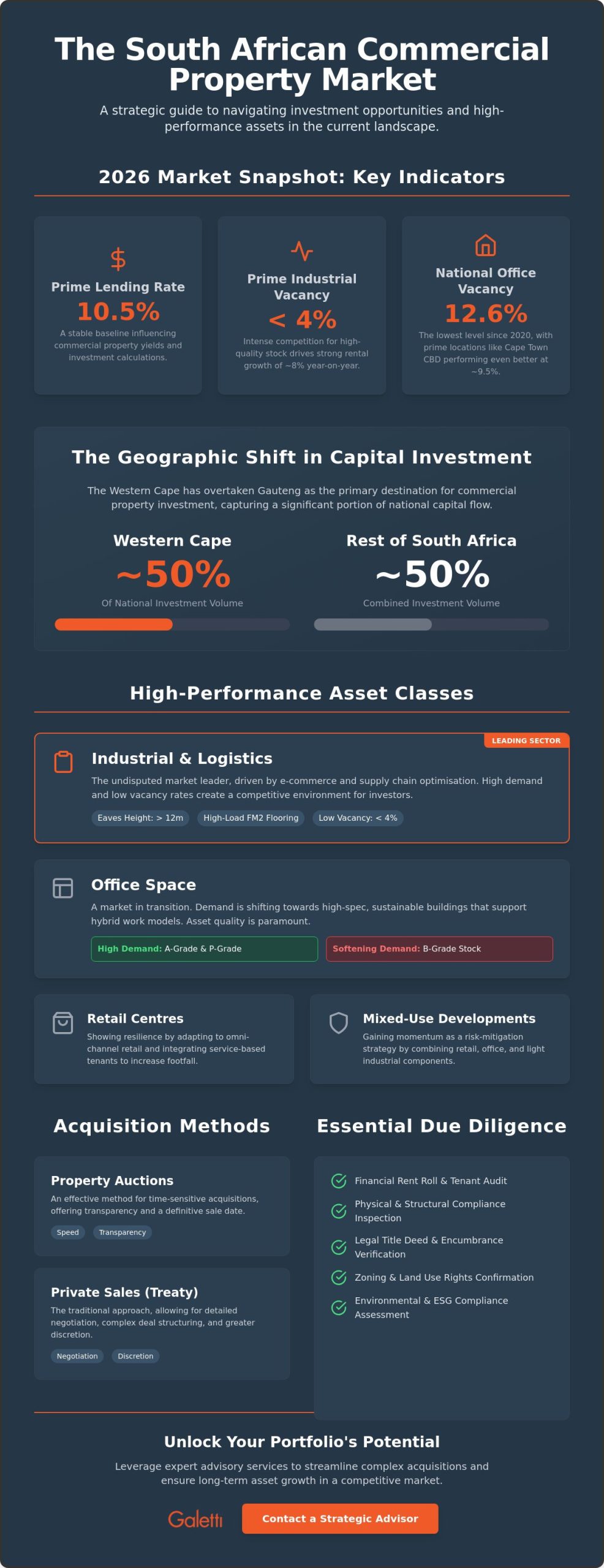
Did you know that the Western Cape captured nearly half of all commercial property investment volume last year, officially overtaking Gauteng as the primary destination for capital? Finding the right commercial property for sale South Africa has become a high-stakes pursuit where speed and data-driven insight are the only currencies that matter. You’ve likely experienced the frustration of opaque market data and a due diligence process that feels unnecessarily complex. It’s a common hurdle for those seeking high-quality stock whilst prime industrial vacancy rates sit below 4% nationally.
This roundup provides a professional roadmap to help you transition from simple listing hunting to strategic asset advisory. We’ll show you how to identify high-performance asset classes and master the acquisition methods required for a resilient portfolio. We’ll examine the impact of the 10.5% prime lending rate and the 2026 PIE Amendment Bill on your bottom line. This guide ensures you have the expertise to secure a strategic partner and unlock growth in the current South African landscape.
Key Takeaways
- Identify the core economic drivers and resilient sectors currently shaping the 2026 commercial landscape.
- Compare acquisition strategies for commercial property for sale South Africa, weighing the speed of property auctions against traditional private sales.
- Master the essential due diligence steps, from financial rent roll audits to structural compliance, required to protect your capital.
- Learn to distinguish high-performance assets by analysing the shift toward logistics-focused industrial sites and omni-channel retail centres.
- Leverage professional advisory and management services to streamline complex acquisition processes and ensure long-term asset growth.
The South African Commercial Real Estate Landscape 2026
The search for commercial property for sale South Africa has moved beyond simple listing reviews into the territory of high-level corporate strategy. Investors are navigating a market defined by a 10.5% prime lending rate and a renewed focus on fiscal discipline following the 2026 National Budget. The South African Commercial Real Estate Landscape 2026 reflects an economy where industrial assets and logistics hubs are significantly outperforming traditional office blocks. This shift requires a nuanced understanding of regional performance, particularly as the Western Cape continues to capture nearly half of all national investment volume.
Industrial real estate remains the market’s primary engine. Low vacancy rates, often dipping below 4% for prime stock, have pushed rental growth to approximately 8% year-on-year. Retail centres are also showing resilience by adapting to omni-channel consumer behaviour and integrating more service-based tenants. Success in this environment depends on national portfolio diversification. Strategic buyers are no longer concentrating capital in a single province but are instead spreading risk across high-growth logistics corridors and revitalised urban nodes. For those looking to acquire assets, commercial property for sale South Africa offers a mix of stable yields and capital appreciation if the asset selection is disciplined.
Market Drivers and Economic Indicators
Interest rate trajectories remain the primary influence on commercial yields. Whilst the 10.5% prime rate provides a stable baseline for 2026, government commitment to infrastructure spending is the real catalyst for long-term value appreciation. National cap rate trends are currently tracking towards compression in the industrial sector whilst remaining wider for non-prime office assets. This divergence highlights the importance of asset quality over mere quantity.
Supply and Demand Dynamics
National office vacancy rates have improved to 12.6%, the lowest level since 2020. This recovery is uneven; Cape Town’s CBD outshines the national average with a vacancy rate of roughly 9.5%. Modern occupiers are redefining their requirements, favouring high-spec, sustainable office spaces that support hybrid work models and ESG mandates. Consequently, demand for B-grade stock is softening whilst A-grade and P-grade properties in prime locations remain in high demand. Industrial land is becoming increasingly scarce, particularly in proximity to major ports and transport hubs, leading to a surge in brownfield redevelopments to meet the needs of the logistics sector.
Strategic Roundup: High-Performance Asset Classes
Asset selection in 2026 requires a shift from broad market exposure to sector-specific precision. Investors seeking commercial property for sale South Africa must prioritise utility and tenant resilience over historical prestige. The current climate rewards assets that facilitate modern supply chains or provide premium, flexible environments for a hybrid workforce. Whilst traditional yields remain under pressure in certain sectors, high-performance classes continue to deliver double-digit returns for those who understand the underlying technical requirements of modern occupiers.
Mixed-use developments are also gaining momentum as a risk-mitigation strategy. By combining retail, office, and light industrial components, these assets create a self-sustaining ecosystem that buffers against sector-specific downturns. This synergy enhances the overall asset performance and provides a more stable income stream. Success hinges on identifying the right commercial property for sale South Africa that aligns with these evolving structural demands. If you require assistance in identifying these high-yield opportunities, you may wish to consult with a strategic advisor to refine your portfolio strategy.
Industrial and Logistics Assets
The industrial sector remains the undisputed leader of the South African commercial landscape. With national vacancy rates for prime stock sitting below 4%, the competition for high-spec facilities is intense. Modern logistics occupiers demand specific technical attributes, such as eaves heights exceeding 12 metres and high-load FM2 flooring. Strategic location near major distribution corridors remains non-negotiable for national networks. For a deeper analysis of this sector’s requirements, refer to our guide on Industrial Real Estate Investment ZA.
Retail and Corporate Office Sectors
Retail property is undergoing a significant transformation as it adapts to omni-channel consumer behaviour. Landlords are increasingly focused on tenant mix, prioritising service-based retailers and “click-and-collect” hubs that drive footfall. Insights from the National Treasury on Acquisition Methods: Private Sales vs. Property Auctions highlight how retail dynamics in various nodes are shifting towards more integrated service models. In the office sector, Grade A and P-grade spaces are the only segments showing robust recovery. Corporate tenants are willing to pay a premium for sustainable, well-located environments that encourage staff to return to the office. You can explore these high-performance options in our roundup of Retail Property for Lease South Africa.
Acquisition Methods: Private Sales vs. Property Auctions
Choosing between a private treaty sale and a property auction is a strategic decision that dictates the speed and transparency of your capital deployment. For those identifying commercial property for sale South Africa, the choice often hinges on specific liquidity requirements and the complexity of the asset. Whilst traditional sales remain the standard for bespoke negotiations, the auction model has seen a significant rise in popularity. It offers a streamlined alternative that addresses the market’s demand for efficiency and immediate results.
The rise of property auctions in 2026 is a direct response to the need for certain execution. In a market where prime stock is limited, sellers are increasingly opting for the auction platform to ensure a competitive environment. Conversely, private treaty sales continue to serve investors who require more flexible timelines or have complex financing structures. Understanding the mechanics of each method is vital for any serious investor looking to secure commercial property for sale South Africa without falling into the trap of protracted negotiations.
The Property Auction Advantage
Auctions have become a primary tool for rapid asset disposal and effective price discovery. This method creates a competitive bidding environment that often pushes the final price beyond initial valuations. The process is defined by its transparency; all participants operate under the same conditions, and the sale is concluded on a non-suspensive basis. This means once the hammer falls, the deal is legally binding. There are no delays for financing clauses or extended due diligence periods. For investors looking for immediate deployment, explore Galetti’s Property Auction Services for immediate opportunities. The speed of this method is particularly beneficial in a fast-moving market where high-quality stock is scarce.
Navigating Private Treaty Sales
Private treaty sales, or traditional brokerage, offer a more controlled environment for complex transactions. This method allows for detailed negotiation on terms, warranties, and handover conditions. It is often the preferred route for high-value P-grade assets where the buyer pool is smaller and the due diligence requirements are extensive. Success in this arena relies heavily on professional brokerage. Expert market analysis ensures that both parties reach a fair market value whilst mitigating the risks associated with long-lead timelines. You can find more detailed info on Corporate Real Estate Sales to understand how bespoke negotiations can secure favourable terms for your portfolio.
Essential Due Diligence for Commercial Property Buyers
Rigorous due diligence is the only safeguard against capital erosion in a high-stakes market. Securing commercial property for sale South Africa requires more than a simple site visit; it demands a forensic audit of the asset’s financial, legal, and physical framework. Errors during this phase often lead to unforeseen liabilities that can compromise your internal rate of return (IRR). A professional acquisition strategy treats due diligence as a non-negotiable barrier between a strategic investment and a distressed asset.
The process must extend beyond surface-level checks. Environmental assessments are increasingly vital in 2026 as ESG mandates influence corporate tenant preferences. Buyers must also verify that all structural components meet national safety standards whilst ensuring the title deed is free of restrictive conditions. If you’re ready to move forward with a specific asset, contact our advisory team to initiate a professional due diligence process.
Valuation and Financial Analysis
Verifying the rent roll is the foundation of any commercial audit. You must scrutinise every lease agreement to confirm expiry dates, escalation rates, and recovery structures for operating expenses. It’s essential to account for potential vacancies and credit risks within the current tenant mix. The Income Capitalisation Method estimates a building’s current value by dividing the net operating income by a specific capitalisation rate. For a deeper understanding of how we arrive at these figures, consult our guide on Commercial Building Valuation Methods.
Compliance and Zoning
Municipal alignment is often where acquisitions face the most significant hurdles. You must ensure the property’s current use is strictly permitted under local zoning rights to avoid heavy fines or forced closures. Occupation Certificates and Fire Safety compliance are mandatory requirements that shouldn’t be overlooked. A thorough review of existing leases is also necessary to identify “hidden” landlord obligations, such as specific maintenance duties or capital expenditure requirements that could impact your long-term cash flow. Protecting your investment in commercial property for sale South Africa means closing every loophole before the transfer of ownership occurs.
Maximising Portfolio Value with Galetti’s Advisory
Asset acquisition is only the first stage of a successful investment lifecycle. Portfolio growth in 2026 requires an integrated approach that spans the entire journey from valuation to long-term management. Galetti provides this through 18 years of national market expertise; we move beyond the simple listing to offer high-level strategic advisory. When you look for commercial property for sale South Africa, you’re looking for more than a building. You’re seeking a vehicle for capital growth supported by data-driven insights and a sophisticated understanding of corporate real estate strategy.
Accessing the best stock often means looking where others don’t. Our professional networks provide clients with access to off-market opportunities that never reach public portals. This insider advantage is essential in a market where prime industrial and Grade A office stock is in high demand. We combine this national reach with advanced technology to ensure every decision is backed by real-time market dynamics. It’s this combination of experience and innovation that allows us to identify value where others see complexity.
Corporate Real Estate Solutions
Optimising a portfolio requires constant vigilance and strategic adjustments. Our team focuses on strategic asset management and portfolio optimisation to ensure your holdings remain resilient against economic shifts. We provide specialised tenant procurement and leasing services designed to reduce vacancy rates and improve the quality of your rent roll. High-performance portfolios depend on high-quality tenants. Explore our Corporate Services for bespoke advisory tailored to your specific investment goals.
Your Strategic Partner in South Africa
Galetti stands as the first choice for both institutional and private investors because we deliver clarity in an opaque market. We don’t just facilitate transactions; we build long-term partnerships based on reliability and results. By combining market intuition with advanced data analytics, we help you navigate the complexities of the South African landscape with confidence. It’s time to move from listing hunting to strategic acquisition. View our current commercial property for sale to begin your next phase of portfolio growth.
Securing Your Strategic Advantage in 2026
Success in the current market requires a shift from passive observation to active, data-driven acquisition. We’ve explored how industrial resilience and the evolution of high-spec office environments are reshaping demand across the country. You now understand that navigating commercial property for sale South Africa demands more than just capital; it requires a forensic approach to due diligence and a clear-eyed choice between the speed of property auctions and the precision of private treaty sales. Strategic deployment is the only way to safeguard your internal rate of return whilst vacancy rates shift across regional nodes.
Galetti brings over 18 years of industry experience to your portfolio strategy. Our specialised Corporate Real Estate Advisory division and leading national commercial property auctioneers are positioned to provide the clarity you need in a complex landscape. We combine market intuition with technical expertise to ensure your next move is both calculated and profitable. High-level decision-making shouldn’t happen in a vacuum. Partner with Galetti for your next commercial property acquisition and take the next step toward a resilient, growth-oriented portfolio.
Frequently Asked Questions
What are the current commercial property trends in South Africa for 2026?
The market is currently defined by the continued dominance of the industrial sector and a significant capital shift toward the Western Cape. Industrial vacancy rates remain below 4% nationally, whilst prime industrial rentals have grown by approximately 8% year-on-year. We’re also seeing a steady recovery in the office sector. Cape Town leads this trend with a CBD vacancy rate of roughly 9.5%, significantly outperforming the national average of 12.6%.
How does the commercial property auction process work for buyers?
Auctions operate on a transparent, non-suspensive basis where the sale is final once the hammer falls. Buyers must register in advance, provide FICA documentation, and usually pay a refundable registration deposit. Because there are no suspensive conditions for finance or due diligence, you must complete all inspections and financial audits before the auction date. Successful bidders pay a deposit and the auctioneer’s commission immediately upon the fall of the hammer.
What is a good yield for commercial property in the South African market?
Yield expectations depend on the asset class and risk profile, but they’re currently benchmarked against the 10.5% prime lending rate. Prime industrial assets often see compressed yields due to high demand and low vacancy. In contrast, B-grade office or retail assets may offer higher initial yields to compensate for increased vacancy risks. Investors should focus on the net initial yield whilst accounting for realistic recovery rates and long-term capital appreciation.
Are there specific zoning requirements for industrial property for sale South Africa?
Yes, industrial land is categorised into specific zones that dictate the type of activity permitted on-site. Industrial 1 typically covers light industry and service trades, whilst Industrial 3 is reserved for heavy or noxious industries. When evaluating industrial property for sale South Africa, you must verify that the current municipal zoning aligns with your operational requirements. Failing to secure the correct occupation certificates can lead to significant legal and financial complications.
How can I list my commercial property for sale with a professional broker?
The process begins with a formal valuation and a review of your current rent roll and zoning documents. A professional broker will conduct a market analysis to determine a competitive asking price before developing a bespoke marketing strategy. Your property is then positioned across national networks and digital platforms. Sellers can choose between a private treaty sale for negotiated terms or an auction for a faster, market-driven result.
What is the difference between Grade A and Grade B office space?
Grade A office space features modern architectural designs, high-quality finishes, and advanced security systems. These buildings often include sustainable “green” features and P-grade amenities that attract blue-chip corporate tenants. Grade B space is generally older stock that remains well-maintained but lacks the high-spec technology and ESG compliance of newer developments. Whilst Grade B offers lower rentals, Grade A properties currently experience higher demand and lower vacancy rates in prime nodes.
What costs are involved in purchasing commercial property besides the sale price?
Buyers must account for transfer duty, conveyancing fees, and potentially VAT if the seller is a registered vendor. According to the 2025/2026 SARS brackets, properties valued above R13,310,000 incur a transfer duty of R1,241,456 plus 13% of the value exceeding that amount. If the transaction is a “going concern” between two VAT vendors, it may be zero-rated. You should also budget for structural inspections and municipal clearance costs during the due diligence phase.
How do I conduct a professional commercial building valuation?
Professional valuations primarily utilise the Income Capitalisation Method to determine an asset’s market value. This involves calculating the Net Operating Income (NOI) by subtracting all operating expenses and vacancy provisions from the gross annual rental. This figure is then divided by a market-related capitalisation rate that reflects the property’s risk and quality. A thorough valuation also considers recent comparable sales of commercial property for sale South Africa within the same geographic node.