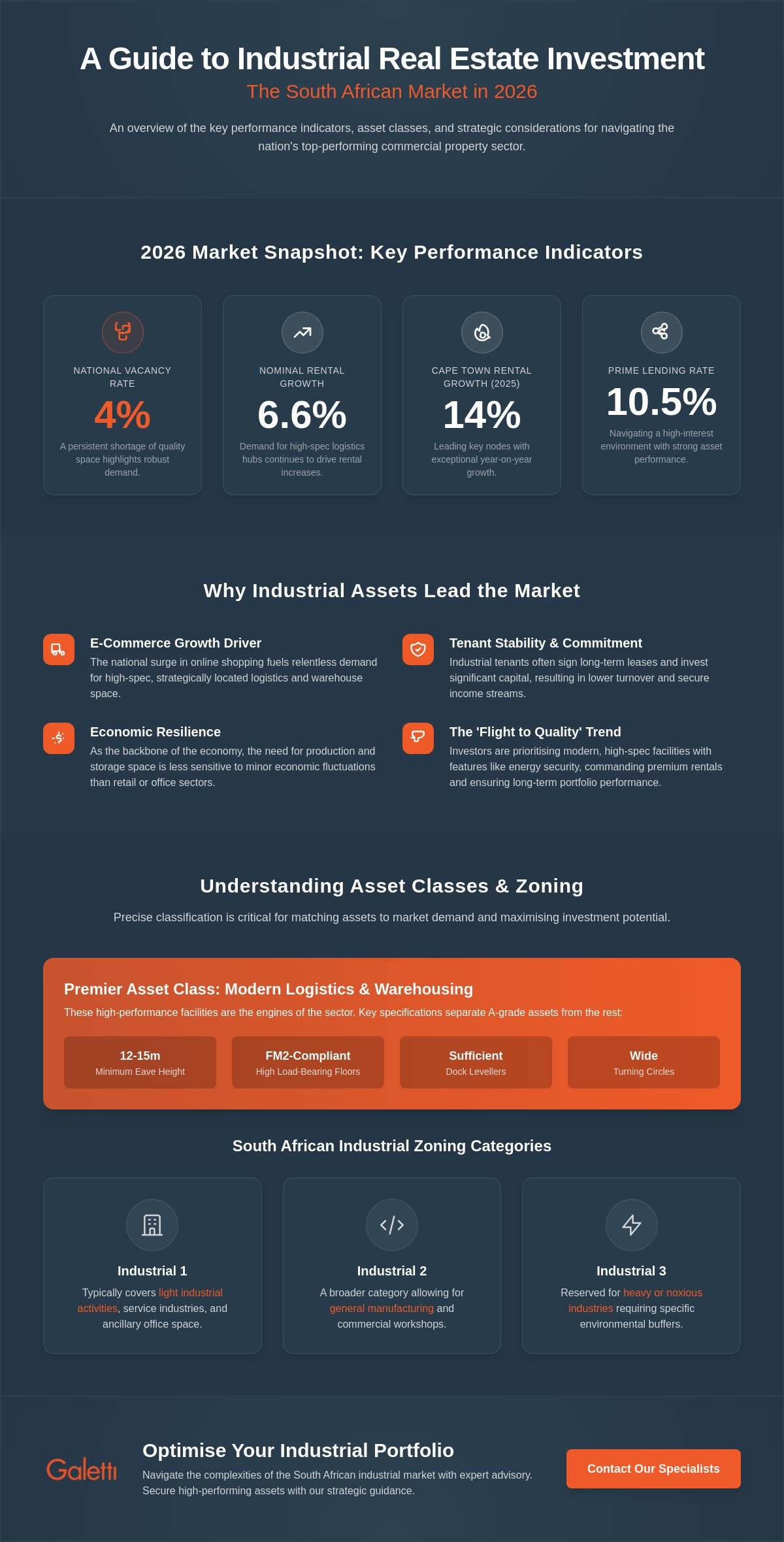
With national vacancy rates sitting at just 4% in early 2026, the industrial sector remains the undisputed anchor of the South African commercial landscape. You’re likely aware that despite a prime lending rate of 10.50%, the demand for high-spec logistics space continues to outpace supply in key nodes like Cape Town and Johannesburg. Mastering an industrial real estate investment ZA strategy requires more than just capital. It demands precision.
This guide provides the essential framework for navigating the South African market, from initial asset selection to strategic disposal. We’ll explore how to manage liquidity in a high-interest environment and identify the logistics hubs driving a 6.6% nominal rental growth. You’ll gain a clear roadmap for securing stable yields whilst managing complex zoning and diversifying your portfolio with high-performing industrial assets.
Key Takeaways
- Identify the drivers behind the industrial sector’s resilience and its status as a top-performing commercial asset class in 2026.
- Gain clarity on South African zoning categories to ensure your site selection meets specific manufacturing or distribution needs.
- Learn to calculate net initial yields and leverage the ‘flight to quality’ trend to secure high-performing logistics assets.
- Navigate the complexities of industrial real estate investment ZA by comparing the efficiency of accelerated auctions with traditional private treaty sales.
- Optimise your commercial portfolio through strategic leasing, sales, and professional property development advisory.
Understanding the Industrial Real Estate Landscape in South Africa
Industrial real estate investment ZA involves the strategic acquisition of land or buildings zoned for production, storage, or logistics. It’s the functional backbone of the national economy. In 2026, this sector remains the most resilient segment of the South African commercial market. Large-scale entities like Growthpoint Properties have built substantial portfolios on this foundation of stability. The landscape has shifted significantly. We’re seeing a clear transition from traditional, heavy manufacturing plants to modern, technology-driven logistics hubs. These facilities are designed for speed and efficiency, catering to the demands of a digital-first consumer base.
Industrial property plays a vital role in a balanced South African investment portfolio. It provides a reliable hedge against the volatility often seen in the retail and office sectors. Demand for space is consistent. High-spec warehouses are essential for the movement of goods, making them less sensitive to minor economic fluctuations. Investors value this predictability. It ensures steady capital growth and consistent income streams over the long term.
Why Industrial Assets Outperform Other Commercial Sectors
The 2026 Investment Outlook for South Africa
The 2026 outlook is defined by a high-interest environment and a focus on operational continuity. With the repo rate at 7.0% as of May 2026, financing costs are elevated. However, property yields are maintaining growth because demand for A-grade space remains high. Energy security is now a non-negotiable requirement. Modern industrial facilities must incorporate solar power and robust back-up systems to mitigate grid instability. Facilities that offer these features command a premium. Nationally, industrial warehouse lease rates are trending upwards, particularly in Cape Town where rental growth reached 14% in 2025. Investors are prioritising assets that offer these modern efficiencies to ensure long-term portfolio performance.
Key Asset Classes and Zoning Categories for Investors
Success in industrial real estate investment ZA depends on a precise understanding of zoning and asset classification. These categories determine the potential tenant profile and the long-term utility of the property. The South African industrial property sector categorises assets primarily by their operational impact and structural capabilities. Investors must distinguish between light industrial, heavy manufacturing, and logistics warehouses to align their portfolios with market demand.
Industrial 1 zoning typically covers light industrial activities, including service industries and ancillary offices. Industrial 2 is broader, allowing for general manufacturing and commercial workshops. Industrial 3 is reserved for heavy or noxious industries that require specific environmental buffers. Selecting the wrong zoning can lead to significant regulatory friction or expensive rezoning applications. Many investors now target distribution centres for lease South Africa to capture the e-commerce surge. These assets require specific yard depths and clear heights to remain competitive in a fast-moving market. For investors considering greenfield development, securing industrial land for sale South Africa with the correct zoning classification and high Floor Area Ratios is a critical first step in building a future-proof logistics asset.
Logistics and Warehousing: The Premier Asset Class
Modern logistics facilities are the high-performance engines of the sector. Investors must evaluate technical specifications with clinical detail. Look for minimum eave heights of 12 to 15 metres to allow for high-density racking. Floors must be FM2-compliant with high-load-bearing capacities to support heavy machinery and inventory. Sufficient dock levellers and wide turning circles for interlink trucks are essential for operational efficiency. The ‘last-mile’ delivery concept has redefined property values in urban peripheries. These smaller hubs allow retailers to fulfil orders within hours. Securing logistics property for sale South Africa in these strategic locations is a priority for 2026.
Industrial Parks and Multi-Tenant Mini-Units
Multi-tenant industrial parks offer a robust defensive strategy. By housing several smaller businesses, investors reduce the risk of a total income loss if one tenant vacates. These parks often feature shared security, fire suppression systems, and centralised management. Identifying high-performance parks requires looking at common area maintenance and the quality of shared infrastructure. Managing these units is more intensive than single-tenant facilities. It requires proactive maintenance and tight control over utility recoveries. We’re also seeing a rise in ‘flex’ spaces. These hybrid units combine high-spec office finishes with a functional warehouse component. They cater perfectly to tech-heavy distribution firms that need a corporate presence alongside their inventory. If you’re ready to expand your footprint, speak with our advisory team about current opportunities.
Evaluating Performance: Yields, Risks, and Market Benchmarks
Performance measurement in industrial real estate investment ZA centres on the net initial yield. You calculate this by dividing the annual net rental income by the total acquisition cost. In 2026, with the repo rate at 7.0% and prime at 10.50%, investors are scrutinising spreads more closely. Market benchmarks are shifting. The South Africa Industrial Market Dynamics report highlights how inflation, which sat at 4.5% in May 2026, continues to impact operating costs. We’re seeing a definitive ‘flight to quality’. Capital is moving away from legacy manufacturing plants towards A-grade logistics hubs. Older facilities often suffer from structural obsolescence, such as low eave heights or insufficient floor loading, which makes them difficult to re-let in a competitive market.
ESG integration is no longer optional; it’s a value preservation tool. High-spec facilities with solar arrays and water-harvesting systems command higher valuations and attract blue-chip tenants. These features mitigate the risk of rising utility costs and grid instability. National infrastructure constraints, particularly around port and rail efficiency, remain a concern. However, assets located within primary logistics corridors provide a natural buffer against these challenges. They ensure your portfolio remains liquid and attractive to institutional buyers.
Benchmarking Industrial Yields in 2026
A-grade logistics typically command tighter yields, reflecting their lower risk profile and modern specifications. B-grade stock offers higher entry yields but comes with increased maintenance requirements and vacancy risks. Most institutional investors prefer triple-net leases. In this structure, the tenant covers all operating expenses, including insurance, rates, and maintenance. This provides the landlord with a predictable net income stream. To invest in South African commercial real estate successfully, you must prioritise assets with long-term lease covenants and sustainable utility solutions that protect against future cost spikes.
Risk Mitigation and Due Diligence
Rigorous due diligence is the only way to protect capital. Your checklist must include comprehensive environmental audits to identify legacy soil contamination, especially in older industrial nodes. Structural integrity assessments are equally vital. Scrutinise the lease expiry profile of the asset. A staggered expiry schedule prevents the risk of total vacancy in a single period. Evaluate the creditworthiness of your tenants with the same rigour as a bank. Location within national logistics corridors is the ultimate risk hedge. It ensures the property remains relevant regardless of specific industry shifts or tenant turnover.
Strategic Acquisition and Disposal: Auctions vs Private Treaty
Strategic agility is essential for a successful industrial real estate investment ZA portfolio. Investors must choose between the traditional private treaty process and the accelerated auction model. Each method serves a specific strategic purpose. Private treaty sales allow for prolonged negotiations and extensive due diligence periods, which often suit highly specialised manufacturing plants. However, the accelerated auction model has emerged as a preferred method for industrial asset liquidation. It provides a definitive timeline and forces market-driven pricing through competitive bidding.
Auctions offer unparalleled transparency. Buyers see exactly what the market is willing to pay in real-time. This eliminates the market stalemate where buyers and sellers are hesitant to commit to a price. For sellers, it ensures a date-certain sale, which is critical for managing liquidity in a high-interest environment. You can explore high-quality industrial stock currently available on auction to identify immediate opportunities that meet your yield requirements.
When to Source Industrial Assets via Auction
Auctions are particularly effective for bank-mandated sales or corporate disposals where a clean exit is required. They offer a level playing field for all participants. Preparation is vital. You must complete FICA requirements well in advance and ensure your deposit structure is ready before the hammer falls. Most commercial auctions require a 5% to 10% deposit on the day. If you are looking to exit a position, you can list your property for auction to tap into a national pool of pre-qualified investors. This competitive environment often yields results that exceed initial valuations.
Private Treaty Sales for Complex Industrial Portfolios
Large-scale industrial acquisitions often happen off-market. This is where commercial property brokers South Africa play a decisive role. They facilitate confidential transactions between institutional sellers and private equity groups. This bespoke approach is necessary for specialised assets where the tenant covenant or complex machinery requires a nuanced negotiation. The private treaty process allows for a more granular assessment of the lease expiry profile and environmental risks. It remains the standard for multi-asset portfolio transfers that require a tailored settlement period. If you need assistance with a strategic acquisition or disposal, contact our expert brokers today for a confidential consultation.
Optimising Your Industrial Portfolio with Galetti
Maximising returns in industrial real estate investment ZA requires an integrated strategy that spans the entire asset lifecycle. Galetti provides a unified platform encompassing property leasing, sales, and auction services. This multi-channel approach ensures that your assets are positioned correctly, whether you’re seeking a long-term tenant or an immediate exit. Our data-driven insights allow landlords to identify rental growth opportunities and optimise occupancy rates amidst shifting economic conditions. We don’t just facilitate transactions; we act as a strategic partner to unlock latent value within your portfolio.
For investors looking at new entries or expansions, our industrial property development advisory is essential. We guide clients through the complexities of greenfield developments and brownfield redevelopments. This is particularly relevant in 2026, as the demand for A-grade logistics space continues to outstrip supply in primary nodes. Upgrading older manufacturing stock to modern specifications can significantly enhance yield and attract high-covenant tenants. Our team provides the technical expertise and market intelligence needed to mitigate development risks and ensure project feasibility.
Comprehensive Asset and Portfolio Management
Galetti’s corporate services provide a robust framework for long-term wealth preservation. This includes professional valuations, strategic consulting, and proactive portfolio management. Professional management is the most effective way to reduce vacancy rates and improve tenant retention. We focus on building strong relationships with occupants whilst ensuring that all operational recoveries are handled efficiently. Galetti’s 18-year track record in the ZA commercial sector provides a foundation of reliability and deep market penetration. This experience allows us to anticipate market shifts and adjust portfolio strategies before they impact your bottom line.
Next Steps: Securing Your 2026 Investment
Securing a competitive advantage in the current market requires immediate action. Engaging with Galetti for a comprehensive portfolio audit or a detailed market analysis is the first step toward optimisation. You can access our latest industrial market reports to stay informed on regional performance and emerging logistics hotspots. We encourage investors to explore our corporate real estate leasing opportunities to gain a deeper understanding of current tenant demand and specific technical requirements. Whether you’re acquiring your first warehouse or disposing of a multi-asset portfolio, our team is ready to provide definitive solutions to your most complex property challenges.
Strategic Advantage in the 2026 Industrial Market
The industrial sector remains South Africa’s most robust commercial asset class. Success in 2026 requires a clinical approach to asset selection, focusing on high-spec logistics nodes and energy-secure facilities. By mastering zoning nuances and leveraging the speed of accelerated auctions, investors can navigate high-interest environments whilst maintaining portfolio liquidity. Precision is the primary driver of growth in this landscape.
Strategic industrial real estate investment ZA is no longer just about acquiring space; it’s about engineering long-term yield through precise market timing and asset management. Galetti offers over 18 years of South African market expertise to guide your capital allocation decisions. As a trusted advisor to JSE-listed entities and corporate occupiers, we provide a sophisticated, integrated auction and brokerage platform designed for maximum efficiency. Our data-driven insights ensure your portfolio remains resilient against national infrastructure constraints and market volatility.
Maximise your returns—explore Galetti's latest industrial property auctions and sales today. Your next strategic acquisition starts with definitive expert advisory.
Frequently Asked Questions
Is industrial real estate a good investment in South Africa in 2026?
Industrial real estate remains the best-performing asset class in the South African commercial market in 2026. Low national vacancy rates of approximately 4% and consistent rental growth of 6.6% in early 2026 highlight its resilience. It outperforms the office and retail sectors by providing stable yields and long-term capital growth. This makes industrial real estate investment ZA a primary choice for diversifying portfolios.
What is the average yield for industrial property in ZA?
Average yields for industrial property vary by asset grade and location, but market rentals for 500m² units increased by 6.6% year-on-year in early 2026. A-grade logistics facilities in prime nodes like Cape Town often command tighter yields due to high demand and rental surges of 14% recorded in 2025. Investors generally target net initial yields that provide a healthy spread over the current 7.0% repo rate.
How does industrial zoning (Industrial 1 vs 2) affect my investment?
Industrial zoning dictates the specific activities permitted on a property and directly impacts its market value. Industrial 1 typically covers light industries and service trades, whereas Industrial 2 allows for broader manufacturing and commercial workshops. Choosing the correct zoning ensures your asset remains compliant with municipal regulations and appeals to the intended tenant profile without requiring costly rezoning.
Can I buy industrial property through an auction in South Africa?
You can certainly acquire industrial property through auctions, which have become a preferred method for strategic asset acquisition in South Africa. Auctions provide a transparent, market-driven environment with fixed timelines for completion. This process eliminates price stalemates between buyers and sellers. It’s an efficient way to secure high-quality stock from bank-mandated sales or corporate disposals.
What are the benefits of a triple-net lease for industrial investors?
A triple-net lease benefits investors by transferring all operating costs, including insurance, rates, and maintenance, to the tenant. This structure ensures a predictable net income stream and protects the landlord from inflationary spikes in utility or service costs. It’s the preferred lease model for institutional industrial real estate investment ZA because it minimises management intensity and stabilises yields.
How much deposit is typically required for an industrial property auction?
Auction houses typically require a 5% to 10% deposit of the purchase price on the day of the sale. This is often accompanied by the auctioneer’s commission. Whilst the auction deposit is immediate, investors should note that South African banks generally require a 30% deposit when providing financing for commercial and industrial property acquisitions.
What is the difference between a warehouse and a distribution centre in ZA?
The primary difference lies in operational intent: a warehouse is designed for long-term storage, whilst a distribution centre focuses on the rapid movement of goods. Distribution centres require specific technical specs like higher eave heights, multiple dock levellers, and large yards for truck turning circles. They are the high-performance engines of the modern logistics sector, prioritising throughput over inventory holding.
Why is ESG becoming important for industrial property investment?
ESG is critical for preserving asset value and mitigating risks associated with grid instability and rising utility costs. Features like solar power and water-saving systems are now essential for attracting high-covenant tenants who have their own corporate sustainability mandates. Properties with strong ESG credentials command higher valuations and experience lower vacancy rates in an increasingly conscious investment landscape.