
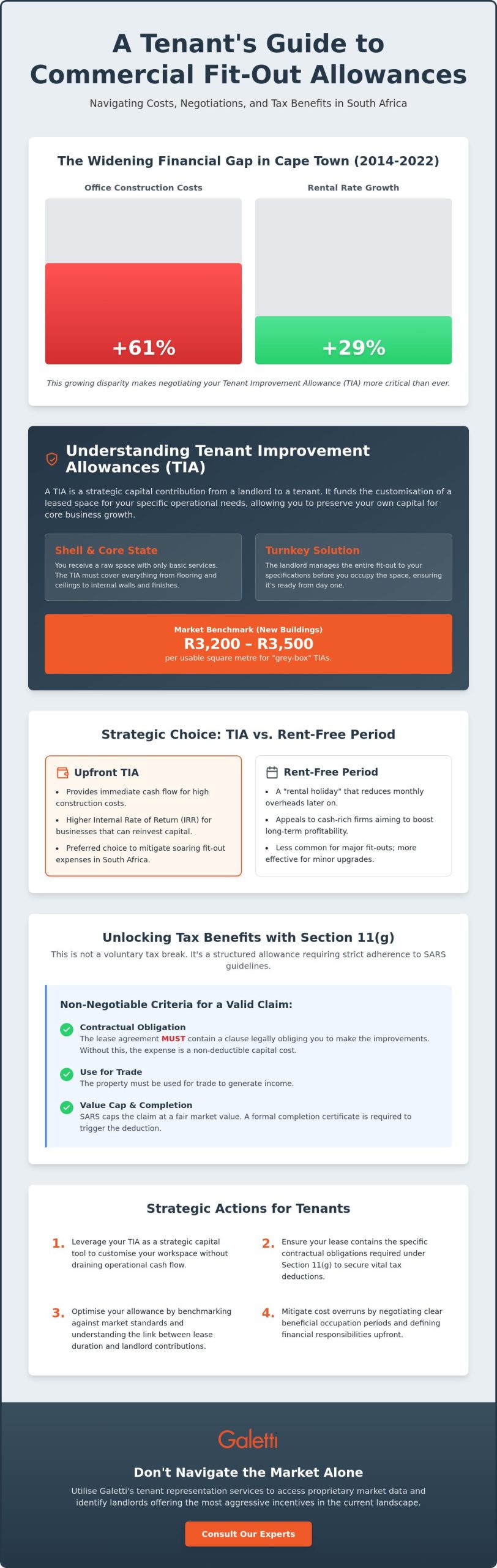
Between 2014 and 2022, office construction costs in Cape Town surged by 61 per cent whilst rental rates grew by just 29 per cent. This massive disparity has turned the standard commercial tenant improvement allowance South Africa into a high-stakes negotiation rather than a simple lease incentive. You’ve likely felt the pressure of these rising fit-out costs when planning your next move. High upfront capital requirements for a bespoke workspace can stall growth. They often force unnecessary compromises on your operational environment.
We’ll show you how to bridge this financial gap. You’ll master the complexities of tenant allowances and leverage Section 11(g) tax benefits to your advantage. Our guide examines the 2026 VAT legislative shifts and breaks down the SARS Section 11(g) deduction framework. We provide actionable tactics to secure maximum funding for your interior. You’ll learn to navigate the “pay now, argue later” principle and align your lease terms with long-term capital efficiency. It’s time to transform your fit-out from a liability into a strategic advantage.
Key Takeaways
- Understand how to leverage a commercial tenant improvement allowance South Africa as a strategic capital tool to customise your workspace without depleting operational cash flow.
- Secure vital tax deductions by ensuring your lease agreement contains the specific contractual obligations required under Section 11(g) of the Income Tax Act.
- Optimise the quantum of your allowance by benchmarking against 2026 market standards and understanding the correlation between lease duration and landlord contributions.
- Mitigate the risk of fit-out cost overruns and project delays by negotiating clear beneficial occupation periods and defining financial responsibilities upfront.
- Utilise professional advisory services to access proprietary market data and identify landlords offering the most aggressive incentives in the current landscape.
Understanding Commercial Tenant Improvement Allowances in South Africa
A commercial tenant improvement allowance South Africa is a strategic capital contribution from a landlord to a tenant. It’s designed to fund the customisation of a leased space to meet specific operational requirements. This allowance isn’t a gift. It’s a vital component of the Net Effective Rent calculation. Landlords use it as a lever to secure high-value occupants, whilst tenants use it to preserve their own capital for core business growth.
The delivery state of a property dictates the scale of the allowance. In a “Shell and Core” state, you receive a raw space with basic services. Here, the allowance must cover everything from flooring to ceilings. 2023 market data indicates that “grey-box” TIAs for new buildings often range between R3,200 and R3,500 per usable square metre. Conversely, “Turnkey” solutions involve the landlord managing the entire fit-out to your specifications before you move in. This model is prevalent across the office, industrial, and retail sectors nationally. It ensures that the facility is fit for purpose from day one.
Negotiating these terms requires precision. With office construction costs in hubs like Cape Town rising by 61 per cent since 2014, the gap between standard allowances and actual fit-out costs has widened significantly. Professional Property Leasing Services are essential to bridge this financial divide and ensure your workspace supports your corporate strategy.
TIA vs Rent-Free Periods: Which is Better?
Choosing between an upfront allowance and a rent-free period depends on your liquidity. A TIA provides immediate cash flow to cover high construction costs. This often results in a higher internal rate of return (IRR) for businesses that can reinvest their own capital into operations. A rent-free period offers a “rental holiday” that reduces monthly overheads later. If your business has ample cash but wants to boost long-term profitability, the rental holiday might appeal. However, most South African firms prioritise the upfront TIA to mitigate the impact of soaring construction expenses.
Common Structures for South African Allowances
Three primary models dominate the local landscape. The “Cash-for-Fit-out” model involves the tenant paying for the work and receiving a reimbursement from the landlord upon providing documented invoices. The “Landlord-Work” model sees the landlord managing the construction directly. This reduces the tenant’s project management burden but offers less control over specific finishes. Finally, the “Credit” model offsets the agreed allowance against future rental obligations. This is less common for major fit-outs but serves as an effective tool for minor upgrades or refurbishments.
The Mechanics of Section 11(g) and Leasehold Improvements
Section 11(g) of the Income Tax Act No. 58 of 1962 provides the legal framework for tax-efficient fit-outs. It’s not a voluntary tax break. It’s a structured allowance for leasehold improvements that requires strict adherence to SARS guidelines. To qualify, you must meet two non-negotiable criteria. First, the property must be used for trade to generate income. Second, the lease agreement must contain a clear contractual obligation to effect the improvements. Without this specific wording in your contract, the expenditure is viewed as a non-deductible capital expense.
SARS Interpretation Note 110 (Version 2), issued in August 2023, reinforces this requirement. The allowance also faces a “Value Cap”. If the lease doesn’t specify a fixed amount for the work, SARS determines the fair and reasonable value of the improvements. They won’t allow inflated claims that exceed market norms. This makes the initial negotiation of your commercial tenant improvement allowance South Africa critical. It’s the moment where tax compliance and commercial strategy must align.
SARS Requirements for Claiming the Allowance
Tax validity hinges entirely on the obligatory nature of the improvements as defined in the lease. You cannot simply decide to renovate and claim the deduction later; the legal duty must exist at the time of signing. Additionally, you must obtain a formal completion certificate. This document serves as the trigger for the deduction. It proves the work is finished and the asset is ready for use. If you improve a space without a legal obligation, you’ll likely lose the tax benefit entirely. You should consult with a property specialist to ensure your lease wording protects your tax position.
Calculating the Spread: Lease Period vs 25 Years
The deduction isn’t claimed in a single tax year. SARS requires you to spread the cost over the shorter of the lease term or 25 years. If you have a five-year lease, you claim one-fifth of the total value annually. Lease renewal options create complexity. Generally, only the initial term is used for the calculation unless the renewal is already certain. If you terminate the lease early, the remaining unclaimed balance requires careful tax handling. It doesn’t automatically accelerate. This timing mismatch can impact your internal rate of return if not managed correctly from the outset.
Strategic Negotiation: Maximising Your Installation Allowance
Negotiation of a commercial tenant improvement allowance South Africa requires more than a casual request for a “sweetener”. It demands rigorous benchmarking against current market norms. In the 2026 climate, the standard guideline remains one month’s gross rental for every year of the lease term. For instance, a five-year lease provides substantially more leverage than a three-year commitment. Landlords view the TIA as a capital investment in their asset. You must view it as a tool to lower your initial capital expenditure. Distinguishing between Tenant Installation (TI) and a Tenant Improvement Allowance (TIA) is vital. TI often refers to the physical work performed, whilst TIA is the financial pool available to fund it.
The “Scope of Works” is the most critical document in this process. It acts as the technical roadmap for your fit-out. If this document is vague, you risk losing a significant portion of your allowance to items that should be the landlord’s responsibility. Precision here ensures that every Rand of the allowance goes toward your specific operational needs rather than basic building maintenance.
Defining the Scope of Works in the Lease Agreement
The Scope of Works is your primary defence against budget creep. It must detail specific line items like HVAC systems, specialised lighting, and partitioning. Ensure the landlord doesn’t include “base-build” costs in your allowance. Items like fire sprinklers or basic plumbing are the landlord’s responsibility to bring the building to code. Professional quantity surveyors play a vital role here. They validate the scope and ensure you aren’t paying for the landlord’s structural maintenance out of your fit-out budget. Detailed line items prevent disputes during the construction phase.
Balancing Allowance Value against Rental Rates
There’s no such thing as free money in commercial real estate. Landlords often offer a high commercial tenant improvement allowance South Africa but recover the cost through “amortised TI” added to the monthly rent. This inflates your face rent and long-term costs. If your business has available cash, consider negotiating a lower rent in exchange for a smaller allowance. This reduces your total cost of occupancy over the full term. You should use Property Leasing Services to run these financial models. Analysing the net effective rent over the entire lease duration is the only way to ensure the deal is truly favourable.
Practical Implementation and Project Management Pitfalls
Execution often reveals the gap between the negotiated commercial tenant improvement allowance South Africa and actual project costs. Beneficial Occupation (BO) is your most vital timeline tool. It’s the period before the formal lease commencement where you gain access to the premises for the fit-out. Without a sufficient BO period, you’ll pay rent on an unusable space. Managing this requires a strict project programme that aligns with your landlord’s delivery date. If the landlord’s base-build work is delayed, your BO period must shift accordingly to protect your budget.
VAT implications also demand scrutiny following the 2026 legislative shifts. A proposed amendment to the VAT Act now extends the adjustment mechanism for leasehold improvements to all lessors. This change impacts how cash flow and contracts are structured for tenants funding their own improvements. With the compulsory VAT registration threshold now at R2.3 million as of April 2026, your business must ensure that the TIA reimbursement process doesn’t create an unexpected tax liability. Mismanaging these technicalities can erode the value of your allowance before construction even begins.
Managing Fit-out Costs and Overruns
A well-structured commercial tenant improvement allowance South Africa should cover more than just bricks and mortar. You should negotiate to use the funds for “soft costs” including professional fees for architects, engineers, and project managers. Furniture and specialised IT infrastructure are also frequent inclusions. To protect your cash flow, align your payments to contractors with the landlord’s reimbursement milestones. This prevents you from acting as a bridge financier for the project. You should always maintain a contingency fund of at least 10 per cent to cover unforeseen site conditions or structural surprises. For expert guidance on structuring these payments, contact Galetti's advisory team today.
Ownership of Improvements and Reinstatement
It’s a common misconception that paying for improvements grants you ownership. In South African law, any permanent attachments to the property generally become the property of the landlord. This creates a dual financial burden at the end of the lease. Not only do you lose the asset, but the “Reinstatement Clause” may require you to pay to remove it. You must negotiate these terms upfront. Aim to exclude TIA-funded installations from reinstatement obligations. Defining “Fair Wear and Tear” exclusions is equally critical. It ensures you aren’t held liable for the natural aging of high-traffic office or industrial environments. Clear definitions here prevent costly disputes when you eventually exit the premises.
Optimising Occupancy with Galetti’s Tenant Representation Services
Galetti identifies landlords offering the most aggressive commercial tenant improvement allowance South Africa by leveraging real-time proprietary data. We track vacancy rates and landlord behaviour across major South African nodes. This intelligence allows us to target properties where capital contributions are highest. Our corporate real estate advisory ZA integrates these allowances into your long-term occupancy strategy. We don’t just secure a lease. We engineer a financial structure that supports your corporate growth and preserves your capital.
Landlords often hide their best incentives behind complex lease structures. Our experts peel back these layers to ensure that the commercial tenant improvement allowance South Africa you receive is truly market-leading. We compare the net effective rent of competing buildings to show you the real cost of occupancy. This level of transparency is essential for high-level decision-makers. It builds trust and ensures you aren’t overpaying for a “free” fit-out through inflated base rentals.
Professional Lease Negotiation and Advisory
Our tenant representation services South Africa remove the friction from complex negotiations. We scrutinise every clause to protect your interests. This ensures you remain shielded from unfavourable terms like restrictive reinstatement obligations. An intermediary provides a vital buffer. It allows for direct, results-oriented financial discussions without compromising your future relationship with the landlord. This process must align with your office space optimization strategy. It ensures the resulting fit-out delivers a high-performance environment that actually drives productivity.
Unlocking Value through Strategic Portfolio Management
Strategic property portfolio management services identify relocation or consolidation opportunities where TIAs act as a catalyst. Consolidating multiple corporate locations into a single hub becomes financially viable when the landlord funds the transition. This capital also plays a role in commercial property sale and leaseback transactions. Here, the allowance can refurbish a property to maximise asset value before a capital exit. We help you use these tools to unlock liquidity and improve your balance sheet.
Every word in our narrative serves a purpose. We move you from inquiry to solution quickly. This efficient approach mirrors the fast-moving nature of the commercial property industry. Contact Galetti Corporate Services to secure your next high-performance workspace and master your fit-out strategy.
Future-Proof Your Commercial Fit-Out Strategy
Securing a commercial tenant improvement allowance South Africa is a sophisticated financial exercise. It requires a deep understanding of Section 11(g) tax mechanics and sharp commercial negotiation. You now have the framework to treat your fit-out as a strategic capital tool rather than a massive upfront cost. By aligning your lease obligations with SARS requirements and benchmarking against 2026 market data, you ensure your workspace supports your bottom line from day one. Precision in your lease wording is the difference between a tax-efficient move and a capital oversight.
Galetti brings over 18 years of corporate real estate expertise to your side. We provide data-driven market insights for South African occupiers through an integrated model of advisory, leasing, and auction services. Our team ensures your next move is backed by precise strategy and industry-leading terms. Don’t leave your capital efficiency to chance. Optimise your next lease with Galetti Tenant Representation and transform your property portfolio into a driver of growth. Your high-performance workspace is ready for execution.
Frequently Asked Questions
Is a tenant improvement allowance taxable in South Africa?
A commercial tenant improvement allowance South Africa isn’t typically treated as taxable income if it’s structured as a reimbursement for capital improvements. The tax impact is instead managed through Section 11(g) deductions spread over the lease term. If the payment is a pure cash incentive without a contractual obligation to improve the property, SARS may view it as revenue. You must ensure the lease specifies the capital nature of the works to protect your tax position.
Can I use my TIA for furniture and move-in costs?
Standard TIAs focus on permanent fixtures like partitioning, flooring, and electrical work. You can negotiate to include “soft costs” like furniture or relocation expenses, but this requires specific agreement from the landlord. Be aware that using the allowance for non-permanent items may disqualify those specific costs from Section 11(g) tax deductions. Landlords usually prefer funding assets that remain with the building to protect their long-term investment value.
What happens to the Section 11(g) allowance if I leave the lease early?
If you terminate your lease before the end of the term, you lose the ability to claim the remaining Section 11(g) deductions. The allowance is spread over the initial lease period, and any unclaimed balance doesn’t automatically accelerate upon your exit. This timing mismatch can create a financial loss for the tenant. It’s vital to factor this into any early exit negotiations to ensure you don’t leave unclaimed tax benefits on the table.
How is the tenant installation allowance calculated by landlords?
Landlords generally calculate the allowance based on the length of the lease and the gross monthly rental. A common market benchmark is one month’s gross rental for every year of the lease term. For a five-year lease, this equates to five months of rental value. The quantum also depends on the space’s condition; a raw shell typically commands a higher allowance than a second-hand space with existing infrastructure.
Do I need to pay VAT on my tenant improvement allowance?
VAT is applicable to a commercial tenant improvement allowance South Africa when the tenant is a registered VAT vendor. You must issue a tax invoice to the landlord to receive the reimbursement. Following the April 2026 threshold changes, businesses must ensure their registration status is current to handle these transactions correctly. The landlord then claims the VAT back as input tax, making the net cost to them the VAT-exclusive amount.
Can I negotiate a TIA for an existing space I am already occupying?
You can negotiate an allowance for space you already occupy, typically during the lease renewal process. This is often termed a refurbishment allowance. Landlords are frequently willing to fund upgrades to retain a high-quality tenant and modernise their asset. It’s an effective way to refresh your operational environment without the disruption of a physical move. This remains a powerful tool for tenant retention in a competitive market.
What is the difference between a TI allowance and a landlord contribution?
Whilst these terms are often used interchangeably, a TI allowance is strictly for physical, permanent improvements to the premises. A landlord contribution can be a broader incentive that includes relocation costs, rent-free periods, or buyouts of an existing lease. TIAs are specifically designed to enhance the property’s value and trigger tax benefits, whereas contributions are general incentives used to secure a lease signature. Knowing the difference helps you allocate funds during negotiations.
Is the landlord obliged to give me a TIA by law?
Landlords are under no legal obligation to provide a TIA. The allowance is entirely a matter of commercial negotiation and current market conditions. In a tenant’s market with high vacancy rates, landlords offer more aggressive allowances to attract occupants. In a landlord’s market, these incentives often shrink. Your ability to secure a high-value allowance depends on your covenant strength, the lease duration, and the demand for that specific property type.