
With retail construction completions hitting a two-decade low of 4.7 million square feet in early 2026, the competition for market dominance has shifted. Success no longer depends on the sheer volume of floor space. It relies on precise, data-driven curation. A poorly planned floor plate leads to tenant cannibalisation and stagnant turnover. You’ve likely seen traditional blocks struggle with a 5.9% national vacancy rate whilst experiential centres continue to thrive.
Optimising your retail tenant mix strategy is the only way to ensure your asset remains a destination rather than a mere convenience. We recognise that maintaining high property valuations requires more than just filling shops. It requires a strategic synergy between brands that encourages longer dwell times and higher basket values. This guide provides a definitive framework for tenant selection that prioritises long-term lease stability and consistent footfall growth. We’ll examine how to transform your centre into a high-performance environment that attracts premium interest at auction or private sale, ensuring your portfolio remains resilient against shifting consumer behaviours.
Key Takeaways
- Define a proactive retail tenant mix strategy that moves beyond passive leasing to create a cohesive, high-performance ecosystem.
- Learn to balance the hierarchy of anchor tenants and line shops whilst maintaining the ideal ratio between essential services and discretionary retail.
- Use demographic data and footfall heatmaps to align your centre with the local catchment area for increased dwell times.
- Follow a structured five-step implementation framework to conduct portfolio audits and identify critical tenant overlaps.
- Maximise your asset’s capitalisation rate and Weighted Average Lease Expiry (WALE) through strategic placement and premium tenant selection.
What is Retail Tenant Mix Strategy? Defining Synergy in 2026
A retail tenant mix strategy is the purposeful selection and spatial arrangement of retailers to create a self-sustaining ecosystem. It isn’t just about filling floor space. It’s about engineering synergy. In the current market, a passive leasing approach is a recipe for asset depreciation. If you simply wait for enquiries, you’ll end up with a fragmented centre that lacks a clear identity. This leads to declining footfall and reduced turnover for everyone involved. We don’t just lease space; we curate environments that maximise the capitalisation rate of the entire property through intentional placement and brand alignment.
In South Africa, we’re seeing a fundamental shift. Centres are evolving from product-centric blocks into community-centric hubs. Modern landlords view Retail Property for Lease South Africa as a strategic asset rather than just a collection of square metres. It’s about building a destination that serves specific lifestyle needs. The goal is to create a phygital environment where the convenience of online shopping meets the tactile, social experience of a physical centre. This requires a deep understanding of local demographics and spending patterns to ensure the mix remains relevant and resilient.
The Role of Synergy in Retail Performance
Synergy is the engine of shopping centre growth. When businesses complement each other, they drive mutual turnover. Placing a gym next to a health food store creates a logical flow of consumer behaviour. This is often called the halo effect, where a prestigious anchor tenant or a strong global brand boosts the visibility of surrounding niche boutiques. However, poor placement acts as a synergy killer. Adjacent tenants that offer identical products create direct cannibalisation. This doesn’t increase total sales; it simply splits a finite pool of revenue, weakening both businesses.
Evolving from Anchor-Led to Experience-Led Models
The traditional model relied almost entirely on a large supermarket to draw crowds. Today, that’s no longer enough. We’re moving toward experience-led models where the anchor might be a wellness centre, a boutique cinema, or an integrated dining precinct. This diversification is essential for risk mitigation. By including a wider range of tenant categories, landlords protect themselves against downturns in specific sectors. A well-balanced retail tenant mix strategy ensures that even if one segment faces pressure, the overall asset remains a vibrant, high-traffic environment that maintains its value.
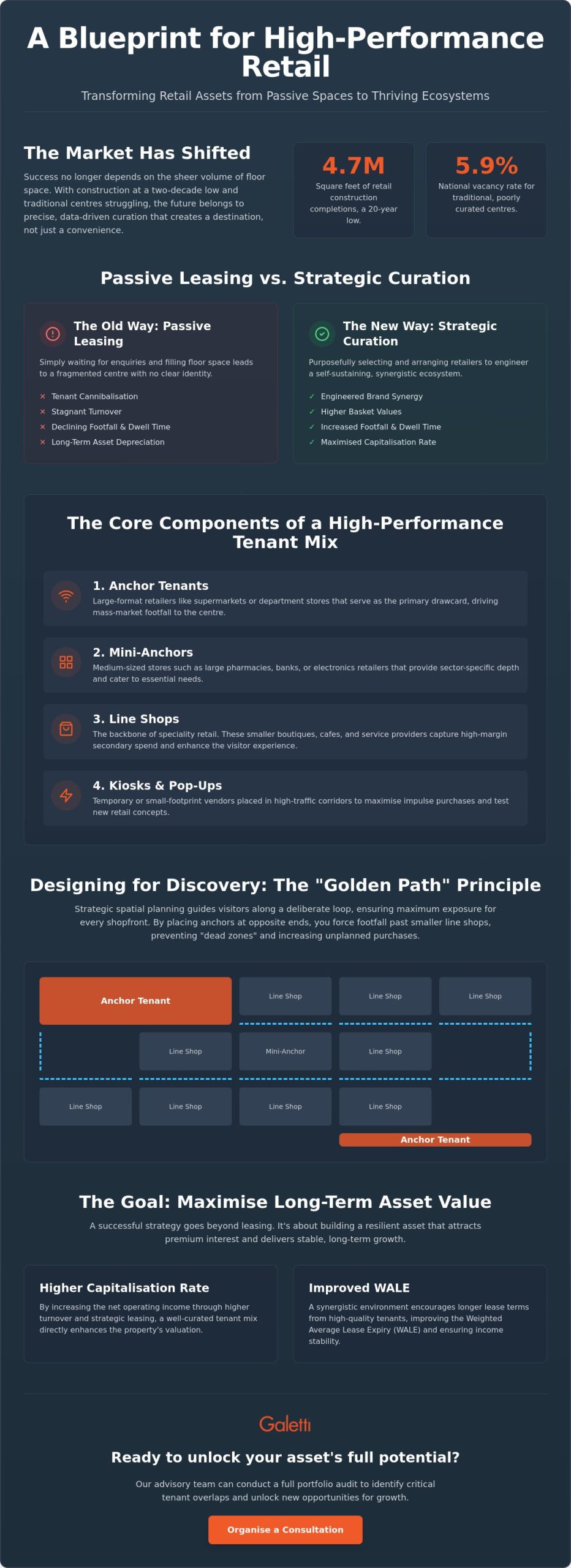
The Core Components of a High-Performance Tenant Mix
A high-performance retail environment relies on a clear hierarchy of tenants. We categorise these into four distinct layers: Anchors, Mini-Anchors, Line Shops, and Kiosks. Anchors drive the mass market. Mini-anchors provide sector-specific depth. Line shops capture high-margin secondary spend, whilst kiosks maximise impulse purchases in high-traffic corridors, often utilising specialised point-of-sale systems from TX Payments & Technology. Developing a successful retail tenant mix strategy requires balancing these layers to ensure no tenant operates in isolation.
Landlords must maintain a precise ratio of essential services to discretionary retail. Essential services like pharmacies and groceries provide a stable floor for footfall, even during economic downturns. Conversely, discretionary and “Destination Retail” tenants act as the primary drawcards for out-of-area visitors. This extends the centre’s reach beyond its immediate catchment area. Many landlords seek specialised retail tenant mix strategy and leasing advisory to navigate these spatial complexities and ensure the mix remains resilient.
Spatial planning must guide visitors along a “Golden Path”. This is a deliberate loop that ensures maximum exposure for every shopfront. By placing anchors at opposite ends of the centre, you force footfall past smaller line shops. This increases the probability of unplanned purchases and ensures that secondary corridors don’t become “dead zones”. If you need to reconfigure your current floor plate, you should speak with our advisory team for a portfolio audit.
Categorising Retailers for Strategic Balance
Modern retail categorisation falls into four primary buckets: Convenience, Comparison, Luxury, and Service. A 2026 strategy must prioritise service-based tenants, such as hair salons, medical suites, and fitness centres. These are e-commerce resistant; you cannot download a physical service. To maintain a competitive edge, balance national franchises with unique local independent retailers. Nationals provide the credit strength required by lenders, whilst independents provide the “soul” and unique appeal that differentiates your centre from generic malls.
Spatial Planning and Clustering Strategies
Clustering involves grouping retailers by lifestyle or category to simplify the shopper journey. A dedicated “Home and Decor” wing or a “Wellness Precinct” allows consumers to compare products without leaving a specific zone. Shop frontage and visibility are critical; even a premium brand will struggle if it lacks clear sightlines from the main thoroughfares. Clustering is a strategic tool used to increase dwell time and encourage cross-shopping by grouping complementary retailers together.
Data-Driven Curation: Analysing Consumer Behaviour for Optimal Mix
Modern shopping centre performance isn’t a guessing game. It’s a precise analytical exercise. Relying on gut feel for leasing decisions is a liability that leads to high vacancy rates. A sophisticated retail tenant mix strategy uses granular data to align every square metre with the actual needs of the local population. We utilise footfall heatmaps and dwell-time analytics to identify exactly how consumers move through a space. This allows us to spot “dead zones” before they impact your bottom line. This level of insight is central to our Corporate Real Estate Advisory ZA, where we transform raw data into a roadmap for asset appreciation.
Beyond simple traffic counts, we employ sentiment analysis to understand the community’s emotional connection to the centre. What do they feel is missing? Is there a demand for more sustainable brands or specialised medical services? By answering these questions, we ensure the mix isn’t just functional but also desirable. This proactive approach prevents the “passive leasing” trap, where landlords simply wait for any tenant to fill a gap. Instead, we hunt for the specific brands that the data proves will thrive in your unique location.
Catchment Area Analysis and Modern Demographics
The “15-minute city” concept is redefining South African retail. We map a precise radius around each property to understand the residents’ lifestyle and income levels. Shifting urbanisation patterns mean that a strategy from 2021 is likely obsolete in 2026. With the persistence of work-from-home trends, suburban centres have become daytime hubs for professionals. This shift requires a pivot toward service-led tenants like high-end coffee shops and wellness clinics.
Predictive Modelling for Future-Proofing
Predictive modelling allows us to anticipate market shifts before they occur. We analyse global and local trends to determine which retail categories will grow over the next five years. Currently, we’re seeing a massive transition from product-led retail to experience-led services. Incorporating “pop-up” or incubator spaces allows you to test new concepts without the risk of long-term vacancies. This agility is a core component of a modern retail tenant mix strategy.
Strategic Implementation: Organising the Leasing Lifecycle
Execution is where strategy meets the balance sheet. A theoretical retail tenant mix strategy only adds value when implemented through a rigorous lifecycle. We follow a five-step framework to ensure every leasing decision reinforces the asset’s long-term objectives. It’s the difference between being a landlord and being an active asset manager.
- Step 1: Portfolio Audit. We begin by identifying current weaknesses and overlaps. This process identifies where tenants are competing for the same rand rather than expanding the centre’s total market share.
- Step 2: Ideal Tenant Profile. We define the specific requirements for each vacant unit. This includes target turnover, credit rating, and the brand’s ability to drive footfall to adjacent shops.
- Step 3: Proactive Procurement. We don’t wait for enquiries. We actively hunt for high-value tenants that fill the strategic gaps identified in our data analysis phase.
- Step 4: Commercial Negotiation. We negotiate commercial terms that prioritise net operating income and lease length whilst allowing for future flexibility.
- Step 5: Performance Monitoring. Retail is not static. We continuously adjust the mix based on real-world performance data and changing consumer behaviours.
Tenant Procurement and Representation
Passive enquiry handling is a strategy for mediocrity. High-performance centres require active procurement. This involves identifying blue-chip retailers whose brand equity aligns with the centre’s identity. Professional Leasing Services provide the network and market intelligence needed to secure these tenants before they look at competing assets. Vetting financial stability is non-negotiable during this phase. We analyse balance sheets to ensure a tenant can withstand market volatility and contribute to the long-term stability of the WALE.
Lease Audits and Performance Clauses
Maintaining mix integrity requires constant vigilance. Utilising lease audit services helps landlords ensure that tenants are operating within their permitted use clauses. “Exclusive use” clauses can be a double-edged sword; whilst they attract premium brands, they can limit your ability to pivot the mix in five years. We recommend using turnover-based rent structures where possible. This aligns the interests of the landlord and the tenant. When the tenant thrives, the asset value grows. If you are looking to optimise your current leasing lifecycle, contact our advisory team today for a comprehensive review.
Maximising Asset Value through Strategic Tenant Placement
A retail tenant mix strategy is the primary driver of an asset’s terminal value. When it comes to disposal, institutional buyers don’t just look at the physical structure; they scrutinise the Weighted Average Lease Expiry (WALE) and the quality of the underlying cash flow. A well-curated mix increases the WALE by securing long-term commitments from blue-chip retailers. This reduces the risk profile of the property, which directly compresses the capitalisation (cap) rate. In a market where retail construction completions hit a two-decade low in early 2026, high-performing centres with stable, synergistic mixes command significant premiums.
Whether you’re preparing for Corporate Real Estate Sales or a competitive Property Auction, the tenant mix is your most powerful marketing tool. Investors pay more for a centre where the retailers actively support each other’s turnover. A diverse and stable mix isn’t just an operational preference. It’s a prerequisite for a successful exit. It proves to the buyer that the income is resilient and the asset is future-proofed against shifting consumer behaviours and e-commerce growth.
The Link Between Tenant Mix and Property Yield
Reducing vacancy through a strategic retail tenant mix strategy directly boosts your Net Operating Income (NOI). It’s a simple calculation: higher occupancy plus higher turnover-based rents equals a more valuable asset. Investors pay a premium for “synergistic” profiles because they know the footfall is sustainable. Before bringing an asset to market, we recommend this optimisation checklist:
- Audit the current WALE and prioritise renewals for key anchors.
- Identify and remove tenants that cause direct cannibalisation.
- Ensure a healthy balance of essential services to maintain recession-proof footfall.
Portfolio Optimisation for Institutional Investors
For large-scale owners, Galetti Corporate Services provides the expertise needed for complex portfolio restructuring. We often use “re-tenanting” as an aggressive value-add strategy for distressed or underperforming retail assets. By replacing weak retailers with high-draw experiential tenants, we transform a lagging property into a prime acquisition target. Once your mix has been fully optimised to capture maximum market value, you can confidently List Your Property with our team to achieve the highest possible return on investment.
Secure the Future of Your Retail Portfolio
Modern shopping centre performance is no longer a matter of chance. It’s the result of a precise retail tenant mix strategy that prioritises synergy and data over passive leasing. By aligning your floor plate with actual consumer behaviour and shifting toward service-led models, you protect your asset from e-commerce volatility. This proactive approach doesn’t just fill space; it actively compresses cap rates and builds long-term property value. We’ve seen that the most resilient assets are those that function as community hubs rather than mere product outlets.
Navigating these complexities requires a partner with deep market intelligence. With over 18 years of commercial real estate expertise and a specialised retail leasing and advisory division, we provide the national South African market coverage needed to optimise your assets. Our team ensures your portfolio remains a high-performance environment that attracts premium interest from institutional investors and stays competitive in a changing landscape.
Optimise your retail portfolio with Galetti Corporate Services to unlock the full potential of your commercial assets. Your property’s resilience starts with strategic curation.
Frequently Asked Questions
What is the most important factor in a retail tenant mix?
Synergy and brand alignment are the most critical factors for success. A successful retail tenant mix strategy ensures that each store adds value to its neighbours, creating a cohesive ecosystem that encourages cross-shopping. This prevents direct cannibalisation and ensures that the centre functions as a single destination rather than a fragmented collection of shops.
How does a landlord determine the right anchor tenant?
Landlords must match the anchor’s profile to the local catchment area’s specific spending power. An effective anchor should be a high-draw brand that ensures consistent daily footfall for the surrounding smaller line shops. We use granular demographic data to determine if a community requires a value-based grocer or a high-end wellness facility to drive maximum traffic.
Can a poor tenant mix decrease my property value?
Yes, a fragmented or misaligned mix directly increases the risk profile of a retail asset. Institutional investors view high vacancy or poor tenant synergy as a sign of future income instability. This leads to higher capitalisation rates and a significant reduction in the property’s market valuation during a private sale or auction process.
How often should a retail tenant mix be reviewed?
A retail tenant mix strategy should be reviewed at least once every twelve months to remain relevant. Consumer trends and local competition evolve rapidly, especially in shifting urban environments. Regular audits allow landlords to identify underperforming categories and adjust the leasing pipeline before vacancies become a systemic problem for the asset.
What is the difference between a convenience mix and a comparison mix?
A convenience mix focuses on speed and essential daily needs, such as pharmacies, laundromats, or groceries. A comparison mix encourages browsing and choice, typically featuring fashion, electronics, or home decor where shoppers want to see multiple options. Most successful modern centres use a hybrid approach to capture both quick-stop and long-dwell visitors.
How do I handle a tenant that no longer fits the centre’s strategy?
Strategic re-tenanting is the standard solution for misaligned occupiers who no longer serve the broader ecosystem. Landlords can use lease expiry dates or performance-based clauses to transition the space to a more suitable brand. In some cases, a negotiated buy-out is a viable investment to protect the long-term integrity and footfall of the centre.
Is it better to have a national brand or a local boutique?
A high-performance centre requires a balanced blend of both to ensure financial and social resilience. National brands provide the credit strength and reliable footfall that lenders require for asset financing. Local boutiques offer the unique character and community appeal that differentiates a centre from generic competitors and encourages customer loyalty.
How does e-commerce affect modern tenant mix planning?
E-commerce has forced a pivot toward “experience-led” and service-based tenants that cannot be replicated online. Modern planning prioritises categories such as dining, fitness, and medical suites to ensure the centre remains a vital destination. This shift protects the landlord’s income by focusing on physical services that remain resilient against digital shopping platforms.