
In 2026, a precise property yield analysis South Africa is no longer a simple mathematical exercise; it is a high-stakes stress test of your portfolio’s resilience against rising municipal costs and interest rate volatility. You likely recognise that traditional benchmarks are shifting quickly. Relying on inconsistent data across different commercial sectors or outdated cap rates can leave your capital unnecessarily exposed.
This guide ensures you master the complexities of commercial property yield analysis to optimise your South African real estate portfolio and identify high-value investment opportunities. We provide a robust framework for calculating true net yields while accounting for the anticipated 50-basis-point reduction in interest rates this year. You will gain a clear understanding of sector-specific benchmarks, from prime industrial yields currently at 9.4% to the tightening Cape Town office market. We also identify proven strategies to compress yields and increase your total asset value in a competitive landscape.
Key Takeaways
- Differentiate between gross and net rental yields to calculate the true profitability of your commercial assets accurately.
- Conduct a comprehensive property yield analysis South Africa to align your portfolio with current 2026 market benchmarks and interest rate forecasts.
- Identify sector-specific yield drivers across industrial, office, and retail classes to spot undervalued investment opportunities.
- Assess the impact of SARB repo rate adjustments and inflation-linked lease escalations on your long-term capital growth.
- Utilise professional corporate services to implement yield-compression strategies or execute strategic asset disposals via auction.
Understanding Property Yield Analysis in the South African Commercial Sector
Property yield is the anticipated annual return on a real estate investment, expressed as a percentage of the asset’s value. In the local market, it serves as the primary barometer for commercial asset health. A robust property yield analysis South Africa allows investors to strip away market noise and focus on the fundamental income-generating capacity of a building. It’s the pulse of the portfolio.
Whilst residential buy-to-let models often focus on gross income, sophisticated commercial cap rates demand a granular assessment of net operating income. For institutional landlords and private investors in 2026, this distinction is vital. As municipal costs rise and interest rates fluctuate, understanding the underlying yield becomes the difference between a resilient portfolio and one burdened by hidden liabilities. Precision in these calculations is non-negotiable for high-level decision-making.
The Role of Yield in Portfolio Valuation
Yield acts as a critical proxy for risk. In the South African landscape, a compressed yield typically indicates a prime asset with a secure tenant profile, such as the logistics hubs currently yielding approximately 9.4%. Conversely, higher yields often signal increased risk or vacancy concerns. Yield-driven decision-making is essential for strategic asset disposal or acquisition. When yields compress, asset values rise, providing a window for investors to exit via property auctions or private treaty. Mastering understanding financial yields ensures that valuations reflect true market sentiment rather than optimistic projections.
Yield vs ROI: Why the Distinction Matters
Accuracy in reporting requires a clear separation between yield and Return on Investment (ROI). Yield focuses strictly on income relative to value at a specific point in time. ROI is a broader metric that incorporates capital appreciation and total equity gains over the holding period. For cash-flow-heavy commercial portfolios, yield remains the more reliable metric for day-to-day performance tracking. It provides an immediate snapshot of operational efficiency without the volatility of unrealised capital growth. Investors favour yield because it offers a direct measure of an asset’s ability to service debt and fund future expansions.
Core Methodologies: Calculating Gross vs Net Yields for Accuracy
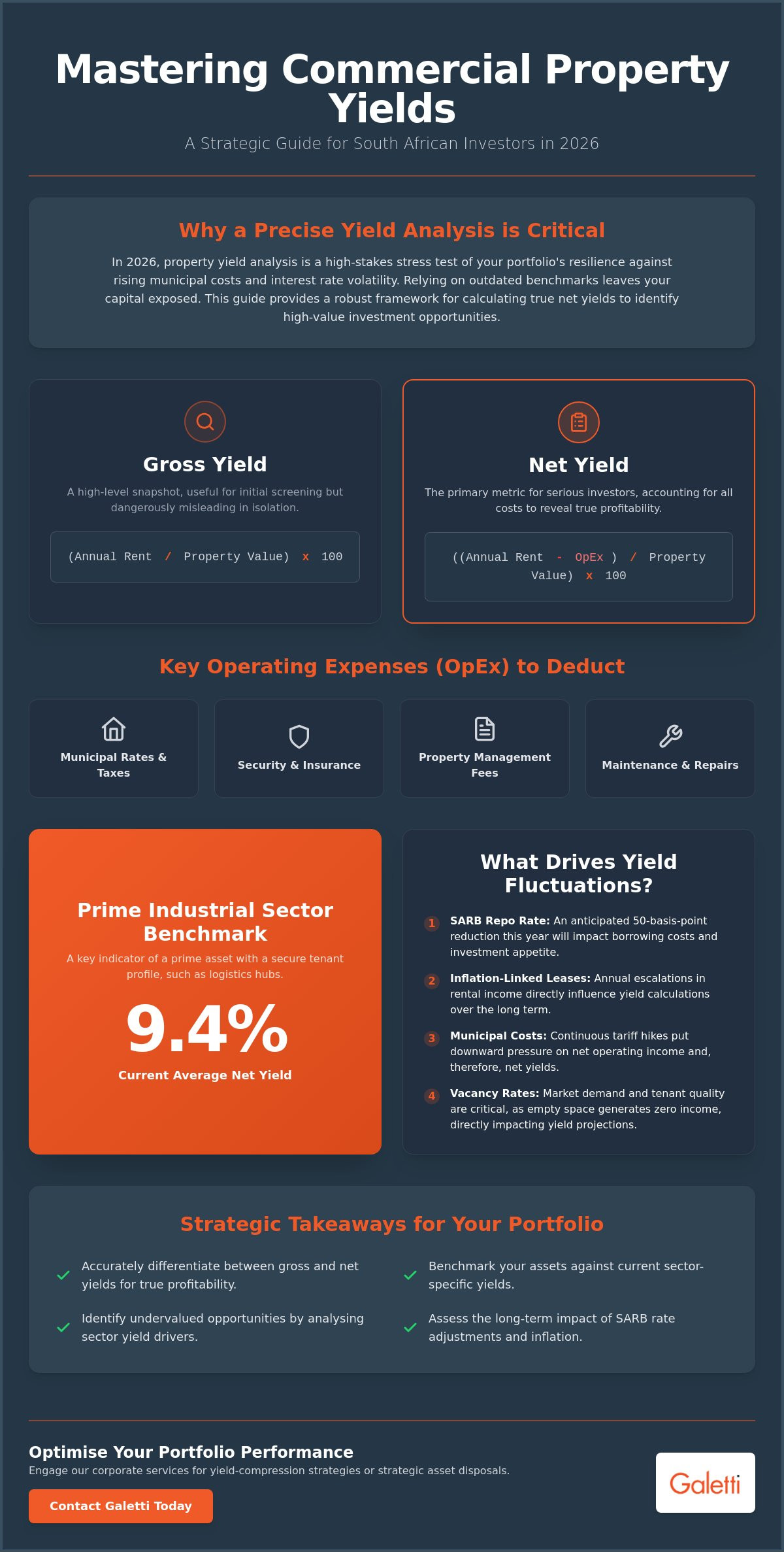
Precision is paramount. A flawed property yield analysis South Africa leads to capital erosion. Gross yield provides a high-level snapshot. The formula is straightforward: (Annual Rent / Property Value) x 100. Whilst useful for initial screening, it’s dangerous in isolation. It ignores the friction of ownership and the escalating costs of maintaining a commercial footprint. Relying on gross figures in a high-cost municipal environment is a strategic error that overstates your actual returns and misleads stakeholders.
Net yield is the primary metric for serious investors. It accounts for every rand that leaves the building before it reaches your bottom line. The formula is: ((Annual Rent – Operating Expenses) / Property Value) x 100. For an even more accurate “all-in” yield, you must incorporate acquisition costs. This includes transfer duties, legal fees, and professional commissions. By adding these to the property value in your denominator, you reflect the true entry price of the investment. This level of detail separates institutional-grade analysis from speculative guesswork.
Accounting for Operating Expenses in South Africa
Operating costs in South Africa’s commercial property sector are under constant pressure from municipal tariff hikes. To calculate a true net yield, you must deduct the following:
- Municipal rates and taxes
- Insurance premiums
- Property management fees
- Security and specialised maintenance
Triple net leases are common in industrial assets, where tenants cover most costs. However, you must still account for non-recoverable items and potential shortfalls in utility recoveries. Security costs, in particular, remain a non-negotiable expense for maintaining asset value in the local context. If you need a professional audit of these variables, consider engaging Galetti Corporate Services for a detailed portfolio review.
The Impact of Vacancy Rates on Yield Projections
Vacancies destroy yield. To create a realistic forecast, you must factor in “void periods” between leases. Projections should distinguish between passing yield and potential yield. Passing yield reflects the return based on current occupied space. Potential yield shows the return if the building were at 100% occupancy. The gap between these two numbers reveals the asset’s upside or its inherent risk. With national industrial vacancies at 3.8% and office vacancies at 12.6%, your projections must align with sector-specific realities. Assess tenant covenant strength carefully. A high-yield asset with a weak tenant is often a liability in disguise.
Strategic Determinants: What Drives Yield Fluctuations in South Africa?
Yields do not exist in a vacuum. They are tethered to the cost of capital and the broader health of the national economy. The South African Reserve Bank (SARB) repo rate is the primary lever here. When interest rates remain elevated, property yields typically expand to maintain a sufficient risk premium over cash. However, with two 25-basis-point cuts anticipated in 2026, we expect a gradual shift in cap rates. This environment makes a proactive property yield analysis South Africa essential for timing acquisitions before yield compression fully takes hold.
Inflation-linked lease escalations, typically ranging between 6% and 8% locally, provide a vital hedge. These escalations protect net yields against currency volatility and rising operational costs. When demand outstrips supply, such as in the current logistics sector, we see yield compression. This signals high investor confidence, where buyers are willing to accept lower initial returns in exchange for perceived asset security and long-term rental growth. Geographic risk also plays a decisive role. Infrastructure reliability, specifically electricity and water security, now dictates the risk premium applied to specific nodes.
Macro-Economic Influences on Cap Rates
The 2026 economic outlook suggests a move towards increased liquidity. Government bond yields, specifically the R186 and R209, serve as the benchmark “risk-free” rate for the local market. Commercial property yields must offer a spread above these bonds to compensate for illiquidity and management intensity. According to a South Africa Commercial Real Estate Market Analysis, market segmentation and regional stability are becoming primary drivers of these spreads. Investors are increasingly penalising assets in municipalities with failing infrastructure, whilst rewarding “semigration” hubs in the Western Cape with tighter yields.
Sector-Specific Yield Variations
Yields vary significantly across asset classes. Prime industrial property currently benchmarks at approximately 9.4%, supported by a low national vacancy rate of 3.8%. This sector commands stability due to the e-commerce boom and a 9.47% projected CAGR for logistics assets through 2031. The office sector is more nuanced. Whilst national vacancies sit at 12.6%, a “flight to quality” is compressing yields for P-grade buildings in prime hubs like the Cape Town CBD, where vacancies have dropped to 9.5%. Retail yields remain bifurcated; smaller neighbourhood centres with strong anchor tenants often outperform larger regional malls in terms of yield consistency and recovery speed.
Benchmarking Performance: Evaluating Yields Across Commercial Asset Classes
Yields are not uniform across the commercial landscape. A sophisticated property yield analysis South Africa requires a sector-by-sector approach to distinguish between market noise and genuine value. In the current 2026 environment, a “good” yield typically falls within the 8% to 12% range, depending on the asset’s grade and location. Institutional investors often prioritise P-grade or Grade A assets. These properties command lower yields, often below 10%, because they offer superior tenant security and lower vacancy risks. It’s a calculated trade-off. You accept a lower immediate return for long-term capital preservation and predictable cash flow.
Secondary assets in B-grade or C-grade nodes present a different risk-reward profile. These properties often feature yields at the higher end of the 12% spectrum. This premium compensates the owner for increased maintenance requirements, higher tenant turnover, and the potential for longer void periods. For private investors with a higher risk appetite, these assets provide significant immediate cash flow, provided the management strategy is aggressive. Balancing these extremes is the hallmark of a resilient South African real estate portfolio.
Industrial and Logistics: The Stability Play
Prime industrial property remains the most resilient asset class in the national market. Yields currently benchmark at approximately 9.4%, supported by a low national vacancy rate of 3.8%. These figures reflect the high demand for modern warehousing and distribution centres. High-performance industrial assets are increasingly defined by their “green” building certifications. Energy-efficiency and sustainable water management are now critical for yield sustainability. These features reduce non-recoverable operating costs and attract high-calibre corporate tenants. If you are looking to capitalise on this sector’s 9.47% projected CAGR, explore our industrial real estate investment options for prime opportunities.
Retail and Office: Navigating Changing Behaviours
The office and retail sectors require a more granular lens due to shifting work and consumption patterns. Hybrid work models have kept the national office vacancy rate at 12.6%, yet P-grade buildings in prime hubs are thriving. Cape Town’s CBD is a notable outlier with a vacancy rate of just 9.5%, driving yield stabilising in that node. In the retail sector, the risk-reward profile has shifted toward neighbourhood convenience centres. These smaller hubs often outperform large regional malls by offering more consistent footfall and lower tenant churn. To identify high-performance retail spaces, check our current retail property for lease listings. For a bespoke yield assessment of your current commercial holdings, contact Galetti today.
Optimising Portfolio Performance via Professional Advisory
Data is only as valuable as the strategy it informs. A professional property yield analysis South Africa serves as the foundation for high-level portfolio decisions. It moves beyond simple calculation into the realm of strategic risk management. By accurately benchmarking your assets, you identify which properties are performing and which require immediate intervention. This level of clarity is essential for maintaining a competitive edge in 2026.
Strategic disposal is a primary outcome of detailed yield analysis. Whether you choose to sell via property auction or private treaty, timing is everything. When yield compression has reached its peak, exiting the asset often unlocks the maximum capital gain for reinvestment. Conversely, if yields are expanding due to rising costs, disposal may be necessary to protect the wider portfolio. Regular strategic property portfolio management services ensure your assets remain aligned with your long-term financial objectives.
Portfolio audits must be a recurring item on the corporate agenda. These audits detect yield drift before it becomes a significant liability. They account for shifting municipal tariffs, tenant profile changes, and micro-market volatility. A disciplined approach to auditing ensures that your yield targets are not just met, but consistently exceeded through proactive management.
Beyond property-specific audits, it is often necessary to explore Business and personal tax preparation services to maintain a holistic view of your fiscal health and ensure your broader tax strategy supports your investment goals.
Actionable Insights from Yield Data
Yield analysis dictates when to redevelop or reposition an asset. If an office building’s yield is stagnating, repositioning it for medical or mixed-use could compress yields and drive value. The concept of “Exit Yield” is equally vital. This is the yield you expect to achieve at the end of your holding period. It forms the basis of your long-term investment planning and dictates your entry price today. If you are considering a transition, list your property with Galetti to receive a professional market assessment based on real-time yield data.
Leveraging Galetti’s National Expertise
Galetti combines deep market data with advanced technology to deliver precise valuations. We don’t guess. We calculate. Our team identifies yield-enhancing opportunities that others miss, from lease restructuring to operational cost reduction. We invite corporate clients to explore Galetti Corporate Services for bespoke advisory tailored to the South African landscape. Contact Galetti to organise a comprehensive property yield analysis South Africa for your portfolio today.
Future-Proof Your Commercial Portfolio
Mastering property yield analysis South Africa is the definitive way to protect your capital in an evolving economic landscape. You now have the framework to distinguish between deceptive gross returns and the true net yields that drive long-term growth. By aligning your strategy with current sector benchmarks and accounting for anticipated interest rate shifts, you position your assets for maximum resilience. Strategic decisions, whether redeveloping a secondary office building or acquiring prime logistics space, must be rooted in this granular data.
Galetti brings over 18 years of commercial real estate expertise to your side. We utilise specialised, data-driven valuation and yield analysis models to provide clarity across all major South African commercial sectors. Our national coverage ensures that your portfolio benefits from local insights and institutional-grade precision. Don’t leave your asset performance to chance. Optimise your portfolio with Galetti’s Corporate Real Estate Advisory and secure your strategic advantage in 2026. Your path to enhanced asset value starts with a professional assessment.
Frequently Asked Questions
What is considered a “good” commercial property yield in South Africa for 2026?
A good yield in the current 2026 market typically ranges between 8% and 12% depending on the asset class and location. Prime industrial properties benchmark at approximately 9.4%, whilst premium office spaces in hubs like the Cape Town CBD often trade at lower yields due to high demand and lower vacancy risks. Secondary assets usually require a higher yield to compensate for increased management intensity.
How does the SARB interest rate cycle affect property yield analysis?
The South African Reserve Bank repo rate serves as the foundation for the cost of debt and the benchmark risk-free rate. In a shifting monetary environment, interest rate adjustments directly influence the spread investors require over government bonds. A precise property yield analysis South Africa must account for these cycles, as falling rates typically encourage yield compression and drive up underlying asset values.
What is the difference between gross yield and net yield in a commercial context?
Gross yield is a high-level calculation that expresses annual rental income as a percentage of the property value. Net yield is the more accurate barometer of performance, as it deducts all operating expenses, including municipal rates, insurance, and management fees. For institutional investors, net yield is the non-negotiable metric for assessing an asset’s ability to service debt and generate actual cash flow.
Why do industrial properties often have lower yields than retail centres?
Industrial assets command lower yields because they offer superior stability and a lower risk profile. These properties often utilise triple net leases, which shift the burden of maintenance and insurance to the tenant. This creates a predictable, low-volatility income stream that investors value more highly than the management-intensive and vacancy-prone nature of many regional retail centres.
How can I improve the yield on my existing commercial property portfolio?
Improving yield requires a dual focus on reducing non-recoverable expenses and optimising rental income. Implementing energy-efficient “green” building technologies can significantly lower municipal utility costs. Simultaneously, restructuring leases to include stronger tenant covenants or higher annual escalations can compress the market yield and result in a substantial increase in the property’s capital value.
What is yield compression and should investors be worried about it?
Yield compression occurs when property values increase at a faster rate than rental income, leading to a lower percentage return. Current owners shouldn’t be worried; it is a signal of strong market demand and results in capital appreciation. For buyers, it indicates a competitive market where assets are highly prized for their security and potential for long-term growth.
How does tenant covenant strength influence the required yield on an asset?
Tenant covenant strength is a primary determinant of the risk premium applied to a commercial building. Assets occupied by blue-chip or national tenants are perceived as lower risk, allowing investors to accept a tighter yield. Conversely, properties with unlisted or smaller tenants require a higher yield to compensate the landlord for the increased probability of default or lease instability.
Can property yield analysis predict future capital growth?
Whilst yield analysis focuses on current income, it provides critical indicators for future value movement. If an asset’s yield is high relative to historical sector benchmarks or the current cost of capital, there is significant potential for the yield to compress. This re-rating by the market leads to capital growth, making yield analysis an essential tool for identifying undervalued assets with high upside potential.