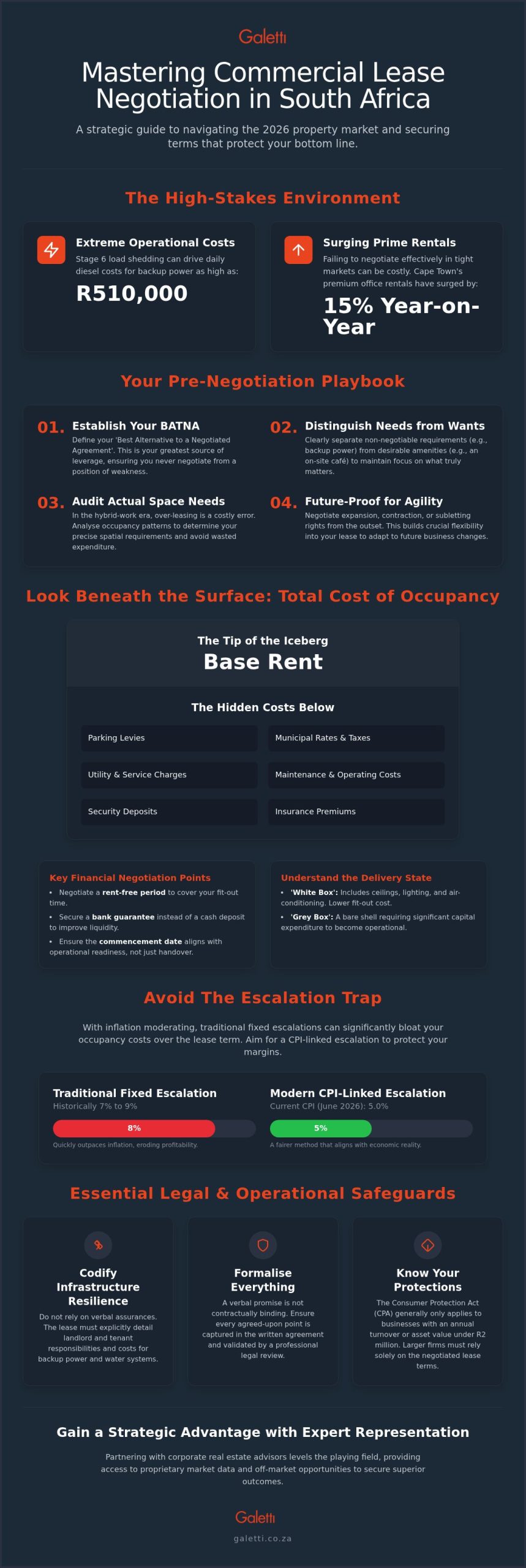
With Stage 6 load shedding potentially driving daily diesel costs as high as R510,000, a boilerplate agreement is no longer a viable strategy. You likely recognise that the South African property landscape has shifted, making expert commercial lease negotiation tips South Africa specific a necessity for protecting your bottom line. In a market where Cape Town’s premium office rentals have surged by 15% year-on-year, failing to secure the right terms can lead to unsustainable occupancy costs and rigid liabilities.
This 2026 guide delivers the strategic insights required to master the complexities of the local property market. We promise to help you navigate evolving legislation, from updated Deeds Office fees to the nuances of the Consumer Protection Act. You’ll learn how to benchmark escalations against the current 5.0% CPI, negotiate for infrastructure resilience, and build the flexibility needed for future expansion or contraction. This is your roadmap to securing a legally sound agreement that prioritises your corporate interests and long-term agility.
Key Takeaways
- Calculate the Total Cost of Occupancy rather than focusing solely on base rent to ensure full transparency of your financial commitments.
- Implement expert commercial lease negotiation tips South Africa to secure strategic rent-free periods and favourable commencement dates.
- Prioritise infrastructure resilience by codifying the specific costs and responsibilities for backup power and water systems within the lease.
- Protect your corporate interests by ensuring all verbal assurances are formalised through a rigorous professional legal review.
- Leverage tenant representation and strategic advisory services to access exclusive off-market opportunities and level the playing field against institutional landlords.
Strategic Preparation for Commercial Lease Negotiations in South Africa
Negotiation success is decided in the boardroom, not at the site viewing. Strategic preparation ensures you enter discussions with an objective, data-driven perspective. In the South African market, timing is everything. With national office vacancy rates at approximately 12.6% in early 2026, tenants in oversupplied nodes possess significant leverage. Conversely, the Cape Town CBD market is tighter at 9.5%, requiring a more assertive approach to secure prime space. High-level preparation allows you to exploit these market variances effectively.
Establish your BATNA (Best Alternative to a Negotiated Agreement) before engaging with landlords. This is your primary source of leverage. Without a viable secondary option, you remain at the mercy of the landlord’s terms. You must clearly distinguish between non-negotiable operational requirements, such as Stage 6 load shedding mitigation, and desirable amenities like on-site cafes or fitness centres. Clear priorities prevent emotional decision-making during high-stakes discussions.
Defining Corporate Occupier Requirements and Objectives
The hybrid-work era has fundamentally altered space utilisation. Before reviewing potential sites, conduct a rigorous audit of your actual occupancy patterns. Over-leasing is a common, expensive error that erodes profitability. Determine a lease duration that balances rental stability with business agility. Short-term leases offer flexibility but often carry higher base rates. Long-term commitments can secure lower escalations, which currently benchmark near the 5.0% CPI rate. Use these commercial lease negotiation tips South Africa to future-proof your space by negotiating expansion or contraction rights from the outset.
Benchmarking Against Current National Market Data
Data is your most powerful tool. Accessing accurate vacancy rates and asking prices across South African sectors allows for realistic benchmarking. It is essential to understand the nuances of general lease agreement terms, specifically the distinction between gross, net, and triple-net structures. In a triple-net lease, the tenant assumes responsibility for taxes, insurance, and maintenance. Given the revised, higher Deeds Office fee schedule effective April 2026, these additional costs can escalate quickly if not capped.
Utilising professional corporate real estate leasing services provides access to proprietary market insights. These services help you use historical rental trajectories to predict future costs accurately. By comparing current asking prices against the 8% year-on-year growth seen in national prime industrial rentals, you can identify whether a landlord’s proposal aligns with market realities or exceeds them. This level of detail ensures your final agreement reflects the true value of the asset.
Optimising Financial Terms and Total Occupancy Costs
Base rent is merely the tip of the iceberg. To truly understand your liability, you must calculate the Total Cost of Occupancy (TCO). This figure encompasses parking ratios, municipal rates, and utility levies. When applying commercial lease negotiation tips South Africa, start by scrutinising the delivery state of the premises. A ‘White Box’ unit typically includes ceilings, lighting, and air-conditioning, whereas a ‘Grey Box’ is a bare shell. The cost difference to reach operational readiness can be millions of Rand, directly impacting your upfront capital expenditure.
Financial liquidity is equally vital. Landlords often demand a three-month security deposit. However, high-growth firms should negotiate for a bank guarantee instead. This keeps cash in your business whilst providing the landlord with necessary security. You should also push for a rent-free period that aligns with your fit-out timeline. Ensuring the commencement date only triggers once the space is fully functional prevents paying for ‘dead time’ during construction.
Navigating Rent Escalations and Operating Costs
Historically, South African landlords have insisted on fixed annual escalations of 7% to 9%. With the Consumer Price Index (CPI) sitting at 5.0% as of June 2026, these fixed rates quickly outpace inflation. Negotiating for a CPI-linked increase protects your margins. Be mindful that the Consumer Protection Act in commercial leases generally only applies to juristic persons with an asset value or turnover below R2 million. Larger corporates must rely entirely on the strength of their contract. Always demand a breakdown of common area maintenance (CAM) charges to ensure you aren’t subsidising other tenants’ operational inefficiencies.
Negotiating Tenant Inducements and Fit-out Allowances
A Tenant Installation (TI) allowance is a powerful inducement. Landlords provide this capital to customise the space to your specific requirements. In the current market, you can often secure a more generous TI by committing to a five-year term rather than a three-year one. It’s a strategic trade-off between long-term flexibility and reduced initial costs. Before signing, clarify the ownership of these improvements. Generally, fixed items like partitions remain the property of the landlord, whilst bespoke branding and specialised equipment stay with you. If you need assistance benchmarking these incentives against current market standards, you can consult with our corporate advisory team to ensure your deal remains competitive.
Essential Legal Safeguards and South African Regulatory Compliance
A commercial lease is a high-stakes legal instrument. Landlords typically utilise standard-form agreements drafted to protect their own interests. You shouldn’t accept these at face value. Professional legal review is a critical risk mitigation strategy that prevents expensive disputes. One of the most effective commercial lease negotiation tips South Africa is to ensure every verbal promise made during a site viewing is formalised in writing. If a landlord promises a parking ratio of four bays per 100 square metres, that specific figure must appear in the contract. Verbal assurances are virtually impossible to enforce in South African courts.
Pay close attention to the ‘use of premises’ and ‘make good’ clauses. A narrow use clause can stifle business evolution. If your operations shift from pure office work to include a small distribution component, you could find yourself in technical breach. Similarly, ‘make good’ or restoration clauses can be financially devastating. These often require you to restore the unit to its original ‘shell’ state at the end of the term. Negotiate to exclude ‘fair wear and tear’ and ensure that any landlord-approved tenant installations do not need to be removed at your expense. This single adjustment can save your business hundreds of thousands of Rand in decommissioning costs.
Understanding the Consumer Protection Act (CPA) and FICA
The application of the Consumer Protection Act (CPA) to commercial leases is frequently misunderstood. It generally only protects ‘juristic persons’ (companies or trusts) with an annual turnover or asset value below R2 million at the time of signing. For these smaller entities, Section 14 of the CPA provides a safety net, allowing for early cancellation with 20 business days’ notice, subject to a ‘reasonable’ penalty. Larger organisations don’t have this luxury. Additionally, you must prepare for rigorous FICA (Financial Intelligence Centre Act) requirements. As of 2026, corporate tenants must provide comprehensive documentation regarding beneficial ownership before any corporate real estate leasing agreement can be finalised.
Securing Favourable Renewal and Termination Clauses
Strategic agility requires flexible exit and expansion options. Negotiate a ‘right of first refusal’ on adjacent spaces to accommodate growth without the upheaval of moving. Clarity is also required for renewal options. Avoid vague phrases like ‘market-related rentals’ without defining a clear mechanism for dispute resolution or benchmarking. Understanding essential legal terms for leases will help you identify the landlord’s legal hypothec, which grants them a security interest over your goods if rent remains unpaid. Finally, aim for break clauses that allow you to terminate the lease at specific intervals, such as at the end of year three in a five-year term, providing a vital escape hatch if market conditions shift.
Addressing Modern Operational Risks: Infrastructure and Sustainability
Infrastructure resilience has transitioned from a secondary amenity to a core negotiation pillar. In 2026, a building’s ability to remain operational during Stage 6 load shedding is a non-negotiable requirement for corporate tenants. These commercial lease negotiation tips South Africa focus on shifting the burden of infrastructure risk away from the occupier. High-level discussions must now include detailed clauses for backup power and water systems. Without these, the daily diesel costs for running large-scale generators can exceed R510,000 during severe outages, significantly inflating your total occupancy costs.
Allocating responsibility for the maintenance of generators and solar arrays is essential. You shouldn’t assume the landlord covers all operational costs. Negotiate for a cap on fuel recovery levies and demand transparency in how these charges are apportioned amongst tenants. Ideally, you should draft rent abatement clauses that trigger during prolonged utility failures where the building’s backup systems fail to perform. This ensures you aren’t paying full rental for a space that lacks the basic utilities required for your business to function.
Mitigating Load-shedding and Utility Disruptions
Negotiate the installation of backup power solutions as a direct landlord contribution rather than a tenant-funded improvement. In a market with a 12.6% national office vacancy rate, landlords are often willing to invest in solar or battery storage to retain blue-chip tenants. Clarify the fuel cost recovery models for shared generator sets to avoid unpredictable monthly levies. Additionally, water security is becoming a critical risk. Ensure your lease includes requirements for on-site storage tanks and filtration systems to mitigate the impact of municipal water outages.
Integrating ESG and Green Lease Provisions
The rise of ‘Green Leases’ represents a strategic shift in the South African corporate sector. These agreements align the interests of both parties regarding environmental performance. You should negotiate shared savings clauses where the benefits of energy-efficient lighting and HVAC systems are passed back to the tenant. This reduces your carbon footprint whilst lowering monthly utility spend. Furthermore, ensure the landlord provides the necessary data for your corporate sustainability audits, as ESG reporting is now a standard requirement for JSE-listed entities and global firms.
Partner with our strategic advisory team to secure a resilient lease
Leveraging professional corporate real estate leasing services ensures these technical requirements are codified correctly. A strategic partner can benchmark the infrastructure standards of a building against the latest market demands, ensuring your business remains operational regardless of external utility volatility.
Partnering with Strategic Real Estate Advisors for Superior Outcomes
Institutional landlords in South Africa possess extensive resources, deep market data, and dedicated legal teams. To level the playing field, corporate occupiers require a strategic partner who understands the nuances of institutional asset management. Engaging a specialist allows you to move beyond basic commercial lease negotiation tips South Africa and access a level of market intelligence that isn’t available to the general public. This includes identifying off-market leasing opportunities where landlords prefer to secure blue-chip tenants quietly rather than listing properties on open portals. Confidentiality is often a priority for landlords in premium nodes like the Cape Town CBD, and a well-connected advisor is your only gateway to these exclusive sites. Discover how Galetti Corporate Services optimises occupier strategy to ensure your property decisions align with your broader financial goals.
The Value of Tenant Representation in Complex Negotiations
High-stakes negotiations often involve emotional bias that can cloud commercial judgement. A dedicated advisor acts as a buffer, ensuring that decisions remain rooted in logic and data. By using advisor-led benchmarking, you can justify lower rental asks based on real-time transaction data rather than outdated asking prices. This objective approach is vital when navigating the 2026 market, where national office vacancies remain at 12.6%. Advisors also manage the administrative burden of FICA compliance and the complexities of the Deeds Registries Regulations, which were updated in March 2026. This allows your internal team to focus on core operations whilst we secure the most favourable terms. Learn more about our corporate real estate leasing expertise to see how we turn market volatility into a tenant advantage.
Leveraging Portfolio Data for Long-term Advantage
Successful businesses are moving from reactive leasing to proactive portfolio management. Instead of addressing leases as they expire, strategic advisors analyse your entire multi-site footprint to identify consolidation opportunities or cost-saving redundancies. In an era where the Western Cape has overtaken Gauteng in investment volume, having a partner who can shift your geographic focus based on data is a significant competitive advantage. We help you stay ahead of legislative shifts, such as the proposed PIE Amendment Bill, ensuring your rights are protected against future regulatory changes. This bird’s-eye view is essential for long-term corporate strategy and portfolio optimisation. For a deeper dive into these high-level strategies, read our Corporate Real Estate Advisory ZA: A Strategic Guide for 2026. Contact Galetti today to secure your next commercial lease and ensure your corporate interests are protected by seasoned industry leaders.
Securing Your Strategic Advantage in 2026
The South African commercial property market requires a shift from reactive leasing to proactive, data-driven strategy. Success in 2026 depends on your ability to look beyond base rental rates and prioritise infrastructure resilience, specifically backup power and water security. By formalising every verbal promise and scrutinising ‘make good’ clauses, you protect your business from hidden liabilities that can erode profitability.
Applying these commercial lease negotiation tips South Africa provides the leverage needed to secure flexible, future-proof terms. Galetti brings over 18 years of industry expertise to your side. We provide specialised tenant representation for corporate occupiers with national coverage across the office, industrial, and retail sectors.
Your next lease should be more than a contract. It should be a strategic asset that supports your long-term growth and operational stability.
Frequently Asked Questions
What are the typical commercial lease escalation rates in South Africa for 2026?
Typical fixed escalation rates range between 7% and 9%. However, with the Consumer Price Index sitting at 5.0% as of June 2026, many corporate tenants are successfully negotiating for CPI-linked increases. Aligning your escalation with inflation protects your operational margins against arbitrary cost hikes.
Does the Consumer Protection Act (CPA) apply to all commercial leases?
The CPA does not apply to all agreements. It only protects juristic persons, such as companies or trusts, with an annual turnover or asset value below R2 million at the time of signing. Larger organisations fall outside this protection and must rely on the specific terms codified in their lease contract.
What is the difference between a gross lease and a net lease in South Africa?
A gross lease is an all-inclusive rental where the landlord covers operating costs, rates, and taxes. In contrast, a net lease requires the tenant to pay a base rental plus a pro-rata share of these additional expenses. Triple-net leases are common in the industrial sector, shifting maintenance and insurance liabilities to the occupier.
Can I negotiate for a rent-free period at the start of my lease?
Rent-free periods are standard tenant inducements used to offset fit-out costs. In sectors with higher vacancy rates, such as the national office market at 12.6%, landlords are often more amenable to these concessions. Securing a period that matches your installation timeline prevents paying rental on a non-functional space.
Who is responsible for maintenance in a commercial lease agreement?
Maintenance responsibility is determined by the lease structure and specific ‘make good’ clauses. Generally, landlords maintain the building’s exterior and primary infrastructure, whilst tenants manage the interior. It’s vital to clarify who maintains specialised equipment like backup generators or solar arrays to avoid unexpected service levies.
What happens if I need to cancel my commercial lease early?
Early cancellation is governed by the presence of a break clause or CPA eligibility. Tenants protected by the CPA can cancel with 20 business days’ notice, subject to a reasonable penalty. Larger entities must negotiate a surrender of lease or find a replacement tenant, which often involves a significant financial settlement.
How do load-shedding and backup power costs affect my lease terms?
Load-shedding risks have made backup power a primary negotiation point. Stage 6 outages can result in daily diesel costs exceeding R510,000 for large commercial buildings. You must ensure your lease includes transparent fuel recovery models and caps on maintenance levies for shared generator sets to maintain cost predictability.
Why should I use a tenant representative instead of dealing directly with the landlord?
A tenant representative levels the playing field by providing access to proprietary market data and off-market opportunities. They apply proven commercial lease negotiation tips South Africa to secure terms that institutional landlords might not offer to unrepresented parties. This strategic partnership ensures your property portfolio supports your broader corporate objectives.