With national industrial vacancy rates plummeting to a record low of 3.8 per cent, the competition for prime floor space has never been more aggressive. This scarcity defines the industrial real estate trends South Africa is experiencing as we approach 2026. You’re likely already grappling with rising construction costs and the urgent need for energy independence. It’s a complex shift. Traditional storage is being replaced by high-tech, energy-autonomous logistics hubs that command premium rentals.
This article provides the strategic insights necessary to turn these operational challenges into a competitive advantage. You’ll discover how to identify high-growth sub-sectors and understand the direct ROI of green-certified upgrades. We’ll preview the critical shifts in last-mile distribution that are currently dictating asset value. By the end of this guide, you’ll have the data required to secure long-term tenant stability in a market that rewards precision, efficiency, and strategic foresight.
Key Takeaways
- Identify why industrial assets remain the cornerstone of commercial stability by analysing the industrial real estate trends South Africa is currently experiencing.
- Explore the technical evolution of logistics spaces, focusing on high-specification distribution centres designed for automated operations.
- Recognise the transition to green-certified industrial spaces as a necessity for energy security and long-term tenant retention.
- Master yield analysis and acquisition strategies for industrial land within a competitive, low-vacancy market.
- Access strategic advisory insights to optimise property performance and capitalise on high-growth sub-sectors across the country.
The Evolution of South African Industrial Real Estate in 2026
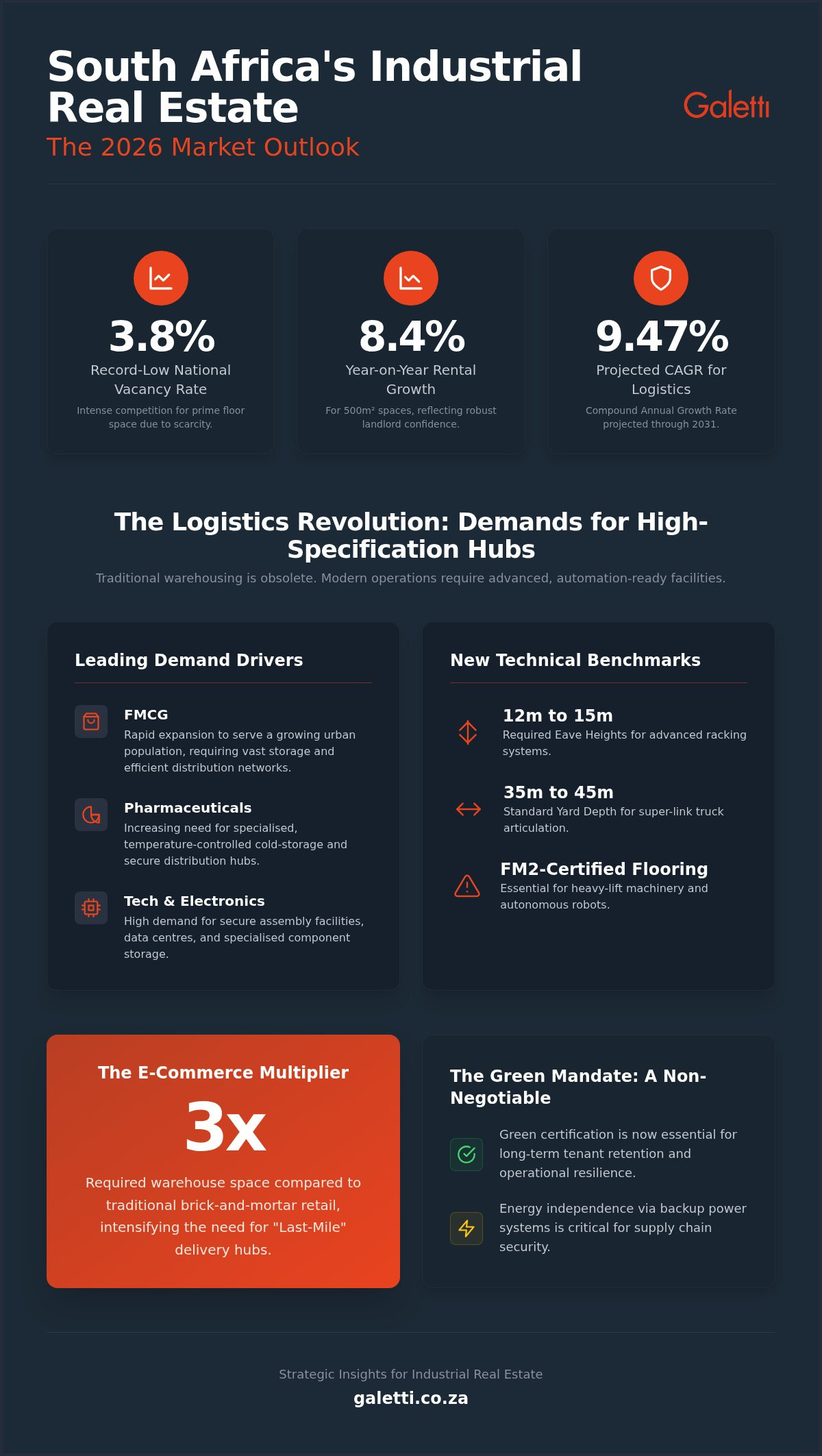
Industrial property has officially transitioned from a secondary asset class to the primary engine of commercial stability. In 2026, the sector stands as the most resilient segment of the property market. While office and retail sectors continue to navigate structural shifts, industrial assets provide consistent returns. National vacancy rates have reached a record low of 3.8 per cent. This scarcity is a direct result of the digital economy’s expansion and a significant shift toward supply chain re-shoring. These factors underpin the dominant industrial real estate trends South Africa is currently witnessing. Landlord confidence remains robust, supported by a fundamental lack of high-spec supply.
Resilience Amongst Market Volatility
Demand within this sector is driven by operational necessity. It doesn’t fluctuate based on corporate sentiment or remote-work trends. Instead, it’s anchored in the physical movement of goods. We’ve observed a strategic shift from “just-in-time” to “just-in-case” inventory management. Businesses now hold larger stock volumes to mitigate global supply chain risks. This behaviour has effectively eliminated the threat of oversupply. Rental growth for 500m² spaces has reached 8.4 per cent year-on-year, reflecting the intense competition for well-located assets.
The 2026 Macro-Economic Context
The broader Economy of South Africa provides a critical foundation for these developments. Current projections indicate the South African Reserve Bank will implement two 25-basis-point interest rate cuts during 2026. These cuts improve development yields and stimulate capital expenditure. National infrastructure projects, particularly those enhancing port efficiency and regional corridors, further facilitate industrial expansion. Three sectors are currently leading the demand:
- FMCG: Rapidly expanding to meet the needs of a growing urban population.
- Pharmaceuticals: Increasing requirements for cold-storage and specialised distribution hubs.
- Tech and Electronics: High demand for secure, high-tech assembly and data centres.
Strategic investors are using corporate real estate leasing data to identify these high-growth pockets before they reach peak pricing. Success in this landscape requires a move away from generic warehousing toward specialised facilities that cater to these industry requirements. Staying ahead of the industrial real estate trends South Africa presents is vital for securing assets with long-term tenant stability.
The Logistics Revolution: High-Spec and Smart Warehousing
The industrial landscape is undergoing a rapid technical transformation. Traditional “sheds” no longer suffice for modern operations. Today’s market demands high-specification distribution centres that function as sophisticated logistics hubs. This shift is a core component of the industrial real estate trends South Africa is experiencing in 2026. According to JLL’s 2025/2026 South Africa investment report, logistics assets are projected to record a 9.47 per cent compound annual growth rate through 2031. Verticality and automation are the new benchmarks.
Modern facilities now require eave heights of 12 to 15 metres to accommodate advanced racking systems. Flooring is no longer a secondary thought. Heavy-duty, FM2-certified flooring is essential for the seamless operation of autonomous robots and heavy-lift machinery. Yard depth is equally critical. Superior vehicle articulation and depths of 35 to 45 metres are now standard requirements for super-link trucks. These technical standards are non-negotiable for blue-chip tenants seeking maximum operational efficiency.
The E-Commerce Multiplier Effect
E-commerce requires approximately three times the warehouse space of traditional brick-and-mortar retail. This multiplier effect has intensified the search for “Last-Mile” delivery hubs within established industrial zones like Linbro Park and Montague Gardens. There’s also a growing necessity for temperature-controlled environments. Cold-chain logistics for the pharmaceutical and FMCG sectors require specialised insulation and backup power systems to maintain product integrity whilst in storage.
Technology and Operational Efficiency
Smart building technologies are no longer optional extras. The integration of IoT sensors and advanced Warehouse Management Systems (WMS) allows for real-time tracking of utility usage and inventory flow. Investing in these systems yields a measurable ROI through reduced operational overheads and improved tenant retention. Data-driven site selection has become a standard requirement for corporate occupiers. Understanding these technical industrial real estate trends South Africa is currently navigating is essential for long-term asset performance.
For those looking to refine their portfolio strategy, Galetti Corporate Services provides the technical expertise needed to evaluate these high-spec assets. Navigating these requirements demands a partner who understands the intersection of property and technology. You can consult with an expert to optimise your leasing strategy based on these evolving technical standards.
The Green Mandate: Sustainability and Energy Independence
Sustainability has evolved from a corporate social responsibility initiative into a hard operational mandate. In the current climate, energy insecurity remains a significant threat to industrial continuity. This reality is a primary driver of the industrial real estate trends South Africa is navigating in 2026. Properties lacking renewable energy infrastructure now face significant valuation pressure. Conversely, assets with integrated solar PV systems and battery storage command higher rentals and exhibit lower vacancy rates. Institutional funders now prioritise ESG criteria; this means sustainable buildings enjoy better access to capital and more favourable lending terms.
Data from the South African Property Owners Association (SAPOA) highlights that green-certified industrial spaces are seeing faster take-up rates than traditional units. Large-scale facilities are also adopting rainwater harvesting and high-efficiency LED lighting to slash utility overheads. These are no longer just environmental choices; they are calculated fiscal decisions. Reducing the operational cost per square metre is essential for maintaining a competitive edge in a high-demand market.
Energy Security as a Competitive Advantage
Off-grid capabilities have become the ultimate tenant retention tool. Industrial parks are increasingly designed as self-sufficient micro-grids. This setup insulates occupiers from national grid instability and ensures 24/7 operational uptime. In 2026, the “Green Premium” in industrial leasing is defined as the rental surplus tenants are willing to pay for guaranteed, uninterrupted power supply. Assets that offer this level of security are significantly more liquid in the secondary market.
Green Certification and Valuation
Ratings from the Green Building Council South Africa (GBCSA) are now essential for modern industrial portfolios. High-quality corporate tenants, particularly multinational logistics firms, often have global mandates to only occupy certified sustainable spaces. Owners of non-compliant properties risk “brown discounting,” where assets lose value due to high operational costs and limited tenant appeal. Strategic upgrades today prevent obsolescence tomorrow.
Investors looking to future-proof their holdings are increasingly using corporate real estate sales data to identify assets with high retrofit potential. Identifying these opportunities requires a deep understanding of both technical requirements and market demand. For a detailed analysis of how sustainability impacts your specific portfolio, consult with our advisory team to ensure your assets remain competitive in a green-focused economy.
Capitalising on Market Dynamics: Investment and Liquidity
The South African commercial real estate market reached an estimated valuation of USD 10.72 billion in 2026. Within this landscape, the industrial sector remains the most sought-after asset class for institutional and private investors alike. Capitalising on industrial real estate trends South Africa currently offers requires a shift toward aggressive land acquisition in high-demand nodes. Developers are prioritising land parcels in the N3 corridor and Durban’s Dube TradePort to bypass the national supply crunch. Success in these acquisitions depends on rigorous yield analysis. With prime rentals growing at roughly 8 per cent year-on-year, investors must balance high entry costs against the potential for sustained rental escalations.
Sale and leaseback agreements have become a vital tool for corporate capital raising. By disposing of owned assets and simultaneously signing long-term leases, businesses can unlock significant liquidity. This capital is then redeployed into core operational growth or technological upgrades. This strategy provides landlords with stable, long-term tenants whilst offering occupiers the financial flexibility they need to scale. It’s a calculated move that addresses both balance sheet optimisation and operational continuity.
Strategic Asset Disposal via Auction
The auction platform has evolved into a premier method for maximising asset value. In a market where national vacancy is below 4 per cent, the competitive bidding environment ensures that the true market value is achieved quickly. It removes the protracted negotiations common in private sales. For corporate sellers, the transparency and speed of the process are significant advantages. You can view current industrial opportunities or initiate a high-speed disposal through Galetti On Auction, where high-demand units are regularly featured.
Portfolio Optimisation and Risk Mitigation
Navigating 2026’s industrial real estate trends South Africa demands frequent portfolio reviews. Professional valuations are no longer an annual formality; they’re a strategic necessity. Market shifts are rapid, and holding onto underperforming assets in a high-growth environment creates unnecessary risk. Tenant representation has also become essential for occupiers. It ensures that lease renewals reflect current market conditions rather than historical precedents. Protecting occupier interests in a landlord-favourable market requires data-driven negotiation and a deep understanding of regional supply dynamics.
Navigating the Industrial Landscape with Galetti
Success in the 2026 market requires more than just property access; it demands a strategic partnership built on deep-seated expertise. Galetti has spent over 18 years refining its position as a premier commercial real estate advisory firm. In a year defined by the complex industrial real estate trends South Africa is currently navigating, this depth of experience is a critical asset. We provide a direct, results-oriented service suite that aligns with the rigorous requirements of the corporate and commercial sectors. Our expertise spans property leasing, sales, and auctions, underpinned by data-driven corporate services that optimise property performance.
Our technology-led approach allows us to unlock value where others see obstacles. By leveraging real-time market data and advanced analytics, we provide definitive answers to complex portfolio problems. Whether you’re a landlord seeking to capitalise on low vacancy rates or an investor looking for high-spec logistics hubs, our team provides the clarity needed to move quickly. We prioritise efficiency and strategic advantage in every transaction. This proactive demeanor ensures that our clients remain ahead of market shifts rather than reacting to them.
Tailored Real Estate Solutions
We believe in an integrated approach to property performance. Our team specialises in connecting landlords with high-quality corporate tenants through a rigorous vetting and matching process. This ensures long-term stability and maximises rental growth potential. By aligning tenant requirements with high-specification assets, we facilitate growth for both parties. If you have an asset that meets the 2026 standards for logistics or sustainability, we invite you to List Your Property with our expert team to access our national network of corporate occupiers.
Strategic Partner for 2026 and Beyond
Galetti is more than a brokerage; we are a strategic partner for the long term. Our national reach and expert market analysis capabilities allow us to identify emerging opportunities across all major industrial nodes. We remain committed to a professional, results-oriented advisory model that prioritises your business objectives. As the industrial real estate trends South Africa presents continue to evolve, our sophisticated approach ensures your portfolio remains resilient and profitable. We provide the movement and growth required to lead in the commercial landscape.
Contact Galetti for a strategic industrial consultation
Securing Strategic Advantage in the 2026 Industrial Market
The industrial sector’s transition toward high-tech, sustainable hubs is complete. With national vacancy rates remaining at record lows, the window for securing prime assets is narrowing. Success in 2026 depends on your ability to integrate smart warehousing and energy-independent infrastructure into your long-term strategy. It’s a landscape that rewards precision and foresight over traditional storage models.
Adapting to the industrial real estate trends South Africa is currently demonstrating requires a data-driven approach to every transaction. Galetti offers 18 years of commercial real estate leadership and specialised corporate advisory for national portfolios. Our integrated auction and leasing platforms provide the agility needed to capitalise on these market shifts immediately. We’re positioned to help you lead in this competitive environment with confidence and authority.
Your portfolio’s growth in this resilient sector is our priority. We look forward to facilitating your next strategic move and ensuring your assets remain at the forefront of the industry.
Frequently Asked Questions
What is the outlook for industrial real estate in South Africa for 2026?
The outlook for 2026 is exceptionally positive, with the industrial sector consistently outperforming the retail and office asset classes. Anticipated interest rate cuts and the continued expansion of the logistics sector drive robust investor confidence. This growth is underpinned by the dominant industrial real estate trends South Africa is currently experiencing, specifically the demand for technology-led distribution hubs and energy-independent facilities.
Why are industrial vacancy rates so low in South Africa?
National industrial vacancy rates have dropped to approximately 3.8 per cent due to limited new development and high demand for modern warehousing. Scarcity is particularly acute in Cape Town, where rates sit at just 3.3 per cent. This trend is exacerbated by businesses shifting toward “just-in-case” inventory models, which require larger floor plates to mitigate global supply chain disruptions and ensure stock availability.
How does e-commerce impact the demand for warehouse space?
E-commerce requires roughly three times the floor space of traditional retail to manage high SKU volumes and complex return logistics. This shift has intensified the search for last-mile distribution centres near major metropolitan areas like Johannesburg and Cape Town. Modern warehouses now require specific technical features, such as 15-metre eaves and heavy-duty flooring, to accommodate the automation necessary for high-speed digital retail fulfilment.
Is it better to sell industrial property via auction or private treaty?
Auctions are often the superior method for disposing of industrial assets in a high-demand, low-vacancy market because they provide immediate price discovery. The process creates a transparent, competitive bidding environment that often exceeds private treaty expectations within a fixed timeframe. Private treaty remains a viable option for highly complex transactions that require extended due diligence periods or bespoke suspensive conditions.
What are the benefits of green-certified industrial buildings?
Green-certified buildings provide critical energy security and lower operational overheads through integrated solar PV and water harvesting systems. These assets help institutional landlords meet ESG criteria, which is essential for securing international funding and favourable lending terms. Sustainable properties attract blue-chip tenants who prioritise energy independence, ensuring higher retention rates and protecting the asset from future “brown discounting” in the market.
How much power does a modern distribution centre require in South Africa?
Power requirements for modern distribution centres depend on the level of automation and cold-chain infrastructure present. High-spec facilities require substantial kVA allocations to support 24/7 operations and specialised temperature-controlled zones. Most developers now integrate renewable energy systems and battery storage as standard to ensure operational continuity and insulate tenants from national grid instability.
What is a sale and leaseback strategy for industrial property?
A sale and leaseback is a strategic financial arrangement where a business sells its industrial property to an investor and immediately signs a long-term lease. This strategy allows companies to unlock capital tied up in real estate to fund core business operations or technological upgrades. It provides the seller with immediate liquidity whilst offering the investor a stable, long-term yield backed by a proven tenant.
How can I find industrial land for sale in South Africa?
Finding prime industrial land requires a targeted approach focusing on high-growth corridors such as the N3 in KwaZulu-Natal or the Midrand and Jet Park nodes in Gauteng. Investors should consult with specialised advisory firms that have access to off-market opportunities and data-driven market analysis. Identifying these pockets early is essential as the scarcity of serviced land continues to drive up acquisition costs across the country.