
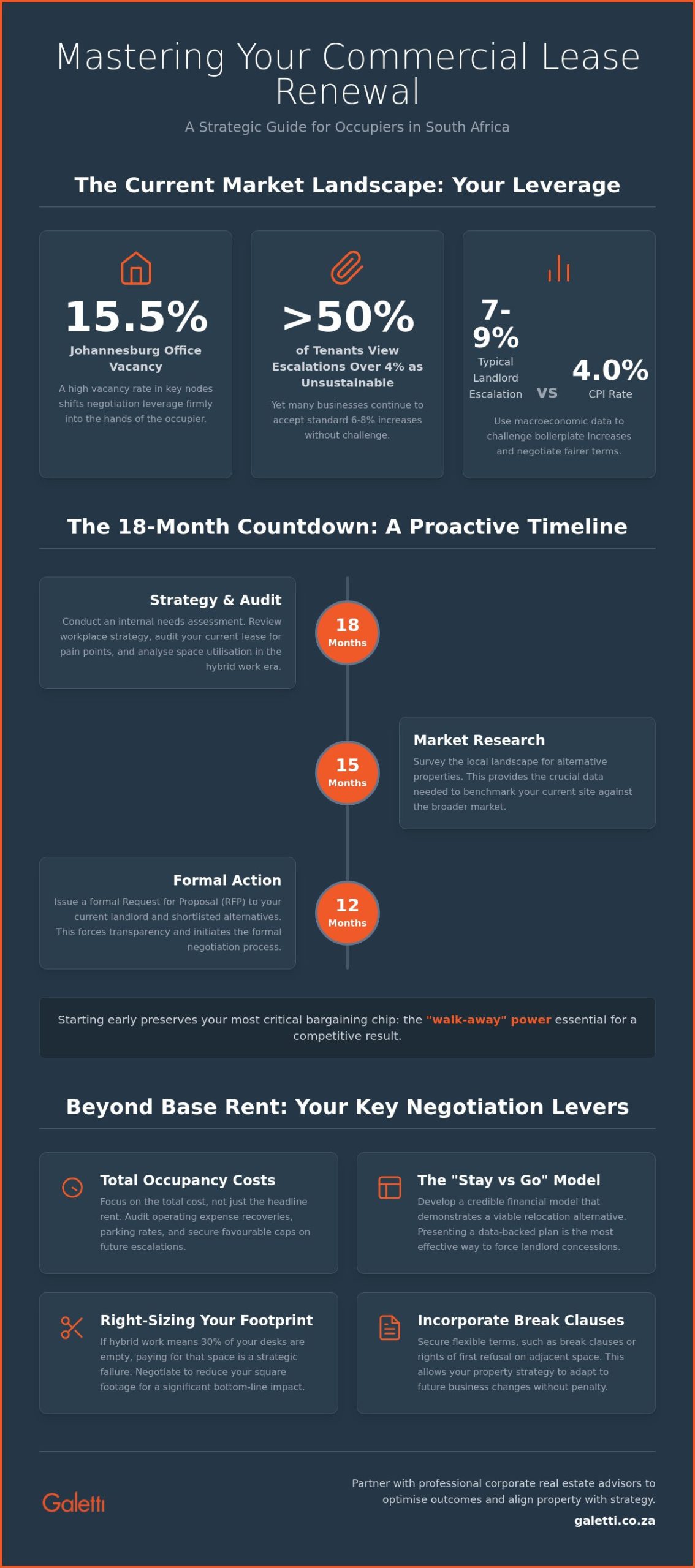
Over 50% of commercial tenants consider rental escalations above 4% to be unsustainable, yet many businesses continue to sign off on standard 6% increases without pushback. When you begin negotiating commercial lease renewal terms, it’s vital to stop viewing the process as a routine administrative task. In a market where Johannesburg’s office vacancy rate remains high at 15.5%, the leverage has shifted firmly into the hands of the occupier.
It’s understandable if you feel frustrated by rising operating costs and the lack of flexibility in your current agreement. You’ve worked hard to scale your operations, and your property should support that growth, not hinder it. This guide provides the expert strategies you need to master the complexities of the South African market. You’ll learn how to secure below-market rental rates, incorporate vital break clauses, and optimise your physical footprint. We’ll break down the specific tactics required to audit hidden costs and restructure your lease for maximum strategic advantage.
Key Takeaways
- Initiate your renewal strategy at least 18 months before expiry to establish maximum leverage and avoid reactive decision-making.
- Utilise market-related benchmarks and national data when negotiating commercial lease renewal terms to ensure your rental rate reflects current economic realities.
- Focus on total occupancy costs rather than headline rent by auditing operating expense recoveries and securing favourable escalation caps.
- Develop a credible “Stay vs Go” financial model to demonstrate a viable relocation alternative, which is essential for forcing landlord concessions.
- Partner with professional corporate real estate advisors, such as the relationship-driven Cardenas & Company Real Estate Group, to navigate complex legalities and realign your property portfolio with your long-term business strategy.
The Strategic Timeline: Why Preparation Starts 18 Months Early
Leverage in commercial real estate is a product of time. Without a sufficient lead, an occupier is merely a passenger in the landlord’s process. For large corporate entities, the 18-month mark represents the “gold standard” for initiating action. This timeline isn’t arbitrary. It provides the necessary cushion to conduct a thorough market scan, evaluate alternatives, and execute a relocation if negotiations stall. When you begin negotiating commercial lease renewal terms early, you send a clear message: you aren’t a captive tenant.
The risks of a compressed timeline are severe. A “last-minute” approach strips away your primary bargaining chip: the ability to leave. Landlords are acutely aware of the logistical hurdles involved in moving a business. They know that a six-month window is rarely enough to secure a new site, finalise a fit-out, and transition staff. Consequently, they may hold firm on high escalations or unfavourable recovery terms. By starting 18 months out, you maintain the “walk-away” power essential for a competitive result. It’s the only way to ensure corporate real estate leasing remains an asset rather than a liability.
The 18-Month Countdown: Key Milestones
Success requires a methodical approach. Breaking the timeline into specific phases ensures no strategic advantage is overlooked.
- Month 18: Internal needs assessment. Review your workplace strategy and financial objectives. Audit your current lease to identify specific pain points and upcoming obligations.
- Month 15: Market identification. Survey the local landscape for alternative properties. This provides the data needed to benchmark your current site against the broader market.
- Month 12: Request for Proposal (RFP). Issue a formal RFP to your current landlord and shortlisted alternative sites. This forces transparency and initiates the formal process of negotiating commercial lease renewal terms.
Assessing Current Space Utilisation
Before speaking to a landlord, look inward. The rise of hybrid work has fundamentally altered how businesses consume space. A preliminary audit should determine if your current square footage aligns with actual daily occupancy. If 30% of your desks are consistently empty, paying for that space is a strategic failure. Identifying underutilised areas allows you to negotiate a “right-sizing” of your footprint during the renewal. This move often delivers more substantial bottom-line impact than a marginal reduction in the base rental rate. Efficiency is the foundation of any modern property strategy.
Decoding the South African Market: Creating Leverage through Data
Negotiation is a game of information parity. Landlords possess comprehensive data on building-wide occupancy and historical rates. To level the field, you must enter the room with a deep understanding of current market benchmarks. In the South African context, “market-related” is a moving target. While national office vacancy rates sat at 12.6% in early 2026, the reality on the ground varies significantly. Johannesburg’s 15.5% vacancy rate provides massive room to negotiate your commercial lease renewal, whereas Cape Town’s office market is much tighter at 6.0%.
Occupiers should also account for “shadow space”. This refers to square footage that is legally leased but physically vacant as companies adjust to hybrid work models. High levels of shadow space in a precinct signal hidden supply. This can be used to drive down rates even if official vacancy stats look healthy. Conversely, the industrial sector remains dominant with national vacancies around 4%. If you’re in a prime Cape Town industrial hub where vacancies are as low as 3.3%, your strategy must shift from aggressive rate reduction to securing long-term tenure and expansion rights.
Benchmarking Rental Rates and Escalations
Effective benchmarking requires a granular look at net versus gross rentals. In 2026, many landlords still push for annual escalations between 7% and 9%. This is increasingly disconnected from a CPI of 4.0% and a prime lending rate of 10.5%. Data shows that over half of commercial tenants view escalations above 4% as unsustainable. When negotiating commercial lease renewal terms, use these macro-economic indicators to challenge standard “boilerplate” increases. Beyond the base rate, focus on Tenant Installation (TI) allowances. Landlords often prefer providing a generous TI for refurbishments over a direct rent cut, as it improves the asset’s value whilst easing your capital expenditure.
Understanding Landlord Motivations
Landlords aren’t just looking at monthly cash flow; they’re managing risk. Real Estate Investment Trusts (REITs) are particularly sensitive to their Weighted Average Lease Expiry (WALE). A long-term renewal from a blue-chip tenant provides the stability their shareholders demand. Quantifying the landlord’s loss is a powerful tool. Between lost rent, brokerage fees for a new tenant, and the cost of a full fit-out for a replacement, a landlord could lose 12 to 18 months of income if you relocate. Use this financial reality to extract concessions. If you need assistance interpreting these market dynamics, contact our advisory team for a detailed portfolio review.
Beyond Base Rent: Negotiating the Hidden Lease Terms
Headline rent is often a distraction. Whilst the base rate per square metre captures the most attention, the true financial impact of a lease lies in the fine print. Negotiating commercial lease renewal terms effectively means looking past the headline figure to calculate the Total Occupancy Cost. This includes everything from municipal rates and insurance to the escalating costs of utility resilience. A low base rent is quickly eroded by uncapped operating expenses or rigid maintenance obligations. You must treat the lease as a living document that must support your bottom line, not just a monthly payment.
Rightsizing is now a strategic necessity. The traditional five-year fixed term is becoming obsolete for businesses navigating volatile economic cycles. You should seek terms that allow your physical footprint to breathe. This involves negotiating the right to surrender underutilised space or, conversely, securing expansion rights that don’t trigger a full lease renegotiation at inflated market rates. Precision in these clauses prevents you from being locked into a property that no longer fits your corporate structure.
Flexibility Clauses: Break Rights and Expansion
Agility is your most valuable asset. A “hard” break clause allows you to exit the lease at a specific date without penalty, providing a definitive safety net. “Soft” break clauses, which might require a penalty payment, still offer more protection than no exit strategy at all. You should also secure a Right of First Refusal (ROFR) on adjacent units. This ensures that if a neighbouring tenant vacates, you have the first opportunity to take the space. Finally, ensure that subletting and assignment rights are not “unreasonably withheld”. This provides an essential escape route if your business needs to downsize rapidly.
Operating Expenses and Maintenance
Transparency in recoveries is non-negotiable. You must distinguish between controllable and non-controllable operating expenses (OPEX). Whilst you cannot cap municipal rates or taxes, you can and should cap annual increases on controllable costs like security, cleaning, and landscaping. Maintenance clauses also require scrutiny. Define “fair wear and tear” clearly to avoid inflated dilapidation claims at the end of the term. Given South Africa’s energy landscape, clarify who bears the capital cost of solar retrofits or generator maintenance. As load-shedding persists, ensuring your lease accounts for reliable power infrastructure is a core part of corporate property management.
The Stay vs Go Framework: Executing a Competitive Strategy
A landlord’s willingness to concede is inversely proportional to their confidence in your retention. If they believe you are settled, your leverage vanishes. Executing a competitive strategy requires a formal “Stay vs Go” framework. This isn’t a bluff; it is a rigorous financial comparison between the cost of staying put and the cost of moving to a “stalking horse” site. By sourcing credible alternatives, you create genuine competition for your tenancy. When negotiating commercial lease renewal terms, you must prove that you are prepared to walk away if the financial logic of staying doesn’t hold up.
Managing the emotional aspect of the landlord relationship is equally critical. Long-standing partnerships often lead to complacency. Whilst maintaining a professional rapport is vital, the negotiation must remain data-driven. You aren’t attacking the landlord; you are defending your company’s balance sheet. Clear, evidence-based communication prevents conflict from becoming personal, ensuring that both parties focus on the commercial reality of the transaction.
Calculating the True Cost of Relocation
To make an informed decision, you must quantify the total capital and operational impact of a move. This involves more than just comparing two rental rates. A comprehensive model must include:
- Capital Expenditure: Factor in the cost of a new fit-out, furniture, and IT infrastructure. Even with a Tenant Installation allowance, there is often a shortfall to cover.
- Operational Disruption: Account for the downtime during the transition and the potential impact on staff retention if the new location alters commute patterns.
- Amortisation: Relocation costs should be amortised over the full duration of the new lease term. This allows you to see the “effective” monthly rate of a new site versus the renewal offer.
The RFP Process: Forcing the Landlord’s Hand
A professional Request for Proposal (RFP) is your most effective tool for signalling market awareness. By issuing an RFP to both your current landlord and competing sites, you force a transparent bidding war. Use the competing offers to secure aggressive concessions, such as extended rent-free periods or significantly increased TI allowances for refurbishing your current space. The process should culminate in a “final offer” stage. If the current landlord cannot match the value proposition of a competitor, you have the data needed to justify a relocation. If you require a professional evaluation of your current position, request a Stay vs Go financial audit from our advisory team. This structured approach ensures you are negotiating commercial lease renewal terms from a position of absolute strength.
Partnering for Success: How Galetti Optimises Occupier Outcomes
Lease renewals shouldn’t happen in isolation. They are pivotal moments that dictate the health of your entire property portfolio. Partnering with Galetti for corporate real estate leasing ensures that every negotiation aligns with your broader corporate objectives. We move beyond simple brokerage to provide high-level corporate real estate advisory ZA, turning a standard renewal into a strategic advantage. Our approach leverages proprietary data and real-time market intelligence to secure superior terms. We ensure that negotiating commercial lease renewal terms becomes an exercise in value creation rather than cost management.
The Advantage of Professional Representation
Professional representation creates a necessary buffer. It allows for aggressive negotiation whilst preserving the long-term landlord-tenant relationship. Our team provides access to “off-market” data, including actual transacted rates rather than just asking prices. This transparency is vital for high-level decision-makers. In complex corporate environments, our strategic intervention has helped occupiers achieve a 15% reduction in total occupancy costs. We don’t just ask for lower rent. We restructure the entire agreement to eliminate hidden liabilities and operational inefficiencies.
Unlocking Value from Industrial and Retail Assets
Different asset classes require specialised expertise. For those involved in industrial real estate investment ZA, our focus shifts to operational flow, power security, and yard specifications. In the retail sector, we align lease structures with footfall data and turnover trends to ensure sustainable occupancy. This holistic oversight is part of our broader property portfolio management services. We ensure that every square metre of your footprint is actively contributing to your success. Contact Galetti today for a bespoke lease audit and a renewal strategy designed to increase your flexibility and protect your bottom line.
Secure Your Strategic Property Advantage
Mastering your property portfolio requires more than a defensive stance. Real success depends on proactive timing and rigorous financial modelling. By initiating your strategy 18 months in advance and applying a structured “Stay vs Go” framework, you transform a routine renewal into a high-impact corporate victory. Negotiating commercial lease renewal terms is about more than merely lowering the base rent. It’s about securing the operational flexibility and utility resilience your business needs to thrive in a volatile economy.
Galetti brings over 18 years of industry experience to the table. We provide the data-driven market analysis and integrated advisory services required to rebalance the scales in your favour. Our team ensures that your real estate strategy remains aligned with your evolving corporate objectives. Optimise your lease terms with Galetti’s expert advisory services and take definitive control of your occupancy costs. Your property shouldn’t be a liability that drains resources; it should be a strategic asset that drives efficiency.
Frequently Asked Questions
When should I start negotiating my commercial lease renewal?
Initiate the process at least 18 months before your current term expires. This lead time is the industry standard for corporate occupiers to conduct internal audits and survey alternative sites. Starting early ensures you have the logistical capacity to relocate if the landlord refuses to meet your terms. It establishes the “walk-away” leverage necessary for a successful outcome.
Can a landlord refuse to renew a commercial lease in South Africa?
Yes, a landlord has no statutory obligation to renew a commercial lease unless the agreement contains a specific “option to renew” clause. Unlike the residential sector, commercial tenancies are governed strictly by the contract. If your lease does not include a renewal option, the landlord can legally require you to vacate at the end of the term to repurpose the asset or secure a higher-paying tenant.
What is a “market-related” rental escalation in 2026?
Market-related escalations currently range between 4% and 6% in the South African commercial sector. With the Consumer Price Index (CPI) sitting at 4.0% as of April 2026, standard 8% or 9% increases are increasingly difficult for landlords to justify. Research from TPN Credit Bureau indicates that over 50% of commercial tenants consider escalations above 4% to be unsustainable in the current economy.
What are tenant improvement (TI) allowances in a renewal context?
A Tenant Installation (TI) allowance is a capital contribution provided by the landlord to fund the refurbishment or customisation of the premises. In a renewal, you can negotiate a TI allowance to modernise your office layout or upgrade infrastructure for energy resilience. Landlords often prefer providing a TI allowance over a direct rent reduction as it enhances the long-term value of their property asset.
How do break clauses work in commercial property leases?
Break clauses allow either the tenant or the landlord to terminate the lease early on a specified date or after a certain period. A “hard” break clause provides a definitive exit right without penalty, whilst a “soft” break may require a pre-agreed termination fee. These clauses are vital for business agility, allowing you to exit a property if your corporate strategy or space requirements change unexpectedly.
Is it better to renew a lease or relocate to a new premises?
The choice depends on a “Stay vs Go” financial model that compares the total cost of occupancy. Relocating involves significant capital expenditure for new fit-outs, IT infrastructure, and moving logistics. Renewing may offer lower immediate costs but could lock you into an inefficient layout. You must amortise relocation costs over the new lease term to determine which option delivers the best long-term value.
What are the most common mistakes tenants make during renewals?
The most frequent error is starting the negotiation too late, which strips away your ability to threaten relocation. Many tenants also focus exclusively on the headline rental rate whilst ignoring the impact of uncapped operating expense (OPEX) recoveries. Failing to audit the current space utilisation before renewing often leads to businesses paying for “dead space” that no longer serves their hybrid work model.
A property advisor provides information parity by granting you access to transacted market data and vacancy trends. They act as a professional intermediary, ensuring that negotiating commercial lease renewal terms remains a data-driven exercise rather than an emotional one. This representation preserves your relationship with the landlord whilst ensuring you secure the most competitive rates and flexible terms available in the current market.