
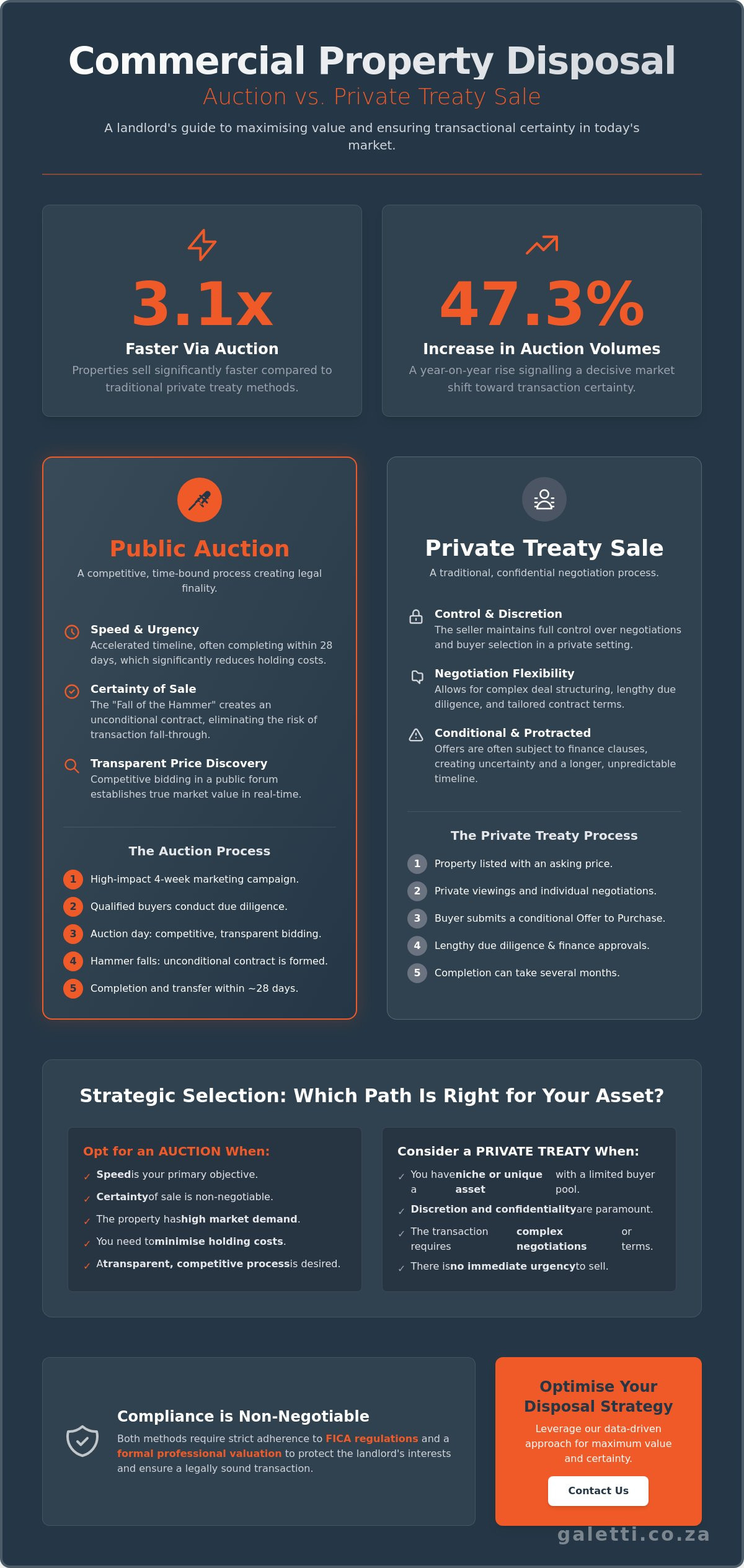
Properties sell 3.1 times faster through auctions than by traditional methods, yet many landlords remain tethered to the slow pace of private treaty negotiations. In the first quarter of 2026, the market saw a record 47.3% year-on-year increase in commercial auction volumes, signalling a decisive shift toward transaction certainty. Choosing the right path for an auction vs sale commercial property disposal is now a critical factor in protecting your portfolio from the high costs of asset illiquidity and market uncertainty.
We understand that holding an underperforming asset is a direct drain on your capital and strategic focus. Every month of delay increases holding costs and complicates your exit strategy. This article provides a definitive comparison of disposal methods to help you maximise your sale price while ensuring a transparent, professional process. We preview the specific conditions where the speed of the hammer outperforms private negotiations, giving you the clarity needed to achieve a certain closure in the current South African landscape.
Key Takeaways
- Distinguish between competitive public bidding and traditional negotiation-led private treaty processes to align with your disposal goals.
- Select the optimal auction vs sale commercial property path based on your specific asset type, market demand, and required transaction speed.
- Leverage the legal finality of the auction process to eliminate the risk of transaction fall-through and significantly reduce holding costs.
- Identify which commercial assets, from industrial warehouses to complex office blocks, perform best under specific market conditions.
- Utilise a data-driven, dual-track approach to capture maximum value and ensure certainty of closure in the South African market.
Navigating Commercial Property Disposal: Auction vs Private Treaty Sale
Disposal strategy dictates the final yield of any commercial portfolio. Landlords must choose between two distinct paths: the private treaty sale or the public auction. A private treaty involves traditional negotiations where a seller sets an asking price and brokers facilitate offers over an extended period. Conversely, a commercial auction is a competitive, public bidding process that culminates in an unconditional sale the moment the hammer falls. Understanding the mechanics of commercial auctions is essential for modern investors who require liquidity without sacrificing asset value.
In 2026, the decision regarding an auction vs sale commercial property disposal has shifted toward data-driven transparency. Tech-integrated platforms now allow for real-time bidding, attracting a global pool of qualified buyers. This evolution ensures that disposal is no longer a passive exercise but a proactive strike to capture peak market demand. Choosing the wrong route can result in months of stagnation and unnecessary capital loss.
The Strategic Importance of Disposal Timing
Holding costs are the silent killers of commercial returns. Rates, taxes, and security expenses erode equity every day an asset remains unsold. Auctions offer an accelerated timeline, often completing within 28 days of the event. This speed is vital when market sentiment in South Africa is volatile. Historically, auctions were viewed as a last resort for distressed assets. That perception has changed. Today, institutional investors use auctions to dispose of high-performing industrial warehouses and retail centres. The process creates a sense of urgency that private sales often fail to replicate.
Regulatory Considerations in the South African Market
Compliance is non-negotiable. Both disposal methods require strict adherence to FICA (Financial Intelligence Centre Act) regulations to prevent money laundering. Sellers must ensure all potential buyers are vetted before any transaction proceeds. Professional bodies maintain industry standards, ensuring that every bid or offer is legitimate. Before selecting a method, a formal professional valuation is required. This benchmark protects the landlord’s interests, ensuring the reserve price at auction or the asking price in a private sale aligns with current market realities. Strategic disposal requires a regulatory-compliant roadmap to avoid legal delays.
Understanding the Mechanics of Commercial Auctions and Private Sales
Success in commercial property disposal depends on the legal framework governing the transaction. The primary distinction in an auction vs sale commercial property strategy lies in the point of commitment. In an auction, the “Fall of the Hammer” signifies immediate legal finality. This creates an unconditional contract between the buyer and seller. There are no suspensive conditions; the deal is done. Conversely, a private treaty sale relies on an “Offer to Purchase” (OTP) which typically includes lengthy due diligence periods and finance clauses.
Protecting the landlord’s interests is achieved through the reserve price. This is a confidential minimum figure agreed upon before the event. If bidding fails to reach this threshold, the property is not sold, though negotiations often continue with the highest bidder. To reach this point, a pre-auction campaign must be marketing-intensive. It compresses months of traditional listing activity into a high-impact four-week window to ensure maximum buyer participation.
The Auction Process: Speed and Finality
The auction timeline is structured for momentum. It begins with a formal mandate and a comprehensive due diligence pack prepared by the seller. Once the campaign launches, potential buyers have a fixed window to inspect the asset and review the legal documents. On auction day, the process is transparent and public. Bidding is competitive, which often drives the price beyond initial expectations through real-time price discovery. Completion is swift, typically occurring within 28 days of the signature. This speed is a powerful tool for optimising property auction services to free up capital quickly.
The Private Treaty Process: Control and Negotiation
Private treaty sales offer a different type of precision. The process starts with a listing and progresses through private viewings and one-on-one negotiations. This method provides the seller with total control over who they engage with. Contracts are often long-form and highly customised. Whilst this offers flexibility, it also introduces risk. OTPs are frequently subject to board approval or third-party financing, contributing to a fall-through rate of approximately 30% in traditional markets. This “quiet” route remains the preferred choice for sensitive corporate disposals where confidentiality outweighs the need for immediate speed.
Analysing Performance Metrics: Speed, Certainty, and Value Realisation
Efficiency in capital recycling depends on three primary metrics: speed, certainty, and final value. When evaluating an auction vs sale commercial property strategy, the “Time on Market” is often the deciding factor. Data indicates that properties sell 3.1 times faster through auctions than by traditional methods. A private treaty sale can languish for six months or longer, whereas an auction provides a fixed date for closure. This compression of time directly reduces holding costs, such as security, insurance, and municipal rates, which can otherwise erode the net proceeds of a sale.
Certainty of closure is another critical differentiator. In a private treaty environment, the fall-through rate is approximately 30%. These failures often occur late in the process during the due diligence or financing stages, forcing the landlord to restart the marketing process from zero. Auctions eliminate this risk. Because bids are unconditional, the transaction is legally binding at the moment of the sale. This structural finality provides landlords with the confidence to plan future acquisitions or distributions without the threat of a deal collapsing at the eleventh hour.
Value Realisation: Getting the Best Price
Price maximisation is achieved through different mechanisms in each model. Auctions thrive on competitive tension. For high-demand assets like industrial warehouses or well-located retail centres, the public nature of bidding can push the price well beyond the reserve. This real-time price discovery ensures the seller captures the absolute market ceiling. Conversely, private sales allow for strategic positioning. This is ideal for complex assets where a broker needs to “sell the vision” to a specific type of institutional investor or a corporate owner-occupier. Success here relies on structured negotiation rather than raw bidding momentum. Before going to market through either route, understanding the data-driven methods to maximize commercial property value in 2026 ensures your asset is positioned at its highest possible capitalisation rate prior to disposal.
Transaction Certainty: Reducing the Risk of Failure
Deal fatigue is a common obstacle in traditional negotiations. Long-form contracts and multiple rounds of revisions can lead to “buyer’s remorse” or a shift in market conditions that gives the purchaser an excuse to withdraw. Auctions bypass this entirely. There is no cooling-off period in a commercial auction context. Once the hammer falls, the buyer is committed. This lack of suspensive conditions is particularly valuable in a volatile economy where interest rate fluctuations can suddenly impact a buyer’s ability to secure finance midway through a private treaty negotiation. Choosing the auction path ensures that when a price is agreed, the money follows.
Strategic Selection: When to Opt for an Auction or a Traditional Sale
Selecting the right disposal path is a strategic exercise in asset matching. Not every property is suited for the public stage. The choice between an auction vs sale commercial property strategy hinges on two primary variables: the asset’s complexity and the landlord’s requirement for liquidity. If the objective is to exit a position within a fixed timeframe to reallocate capital, the auction route is the logical choice. However, if the asset requires a nuanced narrative to justify its valuation, a traditional sale provides the necessary room for manoeuvre.
The “Uniqueness Factor” also dictates the method. Rare, high-demand assets often achieve record prices at auction because the competitive environment removes the “ceiling” of an asking price. Conversely, properties that require significant buyer education or those with complex title issues may benefit from the slower, more deliberate pace of a private treaty negotiation.
Asset-Specific Recommendations
Industrial properties are currently the primary drivers of auction success. The high demand for logistics space and “last-mile” delivery hubs creates a fertile environment for competitive bidding. Buyers for these assets are often well-capitalised and ready to act. For a comprehensive understanding of how to leverage this demand, our guide to industrial property auctions ZA details the strategic framework for maximising returns on logistics and warehouse assets. Retail centres, however, often demand a private treaty approach. Managing a diverse tenant mix and complex lease structures requires a level of due diligence that doesn’t always align with a compressed auction timeline. For office blocks, especially those facing high vacancy rates, a private sale allows brokers to target specific developers who specialise in urban renewal or residential conversions. These “visionary” sales require one-on-one engagement that the hammer cannot provide.
Market Conditions and Investor Sentiment
Market cycles heavily influence disposal success. In a “Sellers Market,” where stock is scarce, auctions are the most effective way to maximise returns by forcing buyers to compete openly. In a “Buyers Market,” the discretion of a private treaty sale can protect an asset’s reputation if it doesn’t move immediately. Interest rates also serve as a barometer for success. High-interest environments can make buyers more cautious, often favouring the private treaty route where suspensive finance conditions can be negotiated. If you are unsure of an asset’s true market value in a volatile period, an auction provides definitive price discovery, setting a transparent benchmark based on real-time demand.
Determining the correct path requires a deep dive into current market data. Our Property Sales Services team can provide the strategic advisory needed to ensure your asset is positioned for the highest possible yield.
Optimising Asset Disposal with Galetti’s Integrated Approach
Galetti provides a sophisticated dual-track disposal model. We don’t force a single methodology; we leverage both Sales and Auctions to ensure the highest possible yield. The decision regarding an auction vs sale commercial property strategy is underpinned by 18 years of proprietary market data. This deep historical insight allows our consultants to identify the precise moment an asset should hit the public floor or remain in structured private negotiations. Our goal is to align your exit with peak market demand to ensure capital is recycled efficiently.
Competitive tension is the engine of value. Galetti’s national network connects your asset with a vetted pool of institutional and private investors. This reach is essential for driving the bidding momentum required at auction. Our success in the industrial and office sectors is built on this ability to match unique assets with the right capital. Whether you’re rebalancing a national portfolio or liquidating a single high-value asset, our integrated approach ensures a transparent and efficient closure without the typical delays of traditional brokerage.
Data-Driven Advisory Services
Our Corporate Services division utilises rigorous market benchmarks to forecast auction performance with high accuracy. We analyse micro-market trends, including current vacancy rates and sector-specific yield expectations across South African commercial hubs. This data-driven approach removes the guesswork from disposal. We manage the entire lifecycle of the transaction, from the initial valuation to the final signature, significantly reducing the administrative burden on your internal teams. By structuring large-scale disposals through a managed programme, we ensure every asset in your portfolio reaches its maximum potential value.
Securing Your Next Transaction
Reaching a definitive decision on your disposal path requires a professional audit. We invite landlords and investors to engage with our team for a comprehensive strategic review of their holdings. Our track record in the industrial and office sectors nationally provides the foundation for reliable, results-oriented advice. We understand the nuances of the South African market and the regulatory requirements that govern high-value transactions. Contact Galetti to discuss your property disposal strategy today and ensure your next transaction is handled with the expertise your portfolio deserves.
Securing the Future of Your Portfolio
Effective capital reallocation requires a decisive choice between speed and precision. As market conditions evolve through 2026, the auction vs sale commercial property decision remains central to portfolio performance. Auctions provide the unconditional finality and competitive tension needed for high-demand industrial assets. Conversely, a private treaty sale offers the control required to navigate complex corporate office blocks. Success isn’t about choosing one method over the other; it’s about matching the right disposal path to the specific needs of the asset.
Galetti leverages over 18 years of commercial real estate expertise to guide these critical decisions. With national coverage across South Africa and integrated auction and sales divisions, we provide the strategic advisory needed to maximise your returns. Whether you require the transparency of the hammer or the discretion of a private negotiation, we have the infrastructure to deliver results. Consult Galetti for Expert Commercial Property Disposal Strategies and take the next step toward rebalancing your holdings with confidence.
Frequently Asked Questions
What is the main difference between a commercial property auction and a private sale?
The primary distinction in an auction vs sale commercial property disposal is the legal point of commitment. Auctions result in an unconditional, legally binding contract the moment the hammer falls. Private treaty sales involve an Offer to Purchase which typically includes suspensive conditions like finance approvals and long-form due diligence periods that can delay the transaction.
How long does a commercial property auction take from start to finish?
A standard commercial auction campaign runs for approximately four weeks of intensive marketing to ensure maximum buyer participation. Once the sale is concluded on auction day, the completion and transfer process typically targets a 28-day window. This structured timeline is significantly faster than the traditional private treaty route, which can extend over several months depending on the buyer’s requirements.
Is an auction bid legally binding for commercial property in South Africa?
Yes, an auction bid is legally binding in South Africa under the Consumer Protection Act and general contract law. When the auctioneer’s hammer falls, it constitutes a definitive sale with no cooling-off period for the purchaser. The buyer is required to sign the conditions of sale immediately and provide a deposit, ensuring a level of transaction finality that private treaty negotiations often lack.
Can I set a minimum price for my property at an auction?
Landlords protect their financial interests by setting a confidential reserve price before the event. This is the minimum amount the seller is willing to accept for the asset. If the highest bid fails to reach this threshold, the property is “passed in,” though the highest bidder usually gains the first right to negotiate a private sale with the seller immediately after the auction concludes.
Why would a seller choose a private treaty sale over an auction?
Private treaty is often preferred for complex, multi-tenant assets that require a nuanced narrative or highly specific buyer profiles. This method allows for discrete negotiations without the public exposure of an auction floor. It’s the ideal path for corporate sellers who prioritised confidentiality and precise control over the bespoke terms of the transaction rather than immediate liquidity.
What costs are involved in selling commercial property at auction?
Sellers typically cover a marketing contribution to fund the intensive pre-auction campaign across digital and national print platforms. A commission is also payable upon the successful sale of the property. These costs are structured to align the interests of the broker with the landlord’s goal of achieving the highest possible market price through competitive tension.
Are auctions only for distressed or repossessed properties?
Modern commercial auctions are no longer reserved for distressed assets. Institutional investors and listed funds now use this platform to dispose of high-performing properties because it creates an environment of transparent price discovery. The process is a strategic tool for efficient capital recycling and is frequently used for premium assets in high-demand sectors.
Which method is better for industrial property disposal?
Auctions are generally superior for industrial property disposal due to the current high demand for logistics and warehouse space. The competitive bidding environment often drives prices beyond initial valuations. Because industrial assets are usually less complex than retail or office blocks, they are perfectly suited for the transparent and accelerated nature of the industrial property auctions ZA process.