
What if your organisation’s most valuable asset isn’t the property you own, but the liquidity trapped within its walls? With nearly $875 billion in commercial real estate loans maturing in 2026, many directors feel the strain of high interest rates and restricted cash flow. You likely recognise that capital tied up in non-core real estate is capital that isn’t driving your next expansion. A commercial property sale and leaseback offers a sophisticated, results-oriented alternative to traditional debt financing.
We understand the need for rapid capital injection without the disruption of relocation. This strategic guide demonstrates how to transform static assets into liquid capital whilst maintaining total operational control of your premises. You will learn how to unlock 100% of your property equity, improve debt-to-equity ratios, and secure long-term tenure through a bespoke lease. We’ll examine the current market dynamics, including cap rates and accounting standards, to ensure your next move is both profitable and permanent.
Key Takeaways
- Understand the transition from owner-occupier to corporate tenant while maintaining full operational control of your premises.
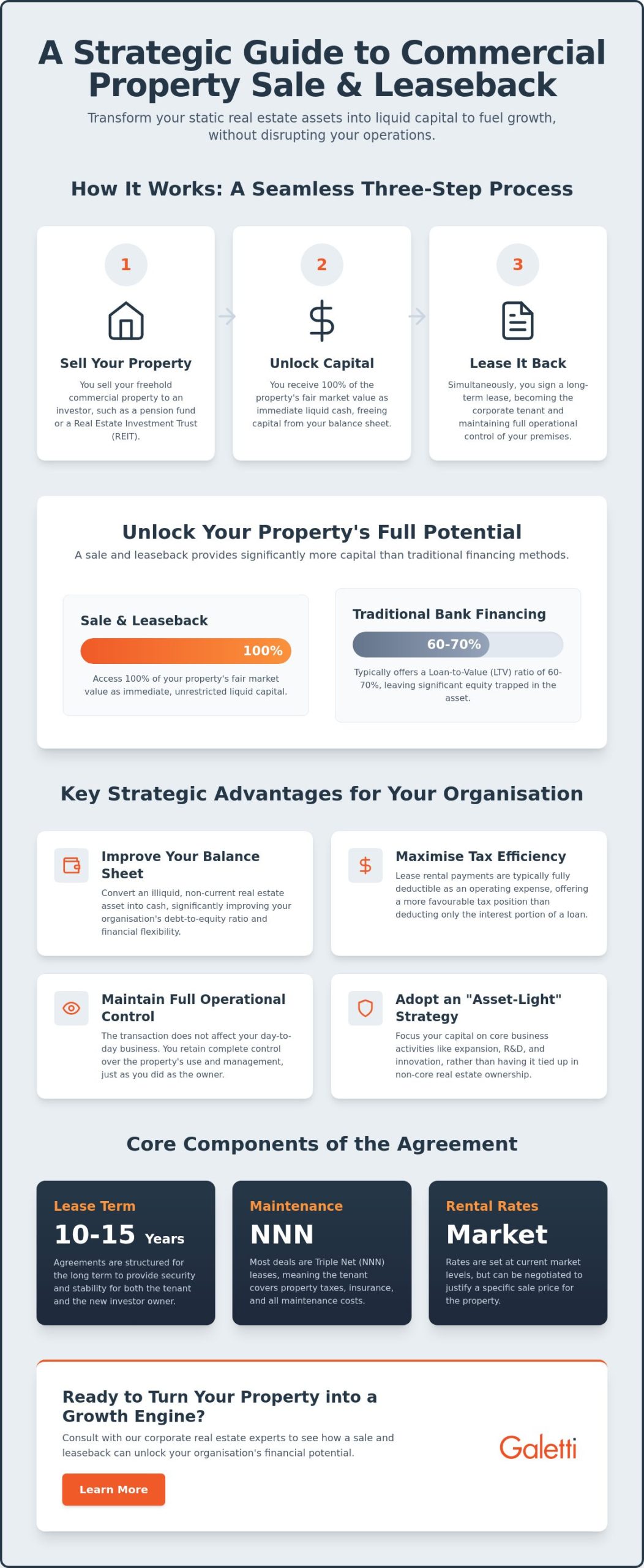
- Learn how a commercial property sale and leaseback unlocks 100% of asset equity, compared to the 60-70% typically offered by bank financing.
- Discover the strategic advantage of converting non-current real estate into liquid capital to improve debt-to-equity ratios.
- Evaluate the critical trade-offs between securing immediate capital and the long-term commitment of a non-cancellable lease.
- Identify the essential steps for structuring a deal, from professional valuation to preparing a robust Investment Memorandum.
Understanding the Mechanics of Commercial Property Sale and Leaseback
A commercial property sale and leaseback is a dual-transaction strategy designed for capital efficiency. It involves the simultaneous sale of a freehold property to an investor and the execution of a long-term lease back to the original owner. This isn’t a property disposal in the traditional sense. It’s a strategic recapitalisation. For a foundational overview of how these arrangements function globally, Understanding Sale-Leaseback Transactions provides essential context on the mechanics involved.
The transaction creates a fundamental shift in your corporate structure. You transition from an owner-occupier to a corporate tenant. This move releases 100% of the property’s value from the balance sheet, providing immediate liquidity for core operations. Institutional investors, including pension funds and REITs, actively seek these stable, income-generating assets. They value the predictable cash flow and the security of a tenant who already knows the building’s operational nuances.
In the South African market, this model is highly effective across the industrial, office, and retail sectors. It’s particularly suited to mission-critical assets like specialised manufacturing plants or regional distribution hubs. By leveraging Galetti Corporate Services, businesses can navigate the complexities of these high-stakes negotiations with precision and speed.
The Transaction Structure
The hallmark of a successful deal is the simultaneous closing process. This ensures zero operational downtime. Your business continues its daily activities without interruption whilst the ownership transfer occurs. The valuation basis differs from a standard sale. It’s determined by a combination of the asset’s market value and the investment value derived from the lease terms. Ultimately, the sale and leaseback acts as a powerful capital-unlocking mechanism that transforms an illiquid asset into a growth engine.
Core Components of the Agreement
Certain standards define most corporate agreements to ensure security for both the tenant and the investor. These components are tailored to the specific needs of the business:
- The lease term: Agreements typically span 10 to 15 years to provide long-term stability.
- Rental rates: Rates are usually set at current market levels, though they can be adjusted to justify a specific purchase price.
- Maintenance responsibilities: Most deals are structured as Triple Net (NNN) leases. This means the tenant pays for property taxes, insurance, and all maintenance costs.
This structure allows the tenant to maintain total control of the premises. You manage the facility as you always have, but without the capital constraints of ownership.
Strategic Advantages: Why Corporates Pursue Sale and Leaseback Deals
A commercial property sale and leaseback provides an immediate capital injection that traditional lending simply cannot match. While banks typically offer 60% to 70% loan-to-value (LTV) ratios, a sale-leaseback unlocks 100% of the property’s fair market value. This capital isn’t a loan; it’s yours to reinvest without the burden of monthly interest repayments on a principal sum. Given the Favorable Market Conditions for Sale-Leasebacks in 2026, many firms are choosing this path to avoid high-interest debt whilst interest rates remain near 6% for industrial assets.
Tax efficiency serves as another driver for this strategy. Rental payments are typically fully deductible as an operating expense. In contrast, traditional financing only allows for the deduction of interest, leaving the principal repayment as a non-deductible cost. You also retain total operational autonomy. The lease agreement ensures you manage the facility’s daily use without interference from the new owner, maintaining the same level of control you enjoyed as an owner-occupier.
Capital Liquidity and Growth
Modern South African corporates are increasingly adopting an “Asset-Light” strategy. They prefer to use capital for core business expansion, R&D, or debt reduction rather than holding it in bricks and mortar. The cost of capital for a leaseback is often lower than high-yield corporate bonds or mezzanine debt. It’s a cleaner way to fund growth. If you are considering these options, you might consult with an advisory expert to assess your specific asset and its potential for liquidity.
Balance Sheet Optimisation
Balance sheet optimisation is critical for listed entities and large private firms. Disposing of real estate improves Return on Assets (ROA) and Return on Equity (ROE) by removing low-yield assets from the books. You must account for IFRS 16, which requires lease liabilities to be recognised on the balance sheet. However, the conversion of a non-current asset into cash significantly boosts your current ratio and overall liquidity. For a deeper dive into these strategies, explore our Strategic Property Portfolio Management Services. This approach ensures that your real estate remains a tool for performance rather than a drag on your financial metrics.
Evaluating the Risks and Long-Term Considerations
Every strategic decision involves a calculated trade-off. While a commercial property sale and leaseback releases significant capital, it also terminates your ownership of a tangible asset. You essentially exchange property equity for liquid cash and a long-term liability. This shift requires a deep understanding of the economic substance of sale-leasebacks, as the transaction fundamentally alters your financial profile and operational boundaries.
The primary risk is the loss of future capital appreciation. Real estate in prime South African industrial or commercial hubs often appreciates over time; by selling, you forego these gains. Additionally, you face the commitment of a non-cancellable lease. This obligation remains on your balance sheet even if your business requirements change or the market shifts. You must also account for annual rent escalations. If these escalations outpace your business growth or local inflation, the cost of occupancy could eventually weigh on your margins.
Financial Trade-offs
The decision hinges on opportunity cost. You must determine if the returns from re-investing that capital into your core business will exceed the projected growth of the property. For most high-performing firms, the answer is yes. The risk is often mitigated by the higher returns generated through core business activities versus passive property appreciation. Don’t overlook the impact of Capital Gains Tax (CGT) on the initial sale. This immediate tax liability can reduce the net capital available for reinvestment, so precise tax planning is essential.
Operational and Leasehold Risks
Transitioning from owner to tenant reduces your flexibility. You can no longer make major structural alterations without the landlord’s consent. This can be restrictive if your operational needs evolve quickly. To protect your interests, focus on these critical areas during negotiation:
- Renewal Options: Secure multiple renewal terms to prevent forced relocation when the initial lease expires.
- “Make Good” Clauses: Clearly define your obligations for restoring the building at the end of the term to avoid unforeseen exit costs.
- Institutional Relationships: Understand that institutional landlords prioritise yield and stability. Their long-term goals may clash with your need for bespoke building modifications.
Managing these relationships requires a proactive approach. It’s about ensuring the lease remains a tool for your success rather than a constraint on your growth.
Structuring a Successful Sale and Leaseback Transaction
Structuring a successful commercial property sale and leaseback requires more than a simple listing. It is a sophisticated financial engineering exercise. You must first secure a professional valuation to determine the asset’s true market worth. This figure is not merely based on the physical structure. It is heavily influenced by the lease terms you are prepared to sign. Investors essentially purchase your company’s credit as much as they purchase the bricks and mortar. A comprehensive Investment Memorandum is vital to highlight both the property’s utility and your business’s financial stability.
Before approaching the market, draft the lease terms to ensure they align with your operational requirements. Identifying and vetting the right investors is a critical phase. You might target Real Estate Investment Trusts (REITs), private equity firms, or high-net-worth individuals. Each has different risk appetites and yield requirements. Investors are currently pricing risk with precision. Cap rates for high-quality assets generally range from 6% to 8%, though investment-grade retail can see rates as low as 5.75%.
Step-by-Step Execution
Accurate financial reporting is the foundation of investor trust. It reassures the buyer of your long-term rental security. By utilising Corporate Real Estate Sales services, you can manage the transaction with technical precision from inception to the final capital transfer. In the South African landscape, a typical deal takes between four and six months to conclude. For those seeking to drive competitive tension amongst institutional buyers, auction services can be an effective way to achieve tighter cap rates and a transparent closing timeline.
Key Negotiating Points
The lease agreement is where your future operational flexibility is won or lost. Focus on these specific mechanisms:
- Rent Review Mechanisms: Decide between CPI-linked escalations or a fixed annual percentage. Fixed rates provide more budget certainty.
- Assignment Rights: Ensure you have the right to assign the lease or sublet portions of the building. This is essential if your corporate structure changes.
- Maintenance Caps: Negotiate repair and maintenance caps to protect your business from unforeseen capital expenditure on a building you no longer own.
If you are ready to evaluate how these structures could benefit your balance sheet, contact our advisory team today for a confidential consultation.
Galetti: Your Strategic Partner in Real Estate Capital Solutions
Galetti brings 18 years of specialised expertise to the South African commercial landscape. We don’t just facilitate transactions; we engineer capital solutions. By combining our Corporate Services with transactional excellence, we ensure that every commercial property sale and leaseback aligns with your broader financial objectives. We provide tailored solutions for industrial, retail, and office occupiers nationwide. This ensures that your mission-critical assets remain under your control whilst your balance sheet is optimised for growth.
Our team understands the nuances of the local market. We recognise that a property isn’t just a building; it’s a strategic tool. We’ve built a reputation for reliability and efficiency, aimed at building trust with high-level decision-makers. We avoid emotional fluff. Instead, we focus on a polished, business-like approach that delivers proactive and sophisticated results for our clients.
Corporate Advisory Expertise
Our approach integrates the sale and leaseback model into a comprehensive Corporate Real Estate Advisory ZA strategy. We provide the data-driven insights CFOs need to make informed “sell vs. hold” decisions. This includes benchmarking industrial warehouse lease rates against current South African market standards to ensure your lease terms are competitive and sustainable. We help you navigate the complexities of maturing commercial real estate loans, which are expected to reach $875 billion globally in 2026, by providing viable liquidity alternatives.
Integrated Disposal Strategies
Choosing the right disposal method is as critical as the transaction itself. We offer both private treaty sales and high-impact Property Auctions. Our auction platform is particularly effective for creating intense competitive tension amongst qualified investors. This tension often drives tighter cap rates and maximises the final sale price. You gain immediate access to our extensive local and global network of institutional and private investors, ensuring your asset receives maximum market visibility.
The communication rhythm at Galetti is fast-paced and streamlined. We move your organisation from initial inquiry to a specific capital solution without wasted movement. If you’re ready to transform your real estate into a growth engine, List Your Property with us today. Let’s explore your liquidity options and secure your corporate future through a bespoke strategic partnership.
Strategic Capital Reallocation for 2026 and Beyond
Transitioning from property ownership to an asset-light model is a definitive move towards corporate agility. By executing a commercial property sale and leaseback, your organisation can bypass the limitations of traditional debt whilst securing the capital necessary for mission-critical expansion. This strategy ensures you retain the operational stability of your current premises while significantly strengthening your balance sheet and improving liquidity ratios.
Galetti provides comprehensive national coverage across South Africa, leveraging over 18 years of commercial real estate expertise to deliver precise results. Our integrated auction and advisory services create the competitive tension required to achieve optimal cap rates in a tightening market. We help you navigate complex lease structures and financial trade-offs with the authority of a seasoned industry leader. Every transaction is designed to align with your long-term corporate goals and operational requirements.
Unlocking the liquidity trapped in your real estate is a strategic priority for any forward-thinking board. Consult Galetti’s Corporate Advisory Team to unlock your property equity today. Let’s transform your fixed assets into a powerful engine for future growth and secure your competitive advantage in the commercial landscape.
Frequently Asked Questions
What is the primary difference between a sale and leaseback and a commercial mortgage?
The primary difference lies in the capital unlocked and the nature of the financial obligation. A commercial mortgage is a debt instrument that typically provides 60% to 70% of the property’s value. In contrast, a commercial property sale and leaseback releases 100% of the asset’s fair market value as liquid capital. You exchange ownership for a leasehold interest, removing the debt principal from your balance sheet entirely.
How does a sale and leaseback affect a company’s balance sheet under IFRS 16?
Under IFRS 16, the property is removed from the balance sheet as a fixed asset and replaced by a “right-of-use” asset and a corresponding lease liability. This change increases transparency for stakeholders but also impacts key financial metrics like debt-to-equity ratios. The conversion of an illiquid asset into cash significantly boosts your current ratio and overall liquidity, providing a clearer view of your operational strength.
Can a business in financial difficulty use a sale and leaseback to recover?
Businesses in financial difficulty can use this strategy to settle high-interest debt or fund a turnaround. However, investors will closely examine your business’s credit profile and the building’s “mission-critical” status. If the business is fundamentally sound but capital-constrained, a leaseback provides a cleaner alternative to distressed borrowing. It allows you to maintain operational control whilst restructuring your financial obligations effectively.
What types of commercial properties are most suitable for leaseback transactions in South Africa?
Industrial properties, distribution centres, and specialised manufacturing plants are currently the most sought-after assets in South Africa. These properties offer long-term stability and are less prone to the volatility seen in the office sector. Prime retail centres with strong anchor tenants also attract significant investor interest. Investors prioritise “mission-critical” assets that are essential to the tenant’s daily operations and long-term viability.
Who typically buys commercial property in a sale and leaseback deal?
Typical buyers include institutional investors such as pension funds, life insurance companies, and Real Estate Investment Trusts (REITs). These entities seek long-term, predictable cash flows to match their future liabilities. Private equity firms and high-net-worth individuals also participate, often focusing on assets with specific value-add potential or higher yield requirements within the South African commercial landscape.
What happens at the end of the lease term in a sale and leaseback arrangement?
At the end of the term, the tenant typically has the option to renew the lease for a pre-determined period. If renewal options weren’t exercised, the tenant must relocate or negotiate a new agreement at then-prevailing market rates. Some bespoke contracts include a “right of first refusal,” giving the tenant the first opportunity to buy the building back if the landlord decides to sell.
Is Capital Gains Tax applicable to the sale in a sale and leaseback transaction?
Capital Gains Tax (CGT) is applicable if the sale price of the property exceeds its original base cost. For South African companies, this tax is calculated based on the specific inclusion rate of the capital gain. It’s vital to consult with a tax professional before concluding a transaction to understand the net capital that will be available for reinvestment into your core business operations.
How is the rental rate determined in a sale and leaseback agreement?
Rental rates are determined by current market benchmarks and the investor’s required cap rate, which generally ranges from 6% to 8% for industrial assets. The rate must be high enough to provide the investor with a competitive yield but sustainable enough to ensure the tenant’s long-term solvency. Negotiating these rates requires a deep understanding of local industrial lease rates and the specific credit risk profile of the tenant.