
More than half of South African commercial tenants now find annual rental escalations above 4% unsustainable. With municipal property rates in Tshwane rising by 5% and Johannesburg facing sharp utility hikes, the “sticker price” of a lease is often just a fraction of the reality. Learning how to calculate commercial rent per square metre South Africa is the only way to avoid these hidden overheads. You need a clear view of your total cost of occupancy to protect your margins in a shifting 2026 market.
It’s common to feel overwhelmed when comparing gross and net rental structures across different provinces. We’ll solve that confusion. This guide provides a precise formula for monthly rent and explains the SAPOA method for measuring floor area. You’ll gain the data-driven confidence to negotiate lease terms that reflect actual market value. We’ll deconstruct the complexities of the current landscape so you can focus on growth rather than unexpected invoices.
Key Takeaways
- Distinguish between Gross and Net rental structures to understand exactly which operating costs are included in your monthly quote.
- Master the precise formula for how to calculate commercial rent per square metre South Africa based on the official Gross Lettable Area (GLA).
- Anticipate the impact of 2026 municipal rate increases and utility recovery models on your total cost of occupancy.
- Evaluate how annual escalation rates and Tenant Installation (TI) allowances affect the long-term financial viability of your lease.
- Utilise market benchmarking to verify that your proposed rental rate remains competitive within the current South African commercial landscape.
Defining the Components: Gross vs Net Rental Structures
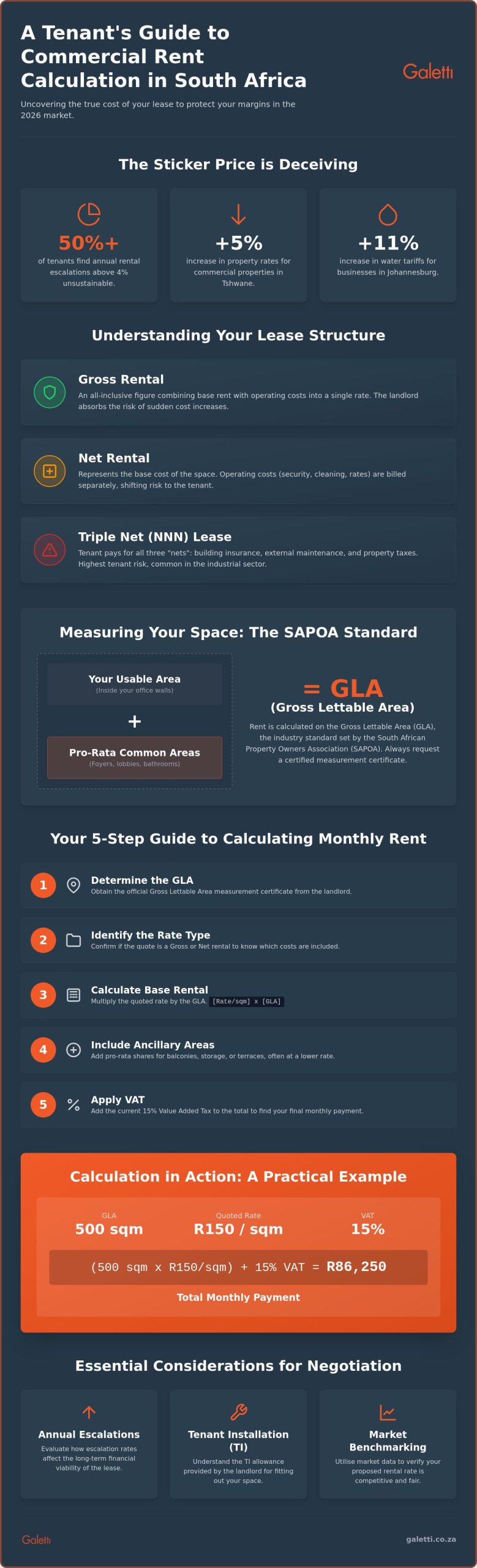
Understanding the fundamental difference between Gross and Net rentals is the first step in learning how to calculate commercial rent per square metre South Africa. A Gross Rental is an all-inclusive figure. It combines the base rent with operating costs into a single monthly rate. Conversely, a Net Rental represents the base cost of the space alone. In this structure, operating expenses and municipal rates are billed separately. South African landlords are increasingly favouring Net Rental Structures to mitigate the risk of volatile municipal tariff hikes.
Operating costs typically include security, cleaning, building insurance, and common area maintenance. With the City of Johannesburg announcing an 11% increase in water tariffs and Tshwane raising property rates by 5% for the 2026/27 cycle, these costs are significant. If you sign a Gross lease, the landlord absorbs these increases until the next review. In a Net lease, you pay the base rate plus your pro-rata share of these fluctuating expenses. This distinction is critical for accurate budgeting. It determines whether your monthly payment remains static or shifts with the local economy.
The SAPOA Method: Understanding Gross Lettable Area (GLA)
Rent is not calculated on the area inside your office walls alone. The South African Property Owners Association (SAPOA) provides the industry standard for measuring space. This is known as Gross Lettable Area (GLA). It includes your usable area plus a pro-rata portion of common areas like foyers, lift lobbies, and shared bathrooms. Verifying the GLA is essential. It is the denominator in every calculation. If the measurement is inaccurate, your entire financial model will be flawed. Always request a certified SAPOA measurement certificate before finalising any property leasing services agreement.
Triple Net Leases in South Africa
The Triple Net lease is the most transparent yet risk-heavy structure for tenants. It requires the lessee to pay for three specific “nets”: building insurance, external maintenance, and property taxes. This structure is the gold standard in the industrial and logistics sectors, where standalone warehouses are common. Whilst it often results in a lower base rental, it leaves the tenant fully exposed to sudden spikes in maintenance or municipal costs. It demands a sophisticated approach to cash flow management. You must ensure that unexpected roof repairs or tax revaluations don’t compromise your operational liquidity.
Step-by-Step: How to Calculate Commercial Rent per Square Metre
Precision in financial forecasting is a prerequisite for any successful commercial lease. To understand how to calculate commercial rent per square metre South Africa, you must first secure the verified measurement of the space. Landlords typically quote a rate based on the Gross Lettable Area (GLA). This figure is the foundation of your monthly commitment. Without an accurate GLA, your budget remains a series of assumptions rather than a strategic plan.
Follow these five steps to determine your total cash outflow:
- Step 1: Determine the GLA. Obtain the official measurement certificate from the landlord. This ensures you pay only for the space defined by SAPOA standards.
- Step 2: Identify the Rate Type. Confirm if the quoted figure is a Gross or Net rental. This determines whether you need to add separate operating costs later.
- Step 3: Calculate Base Rental. Multiply the quoted rate by the GLA. This provides your primary monthly cost before additional levies.
- Step 4: Include Ancillary Areas. Add pro-rata shares for balconies, basement storage, or dedicated terrace areas. These often carry a lower rate than the primary office or retail space.
- Step 5: Apply VAT. Add the current 15% Value Added Tax to the total. This final step reveals the actual cash required for each payment cycle.
The Basic Monthly Rental Formula
Consider a standard office suite measuring 500sqm with a quoted rate of R150 per square metre. The base monthly rental is calculated as 500 x 150, resulting in R75,000. Your annual commitment would be R900,000 before VAT and escalations. The base rate serves as the foundational metric for all commercial negotiations. If you require assistance with complex multi-site calculations, you can contact our advisory team for a detailed breakdown.
Accounting for Common Area Factors
There is a distinct difference between “Usable Area” and “Rentable Area”. The Usable Area is the space contained within your suite’s walls. The Rentable Area includes your share of common lobbies and lift shafts. Landlords apply an “add-on” or “common area factor” to the usable space to reach the final GLA. During a site visit, bring a laser measurer to verify the usable footprint. If the common area factor exceeds the market norm of 15% to 20%, it may signal an inefficient building design that inflates your costs.
Once you have the total monthly rental, including VAT, you can compare different offers on an apples-to-apples basis. Accuracy at this stage prevents the “bracket creep” of unexpected costs that often plague poorly planned lease agreements. It’s the only way to ensure your business remains agile in a competitive property market.
Essential Considerations: Operating Costs and Municipal Charges
Base rental is only the first layer of your financial commitment. To master how to calculate commercial rent per square metre South Africa, you must account for the variable costs that fluctuate annually. These include municipal rates, taxes, and City Improvement District (CID) levies. Utility consumption for water, electricity, and refuse removal adds another layer of complexity. Whilst base rent is often fixed for the year, these municipal charges can shift your total cost of occupancy overnight.
Managing volatility is a core requirement for 2026 budgeting. The City of Johannesburg’s 11% water tariff hike and Tshwane’s 5% property rates increase for the 2026/27 cycle illustrate the pressure on tenants. In a Net lease, these Operating Costs (OpEx) are billed on top of your base rate. You aren’t just paying for your office; you’re funding the building’s ecosystem. This includes security, cleaning, and common area maintenance. These costs are non-negotiable but must be verified for accuracy.
Pro-Rata Apportionment of Operating Costs
Landlords distribute building-wide expenses based on your footprint. The formula is simple: your GLA divided by the building’s total GLA. If you occupy 10% of a retail centre, you pay 10% of the shared security and landscaping costs. It’s vital to audit the OpEx reconciliation provided by your landlord. Common pitfalls occur in industrial parks where high vacancy rates might lead to cost spikes if the landlord doesn’t correctly adjust the shared cost pool. Our Corporate Services team often identifies these discrepancies during lease audits to protect tenant margins.
Municipal Rates and Taxes: The Hidden Variable
Municipal valuations drive your monthly rates. These valuations occur periodically and can result in significant cost jumps that are difficult to predict without historical data. Landlords usually bill rates as a separate line item to ensure transparency. This protects their margin whilst showing you exactly where your money goes. Municipal costs are typically passed through to the tenant regardless of lease type. You must factor in these pass-through costs when comparing properties in different municipalities to ensure your site selection remains economically viable over a long-term lease.
Negotiating the Fine Print: Escalations and Tenant Installation
Negotiation is where a standard lease transforms into a strategic asset. When you evaluate how to calculate commercial rent per square metre South Africa, you must look beyond the initial “Face Rental”. The Face Rental is the price on the page. The Effective Rental is what you actually pay once you factor in incentives and compounding costs. In the 2026 market, these variables often dictate the long-term feasibility of a corporate relocation.
A rent-free period is a common lever used by landlords to attract premium tenants. If you secure two months of rent-free occupation on a three-year lease, your effective monthly cost drops significantly. You must amortise this saving over the total lease term to find the true price per square metre. This transparency allows you to compare a high-spec building with a generous incentive against a lower-priced option with no upfront benefits.
Calculating Annual Escalations
Escalation rates in 2026 typically range between 6% and 8%. Whilst a 1% difference seems negligible, compounding makes it a major expense. Consider a 1,000sqm office at R200/sqm. At an 8% escalation, your R200,000 monthly rent becomes R216,000 in Year 2 and R233,280 in Year 3. This represents a total increase of 16.64% over just 24 months. Negotiating a lower escalation is often more financially impactful than securing a lower starting base rate. CPI-linked escalations offer some protection in a volatile economy, provided a “cap and collar” is in place to prevent runaway costs.
The Tenant Installation (TI) Allowance
The TI allowance is a capital contribution from the landlord to customise the space. It is usually calculated as a Rand value per square metre or a multiple of the monthly rental. A five-year lease typically commands a higher allowance than a three-year term. This fund covers permanent fixtures like partitioning, carpets, and lighting. It generally excludes “soft” costs like furniture or IT hardware. Managing this budget requires precision to avoid out-of-pocket capital expenditure. For professional support in structuring these incentives, our corporate real estate leasing services provide the market data needed to secure maximum value.
Effective lease management requires a balance between upfront savings and long-term cost control. If you are ready to benchmark your current lease against the 2026 market, contact our negotiation experts for a comprehensive portfolio review.
Strategic Portfolio Management: Securing Optimal Lease Terms
A single lease calculation is a tactical exercise. Portfolio management is a strategic one. Once you understand how to calculate commercial rent per square metre South Africa, you must benchmark those figures against the broader market. In 2026, the “flight to quality” trend means P-grade office spaces in Cape Town often command higher premiums than similar Johannesburg assets. Without comparative data, you risk overpaying for space that no longer serves your corporate objectives. Data drives decisions. Efficiency is the priority.
Technology-driven analytics now allow occupiers to identify overpriced space with surgical precision. By mapping your current occupancy costs against national industrial rental growth, which reached 8.4% for 500sqm spaces in late 2025, you can identify where your portfolio is underperforming. Consolidation is often the most effective route to cost reduction. Moving from three disparate offices into a single, high-efficiency hub reduces your total GLA and simplifies your municipal utility recoveries. It’s about doing more with less.
The Role of Professional Property Advisory
Landlords employ professional teams to protect their yields. Tenants should do the same. Appointing a representative ensures your rent calculations align with real-time market shifts rather than historical averages. Leveraging corporate real estate advisory in ZA allows you to uncover hidden savings within your existing agreements. A professional lease audit can reclaim overpaid operating costs by identifying errors in municipal pass-throughs or pro-rata calculations. This is a vital exercise for maintaining lean operations in a volatile economy.
Optimising Your Asset Performance
Your property strategy must align with your broader corporate financial goals. Using property portfolio management tools enables you to track occupancy costs across multiple sites in real-time. This visibility is essential for identifying relocation opportunities when market conditions shift in favour of the tenant. With national industrial vacancy rates sitting at a low 3.8%, timing is everything. Securing a competitive rate requires a proactive approach to market intelligence and negotiation. If your current lease is due for review, you should contact Galetti for a professional lease audit or advisory session to ensure your occupancy costs remain optimised for growth.
Securing Your Competitive Advantage
Navigating the 2026 commercial landscape requires more than basic arithmetic. It demands a deep understanding of how Net lease structures, municipal pass-throughs, and compounding escalations interact. You’ve seen that the face rental of a property rarely reflects the total cost of occupancy. Mastering how to calculate commercial rent per square metre South Africa is the first step towards reclaiming your margins. By auditing operating costs and negotiating aggressive Tenant Installation allowances, you can transform a standard lease into a high-performance strategic asset.
Galetti brings over 18 years of South African market expertise to your boardroom. Our specialised corporate real estate advisory division utilises integrated, technology-driven property solutions to identify inefficiencies in your current portfolio. We don’t just find space; we engineer financial outcomes that support your broader corporate goals. Our team is ready to provide the clarity you need to move forward with absolute confidence.
Optimise your commercial lease strategy with Galetti Corporate Services. Take the lead in your next negotiation with data-backed certainty.
Frequently Asked Questions
How do I calculate monthly commercial rent in South Africa?
Monthly rent is determined by multiplying the Gross Lettable Area (GLA) by the agreed rate per square metre. For a 500sqm office at R150/sqm, the base is R75,000. You must then add the 15% VAT and any utility recoveries. Understanding how to calculate commercial rent per square metre South Africa requires verifying whether the starting rate is Gross or Net to avoid missing hidden costs.
What is the difference between Gross and Net rental?
A Gross rental is an all-inclusive rate that covers base rent and standard operating costs like security and insurance. A Net rental covers only the space itself. In a Net structure, you pay for operating expenses and municipal rates as separate line items. South African landlords increasingly prefer Net structures to protect themselves against rising municipal tariffs.
What is a typical commercial rent escalation rate in South Africa for 2026?
Most commercial leases in 2026 feature annual escalation rates between 6% and 8%. However, a 2026 survey by TPN Credit Bureau indicates that more than half of tenants find increases above 4% unsustainable. This gap creates significant room for negotiation. Tenants should aim for CPI-linked escalations or lower fixed percentages to ensure long-term affordability.
Does commercial rent include VAT?
Commercial rental quotes in South Africa are almost exclusively exclusive of Value Added Tax. You must add 15% to the total monthly figure, including base rent and all recoveries, to find your actual cash outflow. This is a critical step in how to calculate commercial rent per square metre South Africa accurately for your VAT-registered business.
What is GLA and how does it affect my rent calculation?
GLA stands for Gross Lettable Area, which is the industry standard for measuring commercial space. It includes your private usable area plus a pro-rata share of common areas like foyers and bathrooms. Because rent is charged on the total GLA, a building with large, inefficient lobbies will cost you more per usable square metre than a space-efficient alternative.
How is the Tenant Installation (TI) allowance calculated?
Landlords calculate the TI allowance based on the length of the lease and the total GLA. A common benchmark is one month’s rental for every year of the lease term. For example, a five-year lease might provide an allowance equal to five months’ rent. This fund is strictly for permanent improvements like partitioning and lighting.
Are municipal rates included in my commercial rent?
Municipal rates are typically passed through to the tenant. In a Gross lease, the landlord includes an estimate in the base rate. In a Net lease, you pay the actual cost as a separate charge. With Johannesburg’s property rates rising by 3.6% and Tshwane’s by 5% in 2026/27, these costs must be monitored closely to maintain budget accuracy.
Can I negotiate the square metreage of a commercial property?
While the physical footprint is fixed by SAPOA standards, you can negotiate the common area allocation. Some landlords apply a higher “add-on” factor than others. Verifying the measurement certificate ensures you aren’t paying for non-lettable areas. Professional advisory services are essential for auditing these figures before you sign a binding agreement.