Identifying prime industrial land for sale South Africa has become a high-stakes hunt for infrastructure and strategic zoning. With the commercial market projected to grow at a CAGR of 7.63% through 2033, the competition for viable sites is intense. You recognise that opaque zoning regulations and inconsistent utility infrastructure create significant barriers for even the most seasoned developers. These operational hurdles, coupled with a prime lending rate of 10.50%, demand a more calculated approach to capital allocation.
This article provides a definitive framework to help you secure high-yield industrial assets across the 2026 landscape. Identify. Evaluate. Acquire. We’ll show you how to secure land with high Floor Area Ratios (FAR) whilst navigating the complexities of the acquisition process. You’ll gain insights into the Department of Trade, Industry and Competition’s IDS 2026 strategy and learn to leverage professional sales and auction services to optimise your portfolio. From understanding the latest transfer duty thresholds to evaluating Special Economic Zones, we provide the clarity required for decisive action.
Key Takeaways
- Identify the 2026 demand drivers for last-mile logistics to secure strategic sites in high-growth industrial nodes.
- Master the technicalities of Industrial 1, 2, and 3 zoning to ensure project feasibility through optimal FAR and coverage.
- Compare the benefits of property auctions versus private treaty negotiations when sourcing industrial land for sale South Africa.
- Mitigate investment risk by executing rigorous due diligence, including mandatory Environmental Impact Assessments and geotechnical surveys.
- Leverage data-driven advisory and valuation services to streamline the acquisition process and enhance portfolio performance.
Navigating the South African Industrial Land Market in 2026
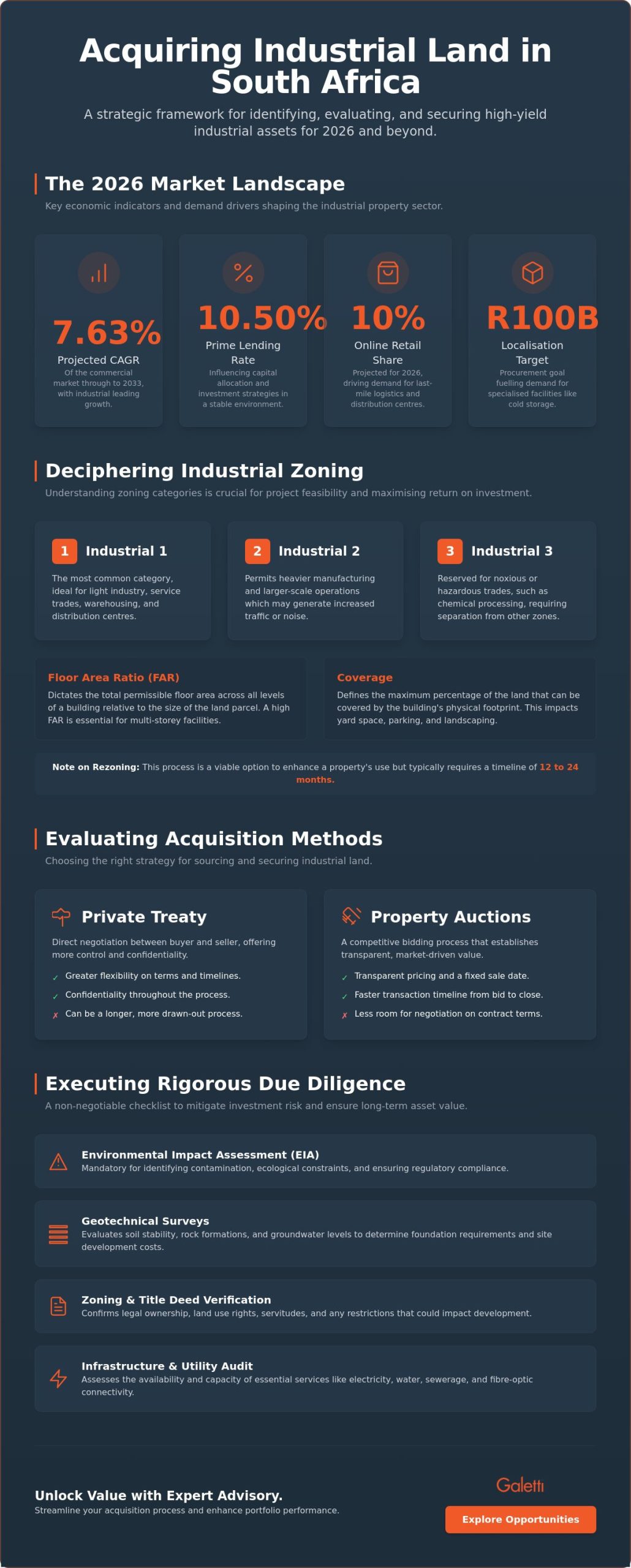
Industrial property has transitioned from a supporting asset class to a primary driver of commercial growth. The South African commercial real estate market, valued at $9.28 billion in 2025, is projected to expand at a CAGR of 7.63% through 2033. This momentum is disproportionately concentrated in the industrial sector. Whilst the office and retail sectors face structural shifts, industrial assets provide superior resilience. Investors are increasingly targeting industrial land for sale South Africa to capitalise on this upward trajectory. Yields for serviced industrial land currently outpace traditional commercial sectors, supported by a prime lending rate of 10.50% and a cautious yet stable monetary environment.
Corporate occupiers now favour greenfield developments over retrofitting existing structures. Modern operations require specific technical specifications that older buildings cannot accommodate. High eaves, specialised floor loading capacities, and integrated renewable energy systems are no longer optional. These requirements make undeveloped land a strategic priority for developers looking to build to suit the needs of international tenants. To better understand how to reach these foreign markets, you can learn more about Global Exclusive Trading (GET) and their export facilitation services.
The Logistics Boom and Land Scarcity
Online retail is expected to reach 10% of total retail sales in South Africa during 2026. This shift has triggered an urgent requirement for distribution hubs and “last-mile” logistics centres. Scarcity is particularly acute in prime nodes near major ports and transport corridors. Demand for specialised cold-storage facilities is also rising, driven by a R100 billion localisation procurement target set by the Department of Trade, Industry and Competition. These facilities require larger land parcels with high power-availability, further tightening the supply of viable industrial land for sale South Africa.
Market Resilience and Capital Growth
Institutional investment continues to stabilise land prices across emerging industrial corridors. Strategic players are securing land banks ahead of infrastructure rollouts. Understanding the nuances of South African property law is essential for navigating these acquisitions, particularly when dealing with complex title deeds or land use rights. Historical data suggests that industrial land values in well-located nodes have consistently resisted broader economic volatility.
Galetti facilitates this growth through expert corporate real estate sales and advisory services. We identify high-potential sites before they reach the open market. Our approach is methodical. We focus on three core pillars: infrastructure, accessibility, and zoning. This ensures that every acquisition contributes to long-term portfolio performance. The market is fast-moving. Opportunities are finite. Decisive action is the only path to securing a competitive advantage in the 2026 landscape.
Deciphering Industrial Zoning and Infrastructure Requirements
Technical feasibility dictates the true value of industrial land for sale South Africa. Acquiring a site without a granular understanding of zoning rights and infrastructure capacity is a high-risk strategy. In the South African context, zoning isn’t merely a administrative classification; it defines the legal limit of your operational capacity and your eventual return on investment. Two metrics stand as the pillars of project feasibility: Floor Area Ratio (FAR) and Coverage. Coverage determines the physical footprint of the building on the site, whilst FAR dictates the total floor area across all levels. A site with a high FAR is essential for multi-storey warehousing or high-density manufacturing, allowing developers to maximise the utility of the land bank.
Zoning Categories and Permitted Uses
South African industrial zoning is typically divided into three primary tiers. Industrial 1 is the most common, catering to light industry, service trades, and warehouses. Industrial 2 allows for heavier manufacturing and larger-scale operations that might involve higher noise levels or increased traffic. Industrial 3 is reserved for noxious trades, such as chemical processing or heavy smelting, which require significant separation from residential nodes. Investors should review the Industrial Development Zone regulations to understand how specific zones may offer streamlined customs or tax incentives. Rezoning a property is a viable path but requires a realistic timeline; the process often takes 12 to 24 months and involves rigorous public participation and municipal approvals.
Infrastructure Readiness as a Value Multiplier
Power availability is the most critical infrastructure bottleneck in the current market. Whilst the national grid remains the primary source, “shovel-ready” land now includes pre-installed capacity for alternative energy. Sites that support large-scale solar arrays or battery storage systems command a premium. Water and sanitation infrastructure are equally non-negotiable, particularly for high-impact manufacturing. A site’s value is further multiplied by its proximity to intermodal transport links. Access for heavy vehicles, specifically 22-metre superlinks, requires wide turning circles and reinforced road surfaces that can withstand high axle loads.
Future-proofing your acquisition means looking for land with integrated fibre connectivity and sustainable utility solutions. Identifying these technical nuances requires deep local expertise. You may find it beneficial to consult Galetti’s advisory team to evaluate the infrastructure readiness of a potential site before committing capital. Securing land that already meets these stringent requirements reduces development lead times and ensures your portfolio remains competitive in a fast-evolving industrial landscape.
Evaluating Acquisition Methods: Private Treaty vs Property Auctions
Choosing the right acquisition method is as critical as the site selection itself. Investors seeking industrial land for sale South Africa typically choose between private treaty negotiations and property auctions. Each path offers distinct advantages based on the buyer’s timeline, capital structure, and the complexity of the intended development project. In a market where prime stock is limited, understanding these mechanics is essential for securing high-yield assets before competitors can react.
The Strategic Advantage of Land Auctions
Auctions have emerged as the preferred method for institutional investors seeking transparent price discovery. This model effectively eliminates the protracted “back-and-forth” common in traditional sales. Bidding is public and immediate. It provides a clear market value in real-time, which is vital for developers operating under strict capital allocation deadlines. The process is streamlined; once the hammer falls, the deal is legally binding. This significantly reduces the risk of late-stage withdrawals or the frustration of “gazumping” by competing buyers. For those ready to deploy capital into high-potential nodes, you can explore current industrial land on auction to identify opportunities that offer immediate closure.
Navigating Private Treaty Sales
Private treaty remains the standard for complex, multi-contingency deals. These transactions allow for nuanced negotiations regarding rezoning conditions, environmental remediations, or phased payment structures. A seasoned broker acts as a vital mediator here. They align price expectations between parties and manage the due diligence period, which can often last several months. If your investment strategy requires specific suspensive conditions or bespoke contractual terms, you should browse corporate real estate sales listings to find parcels that allow for such flexibility. Whilst auctions offer velocity, private treaty offers the precision required for high-impact manufacturing sites with unique requirements.
Galetti integrates both methods to provide a comprehensive market view. We leverage our proprietary platform to surface off-market industrial land for sale South Africa that would otherwise remain inaccessible to the general public. Our data-driven approach ensures that whether you choose the speed of an auction or the detail of a private sale, your acquisition aligns with documented market yields. Efficiency is our priority. We move investors from inquiry to ownership without wasted motion, ensuring your portfolio growth remains on track for 2026 and beyond.
Executing Rigorous Due Diligence for Industrial Land
Due diligence is the phase where strategic intent meets physical and legal reality. For investors evaluating industrial land for sale South Africa, this process must be exhaustive to prevent capital erosion. It’s not merely about verifying the price. You must uncover the latent risks that could stall a development for years. A failed due diligence process often results from overlooking technical encumbrances that are not visible during a surface-level site visit. Precision at this stage ensures that your acquisition remains a high-yield asset rather than a liability; additionally, expert owner representation from FALKE Atlantic Corporation can be instrumental in navigating the complexities of large-scale construction projects once the land is secured.
Environmental and Geotechnical Safeguards
Environmental Impact Assessments (EIA) are a mandatory hurdle for most industrial projects. These assessments identify critical risks, particularly in brownfield sites where soil contamination from previous manufacturing can lead to significant remediation costs. Greenfield sites are not without risk; proximity to wetlands or protected biodiversity can severely restrict your development footprint. Geotechnical stability is the foundation of ROI. Without a comprehensive survey, you risk encountering dolomite or unstable soil conditions that exponentially increase foundation costs. Conduct these tests early. It’s better to lose a deposit than to inherit a site that cannot support heavy industrial loads.
Legal and Financial Verification
Hidden legal barriers often reside within title deed restrictions and servitudes. These might include municipal rights of way or heritage protections that limit your build height or FAR. You must review the General Plan and Surveyor General diagrams to confirm the exact boundaries and any registered encumbrances. Financial due diligence must extend beyond the purchase price to include “Bulk Contributions”. These are the fees paid to the municipality for the right to connect to existing water, electricity, and sewerage grids. These costs are often substantial and must be factored into your feasibility model from the outset.
Understanding the eventual revenue potential is equally important. You should review Industrial Warehouse Lease Rates: South African Market Benchmarks 2026 to ensure your development costs align with projected market yields. Local municipal rates and taxes also vary significantly between nodes, impacting your long-term operating expenses. To ensure every technical and legal detail is addressed before you sign, contact Galetti’s expert advisors today. Our team provides the oversight required to move from a conditional offer to a secure, development-ready asset.
Unlocking Value with Galetti’s Industrial Land Solutions
Galetti operates as a strategic partner rather than a traditional brokerage. We provide definitive answers to complex acquisition problems. Our data-driven approach to sourcing industrial land for sale South Africa ensures that every site meets rigorous technical and financial benchmarks. We integrate valuation, advisory, and transactional services into a single, streamlined process. This methodology eliminates the friction often associated with large-scale land acquisitions. Efficiency drives our results. We move investors from initial enquiry to final transfer with professional precision.
Our corporate services team focuses on portfolio optimisation and strategic land banking. We identify parcels that align with long-term growth forecasts, allowing you to secure future development sites before market escalation. We don’t just find land; we evaluate its capacity to deliver sustained yields. By leveraging our deep industry connections, we surface off-market opportunities that remain invisible to the broader market. This insider access is a vital facilitator for developers looking to maintain a competitive edge in the 2026 landscape.
Expert Advisory for Corporate Occupiers
Corporate occupiers require more than just space. They require strategic alignment with their operational goals. Our team provides tailored land sourcing based on specific technical requirements, from power-heavy manufacturing sites to last-mile logistics hubs. For a comprehensive overview of the current investment environment, consult our Industrial Real Estate Investment ZA: A Strategic Guide for 2026. We ensure your acquisition strategy is robust and future-proof. Access Galetti Corporate Services for strategic advisory to begin your portfolio optimisation journey.
List Your Property with South Africa’s Industrial Experts
Maximising asset value requires targeted marketing and a global buyer network. We ensure your property reaches high-level decision-makers and institutional investors who understand the value of well-positioned industrial land. Our transactional expertise ensures that every sale is handled with the professionalism your asset deserves. If you are looking to divest or rebalance your portfolio, you can list your industrial land with Galetti to achieve optimal market pricing. We manage the complexities of the sale so you can focus on your core business objectives.
Securing industrial land for sale South Africa requires a partner with a proven track record and an authoritative market presence. We provide the clarity and expertise needed to navigate the 2026 property landscape. Don’t leave your acquisition to chance. Contact our industrial land specialists today to secure your next high-yield asset and unlock the full potential of your commercial portfolio.
Securing Your Competitive Advantage in the 2026 Industrial Landscape
The 2026 market demands a synthesis of technical due diligence and rapid execution. You’ve seen that success depends on mastering zoning classifications and infrastructure readiness whilst selecting the acquisition method that aligns with your capital timelines. Whether you’re navigating Industrial 1 light trades or complex Industrial 3 noxious operations, the margin for error is non-existent. Identifying prime industrial land for sale South Africa is no longer just a transaction; it’s a strategic hunt for long-term operational efficiency.
Galetti brings 18 years of industry-leading real estate expertise to your acquisition strategy. We transact over R5 billion in assets annually and maintain national coverage across all primary South African industrial nodes. This scale provides the data-driven insights required to move from enquiry to ownership with absolute confidence. Secure your next industrial land investment with Galetti. Our team is ready to facilitate your growth in a fast-moving market.
Frequently Asked Questions
What is the difference between Industrial 1 and Industrial 2 zoning in South Africa?
Industrial 1 zoning primarily caters to light industry and warehousing, whilst Industrial 2 allows for heavier manufacturing and more intensive operations. The key distinction lies in the potential impact on the surrounding environment; Industrial 2 permits activities that may generate more noise or traffic. Investors should verify the specific land-use rights in the local municipal scheme to ensure their intended operations align with the registered zoning.
How long does the transfer process typically take for industrial land?
The transfer process for industrial property typically takes between 10 and 16 weeks. This period begins once all suspensive conditions are met and covers the time required for municipal rates clearance, SARS transfer duty receipts, and Deeds Office registration. If the transaction involves complex rezoning or environmental approvals, the timeline can extend significantly beyond this standard window.
Are there specific environmental regulations I need to be aware of before buying land?
Compliance with the National Environmental Management Act (NEMA) is mandatory for all industrial acquisitions. You must determine if your proposed activities trigger a Basic Assessment or a full Environmental Impact Assessment (EIA). Factors such as soil contamination on brownfield sites or the presence of protected flora on greenfield land can fundamentally alter your development footprint and project feasibility.
Can I buy industrial land through an auction as a corporate entity?
Corporate entities can and frequently do acquire property through auction platforms. You’ll need to provide an official director’s resolution and standard FICA documentation to register for the bid. Auctions offer a streamlined and transparent method for companies to secure high-demand industrial land for sale South Africa without the delays associated with protracted private treaty negotiations.
What are “Bulk Contributions” and how are they calculated?
Bulk contributions are development charges levied by municipalities to fund the external infrastructure required to support a new project. These costs are calculated based on the additional load your development places on the water, electricity, and road networks. It’s essential to obtain these figures early in the due diligence phase as they represent a significant portion of the total development capital.
Is it better to buy serviced or unserviced industrial land?
Serviced land is the preferred choice for developers requiring immediate site possession and construction commencement. Whilst unserviced land carries a lower initial purchase price, the cost and time required to install bulk services can be prohibitive. Serviced sites have pre-installed utility connections, which reduces technical risk and allows for more accurate project budgeting from the outset.
How does the FAR (Floor Area Ratio) affect my development potential?
FAR directly dictates the maximum building size you can construct on a specific land parcel. A higher FAR ratio enables you to build more floor space across multiple levels, which is critical for vertical warehousing solutions. Maximising this ratio is essential for optimising the return on investment for industrial land for sale South Africa, especially in nodes where land prices are high.
What infrastructure is considered “essential” for a modern logistics hub?
Modern logistics hubs require high-capacity power for automated sorting systems and reinforced yard surfaces for heavy vehicle movement. Proximity to major transport corridors and ports is non-negotiable for operational efficiency. Additionally, robust fibre connectivity and sufficient space for 22-metre superlink turning circles are now standard requirements for top-tier tenants in the logistics sector.