A commercial property acquisition in South Africa is either a calculated triumph or a costly oversight. There is no middle ground in the 2026 market. You recognise that the initial purchase price is merely the surface. The real work lies in uncovering what’s hidden beneath the title deed. Whether it’s the fear of undisclosed structural liabilities or the labyrinth of local zoning laws, the stakes for your capital have never been higher. Mastering commercial property due diligence South Africa is the only way to transform a potential risk into a verified corporate asset.
We understand that uncertainty regarding utility consistency and municipal compliance can stall even the most promising deals. This article provides a definitive, expert-led framework to navigate these complexities with precision. You’ll gain a clear roadmap to mitigate risk and verify asset value before commitment. We’ll examine the critical steps of the due diligence process, from environmental assessments to FICA compliance, giving you the strategic advantage needed to close with confidence. Every step is designed to ensure your next acquisition aligns with national property standards and long-term growth objectives.
Key Takeaways
- Understand the legal framework and the critical 30-day investigation window essential for commercial property due diligence South Africa.
- Execute a rigorous commercial lease audit to verify income streams and identify restrictive covenants hidden within the title deed.
- Mitigate physical liabilities by conducting structural integrity surveys and technical evaluations of HVAC and fire suppression systems.
- Customise your checklist for specific asset classes, such as assessing industrial yard turning circles or office fibre connectivity.
- Streamline the acquisition process by leveraging corporate advisory expertise to prepare for the unique demands of property auctions.
The Strategic Role of Commercial Property Due Diligence in 2026
Strategic acquisitions require more than a signature. They demand a rigorous, systematic audit of every risk factor. Within the South African legal framework, commercial property due diligence South Africa acts as the primary safeguard for capital. It is the period where a buyer verifies the legal, financial, and physical status of an asset before the sale becomes unconditional. What is Due Diligence? In simple terms, it’s the process of ensuring that what you see is exactly what you get. By 2026, the focus has shifted. Investors now prioritise ESG (Environmental, Social, and Governance) metrics alongside traditional yields. This holistic approach is the foundation to maximize commercial property value in a competitive market.
Why Due Diligence is Non-Negotiable in South Africa
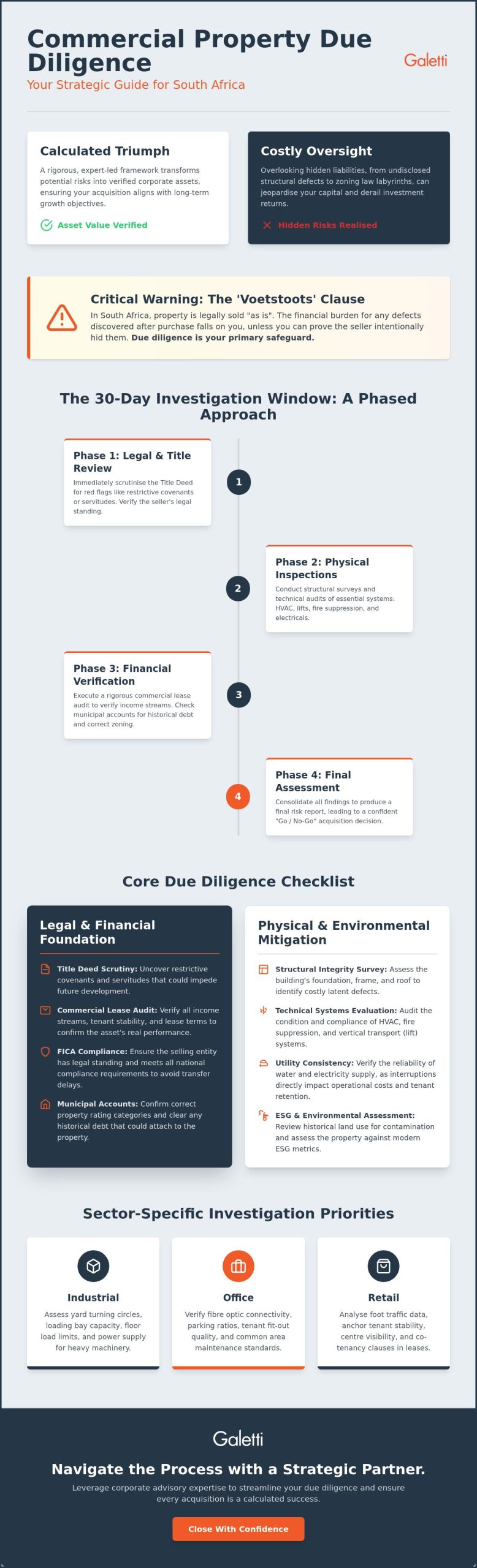
The South African “Voetstoots” clause remains a formidable hurdle for the unprepared. This legal principle implies that a property is sold “as is”. Unless you can prove the seller intentionally hid a latent defect, the financial burden of repairs rests solely on you. Beyond the physical structure, municipal service delivery has become a critical valuation driver. You must verify water security and electricity consistency during your investigation. These factors directly impact operational costs and tenant retention. Additionally, historical land claims or restrictive title deed conditions can paralyse future developments. Identifying these early is not just a precaution; it’s a necessity for investment survival.
The Timeline: Managing the Investigation Window
Time is your most scarce resource. Most local sale agreements grant a 30-working-day “investigation window”. This is a narrow period to coordinate a multi-disciplinary team. You need structural engineers, legal counsel, and financial auditors working in parallel. For investors operating across different regions, consulting with a multidisciplinary firm like Global Engineering Office can provide valuable insights into the technical and engineering standards required for such audits. Efficiency is paramount. A phased approach helps manage this timeline effectively:
- Phase 1: Legal and Title Deed review. Identify red flags immediately.
- Phase 2: Physical inspections and technical audits (HVAC, fire, lifts).
- Phase 3: Financial verification and lease audits.
- Phase 4: Final risk assessment and “Go/No-Go” decision.
Prioritise high-impact investigations first. If the title deed has a fatal flaw, there’s no need to spend capital on an engineering report. This structured framework prevents deal fatigue and ensures that every aspect of your commercial property due diligence South Africa is executed with precision. A disciplined timeline turns a chaotic process into a strategic advantage.
Financial and Legal Verification: The Foundation of Asset Value
Asset value is a product of verified data, not optimistic projections. The financial and legal audit is the bedrock of your acquisition strategy. It begins with the Title Deed. You must scrutinise this document for restrictive covenants or servitudes that could impede future development or expansion. A servitude for municipal pipes or electrical lines might seem minor, yet it can render a significant portion of the site undevelopable. In 2026, the complexity of ownership structures requires a robust Legal Due Diligence Framework to verify the selling entity’s standing and ensure absolute FICA compliance. Skipping these steps exposes your capital to unnecessary litigation or transfer delays.
Municipal accounts often hide silent liabilities. Historical debt can attach to the property, and incorrect rating categories can lead to significant back-billing from local authorities. You must confirm that the property is classified correctly, whether industrial, retail, or office. A discrepancy here can drastically alter your projected yield. This level of forensic detail is a core component of commercial property due diligence South Africa. It ensures that the price you pay reflects the actual net value of the asset, free from undisclosed encumbrances.
The Lease Audit: Verifying the Income Stream
The income statement is only as reliable as the underlying contracts. A comprehensive commercial lease audit is essential to uncover the true health of the investment. You must look beyond the monthly rental figure. Examine tenant payment behaviour over the preceding 24 months to identify potential arrears or consistent late payments. Review lease expiry profiles to assess the risk of upcoming vacancies. Be particularly wary of “right of first refusal” or “exclusive use” clauses. These can limit your ability to secure new tenants or sell the asset later. Distinguish between gross and net lease structures to understand exactly who pays for rates, insurance, and maintenance.
Regulatory and Zoning Compliance
Zoning is absolute. You must confirm that the current property usage aligns perfectly with registered land use rights. Operating outside these rights can result in heavy fines or forced closures. Verify that valid Occupation Certificates exist for all structures on-site. Unapproved building plans are a common liability that can halt a sale or prevent you from securing financing. The impact of the Spatial Planning and Land Use Management Act (SPLUMA) is now a critical factor. Many municipalities require a SPLUMA certificate before a transfer can proceed, necessitating full compliance with all historical conditions of establishment. If you require assistance navigating these regulatory hurdles, consult with our property specialists.
Physical and Environmental Assessment: Mitigating Hidden Risks
Physical condition determines your future maintenance budget. A visual inspection is insufficient for a professional acquisition. You must commission a structural integrity survey, particularly for brownfield sites or older commercial stock. These reports identify latent defects that the “Voetstoots” clause would otherwise force you to inherit. Mechanical systems are equally critical. HVAC units, lifts, and fire suppression systems are high-capital items. If these are nearing the end of their lifecycle, the replacement costs will immediately erode your initial yield. Rigorous commercial property due diligence South Africa requires a technical audit of every major installation to ensure operational continuity from day one.
Energy efficiency is no longer a “nice-to-have” feature. In the 2026 market, an asset’s “Green Status” directly influences its valuation and tenant appeal. You must evaluate the building’s energy performance certificate (EPC) and identify opportunities for efficiency gains. This technical deep dive ensures you aren’t purchasing a “stranded asset” that will become obsolete as sustainability regulations tighten. Understanding the physical state of the property allows you to negotiate from a position of strength or adjust your offer to reflect necessary capital expenditure.
Infrastructure and Utility Resilience
Utility consistency is a primary operational risk in the local landscape. You must verify the property’s backup power capabilities. Assess whether existing generators are sufficient or if there is capacity for solar integration. Water security is the next frontier. Check for on-site storage solutions and borehole availability to mitigate municipal supply failures. For industrial acquisitions, verify that the electrical supply capacity can support future machinery or expansion. A shortfall in kVA (kilovolt-amperes) can be a deal-breaker for manufacturing tenants. Ensure these infrastructure assets are functional and fully compliant with safety standards.
Environmental and ESG Compliance
Liability extends to the soil itself. For industrial sites, a Phase 1 Environmental Site Assessment (ESA) is non-negotiable. This study identifies potential soil or groundwater contamination from historical activities. You must also review the mandatory asbestos register and hazardous waste disposal protocols. In 2026, evaluate the property against current carbon tax benchmarks. High-emission buildings face increasing financial penalties and lower demand from corporate tenants with strict ESG mandates. Identifying these environmental risks early prevents you from assuming long-term legal and financial obligations that could far exceed the property’s value. If you need a partner to manage these complex technical audits, our corporate services team provides the necessary oversight.
Sector-Specific Checklist: Tailoring Investigation to Asset Class
Effective commercial property due diligence South Africa requires a granular focus. A generic approach fails to account for the unique operational demands of different asset classes. You must tailor your investigation to the specific functional requirements of the property type. For instance, a logistics warehouse has a vastly different risk profile compared to a suburban retail centre. Precision in these sector-specific metrics ensures that the asset can actually perform the task for which it’s being purchased. Failing to verify these technical details often leads to post-acquisition capital expenditure that could’ve been mitigated during negotiations.
Industrial and Logistics Specifics
Industrial assets demand a technical deep dive into functional capacity. You must verify floor loading capacity to ensure it supports heavy machinery or high-density racking. Eave heights are equally critical. A warehouse with low eaves limits vertical storage and significantly reduces its future marketability. For logistics, yard turning circles must accommodate super-link trucks to ensure efficient turnaround times. Proximity to major arterial routes is the primary value driver for this sector. We recommend reviewing industrial property auctions ZA data to establish realistic local benchmarks for these specifications. Don’t overlook specialised zoning. “Special Industrial” status is required for chemical or heavy manufacturing processes. Finally, evaluate the security infrastructure. Perimeter fencing integrity and controlled access points are non-negotiable for high-value stock protection.
Office and Retail Nuances
Retail success hinges on footfall and tenant synergy. You must analyse the tenant mix strategy to ensure the centre isn’t over-reliant on a single sector. Verify anchor tenant stability by reviewing their historical performance and remaining lease terms. Loading bay access must be sufficient for daily deliveries without disrupting customer traffic. In the office sector, the focus shifts to infrastructure and flexibility. Check parking ratios to ensure they meet modern demand, often targeting four to five bays per 100m² in prime nodes. Fibre connectivity must be high-speed and redundant. You also need to distinguish between “grey box” and “white box” conditions to accurately estimate tenant installation (TI) costs. Always verify the Gross Lettable Area (GLA) against SAPOA standards to ensure you aren’t paying for non-rentable space. Modern offices must also comply with hybrid work standards, providing flexible layouts and high-quality communal areas. If you’re ready to acquire a sector-specific asset, contact our advisory team for a bespoke assessment.
Navigating the Due Diligence Process with a Strategic Partner
A fragmented approach to commercial property due diligence South Africa often leads to critical data gaps. Successful investors don’t manage this process in isolation. They appoint a lead partner to synthesise technical, legal, and financial findings into a single, actionable risk profile. This strategic oversight is particularly vital when participating in commercial property auctions. Unlike private treaty sales, auction contracts are typically unconditional. This means your investigation must be completed before the hammer falls. There is no 30-working-day window for cold feet after the event. Rigorous preparation is the only protection for your capital in an auction environment.
By 2026, the speed of transactions has increased. Leveraging technology is now mandatory for faster verification. Digital data rooms and AI-driven document analysis allow for the rapid identification of lease anomalies or title deed restrictions. These data-driven insights enable you to move from inquiry to offer with a level of speed that traditional methods cannot match. Transitioning from due diligence to successful asset management requires this digital foundation. It ensures that every maintenance record, tenant history, and compliance certificate is organised and accessible for the duration of your ownership.
The Role of an Advisory Firm
A professional corporate real estate advisory ZA firm acts as the central intelligence hub for your acquisition. Their primary function is coordinating the complex interplay between structural engineers, legal counsel, and municipal consultants. They don’t just collect reports; they interrogate them. By using real-time market data, an advisor can validate a seller’s financial projections against current industry benchmarks. This prevents you from overpaying based on optimistic but unverified income claims. A centralised “Data Room” provided by the firm ensures a seamless document review process, reducing the administrative burden on your internal team and minimising the risk of overlooked liabilities.
Next Steps: From Findings to Final Offer
The conclusion of your investigation is the start of your final negotiation. You must use your due diligence findings to protect your interests. If a structural survey reveals a roof replacement is due within 24 months, this becomes leverage for a price reduction or a “repair to sell” clause. You are no longer guessing; you are negotiating with verified facts. This clarity allows you to finalise the purchase or lease agreement with absolute confidence. Once the deal is closed, the due diligence file becomes the first chapter of your asset management strategy. If you are ready to secure your next investment with absolute clarity, enquire about our Corporate Advisory Services today. Our team is ready to provide the definitive answers you need for complex property problems.
Securing Your Investment Future in 2026
Precision in the current market demands a shift from simple checklists to strategic asset verification. You’ve seen how a rigorous lease audit protects income and how technical surveys prevent unforeseen capital expenditure. Mastering commercial property due diligence South Africa ensures you aren’t just buying a building; you’re acquiring a high-performing corporate asset. Whether you’re bidding on a leading commercial auction platform or negotiating a private sale, the data gathered during this window is your most powerful tool.
Galetti brings over 18 years of South African market expertise to your acquisition strategy. Our integrated approach across the office, industrial, and retail sectors provides the clarity needed to navigate complex legal and environmental landscapes. We turn uncertainty into a competitive advantage. Optimise your portfolio with Galetti Corporate Services and ensure your next transaction is backed by definitive industry insight. Your path to a de-risked and profitable property portfolio starts with the right partner.
Frequently Asked Questions
How long does commercial property due diligence take in South Africa?
Standard commercial property due diligence South Africa typically takes 30 working days. This window is established as a suspensive condition within the sale agreement. Complex industrial acquisitions or large scale retail portfolios may require negotiated extensions for specialised technical audits or environmental testing.
What is the most common mistake made during the due diligence process?
The most common mistake is failing to verify the technical capacity of the building’s infrastructure. Investors often assume that HVAC systems or electrical supply are sufficient for their operational needs. Discovering a shortfall after the sale becomes unconditional leads to significant, unbudgeted capital expenditure that erodes the asset’s initial yield.
Is environmental due diligence required for office buildings?
Yes, environmental due diligence is increasingly critical for office buildings in 2026. While soil contamination is less common than in industrial zones, you must review the mandatory asbestos register and the Energy Performance Certificate (EPC). These documents are essential for ESG reporting and avoiding future carbon tax penalties.
Can I withdraw from a property sale if the due diligence reveals issues?
You can withdraw from the sale if the findings are unsatisfactory, provided the contract includes a specific due diligence suspensive condition. This clause allows the buyer to cancel the transaction without penalty if the investigation reveals undisclosed liabilities, structural failures, or zoning discrepancies before the stated deadline.
What documents should I request from the seller at the start of the process?
Request the Title Deed, latest zoning certificate, and a full set of approved building plans immediately. You also need valid occupation certificates, the last 24 months of municipal accounts, and a comprehensive rent roll. Access to all current lease agreements is essential for a thorough financial audit.
How much should I budget for professional due diligence reports?
Budget for a comprehensive suite of professional reports including structural surveys, electrical compliance certificates, and legal audits. Costs vary based on the asset’s scale and technical complexity. Investing in these reports upfront prevents much larger financial losses from hidden defects or historical legal encumbrances.
Does a professional valuation count as due diligence?
A professional valuation does not count as due diligence. A valuation determines the estimated market price at a specific point in time. Commercial property due diligence South Africa is a forensic investigation that verifies the legal, physical, and financial facts used to justify that valuation and price point.
What is the difference between legal and commercial due diligence?
Legal due diligence focuses on ownership rights, zoning compliance, and contract law. Commercial due diligence evaluates the asset’s ability to generate sustainable income. This includes analysing tenant payment behaviour, market demand, and the overall competitiveness of the property within its specific node or sector.