
The lowest headline rent on a property listing often masks the most significant operational risks for a corporate occupier. It’s a common frustration for high-level decision-makers who find themselves comparing two seemingly identical spaces, only to realise the financial implications are worlds apart. You deserve total transparency in your landlord billings and a predictable monthly overhead that doesn’t fluctuate with every unexpected rise in property taxes or insurance premiums.
This guide provides a comprehensive gross vs net commercial lease explained framework to help you master these critical structures. You’ll learn how to identify hidden costs and negotiate terms that protect your capital. We’ll break down the specific cost allocations of each model and provide a clear methodology for comparing competing lease offers on a true “apples-to-apples” basis. By the end of this article, you’ll have the strategic tools to manage operational risk, improve your financial forecasting, and secure the most cost-effective solution for your organisation.
Key Takeaways
- Identify the fundamental shift in financial risk between all-inclusive gross pricing and the variable expense structures found in net leases.
- Navigate the hierarchy of net leases—Single, Double, and Triple (NNN)—to pinpoint exactly where operational responsibilities and costs reside.
- Evaluate the “compromise” of modified gross structures to achieve a strategic balance between budget predictability and operational flexibility.
- Utilise our gross vs net commercial lease explained framework to compare competing property offers on a transparent, risk-adjusted basis.
- Align your real estate portfolio with long-term corporate strategy by leveraging expert advisory to mitigate the impact of rising utility and maintenance costs.
Defining the Fundamentals: What are Gross and Net Leases?
Understanding the distinction between lease types is the foundation of any robust corporate real estate strategy. At its simplest level, the debate involves how a landlord and tenant partition the financial responsibility for a building’s operating expenses (OPEX). These expenses typically include property taxes, insurance premiums, and common area maintenance (CAM). In a gross structure, the landlord assumes the risk of rising costs. In a net structure, that risk shifts to the occupier. This fundamental difference is why a gross vs net commercial lease explained framework is essential for accurate long-term financial modelling. Without this clarity, your projections for cash flow and EBITDA remain vulnerable to hidden liabilities.
The Core Concept of a Gross Lease
A gross lease, often called a full-service lease, operates on an “all-in” pricing model. The tenant pays a single, fixed monthly sum to the landlord. Behind the scenes, the property owner uses a portion of this payment to cover all property-related outgoings. To protect their profit margins, landlords estimate these costs in advance and bake them into the headline rental rate. This structure offers maximum predictability for the tenant. Corporate occupiers can forecast their property spend with precision, as they’re shielded from sudden spikes in utility rates or municipal tax assessments. It’s a “set and forget” arrangement that simplifies accounting but often carries a premium for the risk the landlord is assuming.
The Core Concept of a Net Lease
The Net Lease functions as a “base plus” model. The tenant pays a lower base rent for the square footage alone, then pays a pro-rata share of the building’s operating expenses. These costs are usually divided into three distinct categories: property taxes, building insurance, and maintenance or utilities. While this introduces variability into the monthly budget, it provides a level of transparency that gross leases lack. Occupiers can audit billings and see exactly how their funds are utilised. For businesses with internal facility management capabilities, this model often allows for greater control over service quality and cost-saving initiatives. Our corporate real estate leasing experts find that this structure is increasingly favoured by tenants who want to pay only for the services they actually consume.
Choosing between these options isn’t just about finding the lowest number on a spreadsheet. It’s a strategic decision regarding risk appetite and administrative capacity. A gross vs net commercial lease explained analysis reveals that while a gross lease provides peace of mind, a net lease rewards efficient operational management. Accurate financial modelling requires a deep dive into these underlying costs to ensure your real estate portfolio supports your broader business objectives.
The Nuances of Net Leases: Single, Double, and Triple (NNN)
Net leases are not a monolithic category. They exist on a spectrum defined by the granularity of expense allocation. Unlike the gross models discussed previously, net structures require the occupier to pay a lower base rent whilst assuming direct responsibility for specific building outgoings. This hierarchy dictates which operational risks you’ll carry on your balance sheet. Understanding these layers is fundamental to having the gross vs net commercial lease explained in a way that actually impacts your bottom line and long-term financial forecasting.
Single (N) and Double (NN) Net Leases
In a Single Net (N) lease, the tenant pays the base rent plus the property taxes. The landlord remains responsible for insurance and all maintenance. This is the simplest net form, but it’s increasingly rare in modern corporate environments. The Double Net (NN) lease adds property insurance to the tenant’s obligations. In both of these models, the landlord typically retains the risk for structural maintenance, such as the roof, foundation, and major HVAC systems. These structures are often found in retail centres where the landlord wants to maintain control over the building’s exterior shell but offload variable tax and insurance burdens.
The Triple Net Lease (NNN) Deep Dive
The Triple Net (NNN) lease is the most comprehensive transfer of risk in the commercial sector. It requires the tenant to pay for property taxes, building insurance, and all common area maintenance (CAM). CAM charges can include everything from landscaping and security to repairs of shared lobbies and parking lots. This structure is the gold standard for long-term industrial and corporate headquarters leases. It provides the landlord with a stable, predictable yield whilst giving the tenant total transparency over how the building is managed. A Triple Net Lease represents the ultimate transfer of property management responsibility to the occupier.
Because NNN terms can be incredibly complex, engaging professional lease negotiation services is vital. Without precise language, an occupier might inadvertently agree to pay for capital expenditures that should be the landlord’s burden. While different jurisdictions vary, the U.S. Code on Lease Agreements provides a useful historical benchmark for how large-scale entities approach these long-term obligations. In the industrial and retail sectors, NNN leases are the default. They allow businesses with internal facility management teams to drive efficiencies that a landlord might otherwise overlook. To ensure your next agreement aligns with your operational capacity, you should consult with our strategic advisors before signing a letter of intent.
Gross and Modified Gross Leases: Predictability vs Flexibility
Whilst net leases offload operational risk to the tenant, gross structures offer a more streamlined approach often favoured in multi-tenant office environments. Having the gross vs net commercial lease explained requires a nuanced look at how landlords bundle services to create a “hands-off” experience for the occupier. For a corporate entity, the choice between these models often hinges on the internal capacity to manage facilities versus the desire for absolute budget certainty. These structures prioritise ease of use, but they often come with a higher headline rental rate to compensate the landlord for taking on variable cost risks.
Full-Service Gross: The “Hands-Off” Approach
A full-service gross lease is the most comprehensive “all-inclusive” model available. In this scenario, the monthly rental payment covers the base rent plus all operating expenses. This typically includes utilities, janitorial services, property taxes, insurance, and building repairs. It is a popular choice for short-term requirements or smaller satellite offices where the administrative burden of managing separate service contracts is undesirable. However, occupiers should be aware of the trade-offs:
- Higher Base Rent: Landlords build a significant risk premium into the rate to protect against utility price hikes.
- Service Quality: Because the landlord pays for cleaning and maintenance, the tenant has limited control over the frequency or standard of these services.
- Lack of Transparency: It is often difficult to determine the actual cost of the services provided versus the profit margin the landlord has added.
The Modified Gross Lease Framework
The modified gross lease serves as a strategic compromise between the full-service and net models. In this framework, the tenant and landlord agree to split specific expenses. For example, the landlord might cover external maintenance and property taxes, whilst the tenant pays for internal electricity and office cleaning. This allows for a degree of flexibility that helps in aligning the lease with specific business goals. Our corporate advisory team often recommends this structure when a tenant has unique utility requirements, such as high-density server rooms, that would be unfair to bundle into a standard building average.
A critical component of this lease type is the “Base Year” concept. Under this arrangement, the landlord pays for all operating expenses during the first year of the lease. In subsequent years, the tenant is responsible for any increases in those expenses above the base year level. This mechanism protects the landlord’s net income from inflation. To further mitigate risk, landlords often implement an “expense stop,” which sets a hard ceiling on the amount of OPEX they will cover. Any costs exceeding this stop are passed directly to the tenant. Understanding these triggers is vital for accurate long-term financial modelling and ensures that your “predictable” lease doesn’t lead to unexpected year-end reconciliations.
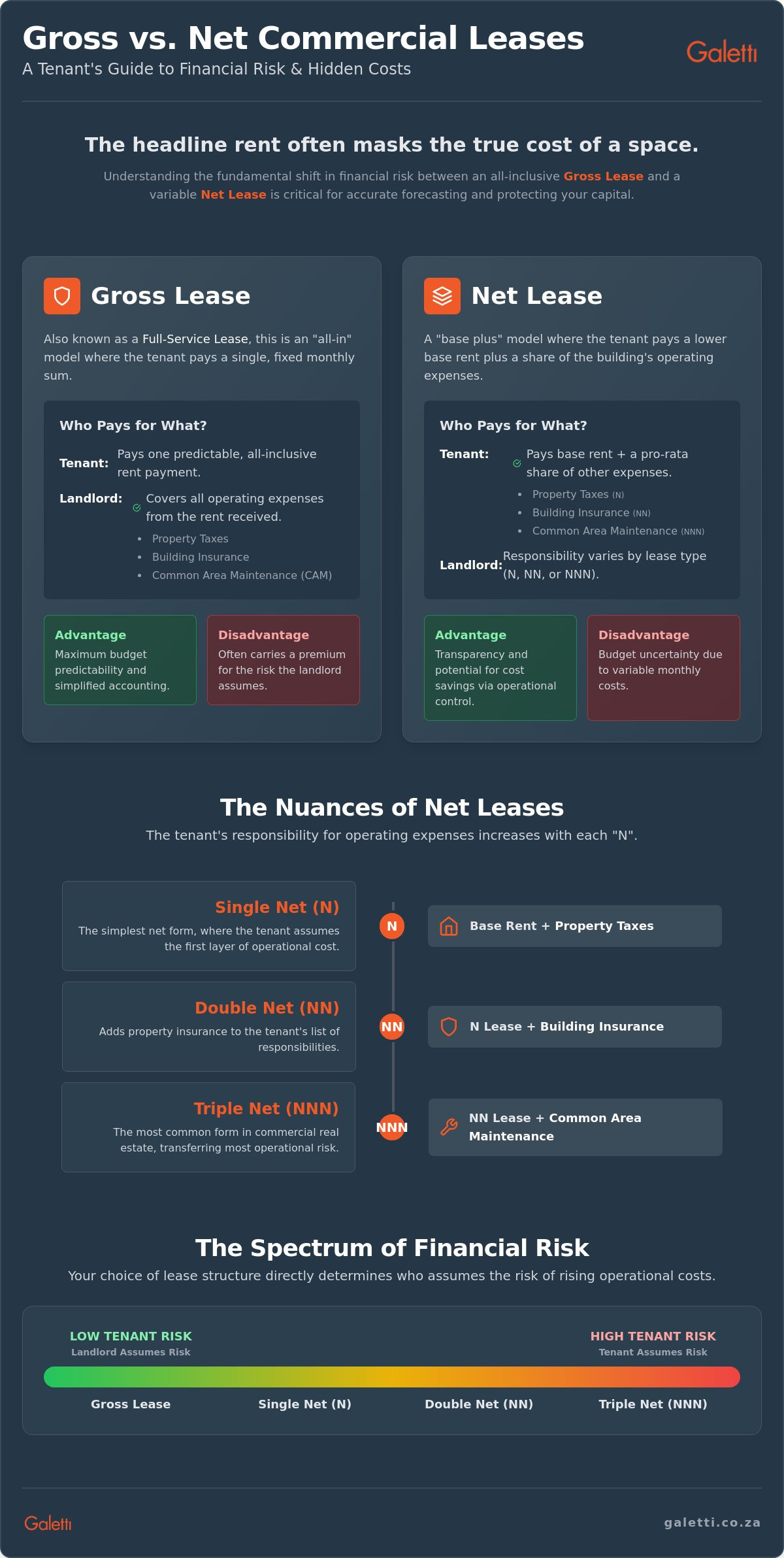
Gross vs Net: A Strategic Comparison for Corporate Occupiers
A commercial lease is more than a monthly invoice. It is a legal mechanism for the strategic transfer of operational risk between a landlord and a tenant. Having the gross vs net commercial lease explained through a strategic lens reveals that the “best” option depends entirely on your organisation’s scale and risk appetite. Whilst a gross lease offers a fixed ceiling on outgoings, a net lease provides the transparency required for aggressive cost-saving initiatives. The choice dictates whether you value budget certainty or operational control.
A common objection amongst occupiers is that a gross lease is always more expensive. This is a simplification. A gross lease includes a risk premium; the landlord charges more to cover the possibility of rising municipal taxes or utility tariffs. If these costs skyrocket, the tenant is protected. However, in a stable or declining cost environment, the tenant effectively overpays for that protection. Conversely, a net lease might have a lower headline rate, but it exposes the tenant to the immediate impact of inflation and rising service costs.
Financial Predictability vs Operational Control
Gross leases favour organisations that prioritise budget stability. They are ideal for high-growth firms or satellite offices where the administrative distraction of managing facilities is undesirable. Net leases favour established businesses with the internal capacity to manage their own environment. If you have a dedicated facilities team, a net lease allows you to drive efficiencies that directly improve your bottom line. Before committing to a structure, conducting a commercial property portfolio audit is essential to determine which model aligns with your current operational maturity.
Evaluating the Total Cost of Occupancy
To compare a gross offer with a net offer, you must calculate the “effective rate”. This requires adding the estimated annual operating expenses (OPEX) to the net base rent. Corporate occupiers often prefer the complexity of a net lease because it grants them audit rights. These rights allow you to verify landlord billings and ensure your organisation isn’t subsidising the inefficiencies of other tenants in a multi-let building. Transparency often outweighs simplicity when managing a large-scale property footprint.
Use this checklist to determine your ideal structure:
- Internal Capacity: Do you have a facility management team to audit billings?
- Cash Flow Volatility: Can your budget absorb a 15% spike in municipal rates?
- Lease Term: Long-term occupiers (5+ years) typically benefit from the transparency of net structures.
- Service Quality: Do you require a higher standard of maintenance than the landlord provides?
Selecting the wrong structure can lead to millions in unrecovered costs over a ten-year term. To ensure your real estate strategy is robust, contact our advisory team for a detailed market comparison and risk assessment.
Optimising Your Lease Portfolio with Galetti Advisory
Having a gross vs net commercial lease explained is only the first step in a broader capital management strategy. For the corporate occupier, the true challenge lies in the execution. Real estate is often the second largest expense on a balance sheet, yet it’s frequently managed with less rigour than other operational outgoings. Galetti acts as your strategic partner, bridging the gap between complex legal clauses and your organisation’s long-term commercial objectives. We don’t just facilitate transactions; we engineer lease structures that protect your liquidity and support growth.
Effective portfolio management requires a shift from reactive leasing to proactive strategic planning. Our team utilises deep market data to identify opportunities where others see only overheads. Whether you’re consolidating a fragmented office footprint or expanding a national industrial network, the choice of lease structure must be intentional. By applying the gross vs net commercial lease explained framework to your specific portfolio, we help you decide where to accept variable risk for transparency and where to pay a premium for budget certainty.
Strategic Tenant Representation
Our experts specialise in identifying the hidden costs that often lurk within standard lease agreements. Landlord-favoured contracts can contain ambiguous language regarding capital expenditure and operational reconciliations that lead to significant budget overruns. Through professional corporate real estate advisory, we audit proposed terms against current market benchmarks. This ensures you aren’t just getting a fair rental rate, but a fair total cost of occupancy. We negotiate aggressively on your behalf to secure “expense stops” and audit rights that keep your property costs predictable and transparent.
Securing Your Next Commercial Space
Galetti provides corporate occupiers with access to premium office, industrial, and retail opportunities across the most sought-after nodes. Our approach integrates leasing services with high-level portfolio management to ensure every new site adds value to your broader business goals. We understand that a warehouse in a logistics hub requires a different risk profile than a flagship retail centre or a high-density corporate headquarters. Our consultants provide the definitive answers you need to navigate these complexities with confidence. Don’t leave your property strategy to chance. Contact Galetti to refine your property strategy today.
Master Your Real Estate Risk Profile
Selecting the right lease structure is a pivotal decision that dictates your organisation’s financial agility. As this gross vs net commercial lease explained guide has demonstrated, the choice isn’t merely about the monthly rental amount. It’s about who carries the burden of inflation and operational volatility. Whilst gross leases provide a fixed ceiling for your outgoings, net structures empower you with the transparency and control needed to drive facility efficiencies. Efficiency. Clarity. Results.
Galetti brings over 18 years of commercial real estate expertise to your side. We provide integrated, technology-driven property solutions and specialised advisory across the office, industrial, and retail sectors. Our consultants ensure your lease terms align with your broader corporate strategy, protecting your capital from unforeseen liabilities. It’s time to move beyond standard agreements and secure a bespoke real estate solution.
Frequently Asked Questions
What is the most common type of commercial lease in South Africa?
Triple Net (NNN) leases are the standard for industrial and retail sectors in South Africa. In the office sector, landlords frequently utilise modified gross structures. These allow for a base rental that includes some operating costs whilst carving out variable expenses like internal electricity. This approach balances landlord risk with tenant requirements for budget transparency and operational control.
Can a gross lease be converted to a net lease during a renewal?
Yes, a lease structure can be converted during the renewal negotiation phase by mutual agreement. Landlords often propose moving from gross to net to shield themselves from volatile municipal rates or utility hikes. It is a strategic moment for occupiers to use our gross vs net commercial lease explained framework to ensure the new base rent is adjusted downwards to reflect the shift in expense responsibility.
Who is responsible for structural repairs in a triple net (NNN) lease?
The landlord typically retains responsibility for structural repairs, such as the roof and foundation, even in a Triple Net (NNN) lease. Whilst the tenant covers insurance, taxes, and maintenance, major capital expenditure on the building’s shell usually remains the owner’s burden. It is vital to define “structural” clearly in the contract to avoid disputes over major component replacements like HVAC systems.
What is an “expense stop” in a commercial lease agreement?
An expense stop is a contractual limit on the amount of operating expenses a landlord will pay. If the building’s actual outgoings exceed this “stop” amount, the tenant pays the difference. This mechanism is common in gross leases to protect the landlord’s net income from inflation. It ensures that the landlord’s contribution to building operations remains capped throughout the lease term.
Is VAT calculated differently for gross and net leases?
VAT is calculated on the total value of the supply, regardless of the lease structure. For a gross lease, VAT applies to the single “all-in” rental amount. In a net lease, VAT is charged on both the base rent and the recovered operating expenses. The total tax liability remains consistent with the total cash consideration paid by the tenant to the landlord each month.
How does a base year affect a modified gross lease?
The base year serves as the financial benchmark for operating expenses in a modified gross lease. The landlord pays for all building outgoings during this initial period. In subsequent years, the tenant is responsible only for the “escalation” or increase in costs above that base year level. It provides the tenant with a period of cost certainty before inflationary pressures take effect.
Are utilities always included in a full-service gross lease?
Utilities are typically included in a full-service gross lease, but they are often subject to “reasonable use” limitations. If a tenant’s consumption significantly exceeds the building average, the landlord may charge an additional surcharge. For businesses with high-density power requirements, such as data centres, it’s often more efficient to sub-meter and carve these out as a separate expense.
What happens if property taxes increase significantly in a net lease?
The tenant bears the full burden of property tax increases in a net lease structure. Because taxes are a pass-through expense, any hike by the local municipality results in a direct increase in the tenant’s monthly outgoings. This exposure is a primary reason why occupiers should seek professional advisory to assess the likelihood of rate increases before committing to long-term net agreements.