
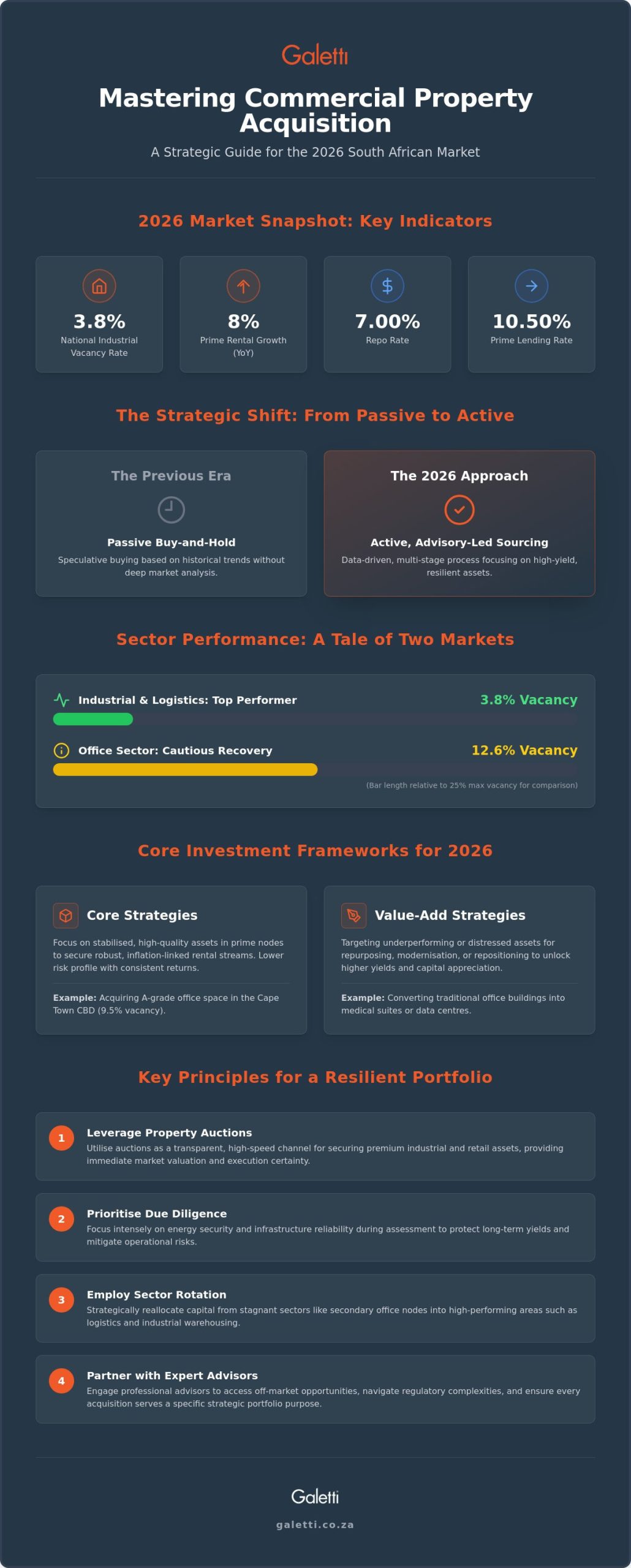
With national industrial vacancy rates at a lean 3.8% and prime rentals growing by 8% year-on-year, the South African commercial landscape has shifted into a high-stakes arena of precision sourcing. You’ve likely noticed that traditional office nodes no longer offer the security they once did. With the repo rate holding at 7.00% and prime lending at 10.50% as of July 2026, implementing the right commercial property acquisition strategies South Africa requires a move away from speculative buying toward data-driven advisory. It’s a challenging environment where energy security and infrastructure reliability dictate asset performance.
We agree that navigating market volatility and high vacancy rates in secondary office nodes is a significant hurdle for any serious investor. This guide promises to help you master the tactical frameworks and sourcing methods required to secure high-yield commercial assets in this evolving market. You’ll learn how to optimise your corporate footprint and diversify into resilient industrial or retail assets that deliver inflation-beating yields. We explore the most effective sourcing channels, from transparent property auctions to off-market industrial opportunities, to ensure your 2026 portfolio is built for growth.
Key Takeaways
- Shift your approach from passive buying to an active, multi-stage process by mastering modern commercial property acquisition strategies South Africa.
- Leverage property auctions as a transparent, high-speed tactical channel for securing premium industrial and retail assets.
- Prioritise energy security and infrastructure reliability during the due diligence phase to protect long-term yields.
- Utilise sector rotation strategies to reallocate capital from stagnant office nodes into the high-performing logistics sector.
- Partner with expert advisors to ensure every acquisition serves a specific strategic purpose within your broader portfolio.
Defining Commercial Property Acquisition Strategies in South Africa
Successful commercial property acquisition strategies South Africa are no longer defined by a single transaction. In 2026, acquisition is a multi-stage strategic lifecycle that begins long before a sale agreement is drafted. The previous era of passive buy-and-hold investing has been replaced by active, advisory-led sourcing. Investors now prioritise tactical frameworks that account for a 7.00% repo rate and the specific operational demands of the local landscape. Securing a commercial property today requires a deep understanding of sector-specific performance and infrastructure resilience.
The national market currently shows a stark divergence in performance across primary sectors. Industrial and logistics assets remain the top performers with a lean national vacancy rate of 3.8%. In contrast, the office sector faces a cautious recovery with a national vacancy rate of approximately 12.6%. This environment has shifted investor focus toward Yield Sourcing. Whilst capital appreciation remains a long-term goal, the immediate priority in a high-interest environment is securing assets with robust, inflation-linked rental streams that cover debt obligations at a 10.50% prime lending rate.
The Core Strategic Framework for 2026
Investors must choose between Core and Value-Add frameworks. Core strategies focus on stabilised, high-quality assets in prime nodes like the Cape Town CBD, where office vacancies sit at a relatively healthy 9.5%. Value-Add strategies involve acquiring underperforming assets for repurposing or modernisation. We see significant movement in distressed asset acquisition within traditional office nodes, where properties are being converted into medical suites or data centres. For corporate occupiers, a strategic sale and leaseback remains a powerful tool to unlock balance sheet capital whilst maintaining long-term operational occupancy.
Why Professional Advisory is Non-Negotiable
Market intelligence is the only hedge against economic volatility. Professional advisory ensures that acquisition decisions are based on real-time data rather than historical trends. Most high-yield opportunities in the current market never reach public listing sites. Accessing these off-market assets requires a partner with deep-rooted industry connections and a national footprint. Strategic guidance helps investors navigate the 2026 regulatory environment, including the recent Deeds Registries amendments that have altered transfer timelines. For a comprehensive look at how data drives these decisions, consult our Corporate Real Estate Advisory ZA guide for 2026.
The Auction Advantage: A Tactical Sourcing Strategy
Auctions have evolved into a primary acquisition channel for high-value industrial and retail assets. In the current market, institutional buyers increasingly favour this method for its absolute transparency. Unlike private treaties, a competitive bidding environment provides immediate market valuation. It eliminates the ambiguity of protracted negotiations. This transparency is particularly valuable when assessing risk-adjusted returns in a high-interest rate climate. According to JLL’s 2024/2025 Investment Review, the shift toward structured sales reflects a broader demand for efficiency and certainty in transaction timelines.
Speed of execution remains a compelling reason to integrate auctions into your commercial property acquisition strategies South Africa. The process moves from discovery to ownership within a fixed timeframe. This compressed cycle reduces the opportunity cost of idle capital. It also provides access to unique asset classes. Bank-mandated and liquidated assets often surface through these channels first. These properties frequently offer significant value-add potential for investors ready to act decisively. If you require a specific asset class, you can discuss your requirements with our team to identify upcoming opportunities.
Bidding Strategies for Professional Investors
Success on the auction floor requires rigorous preparation. You must set a firm walk-away price based on detailed yield analysis. Emotional bidding has no place in a corporate strategy. It’s essential to understand the auction terms before the gavel falls. Most properties are sold under the Voetstoots clause, meaning they are purchased in their current condition. The due diligence window is typically open prior to the event, not after. To view current opportunities and prepare your strategy, consult Galetti’s Auction Schedule for the latest listings.
Acquiring Industrial Assets through Competitive Bidding
Logistics and warehouse spaces are the most sought-after auction items in 2026. This demand is driven by the national industrial vacancy rate of just 3.8%. When bidding on these assets, evaluate the potential for Triple Net leases. These agreements, where the tenant covers all operating costs, are ideal for maintaining net yields against inflationary pressures. For a deeper look at this sector, read our Industrial Real Estate Investment ZA guide. This strategic approach ensures that every bid aligns with long-term portfolio objectives.
Investors in the logistics sector are also increasingly prioritising the security of the equipment and vehicles housed within these facilities. To discover how advanced GPS and IoT software can protect your commercial operations, visit Letstrack.
Due Diligence and Risk Assessment in the South African Market
Acquisition success is determined long before the transfer documents reach the Deeds Office. In the current landscape, the due diligence phase is where the most significant risks are mitigated or ignored. Infrastructure reliability and energy security have surfaced as the primary objections for institutional and private investors alike. You shouldn’t view due diligence as a mere formality. It’s a technical interrogation of an asset’s ability to perform under local constraints. A recent CNBC Africa report on commercial property highlights how rising operational costs and shifting lease expectations are pressuring tenant stability across the continent. This makes a granular assessment of building efficiency and tenant health non-negotiable.
The legal landscape has also become more complex. Amendments to the Deeds Registries Regulations that came into force on 1 March 2026 have introduced additional compliance steps. These changes can extend preparation times for property transfers and require precise documentation. Integrating these legal realities into your commercial property acquisition strategies South Africa ensures that your capital isn’t tied up in avoidable administrative delays. Modern due diligence has transitioned from standard structural inspections to comprehensive ESG and energy audits. Investors are no longer just buying floor space; they’re buying the reliability of the utilities that power it.
The 2026 Due Diligence Checklist
- Energy Independence: Evaluate the existing solar capacity and the scalability of back-up power infrastructure. Properties with integrated micro-grids command higher valuations.
- Tenant Quality: Perform deep-dive financial audits on anchor tenants. In a market with a 10.50% prime lending rate, tenant solvency is your primary yield protection.
- Zoning and Land Use: Verify that all current operations comply with national regulations. Don’t assume that historical usage guarantees future legality.
Analysing Property Yields and Market Benchmarks
Calculating yields in a high-inflation environment requires more than a simple spreadsheet. You must distinguish between the Net Initial Yield and the Reversionary Yield. The former reflects the current income profile, whilst the latter accounts for the potential market rental once current leases expire. Benchmarking these figures against national averages is vital for context. With national office vacancy rates sitting at approximately 12.6% and industrial rates at a lean 3.8%, your yield expectations must align with sector-specific realities. For expert guidance on navigating these benchmarks, consult our Commercial Property Brokers South Africa advisory team. This ensures your acquisition strategy is grounded in real-time market data rather than optimistic projections.
Portfolio Integration: Acquiring for Strategic Growth
Portfolio growth requires more than capital. It demands a structural alignment between new acquisitions and your existing asset mix. Every addition must serve a specific strategic purpose. In 2026, the most effective commercial property acquisition strategies South Africa involve aggressive sector rotation. This means reallocating capital from underperforming office nodes into high-growth logistics and industrial assets. With national industrial vacancy rates at a lean 3.8% and rentals growing by 8% year-on-year, the case for logistics is absolute. You should also consider geographic diversification to hedge against localised infrastructure risks. Whilst Johannesburg faces oversupply challenges, the Cape Town office market remains resilient with a 9.5% vacancy rate.
Conducting a data-driven portfolio audit is the first step toward strategic growth. This process identifies where exposure to high-vacancy sectors is compromising your overall yields. It allows you to prune stagnant assets and reinvest in provinces showing higher infrastructure reliability and lower vacancy rates. If your portfolio is weighted heavily toward traditional office space, now is the time to pivot. You can book a portfolio consultation with our advisors to map out your next move and identify high-yield entry points.
Optimising for Corporate Occupiers
Occupiers are no longer looking for static floor plates. They require spaces tailored for hybrid work models. Acquiring with the intent to occupy or to attract blue-chip tenants means identifying buildings with flex-space potential. Traditional retail or office buildings can be repurposed to include co-working zones or tech-enabled meeting hubs. This versatility ensures high occupancy rates even as corporate footprints shrink. To explore these advisory options, see our Galetti Corporate Services division for bespoke occupancy strategies.
Sustainable Retrofitting as an Acquisition Strategy
The brown-to-green strategy is a dominant trend for 2026. This involves acquiring inefficient buildings at a discount and retrofitting them for energy independence. ESG compliance is no longer optional. It directly increases asset valuation and attracts premium tenants who prioritise sustainability. Upgrading solar capacity and water recycling systems protects your yield from rising utility costs. This active management approach transforms underperforming assets into resilient, high-yield investments. Learn more about our Strategic Property Portfolio Management Services to see how we optimise asset value through sustainable upgrades.
The Galetti Approach: Advisory-Led Acquisition
Galetti operates as a strategic partner rather than a traditional brokerage firm. We understand that high-level decision-makers require absolute clarity and measurable results. Our advisory-led model is backed by over 18 years of national expertise. This deep-rooted industry knowledge ensures that every recommendation aligns with your long-term corporate goals. We utilise sophisticated technology and real-time market data to source assets that meet rigorous performance criteria. By integrating these precise insights into your commercial property acquisition strategies South Africa, we mitigate risk and prioritise growth in a volatile economic climate.
Our role is that of a well-connected insider. We provide definitive answers to complex problems. Whether you are looking to diversify into resilient industrial assets or optimise a retail footprint, our approach remains methodical and streamlined. Expertise informs every stage of the transaction. We don’t just facilitate sales; we engineer portfolios for resilience. We invite you to engage with our team for a bespoke acquisition strategy session tailored to your specific mandate.
Sourcing Excellence: Off-Market and Corporate Sales
The most lucrative opportunities in 2026 rarely reach the open market. Galetti provides exclusive access to corporate disposals and off-market mandates before they are publicised. Our national network is a vital facilitator for sourcing high-value industrial and retail opportunities that others miss. This insider access allows institutional buyers to secure assets with superior yield potential and established tenant profiles. Explore our current Corporate Real Estate Sales to identify premium opportunities that align with your sector rotation strategy.
Next Steps: Your 2026 Acquisition Roadmap
Success in the South African commercial sector requires a structured progression of information and action. The Galetti lifecycle ensures no detail is overlooked. We move quickly from inquiry to solution to maintain your momentum in a fast-paced market. Our proven roadmap includes:
- Consultation: Defining your strategic mandate and risk appetite.
- Sourcing: Leveraging off-market networks and data-driven filtering.
- Due Diligence: Executing technical, legal, and energy audits.
- Finalisation: Navigating the transfer process for a seamless handover.
Your 2026 investment journey begins with a professional partner. Contact our advisory team today to begin your acquisition journey. If you are looking to reallocate capital or prune your current portfolio, you can also list your property with us to tap into our extensive network of qualified national and international buyers.
Secure Your 2026 Commercial Advantage
Success in the current market requires a definitive shift from passive ownership to proactive, data-driven sector rotation. High-yield outcomes are now determined by an asset’s infrastructure resilience and energy independence. With the prime lending rate at 10.50%, investors must prioritise industrial assets with low vacancy rates or high-quality office nodes that support hybrid work models. Leveraging transparent auction channels and exclusive off-market corporate sales remains the most effective way to secure these premium opportunities before they reach the general market.
Mastering these commercial property acquisition strategies South Africa ensures your portfolio is built to withstand volatility whilst delivering inflation-beating returns. Galetti offers 18+ years of industry-leading expertise through an integrated advisory and auction platform. Our specialised teams in the industrial, retail, and office sectors provide the precise market intelligence needed to execute complex transactions with confidence. Partner with Galetti for your next commercial property acquisition and position your portfolio for sustainable growth in the evolving South African landscape.
Frequently Asked Questions
What is the most resilient commercial property sector in South Africa for 2026?
How do commercial property auctions differ from private treaty sales?
Commercial property auctions differ from private treaty sales by offering a transparent, time-bound acquisition process. In an auction, the sale is final upon the fall of the hammer; this provides immediate certainty for both parties. Conversely, private treaties involve protracted negotiation periods and often include complex suspensive conditions. This makes auctions a preferred tactical sourcing method for institutional buyers who require speed and pricing transparency in a competitive environment.
Is it better to acquire commercial property through a company or a trust?
Choosing between a company or a trust depends on your specific tax structure and liability preferences. Most institutional investors in South Africa favour a company structure or a Real Estate Investment Trust (REIT) for large-scale acquisitions. These entities offer efficient capital management and clear governance frameworks. It’s essential to consult with a tax specialist to align your vehicle with your broader commercial property acquisition strategies South Africa.
What due diligence is required for acquiring industrial property?
Industrial due diligence requires a technical interrogation of an asset’s operational capacity. You must evaluate power availability and back-up infrastructure alongside structural specifications like floor loading capacities and eave heights. Assessing the security and accessibility of the surrounding industrial park is equally critical. These factors directly impact a property’s utility for modern logistics tenants and determine its long-term yield potential in the current market.
Can corporate occupiers benefit from a sale and leaseback strategy?
Corporate occupiers benefit from a sale and leaseback strategy by unlocking capital tied up in fixed assets. This arrangement allows a business to sell its owned property to an investor and immediately lease it back under long-term terms. The primary advantage is the immediate release of capital for core business operations or debt reduction whilst maintaining tenure. It improves balance sheet flexibility without disrupting the company’s operational continuity.
How are commercial property yields currently trending in South Africa?
Commercial property yields are currently diverging across primary sectors. Industrial yields have remained relatively stable due to high demand and low vacancies. However, prime retail and premium office nodes are experiencing yield compression. This trend is driven by investors aggressively seeking high-quality, ESG-compliant assets that offer lower risk profiles. Securing these assets requires a sophisticated approach to commercial property acquisition strategies South Africa to identify value.