
With Tshwane municipal rates climbing by 5% in July 2026, the traditional gross lease is fast becoming a liability for the modern commercial landlord. You likely recognise that unpredictable operational expenses and ambiguous maintenance clauses are the primary threats to your portfolio’s performance. Understanding triple net lease South Africa is no longer just a technical requirement; it’s a strategic necessity for those seeking predictable cash flow in a volatile market.
This guide delivers the expertise required to master Triple Net (NNN) structures to reduce your management burden and secure institutional-grade stability. You’ll gain a clear perspective on how to navigate the 2026 PIE Amendment Bill and manage the rising costs of commercial insurance. We provide a definitive breakdown of maintenance responsibilities and cost-shifting strategies to ensure your property remains a high-performing asset. By the end of this briefing, you will have a roadmap to optimise your portfolio and eliminate the hidden costs that erode your bottom line.
Key Takeaways
- Learn how to separate base rent from operational expenses to insulate your property margins from inflation and utility hikes.
- Improve your portfolio’s resilience by understanding triple net lease South Africa and its strategic application in high-growth industrial sectors.
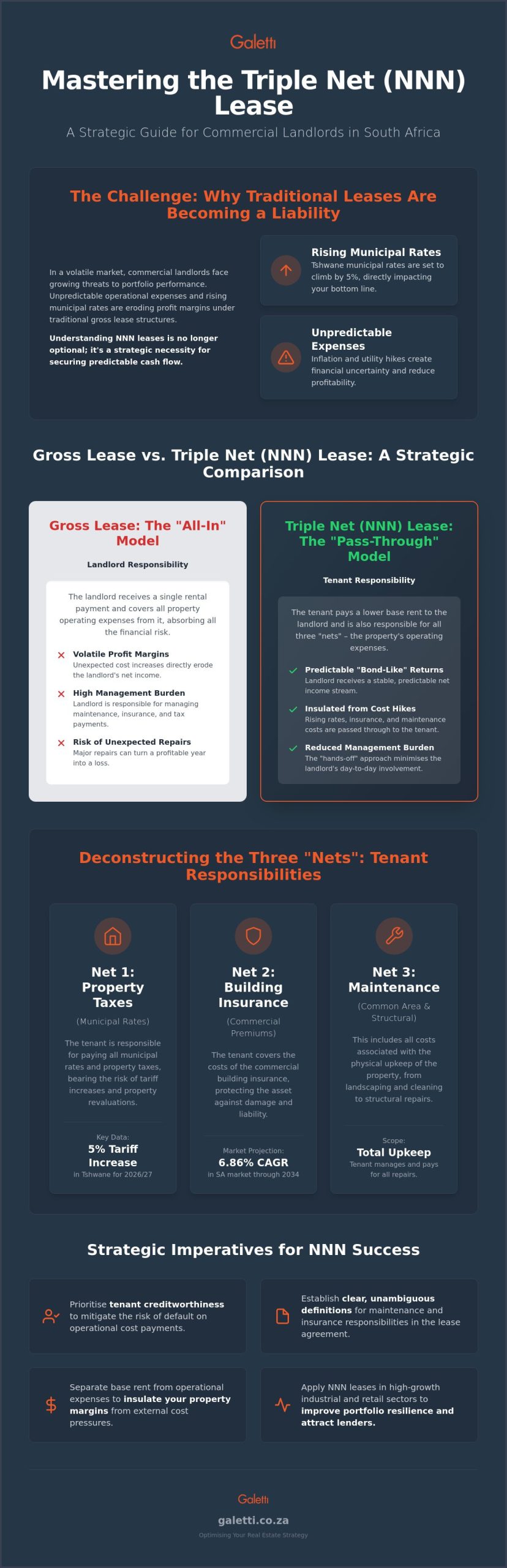
- Compare the “all-in” gross lease approach against the NNN “pass-through” model to determine the most efficient structure for your commercial assets.
- Mitigate operational risk by prioritising tenant creditworthiness and establishing clear definitions for maintenance and insurance responsibilities.
- Discover how professional advisory services can streamline your management burden whilst securing high-quality tenants for long-term stability.
Defining the Triple Net Lease (NNN) in South Africa
A Triple Net Lease (NNN) is a commercial agreement where the tenant assumes responsibility for all property-related expenses. This includes municipal rates, building insurance, and all maintenance costs. In the local market, this structure serves as the gold standard for industrial, retail, and A-grade office sectors. The Triple Net Lease represents the ultimate “hands-off” investment vehicle for South African landlords, transferring the operational burden entirely to the occupant.
Mastering the nuances of this structure is central to understanding triple net lease South Africa, as it forms the bedrock of high-value commercial transactions. It ensures that the landlord’s yield remains protected from the volatility of external cost pressures. When defining the Triple Net Lease (NNN), the primary distinction lies in the total transfer of financial risk from the property owner to the occupier.
The Core Structure: Base Rent plus Operating Costs
The NNN framework separates the “Base Rent” from the “Operating Expenses”. The base rent constitutes the landlord’s actual profit, whilst the operating expenses cover the literal costs of keeping the building functional. In a standard NNN agreement, the “Net” refers to the income remaining after these three primary costs are subtracted. This transparency allows for a clean accounting of the asset’s performance without the noise of utility spikes or tax hikes.
Rent escalations typically apply only to the base rent, often at a fixed annual percentage. Operating expenses, however, fluctuate based on municipal valuations or insurance market shifts. To manage this, landlords and tenants engage in a reconciliation process at the end of each financial year. This ensures the tenant has paid the exact amount required to cover the property’s actual running costs, maintaining a fair balance between both parties.
Why NNN is the Standard for Industrial and Retail Sectors
Institutional investors and property developers favour NNN leases because they provide “bond-like” real estate returns. The stability of a 10-year term, common amongst industrial and retail agreements, offers a predictable income stream that is highly attractive to lenders. This predictability makes it significantly easier for developers to secure financing for new projects, particularly in a high-interest-rate environment.
In the industrial sector, where specialised facilities are common, tenants often prefer the operational control that an NNN lease provides. They manage the maintenance schedules and service providers directly, ensuring the premises meet their specific technical requirements. For the landlord, this reduces the management burden and eliminates the risk of unexpected repairs eroding the annual yield. Our property leasing services focus on securing these high-quality, long-term tenants to ensure the longevity of your investment portfolio.
Deconstructing the Three Nets: Taxes, Insurance, and Maintenance
The financial efficiency of an NNN agreement hinges on the precise allocation of the “three nets”. For those focused on understanding triple net lease South Africa, these components represent the variable costs that shift from the landlord’s balance sheet to the tenant’s. This structure ensures the property owner receives a “net” rental, free from the erosion caused by rising municipal costs or unforeseen repairs. In the South African tax environment, VAT at 15% is typically applicable to the recovery of municipal rates, insurance premiums, and maintenance costs, provided the landlord is a registered VAT vendor.
Property Taxes and Municipal Rates in the SA Context
Municipal rates represent the first net and often the most volatile. In the 2026/2027 financial cycle, municipalities like Tshwane have implemented a 5% tariff increase, with business and industrial property rates set at 3,075 cents in the rand. For a tenant, these figures directly impact the monthly bottom line. It is vital to scrutinise the General Valuation (GV) roll during the due diligence phase. If a property is overvalued by the local authority, the NNN tenant bears the cost of that inaccuracy. Savvy occupants now insist on clauses that allow them to challenge unfair municipal valuations to protect their operational margins. Checking the “Rates Base” is no longer optional; it is a fundamental step in mitigating the risk of sudden cost spikes.
Insurance Premiums and Maintenance Obligations
The second and third nets cover risk and physical upkeep. Commercial insurance premiums are on an upward trajectory, with the South African market projected to grow at a CAGR of 6.86% through 2034. A strategic comparison of NNN leases reveals that whilst the tenant pays the premiums, the landlord usually remains the policyholder to ensure the asset’s long-term protection. This allows the tenant to manage the cost whilst the landlord retains oversight of the coverage limits.
Maintenance responsibilities in an NNN contract are typically comprehensive for the tenant, covering everything from HVAC systems to plumbing. However, the “Structural Exception” remains a standard safeguard; landlords usually retain responsibility for the roof and foundations. In 2026, the management of utility infrastructure has become a primary focus. This includes Eskom connections and the maintenance of solar PV installations, which are now common in industrial NNN agreements. To ensure your lease agreement correctly defines these boundaries, you may wish to consult with our advisory team for a detailed contract review.
Triple Net vs Gross Leases: A Strategic Comparison
Choosing the right lease structure is a matter of risk allocation. A Gross Lease offers an “all-in” rental price, common in smaller office suites or flexible workspaces. Here, the landlord covers all operating costs. In contrast, the NNN lease is a “pass-through” model. It protects the property owner from inflationary pressures and utility hikes. For investors, this distinction is critical when calculating the Capitalisation Rate (Cap Rate). NNN assets often command sharper cap rates because the income stream is more secure and predictable. Corporate occupiers often favour this transparency, as it provides a clear view of service charges without hidden administrative markups.
Understanding triple net lease South Africa requires a shift in perspective. You’re no longer just renting space; you’re managing an operational environment. This transparency eliminates the friction often found in gross leases where tenants might suspect they’re overpaying for poorly managed services. Instead, the NNN model aligns the interests of both parties toward efficient building management.
Cash Flow Predictability for Landlords
NNN leases insulate landlords from “surprise” municipal hikes or insurance adjustments. When rates increase, the cost passes directly to the occupant. This stability is why NNN structures are the preferred choice for South African REITs and institutional funds. A secure, net income stream directly enhances property valuation. It transforms the asset into a reliable yield-generating instrument. This structure allows investors to build portfolios that remain resilient even when local government tariffs fluctuate.
Operational Control and Flexibility for Tenants
Diligent tenants often find that NNN leases are more cost-effective than gross alternatives. By “self-performing” maintenance, the occupier avoids the “Landlord Markup” often bundled into gross rentals. You gain direct control over service provider quality and repair speed. This is particularly valuable for logistics firms where facility downtime is a major risk. NNN agreements also offer greater customisation rights. Since the tenant is responsible for the premises, landlords are typically more flexible regarding corporate branding and bespoke internal fit-outs. This autonomy allows a business to align its physical environment with its operational requirements without constant bureaucratic hurdles.
Navigating the Risks and Rewards of NNN Investments
NNN investments offer institutional-grade stability, yet they aren’t without specific pitfalls. The “Variable Expense” trap is the most frequent risk for tenants. Sudden spikes in municipal costs or insurance premiums can disrupt annual budgets if not properly anticipated. A professional lease audit is essential to ensure that all cost allocations align strictly with the signed agreement and industry standards. Understanding triple net lease South Africa involves recognising that the tenant’s creditworthiness is the actual collateral of the deal. If the occupant’s financial strength falters, the landlord is left with a vacant asset and an immediate burden of high operational costs.
Mitigating Variable Expense Volatility
To avoid unforeseen financial shocks, savvy tenants negotiate “Caps” on controllable operating expenses. Whilst municipal rates (such as the 3,075 cents in the rand seen in Tshwane for 2026) are non-negotiable, administrative and management fees can be limited. Technology now plays a pivotal role in this space. Smart metering and IoT sensors allow for real-time monitoring of utility consumption, preventing waste before it becomes a line item. Before committing to a long-term agreement, always demand a minimum of three years of historical expense reports. This data provides the only realistic baseline for your future financial planning.
The Rise of the Green NNN Lease
In the 2026 market, the “Green NNN Lease” has transitioned from a niche preference to a corporate mandate. These agreements integrate energy efficiency targets and ESG (Environmental, Social, and Governance) reporting directly into the maintenance obligations. Tenants benefit from reduced utility overheads, whilst landlords future-proof their assets against potential carbon taxes. This collaborative framework ensures the property remains competitive and compliant with evolving environmental regulations.
Critical Clauses: What to Look for in an NNN Agreement
Precision in definitions is vital. You must clearly distinguish between Capital Expenditure (CapEx) and Operating Expenditure (OpEx). In a standard NNN structure, the tenant manages OpEx, but major structural CapEx, such as lift replacements or foundation repairs, should remain the landlord’s responsibility. The “Make-Good” clause is another potential flashpoint. It requires the tenant to return the premises to its original state at the end of the term. This can be a significant capital outlay if not budgeted for over the lease period. Lastly, ensure the contract allows for assignability or subletting. This maintains your operational flexibility if your business requirements change during a 10-year commitment. To secure a lease that protects your commercial interests, contact Galetti’s advisory team for expert negotiation and contract review.
Optimising Your Real Estate Strategy with Galetti
Galetti provides a sophisticated framework for navigating the complexities of the South African commercial market. Our integrated approach combines high-level advisory with precise portfolio management. This ensures your real estate strategy remains robust against the macroeconomic shifts of 2026. Understanding triple net lease South Africa is only the first step; the second is executing a lease that aligns with your long-term financial objectives. Our property leasing services specialise in securing blue-chip tenants whose creditworthiness forms the foundation of a successful NNN agreement. We focus on matching institutional-grade assets with occupiers who value operational control and transparency.
Strategic valuations are central to this process. We ensure your lease terms reflect current market benchmarks, from escalation rates to maintenance caps. By leveraging real-time data, we help landlords and tenants avoid the friction of outdated contract structures. This data-driven perspective allows for a clean accounting of asset performance, ensuring that your property remains a high-yielding component of your broader investment strategy.
Leveraging Expert Advisory for Lease Negotiations
Galetti Corporate Services protects occupier interests by deconstructing the “three nets” during the negotiation phase. We provide market-data-driven insights that allow you to benchmark your NNN costs against national averages. This professional representation is vital in major South African commercial centres where competition for A-grade space is intense. Our advisory team acts as a strategic partner, ensuring every clause serves your operational efficiency. We bridge the gap between complex legal requirements and practical business needs, securing terms that promote long-term stability.
Unlocking Value through NNN Property Auctions
NNN-leased assets perform exceptionally well under the hammer. Investors flock to these opportunities because the net income stream is already secured and the management burden is minimal. The auction process offers a transparent and efficient channel for asset disposal. By creating a competitive bidding environment, we maximise the value of NNN assets. For a deeper look at this sales channel, consult our strategic guide to asset disposal. This method ensures the true market value of your institutional-grade property is realised through a fast-paced, streamlined transaction that mirrors the momentum of the modern industry.
Securing Your Commercial Future in 2026
The transition to a Triple Net structure represents a fundamental shift toward institutional-grade efficiency. You now recognise that the NNN model offers unparalleled protection against municipal volatility and maintenance surprises. It aligns the interests of landlords and tenants through transparency and direct operational control. Mastering the nuances of understanding triple net lease South Africa is the definitive step in future-proofing your portfolio against the rising economic pressures of 2026.
Galetti brings over 18 years of South African market expertise to every negotiation and transaction. Our integrated technology-driven real estate solutions ensure that your cost allocations are precise and your yields remain protected. With specialised auction and leasing divisions, we provide a comprehensive approach to asset management that delivers measurable results in a competitive landscape. This strategic advantage allows you to focus on growth whilst we manage the complexities of your commercial agreements.
Take the next step in securing your commercial interests and unlocking the full potential of your assets. Optimise your property portfolio with Galetti’s Strategic Advisory Services. We are ready to help you navigate the 2026 landscape with confidence and professional clarity.
Frequently Asked Questions
What is the difference between an NNN lease and an Absolute Net lease in South Africa?
An Absolute Net lease, often termed a “bondable” lease, requires the tenant to assume every possible financial risk, including structural repairs and costs arising after a total building loss. In a standard Triple Net agreement, the landlord typically retains responsibility for structural integrity, such as the roof and foundations. Absolute Net structures are rarer and usually reserved for high-credit, single-tenant industrial assets where the landlord seeks zero management involvement.
Who is responsible for structural repairs in a Triple Net Lease?
The landlord generally remains responsible for the building’s skeletal structure, including the foundations, load-bearing walls, and roof. Whilst the tenant manages the day-to-day maintenance of HVAC systems, plumbing, and electrical installations, major capital expenditure for structural failure is excluded from the tenant’s “net” obligations. It’s vital to define these boundaries clearly in the contract to avoid disputes over what constitutes a repair versus a structural replacement.
How are municipal rates calculated for a tenant in an NNN agreement?
Municipal rates are determined by multiplying the property’s market valuation, as recorded on the General Valuation roll, by the specific cent-in-the-rand tariff set by the local authority. For example, in the 2026/2027 cycle, Tshwane has set the business and industrial rate at 3,075 cents in the rand. The tenant pays their pro-rata share of this total amount, which is often recovered monthly by the landlord alongside the base rent.
Can a tenant negotiate a cap on maintenance costs in a Triple Net Lease?
Tenants can and should negotiate caps on controllable operating expenses to limit annual cost escalations. Whilst municipal taxes and insurance premiums are market-driven and non-negotiable, administrative fees and general service contracts can be capped at a fixed percentage. This is a critical component of understanding triple net lease South Africa, as it provides the occupier with a degree of budget predictability amidst rising operational overheads.
Why do investors prefer Triple Net Leases for industrial properties?
Investors favour NNN industrial leases because they offer institutional-grade stability with minimal management intensity. With the national industrial vacancy rate at a low 3.8% in 2026 and year-on-year rental growth reaching 8.4% for mid-sized spaces, these assets provide a highly resilient income stream. The NNN structure ensures that the landlord’s yield is protected from the inflationary pressures of building upkeep and municipal tariff hikes.
Is VAT applicable to the operating expenses in an NNN lease?
VAT at the standard rate of 15% is applicable to the recovery of all operating expenses if the landlord is a registered VAT vendor. This includes the pass-through costs for municipal rates, insurance, and maintenance services. Tenants who are also VAT vendors can usually claim this back as input tax, making the structure tax-neutral for most corporate entities operating in the South African commercial sector.
What happens if the building insurance premiums increase significantly?
The tenant is contractually obligated to cover the increased premium costs in an NNN agreement. With the South African commercial insurance market projected to grow at a CAGR of 6.86% through 2034, these hikes are a significant consideration for long-term budgeting. If premiums spike due to climate events or macroeconomic shifts, the landlord passes the full cost to the tenant, maintaining the property’s net yield.
Are NNN leases common for office spaces in South Africa?
NNN leases are the standard for single-tenant, A-grade office buildings but are less frequent in multi-tenant environments. In shared office blocks, landlords often prefer “semi-net” or gross leases to simplify the complex pro-rata allocation of shared services like lifts and communal lobbies. However, for corporate headquarters or standalone commercial centres, the Triple Net structure remains the preferred model for ensuring long-term asset performance.