A commercial lease is no longer a simple overhead; it’s a high-stakes financial instrument that dictates your firm’s agility and talent-retention potential. Securing the right office space to let Johannesburg requires more than a site visit. It demands a clinical understanding of a market where P-grade vacancies in Sandton have tightened to 10.2% whilst operational costs continue to climb at an aggressive rate.
You’re likely facing the frustration of rising utility bills and complex lease agreements that seem designed to protect the landlord’s interests rather than your own. Distinguishing true P-grade value from A-grade marketing is increasingly difficult in a landscape of shifting benchmarks and “flight to quality” trends. We’ll show you how to master these complexities by providing a clear framework for the 2026 leasing cycle. You’ll learn how to optimise occupancy costs, secure flexible terms, and create a workspace that serves as a genuine strategic asset. This guide breaks down current rental rates and expert negotiation tactics to ensure your next move is a calculated, high-performance victory.
Key Takeaways
- Identify the technical benchmarks that define P-grade assets and why they are essential for business continuity in the 2026 market.
- Navigate the financial nuances of securing office space to let Johannesburg by distinguishing between Gross, Net, and Triple Net lease structures.
- Uncover hidden occupancy costs such as municipal rates and common area maintenance to protect your bottom line.
- Utilise specialist tenant representation to balance the scales in lease negotiations and secure maximum flexibility.
- Transform your workspace into a strategic asset that supports talent retention and long-term operational efficiency.
Navigating the Evolving Market for Office Space to Let
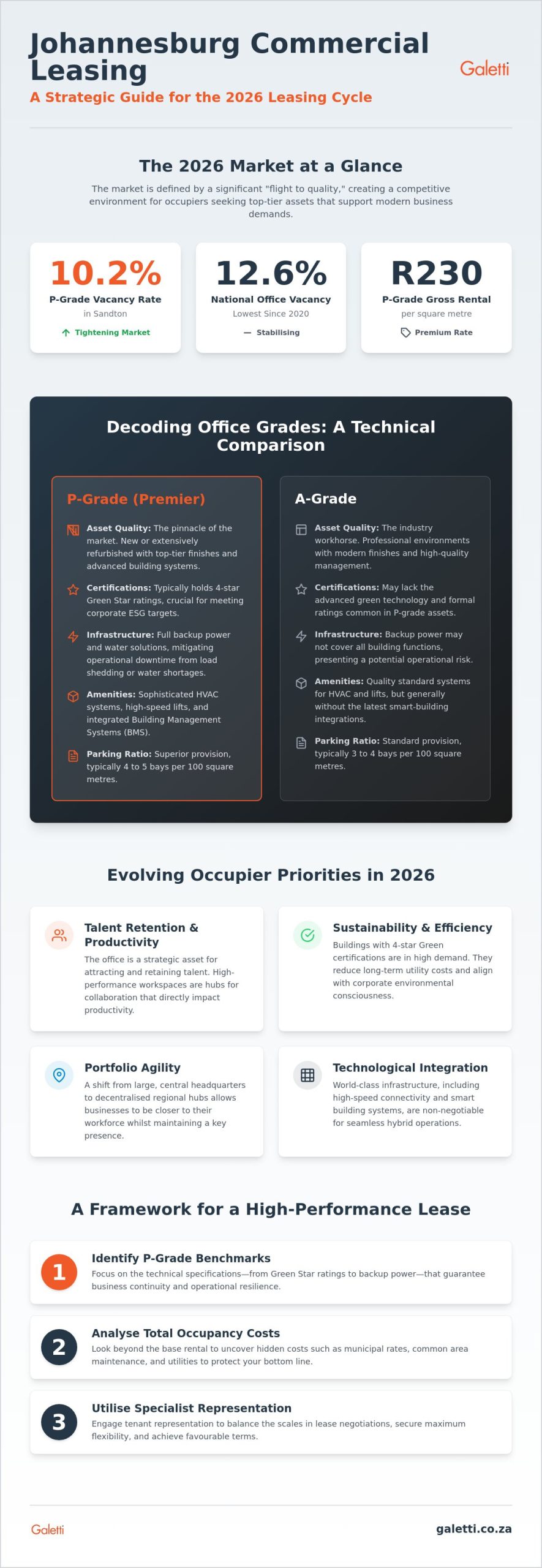
The South African commercial leasing market in 2026 is defined by a stark divergence in performance. Whilst the national office vacancy rate has stabilised at approximately 12.6 per cent, the lowest since 2020, Johannesburg presents a more nuanced picture. General vacancy rates in the city have historically remained high, yet the demand for premium office space to let Johannesburg tells a different story. In prime nodes like Sandton, P-grade vacancy rates have tightened significantly to 10.2 per cent. This creates a competitive environment for occupiers seeking top-tier assets.
Businesses are no longer prioritising sheer floorplate volume. Instead, they’re focusing on high-quality, efficient environments that justify the cost of physical occupancy. This “flight to quality” is the dominant trend of the year. Modern Commercial property strategies now treat the office as a tool for talent retention rather than just a place of work. High-performance office space to let Johannesburg in Rosebank and Sandton commands higher rentals, with P-grade rates reaching approximately R230 per square metre. Occupiers are willing to pay this premium to secure buildings that offer superior amenities and operational reliability.
The Shift Towards High-Performance Workspaces
The modern office must do more than provide a desk. It’s now a hub for collaboration that directly impacts employee productivity. Global corporates are moving away from “standard” stock in favour of buildings with 4-star Green certifications and robust backup power solutions. Sustainability isn’t just a corporate social responsibility goal; it’s a financial imperative. Efficient buildings reduce long-term utility costs and appeal to a workforce that values environmental consciousness. Standard office space often lacks the technological integration required for seamless hybrid operations, making it insufficient for forward-thinking firms.
Understanding Occupier Behaviour in 2026
Occupier behaviour has shifted towards agility. We’re seeing a trend where large headquarters are decentralised into smaller, regional hubs. This allows businesses to be closer to their workforce whilst maintaining a presence in key economic centres. Many firms are also integrating flexible space into their traditional long-term leases to manage headcount fluctuations. Professional corporate real estate leasing strategies now prioritise buildings with world-class technological infrastructure. High-speed connectivity and smart building systems are non-negotiable for businesses operating in a globalised economy.
Decoding Office Classifications: P-Grade vs A-Grade Assets
Understanding the technical distinction between building grades is critical for accurate due diligence. When searching for office space to let Johannesburg, the grade dictates your baseline operational risk and total cost of occupancy. These classifications aren’t merely marketing labels; they represent specific engineering standards, amenity levels, and management qualities that impact your bottom line.
P-grade (Premier) assets represent the pinnacle of the market. These buildings are typically newer or extensively refurbished, featuring top-tier finishes and advanced building systems. Technical criteria include 4-star Green Star certifications, high-speed lifts, and sophisticated HVAC systems. Crucially, they offer full backup power and water solutions, which are essential for business continuity. A-grade assets serve as the industry’s workhorse. They provide professional environments with modern finishes and high-quality management but lack the extreme luxuries or cutting-edge green technology of P-grade. According to JLL’s market analysis, the demand for these spaces remains resilient as occupiers seek a balance between prestige and cost-efficiency. Security and parking ratios are also key differentiators; P-grade often provides 4 to 5 bays per 100sqm, whilst A-grade typically offers 3 to 4.
Why P-Grade Commands a Rental Premium
P-grade space in Sandton commands approximately R230 per square metre. This premium covers more than aesthetic appeal. It funds integrated Building Management Systems (BMS) that optimise energy consumption and reduce waste. For global corporates, these assets are vital for meeting ESG (Environmental, Social, and Governance) targets. By mitigating risks like load shedding or water shortages through onsite infrastructure, these buildings prevent costly operational downtime. The investment in high-performance office space to let Johannesburg often pays for itself through improved employee retention and reduced utility volatility.
Evaluating A-Grade Alternatives
A-grade space offers compelling value for mid-market firms. For instance, A-grade space in Bedfordview averages R144 per square metre, whilst Braamfontein can offer rates as low as R105 per square metre. These assets are often located in established nodes with excellent highway accessibility. Many A-grade buildings present refurbishment opportunities where tenants can negotiate fit-out contributions to modernise the interior to a near-P-grade standard. This approach allows firms to achieve a high-performance workspace without the Sandton CBD price tag. To determine which grade aligns with your long-term strategy, you should consult with a specialist advisor.
Analysing the Total Cost of Occupancy in Commercial Leases
Headline rental rates are a deceptive metric when evaluating office space to let Johannesburg. Occupiers often focus on the quoted price per square metre whilst overlooking the secondary costs that erode operating margins. A strategic lease audit identifies these expenses before they impact your balance sheet. Understanding the distinction between lease structures is the first step in this process. A Gross lease typically includes operating costs and rates, providing budget certainty. Conversely, a Triple Net lease requires the tenant to pay a base rental plus their pro-rata share of property taxes, insurance, and common area maintenance (CAM).
Hidden costs frequently reside within the CAM charges and municipal rates. In Johannesburg, municipal valuations can shift, leading to unexpected spikes in monthly outgoings. Utility escalations also present a significant risk. Electricity and water costs often rise at rates far exceeding standard inflationary increments. If your building lacks efficient sub-metering, you might be subsidising the consumption of other tenants. Accurate financial planning requires a multi-year view of these variables rather than a snapshot of the first year’s rent.
Financial Modelling for Corporate Tenants
Total Cost of Occupancy is the aggregate of all direct and indirect expenses associated with the lifecycle of a commercial lease. This figure encompasses base rentals, operating costs, parking levies, and municipal recoveries. The headline rate is often misleading because it doesn’t account for the efficiency of the floorplate or the reliability of the building’s infrastructure. Large-scale occupiers must audit municipal billings and utility recoveries to ensure they aren’t overpaying. Discrepancies in how common areas are measured can also lead to inflated costs over a five-year term.
The Role of Tenant Installation Allowances
A Tenant Installation (TI) allowance is a capital contribution provided by the landlord to customise the office space to let Johannesburg to your specific requirements. In the current market, these allowances typically range from R250 to R500 per square metre, depending on the lease length and grade of the building. Bespoke fit-outs allow for a workspace tailored to your corporate culture, though they require significant project management. Turnkey installations are more convenient but often limit your choice of finishes. Galetti provides expert guidance in optimising tenant installation negotiations to ensure you extract maximum value from the landlord’s contribution without sacrificing quality.
Strategic Site Selection and Tenant Representation
Landlords employ professional teams to maximise asset yield. Tenants should adopt a similar level of sophistication. Navigating the market for office space to let Johannesburg without professional representation often leads to unfavourable terms and overlooked risks. A specialist advisor acts as a strategic partner; they don’t just find buildings, they engineer lease outcomes. This process begins with a “shortlist” derived from your specific business objectives, such as proximity to transport hubs or alignment with sustainability mandates. Decisions are data-driven, ensuring every potential site meets rigorous operational criteria before it’s even considered.
Professional advisors leverage granular market data to balance the scales during the selection phase. They understand the current deal-making environment, including where landlords are offering higher fit-out contributions or extended rent-free periods. This insight ensures your letter of intent is grounded in market reality rather than landlord aspiration. Technical due diligence must follow, verifying that the building’s infrastructure supports your specific operational requirements before any legal commitment is made. It’s about securing a high-performance environment that facilitates growth whilst minimising long-term liabilities.
The Lease Negotiation Process
Negotiating a lease requires a focus on long-term flexibility and risk mitigation. Critical clauses include annual rental escalations and renewal options that protect your future tenure. A “Right of First Refusal” is particularly valuable for expanding firms. It grants your business the first opportunity to lease adjacent space as it becomes available, preventing the need for a premature relocation. Business continuity clauses, including robust Force Majeure provisions, are now non-negotiable. These protect your organisation against unforeseen disruptions that prevent the use of the premises, ensuring you aren’t held liable for rentals during periods of forced vacancy.
Due Diligence and Building Audits
A physical site visit is only the surface of professional due diligence. You must audit the technical health of the building, including HVAC efficiency, structural integrity, and the reliability of backup power systems. Lift maintenance records and fire safety compliance certificates should also be scrutinised. For organisations managing multiple locations, a commercial property portfolio audit provides a holistic view of occupancy costs and lease expiry profiles. Galetti’s corporate division specialises in this integrated approach. We streamline the site selection journey by combining technical expertise with aggressive negotiation strategies to secure the most competitive office space to let Johannesburg.
Optimising Your Portfolio with Galetti Corporate Services
Galetti acts as a strategic extension of your executive team. We provide definitive answers to complex property challenges. Securing office space to let Johannesburg is only the first step in a broader asset lifecycle. Our firm leverages 18 years of industry experience to ensure every square metre aligns with your corporate strategy. We move beyond the traditional brokerage model. We offer integrated advisory that spans the entire real estate spectrum. This holistic approach ensures your occupancy costs remain optimised whilst your operational flexibility is maintained.
Data and technology drive our advisory process. We don’t rely on intuition. We use granular market analytics to unlock value within your portfolio. This allows decision-makers to identify underperforming assets and capitalise on market shifts in real-time. Whether you are seeking a new headquarters or managing a divestment through corporate property sales, our methodology remains results-oriented. Real estate is a financial instrument. It must support your firm’s long-term growth and talent retention goals.
Integrated Real Estate Advisory
Consolidating your real estate requirements with a single partner eliminates fragmentation. Galetti provides a seamless transition between leasing, sales, and professional valuations. This integration is vital for large-scale occupiers managing complex multi-site portfolios. When market conditions shift, we provide the agility needed to restructure or exit. Our property auction services offer a rapid liquidity solution for disposals. They ensure you achieve market-related pricing within a fixed timeframe. This level of versatility is unique in the South African corporate landscape.
Taking the Next Step
Your current portfolio performance requires constant scrutiny to remain competitive. We invite corporate decision-makers to review their existing lease terms against current 2026 benchmarks. A tailored advisory session with our specialists can uncover significant cost-saving opportunities and strategic advantages. We provide the clarity and expertise needed to navigate the office space to let Johannesburg market with confidence. Every decision we facilitate is designed to move your business forward.
Partner with Galetti to secure your next strategic office space
Future-Proof Your Corporate Real Estate Strategy
The shift towards high-performance environments requires a clinical approach to technical due diligence and a deep understanding of total occupancy costs. Distinguishing between P-grade prestige and A-grade value remains the foundation of a successful workspace strategy. Finding the right office space to let Johannesburg requires more than a standard search. It demands a strategic partner who understands the nuances of the local landscape and the rigorous technical requirements of modern global corporates.
Galetti provides the authoritative guidance needed to balance operational agility with financial efficiency. With 18+ years of corporate advisory expertise and national coverage across South Africa, we offer integrated leasing and sales solutions that go beyond the traditional brokerage model. We focus on securing terms that protect your business interests whilst fostering an environment where your talent can thrive.
Your office is more than an overhead; it’s a catalyst for growth and a statement of corporate intent. Let’s ensure your next move is a calculated, strategic victory that supports your long-term vision.
Frequently Asked Questions
What is the average lease period for office space in South Africa?
Corporate leases typically span between three and five years. Shorter terms of one to two years are occasionally available in serviced offices or through specific negotiations, but five-year agreements are the industry standard for unlocking significant landlord contributions. Long-term commitments provide the stability landlords require to offer competitive rental rates and higher fit-out allowances.
How is the rental price per square metre calculated?
The rental is calculated based on the Rentable Area of the premises, which includes your usable office space plus a pro-rata share of the building’s common areas. This calculation follows the SAPOA Method of Measuring Floor Areas. Your monthly base rental is the result of multiplying this total square metreage by the quoted rate per square metre.
What is the difference between a Gross lease and a Net lease?
A Gross lease is an all-inclusive agreement where the monthly rental covers the base rent and operating costs like security and cleaning. A Net lease separates the base rental from additional costs such as municipal rates, insurance, and maintenance recoveries. Net leases offer greater transparency, though they require tenants to account for fluctuating operational expenses in their financial modelling.
Are utilities and municipal rates usually included in the office rental?
Utilities and municipal rates are almost always treated as separate recoveries and are not included in the base rental for office space to let Johannesburg. You’ll be billed monthly for electricity and water based on metered consumption or a pro-rata share of the building. Municipal rates are subject to change based on city valuations, so it’s vital to audit these charges regularly.
What is a Tenant Installation (TI) allowance and how do I qualify?
A TI allowance is a capital sum provided by the landlord to fund the fit-out of your office. In the 2026 market, these allowances typically range from R250 to R500 per square metre. Qualification depends on your company’s credit standing and the length of the lease; longer terms naturally secure more substantial contributions for your workspace customisation.
Can I negotiate the annual rental escalation rate?
Annual escalation rates are a negotiable component of any commercial lease. Whilst the market standard often ranges between 7 per cent and 9 per cent, your tenant profile and the current vacancy rates in a specific node can provide leverage. Securing a lower escalation rate is a critical strategy for managing your total cost of occupancy over a five-year term.
What happens if I need to exit my office lease early?
Exiting a lease before the expiry date usually involves a buy-out penalty or the requirement to find a suitable replacement tenant. Most agreements include a “sub-letting and assignment” clause that allows you to transfer the lease to another entity with the landlord’s consent. You should ensure these exit strategies are clearly defined during the initial negotiation phase to maintain business agility.
Why should I use a tenant representative instead of dealing directly with a landlord?
A tenant representative levels the playing field by providing clinical market data and professional negotiation expertise. Landlords employ specialist teams to maximise their asset’s yield; a representative ensures you don’t overpay for office space to let Johannesburg. They identify hidden costs and secure flexible terms that a direct negotiation might overlook.