
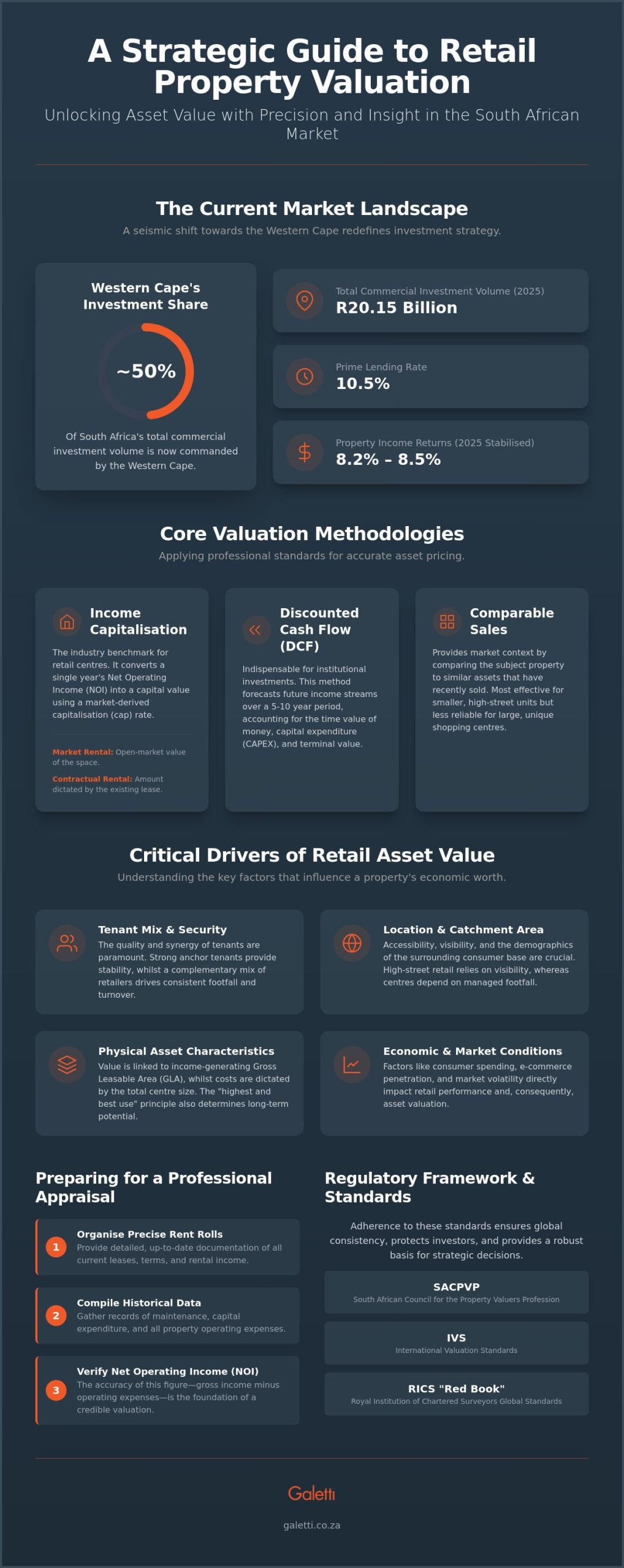
The Western Cape now commands nearly half of South Africa’s commercial investment volume, marking a seismic shift in the national landscape. For landlords and investors, this migration underscores why a generic approach to retail property valuation South Africa no longer suffices. You likely feel the pressure of market volatility and the shifting weight of e-commerce on physical footfall. It’s difficult to quantify how turnover-based lease structures impact your bottom line in a high-interest environment where the prime lending rate sits at 10.5%.
Mastering these complexities is the only way to unlock hidden portfolio value and ensure transactional precision. This guide provides the strategic framework needed to navigate asset appraisal in 2026. We examine the latest RICS standards, the outperformance of rural retail centres, and the alignment of valuations with financial reporting requirements. You’ll gain the insight required to achieve accurate asset pricing for your next disposal or acquisition. This is about clarity, precision, and strategic advantage.
Key Takeaways
- Identify the primary methodologies used by professionals, including Income Capitalisation and Discounted Cash Flow analysis, to determine accurate asset worth.
- Understand how anchor tenants and tenant synergy act as critical drivers for retail property valuation South Africa, ensuring long-term income stability.
- Learn how to prepare for a professional appraisal by organising precise rent rolls and historical maintenance data to verify net operating income.
- Discover the strategic link between accurate valuation and successful corporate real estate sales or high-performance leasing strategies.
- Gain insight into how professional property management maintains asset value amidst market volatility and shifting consumer behaviour.
Understanding Retail Property Valuation in South Africa
Accurate retail property valuation South Africa is the cornerstone of a resilient commercial strategy. It is the technical process of determining the precise economic worth of land and buildings designated for trade. While industrial assets focus on utility and office spaces prioritise floor efficiency, retail value is inextricably linked to consumer behaviour and tenant synergy. It is a specialised field that requires a deep understanding of both bricks-and-mortar and the retail economy.
Primary stakeholders, including landlords, financial institutions, and institutional investors, rely on these valuations to mitigate risk and guide capital allocation. A professional valuer acts as a vital facilitator in this ecosystem. They ensure market transparency by applying Core Methodologies for Valuing Retail Assets that align with global benchmarks. This precision is essential for a market where total commercial property investment volume reached R20.15 billion in 2025. Without accurate data, strategic decision-making becomes guesswork.
The Unique Nature of Retail Assets
Retail valuation differs significantly from other sectors due to the weight placed on Gross Leasable Area (GLA) versus total centre size. Income is generated from the GLA, yet the total footprint dictates operating costs and maintenance. In a South African urban context, the “highest and best use” principle often determines if a site remains high-street retail or evolves into a mixed-use precinct. Enclosed shopping centres rely on managed footfall and anchor tenant security, whereas high-street retail value depends more on individual location and street-side visibility. Each requires a distinct appraisal lens.
Regulatory Framework and Standards
Adherence to the Property Valuers Profession Act is mandatory for all practitioners. Professionals must be registered with the South African Council for the Property Valuers Profession (SACPVP) to operate legally. Most industry leaders also follow the International Valuation Standards (IVS) and the RICS “Red Book” to ensure global consistency. This regulatory rigour protects investors and ensures that retail property valuation South Africa remains robust against volatility. If you are preparing for a disposal, these standards form the basis of a successful corporate real estate sales strategy.
Core Methodologies for Valuing Retail Assets
Precision is the only metric that matters in a high-stakes market. Retail property valuation South Africa demands a technical approach that accounts for shifting yields and tenant risk. For most income-producing assets, the industry relies on a combination of capitalisation and cash flow modelling. These methods provide the clarity needed to navigate a landscape where the prime lending rate sits at 10.5% and market sentiment is rapidly evolving.
Accurately calculating Net Operating Income (NOI) is the first step in any credible appraisal. This figure represents your gross income minus all operating expenses. It’s the heartbeat of the valuation. If your NOI is inflated by non-recoverable costs or unrealistic rental expectations, the entire valuation collapses. Professionals often cross-reference these findings with the Comparable Sales Method. While this approach is useful for smaller high-street units, it often falls short for large malls because no two retail centres share the same tenant synergy or catchment demographics.
The Income Capitalisation Approach
This method is the benchmark for valuing retail centres. It converts a single year’s NOI into a capital value using a capitalisation (cap) rate. Determining the correct cap rate requires an expert understanding of the relationship between risk and location. In 2025, property income returns stabilised between 8.2% and 8.5%, providing a solid foundation for current expectations. A prime centre in the Western Cape might command a tighter cap rate due to lower perceived risk, whereas a rural centre might offer higher yields to compensate for volatility. Market Related Rental represents the current open-market value of the space, while Contractual Rental is the specific amount dictated by the existing lease agreement.
Discounted Cash Flow Analysis
For long-term institutional investments, Discounted Cash Flow (DCF) analysis is indispensable. This method forecasts future income streams over a 5 to 10-year period, accounting for the time value of money. You must factor in the terminal value and a realistic exit cap rate to understand the asset’s eventual disposal worth. It’s also the best way to account for anticipated capital expenditure (CAPEX). If an aging centre requires a significant HVAC overhaul or roof replacement in year three, the DCF model reflects this impact on the present value. Preparing for a Professional Retail Valuation requires ensuring your valuer understands these granular shifts in asset performance. If you need a definitive assessment of your portfolio’s worth, reach out to our specialist team for a strategic consultation.
Critical Drivers of Retail Asset Value in the South African Market
Anchor tenants define the risk profile of any shopping centre. Their long-term lease agreements provide the stability that institutional investors crave. A centre anchored by a national supermarket chain typically commands a lower risk premium than one reliant on independent retailers. This synergy between tenants is vital. If the mix doesn’t align with local consumer behaviour, footfall drops and the asset’s value depreciates. To counter this, many landlords are incorporating experiential dining and event-based activations, such as paella catering South Africa, to enhance the centre’s lifestyle appeal. Effective retail property valuation South Africa must account for these operational nuances to be accurate.
Turnover-based lease structures add a layer of complexity to the appraisal process. Whilst they offer potential upside during economic booms, they also expose landlords to the retailer’s operational risks. Valuers must scrutinise historical sales data to determine if the turnover rent is sustainable or merely a temporary peak. This data-driven approach is a key part of Strategic Advisory: Maximising Retail Portfolio Performance, ensuring that every lease contributes to the asset’s capital growth. Transparency in these figures is essential for maintaining investor confidence.
Infrastructure resilience is now a non-negotiable value driver in the local market. Centres equipped with robust backup power and water systems maintain higher occupancy levels and command premium rentals. A shopping centre that goes dark during power outages loses more than just sales; it loses consumer trust and tenant loyalty. This physical security directly impacts the capitalisation rate. If a property lacks these redundancies, its marketability for corporate real estate sales is significantly diminished.
Tenant Profile and Lease Covenants
National tenants provide the covenant strength that secures financing. Their financial robustness reduces the likelihood of default, which in turn lowers the discount rate used in appraisals. The Weighted Average Unexpired Lease Term (WAULT) is a critical metric for any portfolio manager. A high WAULT indicates long-term income security, making the property a more attractive prospect for institutional acquisition. Conversely, a high concentration of local independent retailers may increase the perceived risk, requiring a higher yield to attract buyers.
Location and Catchment Area Dynamics
Value is ultimately driven by the purchasing power of the primary catchment area. A deep dive into consumer demographics reveals whether the tenant mix is appropriate for the local market. Accessibility and visibility from national transport links remain paramount for regional malls. As urban centres shift and decentralisation continues, the long-term viability of retail assets depends on their ability to adapt to new residential growth nodes. Strategic location remains the most significant hedge against market volatility.
Preparing for a Professional Retail Valuation
Preparation is strategic, not just administrative. A valuer is only as accurate as the data you provide. If you want to maximise your retail property valuation South Africa, you must present a transparent, data-driven narrative. Start by organising an up-to-date rent roll. This document must detail every tenant, their current rental, and all scheduled escalations. It’s the foundation of your income assessment and the first thing any professional will scrutinise.
Collate your historical utility and maintenance costs for at least the last three years. This allows the valuer to verify your net operating income with precision. Don’t forget to have your building plans and title deeds ready for inspection. These documents confirm the legal parameters of the property. You should also document any recent capital improvements or refurbishments. Whether it’s a facade uplift or a new solar installation, these investments directly influence the perceived quality and longevity of the asset. If you’ve invested in backup power to combat local infrastructure challenges, ensure this is highlighted as a key value driver.
Review every lease agreement for onerous clauses or break options. A valuer looks for any terms that might compromise future income stability. If a major tenant has a break option in the next 12 months, it introduces risk that needs to be quantified. Addressing these issues before the appraisal process begins can prevent unnecessary downward adjustments in the final report. Accuracy here is vital for a successful corporate real estate sales strategy.
The Landlord Checklist for Valuation Success
Verify your Gross Leasable Area (GLA) with professional measurement certificates. Discrepancies here often lead to significant value loss. Highlight your low vacancy rates and successful tenant retention strategies to demonstrate asset health. With the national all-property vacancy rate stabilising at 6.4% in 2025, showing performance above this benchmark adds weight to your valuation. Finally, identify any potential for future expansion or redevelopment. This “hope value” can be a powerful lever if supported by credible feasibility data.
Common Mistakes to Avoid
One of the most frequent errors is underestimating operating expenses or “leakage”. If your recoveries don’t match your outgoings, your net income is compromised. Avoid relying on outdated market rental data from previous years. The South African retail market moves fast; what was relevant in 2024 is likely obsolete in 2026. Lastly, never ignore the impact of nearby competing developments. A new regional mall in the same catchment will inevitably affect your footfall and rental growth prospects. Ensure your retail property valuation South Africa reflects these external competitive pressures.
Strategic Advisory: Maximising Retail Portfolio Performance
Valuation is not a static exercise. It is a strategic instrument that dictates the trajectory of your investment. In a market where listed property was the best-performing local asset class in the first half of 2026, precision is paramount. Accurate retail property valuation South Africa provides the data required to execute a high-performance corporate real estate sales strategy. It ensures that when you bring an asset to market, the pricing reflects its true economic potential, not just historical performance.
Maintaining asset value requires more than just a favourable appraisal. It demands rigorous, professional retail property management South Africa. Active management ensures that tenant mixes remain optimised and operating costs are controlled, directly protecting the net operating income. For high-demand retail assets, commercial property auctioneers South Africa offer a transparent, competitive platform to achieve maximum value. Galetti positions itself as the vital facilitator for national retail portfolio audits, providing the clarity needed to navigate complex market dynamics.
Valuation as a Tool for Asset Optimisation
Strategic investors use valuation data to regear portfolios and renegotiate leases before they expire. This proactive approach identifies underperforming assets that no longer align with your core objectives. By leveraging galetti corporate services, you gain access to sophisticated market intelligence. This data-driven decision making allows you to pivot quickly, disposing of non-core assets and reinvesting in high-growth nodes or resilient township retail centres. Identifying these opportunities early is the difference between a stagnant portfolio and one that delivers consistent capital growth.
The Path to Transactional Success
A professional valuation bridges the gap between buyer and seller expectations. It removes the emotional fluff from negotiations and replaces it with technical certainty. Whether through a private treaty or a public auction, transparency is the catalyst for closing deals efficiently. Galetti combines 18 years of expertise with an integrated approach across leasing and sales to ensure your portfolio remains agile and profitable. We provide definitive answers to complex problems, positioning your business for strategic advantage in a fast-moving landscape.
Consult with Galetti for a professional valuation and portfolio review
Securing Strategic Advantage in the 2026 Retail Market
Navigating the complexities of the current retail landscape requires more than just technical data. It requires a strategic partner. We’ve explored how precise methodologies form the bedrock of asset pricing. You now understand that value is driven by operational resilience, tenant synergy, and infrastructure stability. Achieving a precise retail property valuation South Africa is the first step toward high-performance asset management and successful portfolio regearing.
Galetti provides the technical rigour needed to unlock capital growth. We leverage 18 years of national real estate expertise and a specialised corporate advisory division to provide definitive answers to your most complex problems. Our proven track record in high-value retail auctions ensures that your assets achieve maximum market reach and transactional precision.
The retail sector remains a vital asset class for those who prioritise clarity and foresight. Take the lead by ensuring your portfolio is primed for the opportunities ahead.
Frequently Asked Questions
How is retail property valued in South Africa compared to other asset classes?
Retail property valuation South Africa differs from other sectors because it prioritises the quality of the tenant mix and consumer catchment dynamics. While industrial assets are valued on cubic capacity and office spaces on floor efficiency; retail worth is driven by trade potential. Valuers focus on the Gross Leasable Area (GLA) and the strength of anchor tenants to determine sustainable income levels rather than just the physical structure.
What is a typical capitalisation rate for a regional shopping centre in South Africa?
Capitalisation rates for regional centres typically reflect the lower risk associated with high-quality national tenants. While prime centres in the Western Cape command tighter yields, the broader market has seen income returns stabilise between 8.2% and 8.5%. These rates are influenced by the current 10.5% prime lending rate and the specific risk profile of the centre’s location and tenant covenants.
How does turnover rent influence the final valuation of a retail property?
Turnover rent introduces a variable component that can enhance the total income but also increases the risk profile. Valuers scrutinise historical trading data to determine if these sales levels are sustainable over a long-term horizon. If turnover rent contributes a significant portion of the total income, it may result in a slightly higher capitalisation rate to account for the potential volatility in consumer spending behaviour.
Why is the Income Capitalisation method preferred over the Cost Approach for retail?
The Income Capitalisation method is preferred because retail investors are primarily concerned with the yield generated by the asset. The Cost Approach only measures the expense of replacing the physical building; this often bears little relation to its actual market value. Since the worth of a shopping centre lies in its ability to attract shoppers and generate rent, income-based models provide a more accurate reflection of market demand.
What documents do I need to provide for a professional retail property valuation?
You must provide a comprehensive rent roll, historical utility and maintenance records, and all current lease agreements. Additionally, professional measurement certificates for the GLA, building plans, and title deeds are essential for verifying the legal and physical parameters of the site. Providing documented evidence of recent capital expenditure, such as backup power installations, also helps in justifying the final valuation.
Can a retail property valuation be used for securing bank financing in SA?
Yes, professional valuations are the standard requirement for financial institutions when assessing loan-to-value (LTV) ratios. Banks use these reports to mitigate their risk and determine the maximum facility they can provide against the asset. In the current 2026 market, LTV ratios in the listed property sector have hovered around 37% to 38%, reflecting a cautious but stable lending environment for high-quality retail assets.
How often should a commercial retail portfolio be revalued?
A commercial retail portfolio should be revalued at least annually to comply with financial reporting standards and ensure balance sheet accuracy. In a volatile economic climate with fluctuating interest rates, bi-annual reviews are often recommended for large portfolios. Regular valuations allow landlords to identify underperforming assets early and make informed decisions regarding disposals or strategic refurbishments to maintain capital growth.
What impact does e-commerce have on physical retail property valuations in 2026?
E-commerce has shifted the focus of retail property valuation South Africa toward convenience and “essential” shopping. Smaller neighbourhood and rural centres have delivered resilient returns by focusing on daily needs that online platforms don’t easily replicate. Valuations in 2026 now place a higher premium on centres that offer a mix of service-based tenants and robust, footfall-driven anchor supermarkets that secure consistent consumer traffic.