
What if your lowest rental offer is actually your most expensive financial mistake? With national industrial vacancy rates sitting below 4 per cent, understanding triple net lease industrial South Africa agreements is now a mandatory requirement for any strategic occupier. Many businesses secure a warehouse based on an attractive base rate, only to find their margins eroded by unpredictable municipal rate hikes and unbudgeted maintenance obligations. Clarity. Precision. Performance.
It’s difficult to maintain operational efficiency when your total occupancy costs remain a moving target. You need a data-driven strategy to ensure your lease structure supports long-term growth. This guide provides the framework to master NNN complexities and accurately calculate your total liabilities. We will explore how these leases affect property yields and provide the strategies required to negotiate superior maintenance and insurance terms for your industrial assets.
Key Takeaways
- Differentiate between base rentals and the “three nets” to establish a transparent baseline for all industrial lease negotiations.
- Gain a competitive advantage by understanding triple net lease industrial South Africa structures to forecast total occupancy costs with precision.
- Analyse how NNN agreements stabilise net operating income and influence property capitalisation rates for long-term asset performance.
- Identify critical clauses and Consumer Protection Act regulations to mitigate risks associated with municipal rate hikes and maintenance obligations.
- Leverage data-driven benchmarking and professional valuations to optimise industrial portfolio yields and secure market-aligned lease terms.
The Mechanics of Triple Net (NNN) Leases in the Industrial Sector
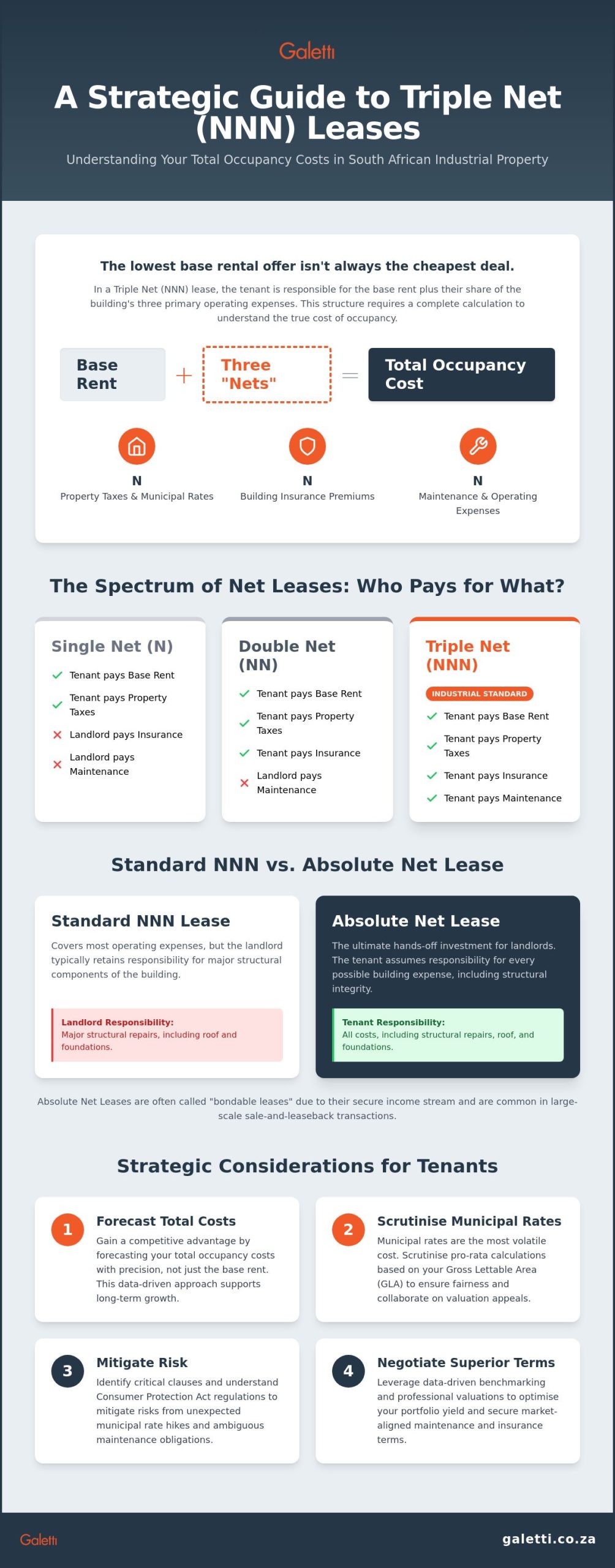
In the South African industrial property market, the Triple Net (NNN) lease functions as the primary mechanism for aligning landlord and tenant interests. Unlike gross leases where the landlord covers all operating costs, the NNN structure requires the tenant to pay a base rental plus their pro-rata share of three specific operational categories: property taxes, building insurance, and maintenance. This model is the prevailing standard for standalone warehouses and large scale factories across Gauteng, KwaZulu-Natal, and the Western Cape. Strategic occupiers benefit from corporate real estate leasing strategies that account for these variables from the outset.
The core philosophy of this arrangement is the transfer of operational risk. By shifting the burden of fluctuating municipal rates and insurance premiums to the occupier, the landlord secures a predictable, “clean” yield. For the tenant, understanding net leases provides a level of transparency that gross leases often lack. You gain direct oversight of the service providers and maintenance schedules that impact your operational efficiency. This clarity is vital when understanding triple net lease industrial South Africa agreements, as it prevents the “hidden” margins landlords often build into gross rental rates to hedge against inflation.
The Spectrum of Net Leases: Single, Double, and Triple
Lease structures exist on a gradient of responsibility. Understanding where your agreement sits is essential for accurate financial forecasting:
- Single Net (N): The tenant pays the base rent plus the property taxes. The landlord remains responsible for insurance and all maintenance.
- Double Net (NN): The tenant covers base rent, property taxes, and building insurance premiums. The landlord handles all maintenance and repairs.
- Triple Net (NNN): The comprehensive industrial standard. The tenant pays for rent, taxes, insurance, and all operating expenses, including common area maintenance (CAM).
Absolute Net vs. Standard NNN Leases
While a standard NNN lease covers most operating costs, it typically excludes structural repairs like the roof or foundation. However, in large scale South African industrial sale and leaseback transactions, the “Absolute Net” variant is becoming increasingly common. In this scenario, the tenant carries the risk for the entire building, including the structural integrity of the asset. This is often referred to as a bondable lease because the income stream is as secure as a corporate bond. An Absolute Net lease represents the ultimate hands-off investment for landlords, as the tenant assumes responsibility for every possible building expense, including structural integrity and roof repairs. This structure is particularly attractive for institutional investors seeking long term, low touch industrial assets with minimal management requirements.
Breaking Down the Three Nets: Operating Expenses for Industrial Assets
Operational clarity depends on granular data. While the previous section defined the broad mechanics of NNN agreements, the true financial impact lies in the specific variables of the “three nets.” In the South African context, these expenses are not static. They are influenced by municipal policy, inflationary pressures, and the physical demands of heavy industrial use. Precision in understanding triple net lease industrial South Africa requires a deep dive into how these costs are calculated, audited, and recovered. Efficiency matters. Every unmanaged line item directly erodes your bottom line.
Navigating South African Municipal Rates and Taxes
The first net comprises municipal rates and taxes, which often represent the most volatile component of industrial occupancy costs. South African municipalities, such as the City of Johannesburg and the City of Cape Town, operate on multi-year General Valuation (GV) cycles. When a new valuation roll is published, an industrial asset’s value can spike significantly, leading to a corresponding leap in monthly rates. In multi-tenanted industrial parks, these costs are typically distributed on a pro-rata basis. This is determined by the tenant’s GLA (Gross Lettable Area) as a percentage of the total park size. It is vital for occupiers to scrutinise these calculations to ensure they aren’t subsidising common areas or vacant units unfairly. Landlords and tenants should collaborate on valuation appeals to mitigate these hikes, as lower rates improve the asset’s overall marketability.
Maintenance Obligations in Industrial Centres
The third net, maintenance, is where most lease disputes originate. Most industrial agreements include a “good tenantable repair” clause. This mandates that the tenant returns the property in the same condition it was received, barring fair wear and tear. The boundary between interior maintenance and structural integrity must be clearly defined. In a standard NNN lease, the tenant handles roller shutter doors, yard surfaces, and internal plumbing. The landlord typically retains responsibility for the roof and foundation, unless an Absolute Net structure is in place.
To protect your interests, always insist on a comprehensive “Schedule of Condition” before taking occupation. This document, supported by high-resolution imagery, serves as the definitive record of the property’s state. It prevents landlords from claiming for pre-existing defects at the end of the term. For those managing complex portfolios, Galetti Corporate Services provides the technical oversight needed to benchmark these maintenance costs against industry standards. If you require expert assistance in reviewing your current maintenance obligations, contact our advisory team today.
Building insurance forms the second net. This covers the physical structure against fire, natural disasters, and political riot through SASRIA. The legal implications of NNN leases dictate that whilst the landlord selects the policy, the tenant pays the premium. Occupiers must ensure the coverage is adequate for industrial risks, particularly if hazardous materials or high-value machinery are involved. Utilities, including water, electricity, and sewerage, are treated as separate costs. With South Africa’s focus on energy security, many industrial tenants now negotiate for integrated solar infrastructure or backup power systems as part of their broader utility management strategy.
Financial Implications: Impact on Yields and Total Occupancy Costs
Financial performance in industrial real estate relies on the stability of the income stream. For institutional investors and private landlords, understanding triple net lease industrial South Africa structures is the key to calculating a reliable Net Operating Income (NOI). Because the tenant absorbs the variable costs of rates, insurance, and maintenance, the landlord’s income remains insulated from operational volatility. This predictability often results in more compressed capitalisation (cap) rates for NNN assets. A “clean” income stream is easier to value, making these properties highly sought after during portfolio acquisitions or disposals.
Corporate occupiers often prefer this model for its transparency. In a gross lease, a landlord might over-estimate operating costs to protect their margins, effectively charging the tenant a premium for “certainty.” The NNN structure removes this hidden markup. It allows the tenant to pay the actual market cost for services. When comparing different industrial sites, looking at the base rental alone is insufficient. You must calculate the Total Occupancy Cost (TOC), which combines the base rent, the three nets, and utility consumption. This holistic view is the only way to determine the true impact on your operational budget.
NNN vs. Gross Leases: A Financial Comparison
The choice between different types of commercial leases significantly alters your risk profile. The table below illustrates how responsibilities shift across the most common structures:
| Lease Component | Gross Lease | Semi-Net Lease | Triple Net (NNN) |
|---|---|---|---|
| Base Rental | Highest | Moderate | Market Baseline |
| Operating Costs | Landlord Pays | Shared/Capped | Tenant Pays |
| Inflation Risk | Landlord Bears | Shared | Tenant Bears |
| Accounting (IFRS 16) | High Liability | Moderate Liability | Lower Fixed Liability |
Under IFRS 16 accounting standards, most leases must be recognised on the balance sheet as a “right-of-use” asset and a corresponding lease liability. Because NNN leases typically have a lower base rental than gross leases, the capitalised liability on the tenant’s balance sheet is often reduced. This can improve debt-to-equity ratios and other key financial metrics for listed entities.
The Role of Escalations in Long-Term Industrial Leases
Escalation clauses are the primary defence against inflation. In the South African market, annual rental escalations typically range between 7 per cent and 10 per cent. While the base rental increases at this fixed rate, the three nets fluctuate according to actual market costs. This ensures the landlord’s real return is protected even if municipal rates or insurance premiums outpace the Consumer Price Index (CPI), which currently sits around 4.5 per cent. Managing these variables across a diverse portfolio requires a specialised approach. For comprehensive asset management and portfolio growth, Galetti Corporate Services provides the data-driven insights needed to align your lease structures with long-term investment goals.
Strategic Negotiation and Risk Management for South African Occupiers
Negotiation in the industrial sector extends far beyond the base rental rate. It requires a forensic approach to risk allocation. For any corporate entity, understanding triple net lease industrial South Africa agreements means identifying where the landlord’s responsibility ends and the tenant’s liability begins. Without specific protective clauses, an occupier might find themselves funding the long term appreciation of a landlord’s asset under the guise of “operating expenses.” Strategic occupiers prioritise the negotiation of “controllable” operating expenses. This includes management fees, security costs, and cleaning services. By placing a percentage cap on the annual increase of these specific items, you protect your budget from inefficient third party service providers.
The legal landscape in South Africa adds another layer of complexity. New regulations under the Consumer Protection Act that came into effect in April 2026 have sharpened the focus on transparency and consent in commercial dealings. Whilst many large corporate leases fall outside certain CPA protections due to turnover thresholds, the spirit of the law encourages clearer, more equitable terms. You should scrutinise clauses related to “reinstatement.” These often require a tenant to remove all improvements at the end of the lease. Negotiating for “beneficial occupation” or “tenant installation” allowances can offset these future costs, provided the definitions are precise.
Defining Capital Expenditure (CapEx) vs. Operating Expenditure (OpEx)
The distinction between CapEx and OpEx is a frequent point of contention in industrial centres like Durban South or Epping. Operating expenditure covers the daily running and maintenance of the facility. Capital expenditure, however, involves structural improvements or the replacement of major systems like HVAC units or specialised industrial plant. A clear CapEx/OpEx distinction is vital to prevent industrial occupiers from inadvertently funding the landlord’s long term asset appreciation through monthly maintenance contributions. Ensure your lease explicitly states that structural repairs, such as roof replacements or foundation work, remain the landlord’s sole financial burden.
The Importance of Professional Lease Audits
Transparency is the cornerstone of a successful NNN partnership. You have the right to request annual audited reconciliations of all operating expenses. This ensures that municipal spend aligns with actual billings and that pro-rata shares are calculated accurately. Professional brokers and advisors identify hidden costs, such as “administrative markups” on utility billings, which can quietly inflate your Total Occupancy Cost. Utilising expert corporate real estate leasing services ensures your agreement is benchmarked against current market standards.
Optimising Industrial Portfolios with Galetti’s Strategic Advisory
Galetti serves as a strategic partner in the commercial landscape. We bridge the critical gap between corporate occupiers and institutional landlords. Success in the industrial sector requires more than just a signed agreement. It demands the strategic alignment of operational costs and investment yields. Understanding triple net lease industrial South Africa is merely the starting point. The real value lies in applying that knowledge to optimise asset performance across your entire portfolio. We utilise data-driven insights to benchmark industrial lease rates nationally. This ensures your occupancy costs remain competitive in a fast-moving market.
Professional valuations are essential when setting NNN base rentals. Without an accurate market baseline, you risk overpaying or leaving yield on the table. Our integrated approach combines real-time market data with 18 years of technical expertise. We don’t just provide numbers. We provide definitive answers to complex property problems. This clarity is vital for high-level decision-makers who prioritise efficiency. Reliability and growth are the cornerstones of our advisory process.
Tailored Solutions for Industrial Asset Liquidation
Liquidity is a primary driver for modern industrial occupiers. Sale-and-leaseback strategies allow businesses to unlock capital tied up in property while maintaining operational control through a long-term NNN agreement. This structure provides immediate capital for growth while securing a stable environment for your operations. For those seeking immediate disposal, our auction platform provides transparent market value discovery. You can explore current industrial opportunities On Auction to see how we drive competitive bidding for prime assets. This mechanism ensures an efficient exit at a price determined by real-time market demand.
Your Partner in South African Commercial Real Estate
Galetti delivers national reach with a seasoned 18-year track record. We operate as high-level consultants for both landlords and corporate tenants. Our team prioritises results. Whether you’re looking to initiate a portfolio audit or refine a lease negotiation strategy, we provide a strategic advantage. Our expertise in industrial property valuations and portfolio management ensures that every lease component serves your broader corporate strategy. For more in-depth analysis on market trends and growth opportunities, consult our industrial real estate investment advisory team. We help you navigate the complexities of the South African market with confidence. Efficiency. Reliability. Growth.
Strategic Advantage through Lease Precision
Precision in property management starts with total transparency. Mastering the NNN structure ensures you can forecast total occupancy costs with certainty, shielding your margins from volatile municipal shifts. By clearly defining maintenance boundaries and leveraging professional valuations, you transform a standard contract into a strategic asset. Understanding triple net lease industrial South Africa agreements is the foundation of a resilient industrial portfolio. You don’t just occupy space; you manage a critical financial instrument that dictates your long-term profitability.
Galetti delivers over 18 years of commercial real estate expertise to every negotiation. We provide specialised industrial property valuation services and national coverage across all South African industrial hubs. Our integrated approach ensures that your lease terms are benchmarked against the latest market data to drive maximum asset performance. We act as your high-level consultant, providing definitive answers to the most complex property challenges in the current economic climate.
Secure your operational future with a partner that prioritises your growth and efficiency. It’s time to align your industrial assets with your broader corporate strategy for lasting success.
Frequently Asked Questions
What is the difference between a gross lease and a triple net lease in South Africa?
In a gross lease, the landlord pays all operating costs from the total rental income. A triple net lease separates the base rental from property taxes, insurance, and maintenance costs. This transparency allows for a lower base rate whilst shifting the risk of cost increases to the occupier. Understanding triple net lease industrial South Africa structures is essential for comparing these two models and identifying hidden risk premiums.
Who is responsible for structural repairs in a standard industrial NNN lease?
The landlord typically remains responsible for structural repairs, such as the roof and foundation, in a standard industrial NNN lease. The tenant handles non-structural maintenance, including roller shutter doors and internal systems. It’s vital to distinguish this from an Absolute Net lease where the tenant carries all structural risk. Always verify these boundaries in the specific lease agreement to avoid unbudgeted capital expenditure during your occupancy.
Does the Consumer Protection Act (CPA) apply to industrial NNN leases?
The CPA applies to leases where the tenant is an individual or a juristic person with an annual turnover or asset value below R2 million. Most large scale industrial tenants exceed this threshold and fall outside CPA protection. However, the April 2026 regulations have influenced market standards for transparency across all commercial sectors. Professional advisory ensures your lease remains equitable regardless of your entity’s specific turnover or size.
How are municipal rate increases handled in a triple net lease agreement?
Municipal rate increases are passed directly to the tenant as part of the first net. If the property is in a multi-tenanted park, the increase is calculated on a pro-rata basis according to your Gross Lettable Area. Because these hikes are determined by municipal valuation cycles, they are considered uncontrollable costs. Tenants should monitor these increases closely and collaborate with landlords on valuation appeals when necessary.
Can a tenant negotiate a cap on operating expenses in an NNN lease?
Tenants can often negotiate a cap on controllable operating expenses such as security, landscaping, and management fees. Uncontrollable costs, including municipal rates and building insurance, are rarely capped as the landlord has no influence over these market variables. Implementing a cap protects your operational budget from excessive third-party service provider increases. This strategy is a standard component of professional lease negotiation in the industrial sector.
What happens if the building insurance premiums increase significantly?
Significant increases in building insurance premiums are recovered from the tenant as the second net. The landlord typically selects the policy to protect their asset, but the financial burden rests with the occupier. If premiums spike, you should request a review of the policy to ensure the coverage remains market-related. Direct transparency in these billings prevents the landlord from adding undisclosed administrative markups to the premium cost.
Why do investors prefer triple net leases for industrial property portfolios?
Investors prefer triple net leases because they create a predictable Net Operating Income (NOI). By shifting operational risks to the tenant, the landlord’s yield remains insulated from inflation and rising municipal costs. This stability makes the asset easier to value and more attractive to institutional buyers. A clean income stream often results in compressed capitalisation rates, which enhances the property’s overall market value and investment appeal.
Is maintenance of the warehouse yard and parking area included in the “three nets”?
Maintenance of the warehouse yard and parking area is usually the tenant’s responsibility under the third net. In standalone facilities, you manage these areas directly. In industrial parks, these are managed as Common Area Maintenance (CAM) and charged pro-rata. Maintaining these surfaces is critical for operational safety and prevents disputes regarding the “good tenantable repair” clause at the end of your lease term.