The fall of the auctioneer’s hammer is a point of no return, not a starting line for negotiations. Many investors mistake the speed of an auction for a simplified process, yet the legal finality of a commercial bid carries significant weight. If you’re looking for an edge in the 2026 market, understanding how to buy commercial property at auction South Africa requires more than just a high bid. It demands a rigorous approach to due diligence and a clear-eyed view of the total cost of acquisition.
We recognise that the complexities of the voetstoots clause and the nuances of corporate FICA requirements can feel like barriers to entry. This guide provides the strategic clarity you need to compete. We’ll break down the financial readiness required for the current 10.50% prime lending environment, explain the distinction between purchase price and auctioneer commission, and offer a step-by-step roadmap to ensure your next acquisition is a calculated success rather than a costly surprise. You’ll gain the confidence to bid against seasoned investors and secure high-value assets with precision.
Key Takeaways
- Mitigate acquisition risk by conducting exhaustive due diligence on Information Packs, including zoning and title deeds, prior to the event.
- Prepare for immediate liquidity requirements, specifically the 10% deposit and the buyer’s premium, which are non-contingent upon the hammer’s fall.
- Learn how to buy commercial property at auction South Africa by navigating FICA registration and the distinct communication rhythms of digital and on-site bidding.
- Streamline the post-auction transition by understanding the role of conveyancing attorneys and the timeline from occupation to final transfer.
- Capitalise on the 2026 market shift towards transparent, corporate-led auctions through pre-approved financial structuring and strategic bidding.
Understanding the Commercial Property Auction Landscape in South Africa
Commercial property auctions represent a high-velocity, transparent alternative to traditional private treaty sales. Whilst residential buyers often browse generic property portals for a slow-paced negotiation, the commercial sector operates with greater urgency and legal finality. In this environment, the auctioneer serves as a neutral facilitator, driving a time-bound process that concludes with a definitive sale rather than a protracted discussion. Understanding how to buy commercial property at auction South Africa begins with recognising that this is a sophisticated financial event designed for efficiency and market-driven price discovery.
The 2026 property market has seen a significant shift. Institutional landlords and corporate entities now frequently bypass traditional brokerage in favour of on-auction listings to ensure transparent price discovery. This trend is driven by the need for liquidity and the certainty that a sale will conclude on a specific date. Unlike a broker who manages a sequence of private offers, the auction house brings all interested parties into a single arena, forcing real-time competition that reflects the true market value of the asset.
Why Investors Choose the Auction Floor
Investors prioritise the auction floor for its inherent transparency. You can see exactly who you’re bidding against and what they’re willing to pay. This eliminates the “black box” of private negotiations where competing offers are hidden. To understand the fundamental mechanics of how auctions work, one must appreciate the shift from distressed sales to high-yield investment opportunities. In 2026, the inventory has expanded beyond liquidations to include prime industrial hubs and retail centres with established tenant profiles.
Efficiency is the primary driver. The timeline is fixed. The due diligence period is defined. The closing date is certain. This allows for precise capital allocation and avoids the opportunity costs associated with long-term, uncertain negotiations. For those learning how to buy commercial property at auction South Africa, the speed of the transaction is its greatest advantage, provided your financial structures are ready before the event begins.
The Legal Framework: The Rules of Auction
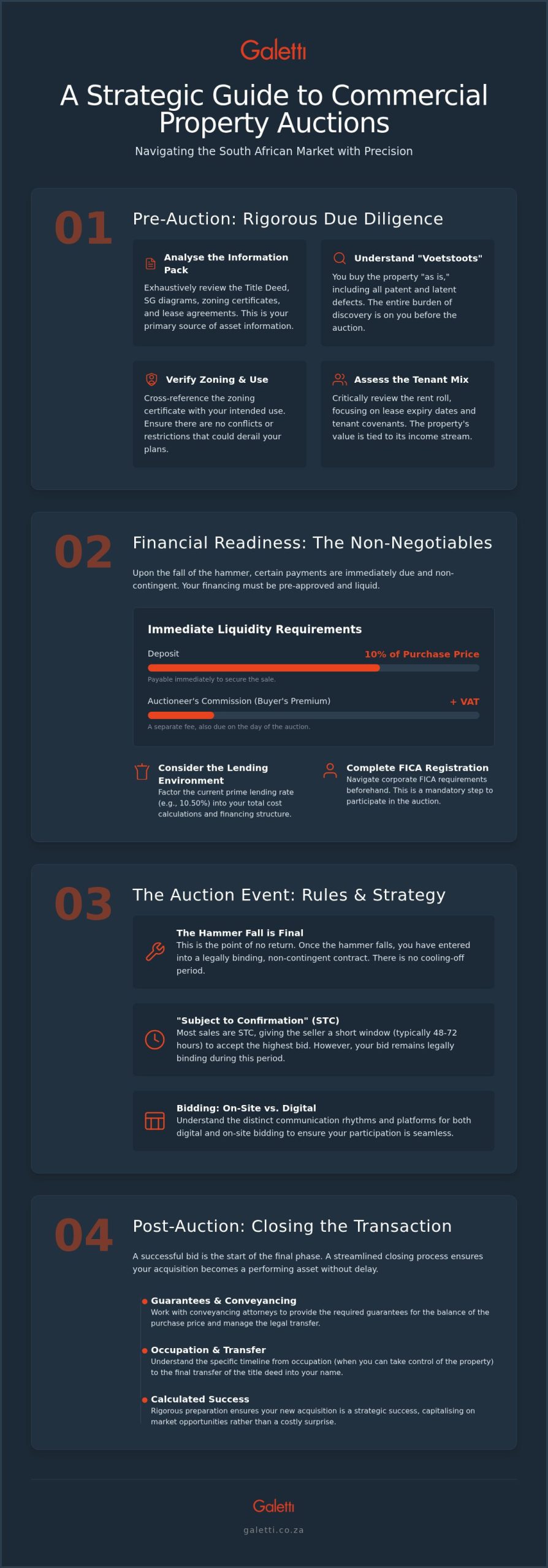
Every commercial auction is governed by a specific “Rules of Auction” document, which complies with Section 45 of the Consumer Protection Act (CPA). This document is not a suggestion; it’s the legal backbone of the transaction. You must review this before the first bid is cast. Most sales are “Subject to Confirmation” (STC), giving the seller a short window, typically 48 to 72 hours, to accept the highest bid. However, the bidder is legally bound from the moment the hammer falls. There is no cooling-off period. Once that hammer drops, you have entered into a non-contingent contract that demands immediate performance.
Pre-Auction Due Diligence: Mitigating Risk Before You Bid
The “voetstoots” clause is the most critical legal hurdle for any bidder to understand. In the South African context, this means you buy the property “as is,” with all its patent and latent defects. Unlike a private treaty sale where you might negotiate repairs after an inspection, the auction environment places the entire burden of discovery on the buyer before the event. If the HVAC system fails or the roof requires a total overhaul, these costs become your responsibility the moment the hammer falls. Success in how to buy commercial property at auction South Africa depends on your ability to uncover these issues during the three-week marketing period preceding the sale.
Your primary resource is the Information Pack (IP) provided by the auction house. This document is a comprehensive dossier containing the title deed, SG diagrams, zoning certificates, and current lease agreements. You shouldn’t take these at face value. Cross-reference the zoning certificate with your intended use for the site; a building zoned for “General Business” may have restrictions that conflict with industrial manufacturing. To begin your search for viable assets, you can view our current commercial properties on auction to download specific bidder packs.
Analysing the Financials and Tenant Mix
A property’s value is intrinsically linked to its income stream. Review the rent roll with a critical eye, looking specifically for lease expiry dates and tenant covenants. If a major anchor tenant’s lease expires within six months of your purchase, your risk profile changes significantly. Verify the status of municipal accounts. Whilst the seller is typically responsible for settling arrears to obtain a rates clearance certificate, understanding the monthly utility overheads is vital for calculating a “True Yield.” Use actual historical data rather than optimistic projections to ensure your bid remains grounded in reality.
Legal and Structural Verifications
The title deed often hides restrictive conditions or servitudes that can limit future development. A registered servitude for municipal piping or electrical lines could prevent you from expanding a warehouse footprint. Simultaneously, structural integrity and Occupational Health and Safety (OHS) compliance are non-negotiable. For industrial assets, check for fire safety certifications and lift maintenance records. A professional commercial building valuation before the auction day provides an objective baseline, ensuring you don’t overextend in the heat of the moment. This data-driven approach is a pillar of our Strategic Guide to Asset Liquidity, which emphasises the importance of pre-bid certainty.
If you’re unsure about the technical details of a specific listing, it’s best to consult with a strategic advisor who can help you interpret the complexities of the Information Pack.
Financial Readiness: Deposits, Guarantees, and Tax Implications
Financial readiness is the ultimate filter in the auction room. In the 2026 market, liquidity is not just an advantage; it is a prerequisite for participation. When mastering how to buy commercial property at auction South Africa, you must account for immediate capital requirements that trigger the moment the hammer falls. These are non-negotiable costs that demand cleared funds, typically via electronic transfer on the day of the event.
The primary financial commitment is the 10% deposit on the purchase price. Simultaneously, you must settle the buyer’s premium. This commission usually ranges between 5% and 10% of the bid price, plus VAT at the current 15% rate. FICA requirements for corporate entities are equally stringent. You cannot bid without presenting updated CIPC documentation, proof of business address, and verified identification for all directors or trustees. The Legal and Financial Benefits of Auctions include transparent price discovery, but these benefits are only accessible to those with a fully compliant and liquid profile.
VAT vs Transfer Duty in Commercial Transactions
Tax structuring can significantly alter your total acquisition cost. If the seller is a VAT vendor, the transaction will likely attract VAT at 15% rather than transfer duty. However, many commercial assets are sold as “going concerns.” If the property is income-generating and both parties are VAT-registered, the transaction may qualify for zero-rating. This effectively reduces the immediate cash flow burden. To understand the broader context of asset classes and tax efficiency, review our Industrial Real Estate Investment ZA: A Strategic Guide for 2026. Always budget for conveyancing fees and municipal deposits to avoid undercapitalisation during the transfer process.
Securing Guarantees and Financing
Auction bids are non-suspensive. You cannot make your offer subject to bank finance. With the prime lending rate currently at 10.50%, your financial facility must be pre-approved and ready for deployment. Once the sale is confirmed, you typically have a 30-day window to provide the balance of the purchase price via acceptable bank guarantees. Working with corporate real estate advisors to pre-approve your facility ensures you bid with confidence. If you fail to produce these guarantees within the stipulated timeframe, you risk forfeiting both your deposit and the buyer’s premium. Precision in your financial planning is the only way to safeguard your investment.
The Auction Event: Mechanics and Bidding Strategies
The live auction event is where strategy meets execution. To participate, you must first clear the registration hurdle. This involves submitting your FICA documentation and paying a registration fee, which is refundable if you don’t secure a property. Once registered, you’ll receive a bidder’s paddle for on-site events or access credentials for a digital platform. Learning how to buy commercial property at auction South Africa requires adapting to the specific format of the sale. On-site auctions in a ballroom setting offer a palpable sense of competition, whilst online-only platforms rely on a digital dashboard that tracks bids in real-time. Each has a different communication rhythm.
Discipline is your most valuable asset during the bidding process. You must establish a “walk-away” price before the first bid is called. The competitive atmosphere of a live event can easily push an unprepared investor beyond their financial limits. Successful bidders remain detached, viewing the property as a set of yield-based metrics rather than an emotional acquisition. If you require professional guidance on market valuations to set these thresholds, our expert corporate real estate sales advisory provides the necessary data to bid with authority.
Strategic Bidding Techniques
Your bidding style should reflect your confidence and the depth of your research. A “Fast Opener” strategy involves placing an early, assertive bid to signal strength and discourage casual participants. Conversely, the “Wait-and-See” approach allows you to observe the room’s momentum and identify when the bidding pool is thinning. Reading the room is vital. In a digital environment, look for the speed of counter-bids on the dashboard; a delay often suggests a competitor is reaching their limit. When you do bid, ensure your communication with the auctioneer is clear and immediate. Ambiguity leads to missed opportunities.
The Fall of the Hammer
The moment the hammer falls, a legally binding contract is formed. There is no further room for negotiation. You’ll be required to sign the Conditions of Sale immediately. This document mirrors the terms outlined in the bidder’s pack, confirming your acceptance of the price and the voetstoots condition. As discussed in previous sections, the 10% deposit and the buyer’s premium must be paid immediately. Most commercial sales are “Subject to Confirmation” (STC). This means that whilst you are the highest bidder, the seller has a set period, usually 48 to 72 hours, to formally accept the price. During this time, you’re legally bound to the offer, but the sale isn’t final until confirmation is received.
Post-Auction Procedures: Closing the Transaction
The fall of the hammer marks the transition from competition to administration. Whilst the auction event provides the speed, the subsequent transfer process requires meticulous legal coordination. When you’re learning how to buy commercial property at auction South Africa, you must realise that the conveyancing attorney is the pivot point of the transaction. The seller usually nominates the attorney, but the buyer remains responsible for the fees. This professional manages the complex requirements of the Deeds Office, ensuring that all municipal clearances and tax obligations are met before the title is formally registered in your name.
Fulfilling guarantee requirements is the most urgent post-auction task. You typically have 30 days from the date of confirmation to produce bank guarantees for the balance of the purchase price. This is a hard deadline. Missing it can lead to the forfeiture of your deposit. This phase demands constant communication with your financial institution to ensure their requirements align with the seller’s attorney’s demands. For insights into how sellers prepare for this stage, refer to our guide on Commercial Property Auctioneers South Africa: A Strategic Guide to Asset Disposal.
Occupation, Possession, and Risk
Risk traditionally passes to the buyer on the fall of the hammer or the date of confirmation. This means you must secure comprehensive insurance for the asset immediately. You don’t wait for the transfer to conclude. If you require occupation before the formal registration, which usually takes about three months, you’ll be liable for occupational rent. This rate is pre-defined in the Conditions of Sale and ensures the seller is compensated whilst you begin your operational setup or tenant management. It’s a pragmatic arrangement that allows you to start generating value before the legal paperwork is finalised.
Finalising the Transfer of Ownership
The final sprint involves the assignment of existing leases and the management of tenant deposits. You aren’t just buying a building; you’re taking over a commercial ecosystem. Ensuring a seamless transition for current tenants is vital for maintaining your yield from day one. This involves auditing the status of all security deposits and ensuring the rent roll is updated to reflect the change in ownership. Post-purchase, Galetti’s portfolio management can assist in optimising these assets, handling everything from lease renewals to facilities oversight. This integrated approach ensures that the strategic advantage you gained on the auction floor translates into long-term capital growth.
Securing Your Competitive Edge in the 2026 Auction Market
The 2026 commercial landscape rewards the prepared. Success on the auction floor is built weeks before the event through meticulous due diligence and precise financial structuring. By understanding the non-negotiable nature of the voetstoots clause and the immediate liquidity requirements of the buyer’s premium, you position yourself as a serious contender. Mastering how to buy commercial property at auction South Africa is a matter of moving from speculation to data-driven strategy. You must treat every bid as a calculated financial move rather than an emotional impulse.
With over 18 years of commercial real estate expertise, Galetti provides the specialised industrial, retail, and office advisory needed to navigate these high-stakes transactions. Our national South African footprint ensures you have access to prime assets and local market intelligence in every major economic hub. We act as your strategic partner, ensuring that your acquisition aligns with your long-term growth objectives. This level of reliability is vital when the hammer falls and the transition from bidder to owner begins. You don’t have to navigate the complexities of the auction room alone.
Take the next step in diversifying your portfolio with the confidence and clarity that only a seasoned industry leader can provide.
Frequently Asked Questions
Can I buy a commercial property at auction with a bond or bank finance?
You cannot make an auction bid subject to bank finance. Whilst you can use a bond to settle the balance, the contract is non-suspensive and legally binding from the moment the hammer falls. You must have your facility pre-approved and be ready to provide bank guarantees within the 30-day window stipulated in the Conditions of Sale. Failure to secure these funds will result in the forfeiture of your deposit.
What is the “voetstoots” clause and why is it critical in South African auctions?
This clause means the property is sold in its current condition with all patent and latent defects. It is a critical component of how to buy commercial property at auction South Africa because it shifts the entire burden of due diligence to the buyer. You waive the right to claim for repairs or defects discovered after the sale. Thorough physical inspections during the marketing period are therefore non-negotiable.
How much is the typical deposit and commission for a commercial auction?
Bidders should budget for a 10% deposit and a buyer’s premium, which is the auctioneer’s commission, typically ranging between 5% and 10% plus VAT. These funds must be available for immediate electronic transfer on the day of the auction. Note that these costs are calculated on the bid price and represent an additional capital requirement over and above your final offer.
What documents do I need for FICA registration as a company?
Corporate entities must provide a copy of the company’s CIPC registration documents, proof of the business’s physical address, and certified copies of all directors’ identity documents. A formal resolution on a company letterhead is also required to authorise a specific individual to bid on behalf of the entity. You won’t be issued a bidder’s paddle without these verified documents.
What does “Subject to Confirmation” (STC) mean in a property auction?
STC means the highest bid is not automatically accepted at the close of the auction. The seller has a confirmation period, usually 48 to 72 hours, to formally accept or reject the offer. During this window, the bidder remains legally bound to their bid and cannot withdraw it. The sale only becomes final once the seller signs the acceptance of the offer.
Is VAT or Transfer Duty payable on commercial property auctions?
Commercial transactions typically attract VAT at 15% if the seller is a registered VAT vendor. If the seller is not registered, transfer duty applies based on current SARS thresholds. Many commercial assets qualify for a “zero-rating” of VAT if the property is sold as a going concern between two VAT-registered entities, provided the asset is income-generating at the time of sale.
Can I view the property before the auction day?
Viewing the property is essential and highly encouraged before the auction day. Marketing periods typically run for three to four weeks, during which scheduled viewing times or private appointments are arranged through the auction house. This is the only window available to conduct structural assessments and verify the property’s physical state before you commit to a non-contingent contract.
What happens if the seller does not accept my highest bid during the confirmation period?
If the seller does not accept your highest bid during the confirmation period, the sale is cancelled and you are released from your legal obligations. Any registration fees or deposits already paid to the auction house are refunded in full. This outcome typically occurs if the highest bid fails to meet the seller’s confidential reserve price and subsequent negotiations prove unsuccessful.