
An empty storefront is a silent liability that erodes your asset’s market authority with every passing month. While high holding costs for rates and security are immediate pressures, the long-term damage to your property’s brand often proves more costly. You likely recognise that in a volatile economic climate, maintaining a stable, high-quality tenant mix is no longer a passive exercise. It requires a disciplined, proactive approach to asset management.
This guide delivers the professional-grade frameworks required to implement successful commercial vacancy reduction strategies in the South African market. You’ll discover how to transition from simply offering available space to providing comprehensive business solutions that attract resilient tenants. We outline specific methods to improve your Net Operating Income, enhance property yield, and transform chronic vacancies into strategic advantages for your portfolio. Through a methodical focus on asset repositioning and tenant stability, you can secure your position in a fast-moving industry.
Key Takeaways
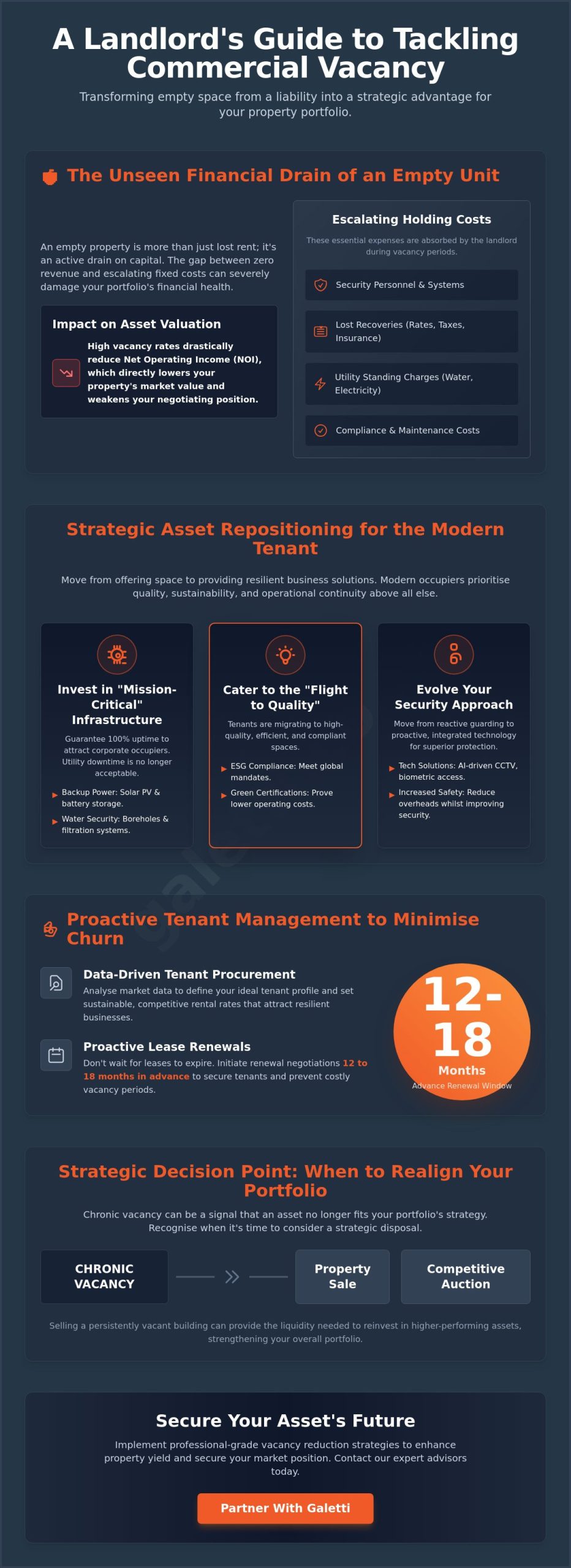
- Quantify the hidden impact of empty GLA by comparing lost rental income against escalating fixed holding costs.
- Modernise assets through “mission-critical” infrastructure upgrades, including backup power and water security, to meet corporate occupier expectations.
- Deploy data-driven commercial vacancy reduction strategies to define your ideal tenant profile and set sustainable, market-related rates.
- Minimise portfolio churn by initiating proactive lease renewal negotiations at least 12 to 18 months in advance.
- Identify when chronic vacancy signals a need for strategic portfolio realignment through property sales or competitive auctions.
Quantifying the True Cost of Commercial Vacancy
An empty unit is more than a missed opportunity. It’s an active drain on your capital. Most landlords focus exclusively on lost rental income, yet this represents only a fraction of the total deficit. Effective commercial vacancy reduction strategies begin with a cold, analytical assessment of the total cost of ownership for an unproductive asset. You must account for the widening gap between zero revenue and the unrelenting pressure of fixed overheads.
Operational erosion occurs the moment a tenant vacates. Empty buildings require heightened security to prevent vandalism or illegal occupation. Maintenance costs often spike because systems like HVAC and plumbing require regular cycling to remain functional. Without a tenant to report minor leaks or electrical faults, small issues escalate into major capital expenditure requirements. This lack of daily oversight accelerates the physical depreciation of the asset.
Market perception remains your most significant intangible risk. Chronic vacancy signals distress to the brokerage community and potential occupiers. It weakens your leverage during negotiations, as prospective tenants recognise your urgency to fill the space. In retail or mixed-use precincts, this can trigger a “vacancy spiral” where reduced footfall leads to further closures. Understanding the broader causes of urban decline helps landlords recognise that vacancy is often a contagious condition that requires immediate intervention.
Calculating Your Portfolio Holding Costs
In commercial real estate, a holding cost represents the total financial burden of maintaining an unproductive asset, encompassing all fixed and variable expenses incurred whilst the property remains untenanted. You must track these “invisible” costs to protect your portfolio’s health:
- Security Personnel: Round-the-clock guarding is essential for vacant sites but offers no return on investment.
- Utility Standing Charges: Fixed connection fees for water and electricity remain due regardless of consumption levels.
- Lost Recoveries: The landlord must absorb the share of rates, taxes, and insurance normally paid by the tenant.
- Compliance Costs: Fire safety certifications and insurance premiums must be maintained to avoid policy voidance.
Professional property management and advisory services can help audit these expenses to reveal the true net loss of an empty floorplate.
The Impact on Asset Valuation and Exit Strategy
Vacancy directly compromises your property’s capitalisation rate. Since commercial valuations are largely driven by Net Operating Income (NOI), a high vacancy rate drastically reduces the market value of the building. This creates a secondary crisis when seeking to refinance or secure new lines of credit. Financial institutions view low occupancy as a high-risk indicator, leading to less favourable lending terms or outright rejection. Whether you intend to hold the asset or move towards a disposal via sale or auction, your exit price is tethered to the stability of your rent roll. A vacant building is sold as a “turnaround project” at a discount, rather than a premium investment asset. Engaging professional property portfolio management services ensures you have the data-driven insights needed to make confident hold or sell decisions before vacancy erodes your asset’s value.
Strategic Asset Repositioning for the 2026 Market
Repositioning is an investment in operational resilience. In the current climate, effective commercial vacancy reduction strategies prioritise infrastructure that guarantees business continuity. Occupiers are no longer willing to tolerate utility downtime. Solar PV installations, battery storage, and boreholes with filtration systems have moved from luxury additions to core requirements. If your building cannot guarantee 100% uptime, it will remain at the bottom of the shortlist during a tenant’s search.
The “flight to quality” is a defining trend in the 2026 market. Tenants are migrating from older Class B and C buildings to smaller, high-quality spaces with superior amenities and locations. Institutional and multinational tenants now operate under strict global mandates where ESG (Environmental, Social, and Governance) compliance is a prerequisite. Green building certifications, such as those from the GBCSA, act as a quality filter. these ratings prove lower operating costs through energy efficiency and modern waste management systems. A thorough commercial property risk assessment can help you identify which ESG and compliance gaps are most likely to deter institutional occupiers from your asset.
Security must also evolve to meet modern expectations. Moving from reactive guarding to integrated technology solutions reduces overheads whilst increasing safety. AI-driven CCTV, biometric access, and perimeter sensors provide superior protection compared to traditional methods. This modernisation protects both the physical asset and the tenant’s peace of mind. If you need an expert audit of your property’s market position, you can speak with a Galetti consultant to identify specific high-impact upgrades.
Adapting Space for Hybrid Work and Flexibility
Large, monolithic floor plates are increasingly difficult to let in a hybrid-work era. Repositioning involves reconfiguring Gross Lettable Area (GLA) into smaller, modular units that cater to SMEs. The rise of “plug-and-play” offices is a direct response to move-in friction. By providing pre-fitted spaces with high-speed fibre and basic furniture, you cater to businesses that need to scale quickly without heavy capital expenditure. Shared boardrooms and “third spaces” within the building allow smaller tenants to access premium amenities they could not otherwise afford.
Enhancing Kerb Appeal and First Impressions
First impressions dictate the tone of every viewing. Professional signage and well-lit common areas are basic requirements for any serious landlord. You should avoid the “ghost building” look by using vacant windows for lifestyle branding or professional graphics instead of tattered “To Let” posters. Every unit must be “walk-through ready” at a moment’s notice. Dust, stale air, or poor lighting will kill a deal before it begins. A polished, active environment signals to prospects that the building is managed by a proactive and reliable partner.
A Data-Driven Tenant Procurement Template
Procurement is a deliberate exercise in matching asset capabilities with market demand. Passive listing on general portals is insufficient for high-value assets. You must define an Ideal Tenant Profile (ITP) based on your building’s specific configuration, loading capacity, or technological infrastructure. This profile guides your marketing efforts and ensures you don’t waste resources on incompatible leads. Precision is the foundation of successful commercial vacancy reduction strategies.
High-quality visual collateral is now a non-negotiable standard. Professional architectural photography and 3D virtual tours significantly reduce the leasing cycle by allowing high-level decision-makers to shortlist properties without initial site visits. This is particularly vital for international occupiers or decentralised corporate teams. A data-driven approach removes guesswork from the marketing phase, ensuring your property is positioned as a premium business solution rather than just another listing.
Step 1: Market Benchmarking and Pricing Analysis
Pricing must reflect current market benchmarks for your specific sector. You should evaluate the total occupancy cost for the tenant, comparing Gross versus Net rental structures to ensure transparency. Offering competitive Tenant Installation (TI) allowances can be the deciding factor for a corporate move. Whilst “step-up” leases offer immediate relief to tenants, flat-rate incentives with annual escalations often provide better long-term yield stability for the landlord. Decisions should be based on real-time data rather than historical expectations.
Step 2: Aggressive Broker and Network Engagement
Brokers are the gatekeepers to high-value occupiers. You must organise and standardise your property data packs to include floor plans, utility capacities, and ESG certifications for immediate distribution. Hosting broker open days creates tangible buzz and allows professionals to experience the repositioned asset firsthand. For expert representation in this space, explore our Corporate Real Estate Leasing services to leverage a global network of corporate contacts.
Step 3: Lead Qualification and Screening
A signed lease is only as strong as the tenant’s balance sheet. Implementing a rigorous financial vetting process is essential to prevent future defaults and maintain portfolio stability. Beyond creditworthiness, you must assess how a prospect fits within the existing retail mix or office ecosystem. Synergistic tenants drive footfall and improve overall precinct value. Use industry data to predict the long-term stability of the applicant’s sector, ensuring your rent roll remains resilient against economic volatility. This methodical screening protects your Net Operating Income from the high costs of tenant churn.
Tenant Retention: Preventing Future Vacancies
Retention is the most efficient form of asset protection. Industry data suggests that retaining an existing tenant is approximately three times cheaper than securing a new one. When a tenant departs, you face not only the immediate loss of revenue but also the cumulative costs of brokerage commissions, tenant installation allowances, and marketing expenses. Integrated commercial vacancy reduction strategies must prioritise the stability of your current rent roll to avoid these avoidable capital outlays and maintain a consistent Net Operating Income.
Proactive lease management is your primary defence against churn. You shouldn’t wait for a formal notice of intent to vacate. Instead, initiate renewal negotiations 12 to 18 months before the lease expiry date. This window provides sufficient time to address tenant grievances or adjust terms to meet their evolving business needs. By the time a “To Let” sign is required, you’ve already lost the strategic advantage and the ability to negotiate from a position of strength.
Building a “Landlord of Choice” reputation requires more than just collecting rent. It demands responsive facilities management and a commitment to operational excellence. Conduct regular tenant surveys to identify friction points before they escalate into a decision to relocate. If you want to professionalise your retention efforts and protect your asset value, enquire about our tenant management advisory to secure your long-term yield.
Implementing a Tenant Relationship Management (TRM) System
A TRM system moves beyond basic spreadsheets to track tenant satisfaction and maintenance turnaround times. Speed of resolution is often the highest-rated factor in tenant satisfaction scores. Beyond basic repairs, creating a sense of community through regular building updates or small-scale networking events fosters professional loyalty and anchors the tenant to the precinct. For landlords overseeing multiple assets, Galetti Corporate Services provides the strategic oversight and management frameworks needed to maintain these high-level relationships at scale.
Flexible Leasing and Expansion Strategies
Business growth is a primary driver for relocation. You can mitigate this risk by offering a “Right of First Refusal” on adjacent spaces to your most successful tenants. This allows them to scale their operations without the disruption of moving to a new building. Additionally, structuring flexible lease terms that permit scaling up or down within your broader portfolio provides the agility modern businesses demand in a volatile economy. Addressing tenant grievances regarding utility costs through transparent sub-metering also removes a common source of friction, ensuring tenants only pay for their verified consumption.
Liquidity as a Strategy: When to Sell or Auction
Capital is finite. Holding onto a non-performing asset because of historical sentiment is a common error in property management. If your commercial vacancy reduction strategies haven’t stabilised the rent roll after significant repositioning, the market is sending a clear signal. Chronic vacancy often indicates that the asset’s current use or configuration is no longer aligned with precinct demand. In these instances, disposal acts as a risk-mitigation tool, preventing further erosion of your portfolio’s Net Operating Income. Conducting a structured commercial property risk assessment before proceeding with a disposal ensures you have accurate data on structural, regulatory, and compliance factors that could affect your exit price.
Strategic sales allow you to reallocate capital into higher-yielding sectors or modernise other core assets. This is particularly relevant for aging buildings that face mounting compliance costs or require heavy capital expenditure to remain competitive. By exiting a stagnant position, you protect your liquidity and maintain the agility needed to capitalise on new market opportunities. You shouldn’t view a sale as a loss of ground, but as a tactical withdrawal to strengthen your broader investment position. A structured approach to strategic property portfolio management services can help you identify which assets to exit and where to redeploy capital for maximum yield.
The Benefits of the Auction Disposal Path
Auctions are designed for speed and transparency. They eliminate the uncertainty of long-term holding costs by forcing a time-bound, non-suspensive sale process. This environment creates immediate competition amongst a national and international pool of investors, often resulting in superior price discovery. The auction floor removes the “subject to finance” delays that frequently stall private transactions. If you need to move an asset quickly to stop the drain on your cash flow, explore our upcoming Property Auction Services for rapid asset liquidation.
Private Treaty Sales for Corporate Assets
A discrete, negotiated sale is often more appropriate for high-value corporate assets where confidentiality is paramount. This path allows for a targeted marketing approach to qualified institutional buyers who value stability and long-term potential. We leverage professional valuations and deep market data to ensure the property is priced to move in the current South African climate. You can learn about our Corporate Real Estate Sales approach to understand how we manage these complex transactions. A structured private treaty sale ensures you achieve maximum value whilst maintaining control over the narrative of the disposal.
Optimising Your Asset Portfolio for Future Growth
Successful asset management requires a shift from reactive leasing to a disciplined, proactive framework. You’ve seen how quantifying the total cost of vacancy and investing in mission-critical infrastructure repositions your property for the 2026 market. By implementing data-driven commercial vacancy reduction strategies, you ensure your portfolio remains resilient against economic volatility. Whether through rigorous tenant retention or the strategic use of auctions for liquidity, the primary objective is the consistent optimisation of Net Operating Income.
Galetti delivers the authoritative expertise needed to navigate these complexities. With over 18 years of commercial real estate experience and a national footprint across South Africa, we provide integrated leasing and auction solutions tailored to your specific asset class. Our team acts as a strategic partner, offering the clarity and efficiency required to populate your GLA with high-quality occupiers. Minimise your vacancy rates; list your property with Galetti today. This proactive approach ensures your asset’s market authority remains intact whilst securing your future returns.
Frequently Asked Questions
What is a healthy vacancy rate for commercial property in South Africa?
A healthy vacancy rate typically sits below 10%, though current market conditions have shifted these benchmarks. As of early 2026, national office vacancy rates are recorded between 17.6% and 18.6%. Landlords should focus on outperforming their specific precinct’s average rather than national figures to determine the relative health of their portfolio.
How much should I spend on Tenant Installation (TI) allowances?
TI allowances are generally calculated as a factor of the monthly rental and the lease term. A common industry benchmark for a five-year lease is one month’s rental for every year of the agreement. You must ensure this capital outlay is balanced against the long-term yield and the improvement it brings to your asset’s internal valuation.
Should I lower my rent to fill a vacant commercial space?
Reducing the headline rental should be a secondary tactic after exploring other commercial vacancy reduction strategies like increased TI allowances or rent-free periods. Lowering the rent directly impacts your property’s capitalisation rate and overall market value. It’s often more effective to align the total occupancy cost with market benchmarks whilst maintaining your headline rate.
What are the most common reasons for high commercial vacancy rates?
High vacancy is usually the result of a mismatch between a building’s infrastructure and current occupier requirements. Common factors include inadequate backup power, poor security, and rigid floor plates that don’t accommodate hybrid work. Macroeconomic shifts and the “flight to quality” mean that older, poorly maintained assets struggle to compete with modern, efficient spaces.
How does ESG compliance help in reducing commercial vacancy?
ESG compliance makes your property eligible for a broader pool of institutional and multinational tenants who must adhere to global sustainability mandates. Green-certified buildings typically offer lower operating costs through energy and water efficiency, which is a significant draw for modern occupiers. These certifications act as a verified mark of quality, reducing the risk of long-term vacancy.
Can a property auction really solve a chronic vacancy problem?
A property auction is a highly effective tool for resolving chronic vacancy by creating immediate competition and transparent price discovery. This time-bound, non-suspensive process eliminates the ongoing holding costs of a stagnant asset. It allows the landlord to achieve a market-related exit price quickly, freeing up capital for more productive, higher-yielding investment opportunities elsewhere in their portfolio.
What is the difference between a gross lease and a net lease for vacancy reduction?
A gross lease provides a single, all-inclusive rental figure, whilst a net lease separates the base rent from municipal recoveries and operating costs. Net leases are increasingly favoured for vacancy reduction because they offer tenants transparency. This structure ensures occupiers only pay for the services and utilities they consume, protecting the landlord from escalating municipal charges.
How can I attract high-quality corporate tenants to an older building?
Attracting corporate tenants to older assets requires a focus on operational reliability over aesthetics. You must prioritise “mission-critical” upgrades such as redundant power systems, water security, and top-tier fibre connectivity. By matching the technical performance of newer developments and offering flexible, pre-fitted office solutions, you can successfully compete for high-value occupiers despite the age of the structure.