A single structural failure or a regulatory oversight can erode decades of capital growth in a matter of weeks. In a volatile market, a reactive approach is no longer a viable strategy for asset preservation. You likely recognise that staying ahead of evolving global standards like ASTM E2018-24 and complex South African safety regulations feels increasingly difficult. The risk of underinsurance due to poor data quality remains a constant threat to your bottom line.
This guide ensures you master the essential framework for a robust commercial property risk assessment to protect your portfolio value. We provide a strategic roadmap to identify, evaluate, and mitigate modern threats before they impact your balance sheet. You’ll gain a clear, actionable checklist for 2026 that covers technical benchmarks, ESG disclosure mandates, and the role of AI in compliance monitoring. We move beyond basic safety to look at how proactive risk management secures long-term property yields and reduces liability. This is your blueprint for maintaining a resilient and profitable commercial real estate portfolio.
Key Takeaways
- Transition from reactive maintenance to a proactive strategy that secures the long-term yield and resilience of your commercial assets.
- Identify critical structural and operational vulnerabilities within building envelopes and electrical systems to prevent costly downtime and failures.
- Implement a rigorous commercial property risk assessment using our 2026 checklist to ensure full compliance with fire safety and emergency management standards.
- Define clear boundaries for tenant and landlord responsibilities to effectively mitigate third-party claims and public liability risks.
- Leverage professional portfolio management to transform raw risk data into strategic advantages that enhance overall property valuation and investor trust.
Understanding Commercial Property Risk Assessment
A comprehensive commercial property risk assessment is a structured methodology designed to identify and quantify hazards that threaten asset value or occupant safety. It’s a systematic process that moves beyond simple inspections. It evaluates the probability of adverse events against their potential impact. In the current market, this framework is the foundation of any resilient asset management strategy. It ensures that every decision is backed by data rather than intuition.
Historically, many owners operated on a reactive basis. They addressed structural failures or compliance gaps only after they manifested. This is no longer sustainable. By 2026, the landscape has shifted towards proactive risk management. This involves a holistic view of physical, financial, and regulatory variables. Applying established risk assessment principles allows landlords to transform raw data into actionable capital expenditure plans. High-performance portfolios depend on this foresight to maintain yield and investor confidence.
The Core Objectives of Assessment
The primary goal is the safety and well-being of every occupant. A building that’s unsafe is a building that’s unlettable. Beyond physical safety, assessments aim to minimise the financial impact of property damage. Poor risk data often leads to underinsurance. This leaves owners vulnerable to massive capital losses during a claim. Finally, strict adherence to the Occupational Health and Safety Act is essential. Non-compliance carries heavy legal penalties and reputational damage that can take years to repair.
Who Should Conduct the Audit?
Whilst internal facilities teams have deep knowledge of daily operations, they often lack the objectivity required for a rigorous audit. Independent, professional property advisors provide an unbiased perspective. They identify blind spots that internal teams might overlook. A collaborative approach is most effective. Internal staff provide the operational history, whilst external specialists apply technical benchmarks like ASTM E2018-24. For those managing complex portfolios, Galetti Corporate Services provides the strategic advisory needed to align risk mitigation with business objectives. Conducting a formal commercial property risk assessment annually ensures that your insurance premiums remain accurate and your liability is contained. This frequency is now the industry benchmark amongst South African institutional investors.
The Physical Asset: Structural and Operational Risks
The physical state of a building directly dictates its marketability and long-term capital appreciation. A rigorous commercial property risk assessment must begin with the building envelope. Cracks in masonry or persistent water ingress aren’t just minor maintenance issues; they’re often symptoms of structural fatigue that lead to accelerated asset depreciation. We advise owners to look beyond aesthetics. Modern audits now incorporate environmental management and radio frequency (RF) radiation levels, particularly in mixed-use developments with rooftop telecommunications. These invisible risks can impact tenant health and building compliance in ways that traditional inspections miss.
Operational continuity relies on the heart of the building: the plant room. Fire safety and Emergency Management Systems (ESM) protocols aren’t optional. They’re legal imperatives that protect both lives and balance sheets. Following official risk assessment guidance, owners should map out every potential point of failure. This includes the disposal of hazardous materials and the management of environmental waste. Neglecting these areas creates a liability trail that can halt a sale or leasing deal in its tracks. Effective risk management ensures that physical defects don’t become financial sinkholes.
Plant Rooms and Electrical Infrastructure
Reliability starts with the HVAC systems and cooling towers. These units require frequent inspections to prevent legionella outbreaks and mechanical collapse. Electrical switchgear shouldn’t just be serviced; it should be subjected to thermal imaging. This non-invasive technique identifies hotspots before they ignite, preventing catastrophic fire damage. In 2026, back-up power is a non-negotiable requirement for tenant retention. Evaluate your generator and UPS systems for load-bearing capacity and fuel stability to ensure a seamless transition during power outages.
Fall Prevention and Vertical Access
Roof access remains a high-risk area. Every gutter maintenance task or plant repair involves potential falls. Ensure all anchor points are certified and that clear safety protocols exist for every contractor on site. Vertical transport systems also require constant scrutiny. Lifts and escalators must have valid Annexure B certifications to operate legally. Managing contractor safety whilst they perform high-risk maintenance is the owner’s responsibility. Failure to supervise these activities can lead to massive public liability claims. If you’re concerned about the technical compliance of your assets, it’s wise to consult with an expert advisory team to bridge the gap between risk and value.
Strategic and Financial Risk Factors
Asset preservation requires a shift from purely physical inspections to a broader strategic analysis. Financial risk factors often remain hidden until they directly impact your balance sheet. A comprehensive commercial property risk assessment identifies these fiscal vulnerabilities before they compromise your yield. One of the most significant threats in 2026 is the risk of underinsurance. As global construction costs continue to fluctuate, historical valuations often fail to reflect actual replacement values. This gap leaves portfolios exposed. Owners must ensure their risk data is precise to avoid substantial capital shortfalls during a major loss event.
Regulatory compliance is a moving target. Staying ahead of legislative shifts is essential for maintaining asset liquidity. For example, updated accessibility standards in 2026 require a rigorous review of both physical and digital access points. Failing to meet these benchmarks doesn’t just invite fines; it alienates high-value corporate tenants who prioritise ESG performance. Integrating risk management into your broader portfolio strategy transforms compliance from a cost centre into a competitive advantage. It ensures your assets remain attractive to institutional investors and top-tier occupiers alike. Pairing your risk assessment with a structured commercial property portfolio audit provides the comprehensive visibility needed to identify underperforming assets and unlock hidden value across your holdings.
Liability and Tenant Management
Tenant default is a primary risk to portfolio stability. A thorough audit evaluates the financial health of occupiers alongside their operational safety. Public liability remains a critical focus. Common areas, disability access, and clear signage must be scrutinised to mitigate third-party claims. It’s essential to review lease agreements to ensure the risk divide is clearly defined. Landlords should confirm that tenants are responsible for their specific fit-outs and operational hazards. This clarity prevents legal disputes and ensures that insurance responsibilities are correctly apportioned amongst all parties. Understanding how commercial property management fees ZA are structured is equally important, as the right oversight model directly influences tenant retention and reduces the liability exposure that risk assessments are designed to address.
Emerging Environmental Risks
Modern office blocks face new environmental challenges that impact tenant retention and health. Indoor air quality and noise pollution are now standard metrics in a sophisticated commercial property risk assessment. We’ve seen an increased focus on Radio Frequency Radiation (RFR) monitoring. As smart-building technology proliferates, managing these invisible emissions is vital for health and safety compliance. Waste management strategies must also evolve. Efficient mitigation of environmental impacts reduces operational costs and aligns with global ESG mandates. For owners looking to optimise their holdings, Galetti Corporate Services offers the advisory expertise to navigate these complex strategic requirements.
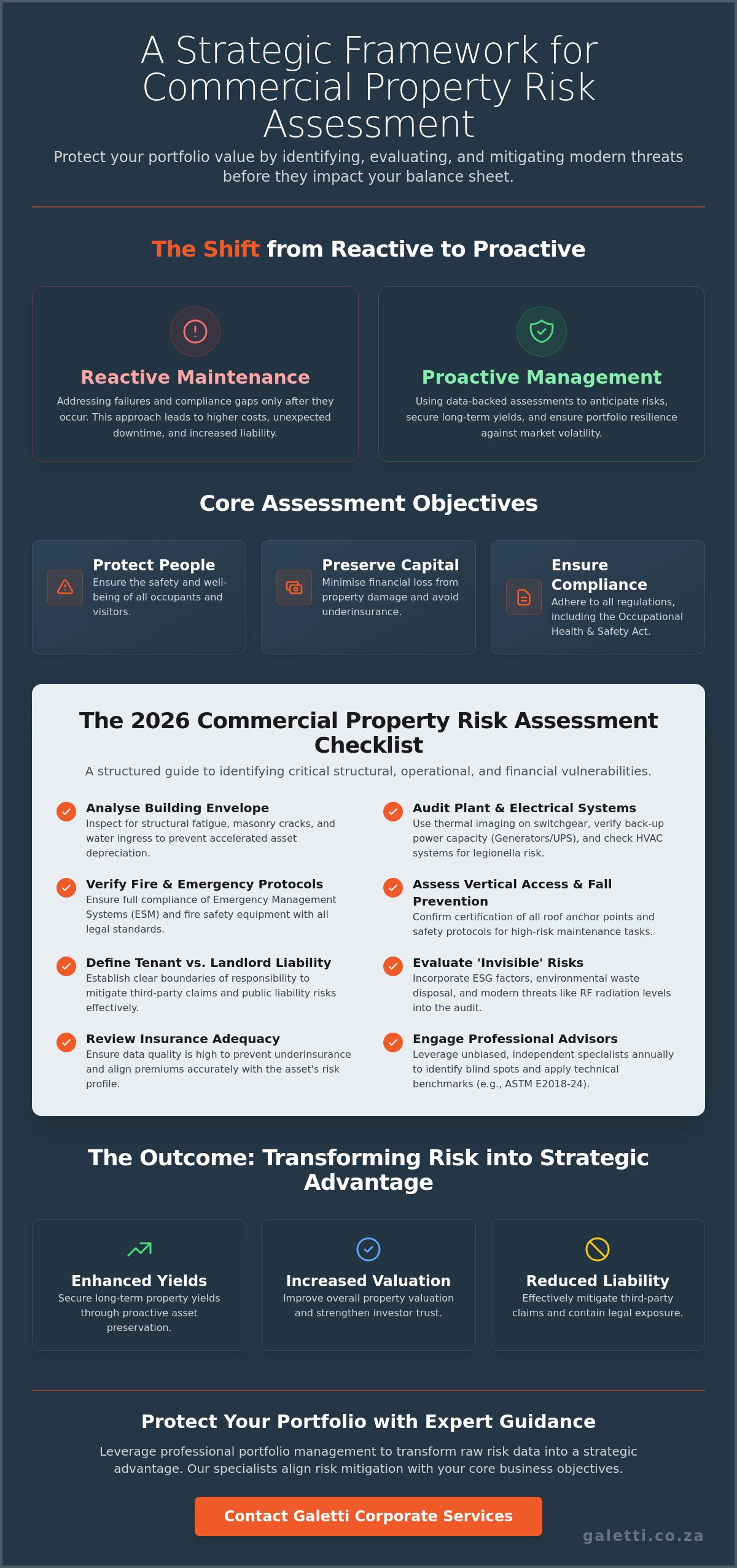
The 2026 Commercial Property Risk Assessment Checklist
Execution is the bridge between strategy and asset safety. A commercial property risk assessment requires a methodical approach to ensure no vulnerability remains hidden. By following a structured checklist, property owners can standardise their evaluations across diverse portfolios. This process isn’t merely a compliance exercise. It’s a fundamental tool for protecting your long-term yield and ensuring operational continuity in an increasingly complex regulatory environment. Clear documentation is the only way to prove due diligence if a liability claim arises.
- Step 1: Physical Inspection. Conduct a thorough walkthrough of all plant rooms, roof areas, and common zones. Look for signs of structural fatigue, water ingress, or mechanical wear that could lead to failure.
- Step 2: Safety Certification Review. Verify all fire safety and emergency management certifications. Ensure compliance with the latest 2026 standards for fire suppression, detection systems, and Annexure B lift certifications.
- Step 3: Contractor Management Audit. Review contractor files and safety permits. Confirm that every third-party service provider on site adheres to your safety protocols and possesses valid liability insurance.
- Step 4: Financial Insurance Review. Compare current insurance limits against updated replacement costs. Construction inflation in 2026 makes historical valuations obsolete. Ensure your coverage reflects the actual cost of rebuilding.
- Step 5: Document Findings. Record all data in a centralised risk register. Include a 12-year table of probable costs for major capital expenditures. This creates a strategic roadmap for future asset upgrades and maintenance. Complement this process by learning how to conduct a commercial property portfolio audit to ensure your risk findings are integrated into a broader performance review of all your assets.
Pre-Audit Documentation
Efficiency starts with preparation. Organise your maintenance logs and safety certificates before the physical inspection begins. You should also gather current tenant insurance certificates. This ensures that their liability coverage aligns with the lease requirements. Prepare updated floor plans and emergency egress maps. Having these documents ready streamlines the audit process. It allows for a more focused evaluation of high-risk zones and ensures that no critical infrastructure is overlooked during the walkthrough.
On-Site Evaluation Points
During the site visit, focus on critical life-safety systems. Test emergency lighting and fire suppression units to confirm they function under load. Check for hazardous chemical storage. Ensure all substances are correctly labelled and stored in ventilated, secure areas. Inspect building security systems and access control points. In 2026, the rise of smart-building systems means digital security is as vital as physical locks. If your current assessment framework feels incomplete or outdated, it’s time to contact Galetti today for a professional consultation that secures your asset’s future.
Mitigating Risk through Professional Portfolio Management
Professional management transforms static data into a dynamic strategy for growth. A commercial property risk assessment shouldn’t sit in a drawer; it must dictate your operational priorities. When professional advisors interpret audit findings, they identify which capital projects yield the highest return whilst simultaneously lowering the building’s liability profile. Institutional investors and lenders prioritise assets with transparent, low-risk data. By proactively managing these variables, you move beyond mere compliance to actively enhance the market value of your holdings. Lower risk profiles consistently command higher property valuations in the South African market.
Corporate real estate advisory is essential for navigating complex portfolios. Managing multiple assets across different jurisdictions requires a centralised approach to risk. Independent experts provide the objectivity needed to benchmark performance against global standards. This strategic oversight ensures that resources are allocated where they’re most needed. It prevents the slow erosion of value that occurs when minor maintenance issues are ignored. High-level decision-makers rely on this clarity to protect long-term property yields and ensure that every asset remains a high-performance vehicle for capital growth.
Optimising Asset Performance
Strategic risk assessments allow you to prioritise capital expenditure (CapEx) with precision. Instead of reactive spending, you can plan for major plant replacements or structural upgrades years in advance. This foresight reduces the likelihood of emergency repairs that disrupt tenant operations. Providing a safe, fully compliant environment is the most effective way to reduce vacancy rates. Tenants in 2026 demand buildings that meet rigorous safety and ESG standards. Utilising strategic property portfolio management services ensures your assets remain competitive and resilient against market shifts.
Strategic Disposal and Acquisition
A clean risk report is your most powerful tool during a transaction. Whether you’re preparing for corporate real estate sales or a high-stakes acquisition, due diligence is the foundation of trust. Full disclosure of risk data accelerates the closing process and prevents last-minute price renegotiations. Transparency is equally vital for those engaging with commercial property auctioneers South Africa. Galetti plays a vital role in navigating these complexities. We bridge the gap between technical risk data and commercial reality. Our expertise ensures your asset is positioned for success, protecting your interests at every stage of the property lifecycle.
Securing Your Asset’s Future Performance
Effective asset management in 2026 demands more than basic compliance. It requires a definitive shift toward strategic foresight where every physical, financial, and regulatory vulnerability is mapped and mitigated. By adopting a rigorous commercial property risk assessment framework, you protect your portfolio from unforeseen structural failures and the persistent threat of underinsurance. A clean risk profile doesn’t just reduce liability; it actively drives property yield and enhances market liquidity during a sale or auction. It’s the difference between a depreciating building and a high-performance investment.
Galetti brings over 18 years of industry experience and an integrated approach to portfolio management. As authoritative experts in the South African commercial landscape, we provide the clarity needed to navigate complex regulatory shifts and operational challenges. We transform technical risk data into a strategic advantage that secures your capital growth. Our team is ready to provide the definitive answers your portfolio requires. We move your assets from a state of uncertainty to a position of strength.
Contact Galetti for Professional Corporate Real Estate Advisory and ensure your assets are positioned for long-term resilience and superior market value.
Frequently Asked Questions
What is the most common risk in South African commercial property?
Electrical infrastructure failure and fire safety non-compliance are the most frequent risks identified in South African assets. Frequent power fluctuations often damage switchgear and backup power systems, leading to operational downtime. Outdated fire suppression systems also remain a major concern, as they can lead to the total loss of an asset and the rejection of insurance claims if not maintained to current standards.
How often should a commercial property risk assessment be conducted?
An annual commercial property risk assessment is the industry benchmark for maintaining a high-performance portfolio. This frequency allows owners to capture changes in tenant activities, building wear, and evolving safety regulations. Conducting these reviews yearly ensures that your insurance data remains accurate and that minor maintenance issues don’t escalate into catastrophic structural failures that threaten your property yield.
Who is legally responsible for fire safety in a multi-tenanted building?
The property owner or the designated landlord representative holds the primary legal responsibility for fire safety. Whilst tenants are responsible for managing risks within their specific leased areas, the owner must ensure that all common area systems and the building’s overall fire shell are compliant. This includes maintaining emergency lighting, fire alarms, and suppression systems that serve the entire structure.
Can a risk assessment help reduce my commercial insurance premiums?
Yes, insurers frequently offer more competitive premiums to owners who provide comprehensive risk data and proof of mitigation. A formal commercial property risk assessment proves to underwriters that the asset has a lower probability of loss. By demonstrating proactive management of hazards like electrical hotspots or water ingress, you can negotiate better terms and avoid the costs associated with underinsurance.
What is the difference between a safety audit and a risk assessment?
A safety audit is a reactive process that checks for compliance with existing rules and regulations. In contrast, a risk assessment is a proactive strategy that identifies and evaluates potential hazards before they occur. Audits verify that you’ve followed the law, whilst assessments look at the probability and impact of future events to protect your asset’s long-term value and continuity.
How does a risk assessment affect commercial property valuation?
It directly influences the capitalisation rate by reducing the perceived risk for potential investors. A building with a clean compliance record and a documented history of risk mitigation is seen as a more secure investment. This transparency allows for a higher valuation, as buyers are willing to pay a premium for assets that don’t have hidden liabilities or significant deferred maintenance.
What happens if a property fails to meet compliance standards?
Owners face severe penalties, including heavy fines and legal liability for any injuries sustained on the premises. Non-compliance can also result in the immediate withdrawal of insurance coverage, leaving the owner fully exposed to capital losses. In extreme cases, local authorities can issue prohibition notices that shut down the building entirely until all safety defects are rectified and certified.
Should I conduct a risk assessment before buying a commercial property?
Conducting an assessment is a vital component of technical due diligence before any acquisition. It reveals hidden structural defects, environmental hazards, or regulatory gaps that may not be visible during a standard walkthrough. Identifying these issues early allows you to factor repair costs into your offer or walk away from a deal that carries too much liability for your portfolio.