In the South African commercial market, the auction hammer signifies a final, non-negotiable corporate contract that bypasses standard suspensive conditions. You likely recognise auctions as an efficient route to secure assets in a market where industrial vacancies sit below 4% and the prime lending rate holds at 10.5%. However, the speed of these transactions often masks significant commercial property auction pitfalls South Africa investors must navigate to safeguard their capital. A single oversight regarding FICA compliance or a miscalculation of auctioneer’s commission can turn a strategic acquisition into a financial liability.
We understand the anxiety surrounding non-refundable deposits and the “voetstoots” clause. This guide provides a comprehensive risk-mitigation framework to help you manage these complexities with professional precision. You’ll gain clarity on 15% VAT applications, commission structures, and the hidden burden of arrear municipal rates. We’ll equip you with the strategic insight to bid with confidence and secure value without compromising your portfolio’s stability. From vetting the sale in execution rules to verifying tenant lease structures, we cover the essentials for the sophisticated bidder.
Key Takeaways
- Calculate the total acquisition cost by factoring in auctioneer’s commission and VAT beyond the winning bid price.
- Prepare mandatory FICA documentation for entities and individuals to ensure eligibility before the auction commences.
- Mitigate commercial property auction pitfalls South Africa by conducting rigorous due diligence on occupancy certificates and structural integrity before the hammer falls.
- Navigate the “voetstoots” clause through proactive physical inspections to identify potential mechanical or structural defects.
- Establish a strategic walk-away price based on professional valuations to maintain financial discipline in a fast-paced bidding environment.
The High-Stakes Nature of Commercial Property Auctions in South Africa
Commercial auctions operate as a forced, transparent market mechanism. They strip away the ambiguity of private negotiations to reveal the true market value through immediate, competitive bidding. In this environment, price is dictated by demand. Sellers favour this method for its speed and certainty; however, the velocity of the transaction creates significant commercial property auction pitfalls South Africa investors must anticipate. The auction process is governed strictly by the “Rules of Auction” document. This legal blueprint outlines the terms of the sale and must be available for inspection before the event. Ignoring these rules is a critical error, as they define the boundaries of the engagement.
The Non-Negotiable Contract: Why Suspensive Conditions Don’t Apply
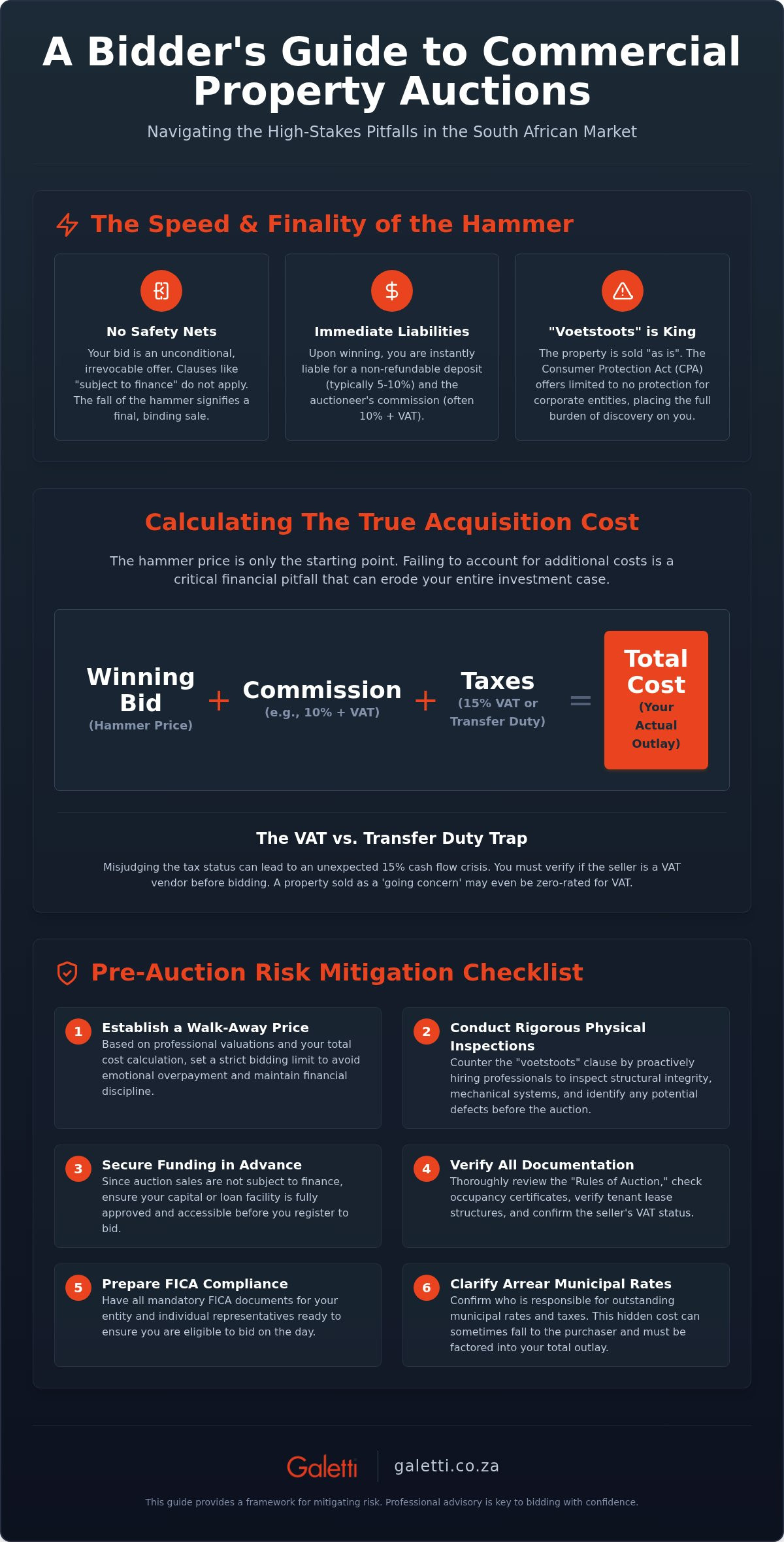
In a standard private treaty sale, buyers often include clauses making the purchase “subject to finance” or “subject to the sale of another property.” Auctions eliminate these safety nets. Every bid made at a property auction is unconditional. If you are the highest bidder and the reserve is met, you’ve bought the property. There is no cooling-off period. You face immediate liability for a non-refundable deposit, typically 5% to 10% of the purchase price. Additionally, the auctioneer’s commission, often 10% plus VAT, is usually payable by the purchaser on the day. An auction bid in South Africa constitutes an irrevocable offer that matures into a final sale the instant the hammer strikes the rostrum. Investors must secure their funding and complete their due diligence before the first bid is called.
Consumer Protection Act (CPA) Misconceptions
Many corporate entities assume they enjoy the same protections as residential consumers. This is a dangerous oversight. Under South African law, the CPA generally excludes juristic persons, including companies, trusts, or partnerships, with an annual turnover or asset value exceeding R2 million. Most commercial transactions naturally exceed this threshold. Consequently, corporate buyers have limited recourse for disputes regarding the property’s condition. The “Voetstoots” clause, meaning the property is sold “as is,” holds heightened relevance here. Sellers are not legally obligated to repair defects discovered after the sale. This lack of protection is one of the most common commercial property auction pitfalls South Africa buyers face. Without the CPA safety net, the burden of discovery rests entirely on your pre-auction inspection and professional advisory team.
Financial Pitfalls: Beyond the Winning Bid
Winning a commercial property at auction is an adrenaline-fuelled victory. However, the hammer price represents only a portion of the total capital outlay. Successful investors treat the bid as the base of a much larger financial structure. One of the primary commercial property auction pitfalls South Africa bidders encounter is failing to calculate the “all-in” cost before raising their paddle. In a high-pressure environment, the absence of a pre-set ceiling can lead to emotional overbidding. This often erodes the projected yield before the transfer process even begins. Discipline is your most valuable asset in the auction room.
Total acquisition costs include the bid price, the auctioneer’s commission, and statutory taxes. In most corporate real estate sales conducted via auction, the “Buyer’s Premium” model applies. This structure shifts the commission burden to the purchaser. If you bid R10 million, you aren’t just paying R10 million. You’re likely paying R11 million plus VAT. Failing to account for this 10% premium is a common error that can derail your financing arrangements.
The VAT vs. Transfer Duty Trap
SARS regulations for commercial property are complex and require precise tax structuring. If the seller is a VAT vendor, the transaction usually attracts VAT at 15%. If you are also a VAT vendor and the property is sold as a “going concern” (for example, a fully tenanted office block), the transaction might be zero-rated. However, if the seller is not a VAT vendor, Transfer Duty applies based on a sliding scale. Misjudging this status can result in an unexpected 15% cash flow requirement. You must verify the VAT status of both parties and the nature of the asset long before the auctioneer calls for opening bids.
Commission and Hidden Costs
The standard auctioneer’s commission in South Africa is 10% plus VAT on that commission amount. Additionally, many auction contracts, especially sales in execution, stipulate that the purchaser is liable for all arrear rates, taxes, and municipal service charges. These liabilities can reach significant sums for neglected industrial or retail buildings. Another factor is the “confirmation period,” which typically lasts 7 to 14 days. During this window, the seller can still reject the highest bid. Your deposit remains tied up whilst you wait for a decision. To ensure your financial modelling accounts for every variable, you should consult with a strategic advisor to review the specific conditions of sale.
Legal and Regulatory Pitfalls: FICA and Compliance
Compliance is the foundation of a successful bid. In the high-stakes environment of South African real estate, regulatory oversights represent some of the most significant commercial property auction pitfalls South Africa investors encounter. The Financial Intelligence Centre Act (FICA) is not a mere formality; it is a rigid legal barrier to entry. All bidders must undergo rigorous customer due diligence before they are permitted to register. Failure to provide the correct documentation can result in immediate disqualification or, worse, the forfeiture of a deposit if compliance issues surface after the hammer falls.
Strategic investors often utilise complex structures for acquisitions. However, bidding on behalf of a “company to be formed” or a trust requires precise legal preparation. If a representative bids without a formal “Authority to Bid” or a valid board resolution, they may become personally liable for the purchase. This risk is particularly acute when the intended entity is not registered in time or fails to ratify the contract. To manage these administrative complexities, sophisticated buyers often leverage Galetti Corporate Services to ensure their bidding structures are legally sound and compliant with current regulations.
FICA Compliance for Corporate Entities and Trusts
The 2023 amendments to FICA reinforced the requirements for identifying beneficial owners. For companies, you must provide the Certificate of Incorporation (COR14.3), proof of the business’s physical address, and certified identification for all directors and shareholders holding 25% or more of the voting rights. Trusts require the original Trust Deed, Letters of Authority from the Master of the High Court, and identification for all trustees and named beneficiaries. If you fail these checks post-bid, the sale is cancelled as a breach of contract. Most auctioneers also require individual directors to sign personal guarantees, ensuring the auction house has recourse if the corporate entity defaults.
Zoning and Land Use Mismanagement
Never assume the current use of a building is legally permitted. A common pitfall involves purchasing a property where the operational behaviour does not align with the registered zoning. You must inspect the Surveyor General (SG) diagrams and the zoning certificate before the auction starts. Obtaining “Special Consent” or rezoning a property post-auction is a slow, expensive process that can take years to finalise. If the property lacks a valid Occupancy Certificate or violates building lines, the cost of regularisation falls entirely on the purchaser. These hidden legal liabilities can transform a high-yield asset into a stagnant portfolio burden.
Operational and Physical Due Diligence Gaps
Physical inspection is non-negotiable. Whilst previous sections established the legal finality of the hammer, the physical integrity of the asset is where many investors lose their margin. Commercial property auction pitfalls South Africa buyers often ignore include the absence of a valid Occupancy Certificate. Without this document, you cannot legally occupy or lease the building. This is particularly critical in industrial real estate investment ZA, where specialised machinery or storage requirements demand strict compliance with safety standards. The auction room moves fast. You must move faster during the inspection phase.
The Occupancy and Tenant Pitfall
The principle of “huur gaat voor koop” (lease precedes sale) means you inherit existing tenants and their specific lease terms. If a tenant has a ten-year lease at a sub-market rate, you cannot simply increase the rent post-purchase. You are bound by the seller’s previous agreements. Additionally, some auction properties, especially those in liquidation, may house non-paying tenants or illegal occupiers. Commercial evictions in South Africa are costly and time-consuming. You might face months of legal fees and lost revenue whilst the matter moves through the courts. Always demand a rent roll and copies of all active lease agreements before bidding.
Technical Due Diligence Checklist
Sellers are not required to provide a warranty for mechanical systems. You must personally verify the condition of HVAC systems, lift installations, and fire safety equipment. ASIB (Automatic Sprinkler Inspection Bureau) compliance is essential for industrial insurance; if the system is outdated, the retrofit costs can be astronomical. Ensure your pre-auction inspection covers these critical areas:
- Electrical Certificates of Compliance (COC): Verify the validity and scope of the current certification.
- Fire Safety: Inspect sprinkler systems and fire escapes to ensure they meet municipal bylaws.
- Mechanical Integrity: Audit the maintenance logs for HVAC and lift systems to avoid immediate capital expenditure.
- Structural Integrity: Look for signs of latent defects, such as rising damp or roof leaks, which are excluded from seller liability.
Professional valuations are essential before the auction day. Relying on the auction house’s marketing brochure is a risk. You need an independent assessment of the building’s technical state to set a realistic bid ceiling and avoid the commercial property auction pitfalls South Africa market presents to the unprepared. This diligence ensures you bid based on data rather than speculation.
Strategic Mitigation: How Professional Advisory Eliminates Auction Risk
Success in the on auction environment isn’t a matter of luck. It’s the result of cold, calculated preparation. Raw auction data provides the starting point, but strategic advisory provides the finish line. Galetti functions as the bridge between market opportunity and capital security. We help you navigate the commercial property auction pitfalls South Africa investors face by providing an objective, expert layer of due diligence that others often miss. This partnership transforms a high-stakes, high-risk transaction into a controlled and transparent corporate acquisition.
Pre-Auction Valuation and Market Analysis
Galetti leverages data-driven insights to determine the true market value of an asset long before the first bid is called. We use precise market benchmarks to insulate you from the “winner’s curse,” a common scenario where the successful bidder overpays due to the heat of the competition. Setting a definitive “walk-away” price is critical, particularly when the prime lending rate sits at 10.5%. We ensure your bid is supported by a rigorous analysis of yield projections and capital expenditure requirements. A well-defined portfolio strategy is the only way to ensure that an asset acquisition strengthens your balance sheet rather than burdening it with hidden liabilities or structural defects.
Integrated Asset Management and Leasing
Our involvement doesn’t terminate at the fall of the hammer. Once the acquisition is secured, we provide the infrastructure to optimise property performance immediately. Galetti offers an integrated suite of corporate services that include proactive property management and strategic leasing. We maintain a national network of corporate tenants, allowing us to identify high-quality occupants for vacant spaces with speed and efficiency. This national reach provides a distinct advantage in a market where office vacancies in Johannesburg still hover around 15.5%. By aligning your new asset with our tenant database, we help you secure cash flow and realise value faster than the competition. Our goal is to ensure your investment operates at peak efficiency from day one.
Partner with Galetti for your next commercial auction acquisition.
Secure Your Next Acquisition with Professional Precision
Success in the auction room isn’t about the loudest bid; it’s about the most informed strategy. Navigating the commercial property auction pitfalls South Africa presents requires a rigorous commitment to pre-sale due diligence. By prioritising FICA compliance, verifying zoning certificates, and calculating the all-in cost including buyer’s premiums, you insulate your capital from unnecessary risk. The “fall of the hammer” is final, making it essential to resolve every operational and financial uncertainty before the first bid is called.
Galetti offers the strategic edge required to thrive in this environment. We combine 18+ years of commercial real estate expertise with national coverage across South Africa to provide a seamless acquisition experience. Our integrated valuations and advisory services ensure your bidding is supported by data rather than emotion. We help you set a definitive walk-away price whilst identifying the value-add opportunities others overlook.
Take the next step in your investment journey with confidence. Professional preparation turns market complexity into your greatest strategic advantage.
Frequently Asked Questions
What is the standard deposit for a commercial property auction in South Africa?
The standard deposit is typically 5% or 10% of the purchase price. This amount is payable immediately upon the fall of the hammer via electronic funds transfer (EFT). You must ensure these funds are liquid and accessible before the auction commences. Failure to pay the deposit constitutes a breach of contract, which allows the auctioneer to resell the property at your expense while holding you liable for any shortfall.
Can I get a bond for a property bought at auction?
You cannot make an auction purchase subject to obtaining a bond. Whilst you may use bank financing to settle the balance, the sale is unconditional and lacks suspensive conditions. You must have your finance pre-approved or capital readily available before bidding. If your bond application is rejected post-auction, you remain legally obligated to pay the full purchase price or risk losing your deposit and facing litigation.
What does ‘voetstoots’ mean for a commercial buyer?
“Voetstoots” means the property is sold in its current condition, including all visible and hidden defects. The seller is not legally required to repair structural issues or mechanical failures discovered after the sale. This clause is a central element of commercial property auction pitfalls South Africa investors must manage through rigorous pre-auction inspections. You accept the asset exactly as it stands at the moment the hammer falls.
Who is responsible for arrear rates and taxes on an auctioned property?
Responsibility depends on the specific “Rules of Auction” for that transaction. In many sales in execution, the purchaser is liable for all outstanding municipal debts and body corporate levies. In private treaty auctions, the seller often settles these from the proceeds. You must review the conditions of sale to confirm whether these liabilities will be added to your acquisition cost, as they can significantly impact your total investment.
Is the winning bid at an auction always the final price?
The winning bid is rarely the final acquisition cost. You must factor in the auctioneer’s commission, usually 10% plus VAT, and either Transfer Duty or VAT on the purchase price. Managing the financial commercial property auction pitfalls South Africa presents requires accounting for these premiums before the event. These additional costs can increase your total capital outlay by 15% or more, depending on the tax status of the seller.
How does the Consumer Protection Act (CPA) apply to commercial auctions?
The Consumer Protection Act (CPA) offers limited protection in the commercial sector. It does not apply to transactions where the purchaser is a juristic person with an annual turnover or asset value exceeding R2 million. Since most commercial assets exceed this threshold, corporate buyers are generally excluded from CPA safeguards. You must rely on your own due diligence and professional advisory rather than statutory consumer protections when bidding.
What are the FICA requirements for bidding as a company?
FICA requirements for corporate entities include providing the Certificate of Incorporation (COR14.3) and proof of the business’s physical address. You must also submit certified identification for all directors and shareholders holding 25% or more of the voting rights. These documents must be verified by the auction house before you receive a bidder’s card. Compliance is non-negotiable and ensures the transparency and legality of the bidding process.
Can a seller reject the highest bid at a South African auction?
A seller can reject the highest bid if the auction is conducted “subject to confirmation” (STC). This confirmation period typically lasts between 7 and 14 days. During this window, the seller evaluates the bid against their reserve price and internal mandates. Even if you are the highest bidder on the day, the sale is only finalised once the seller provides written acceptance of your offer and the confirmation period expires.